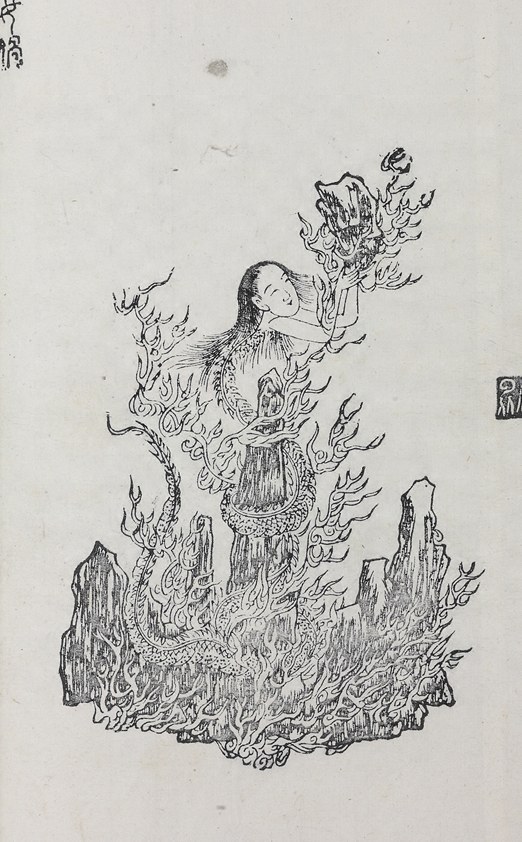
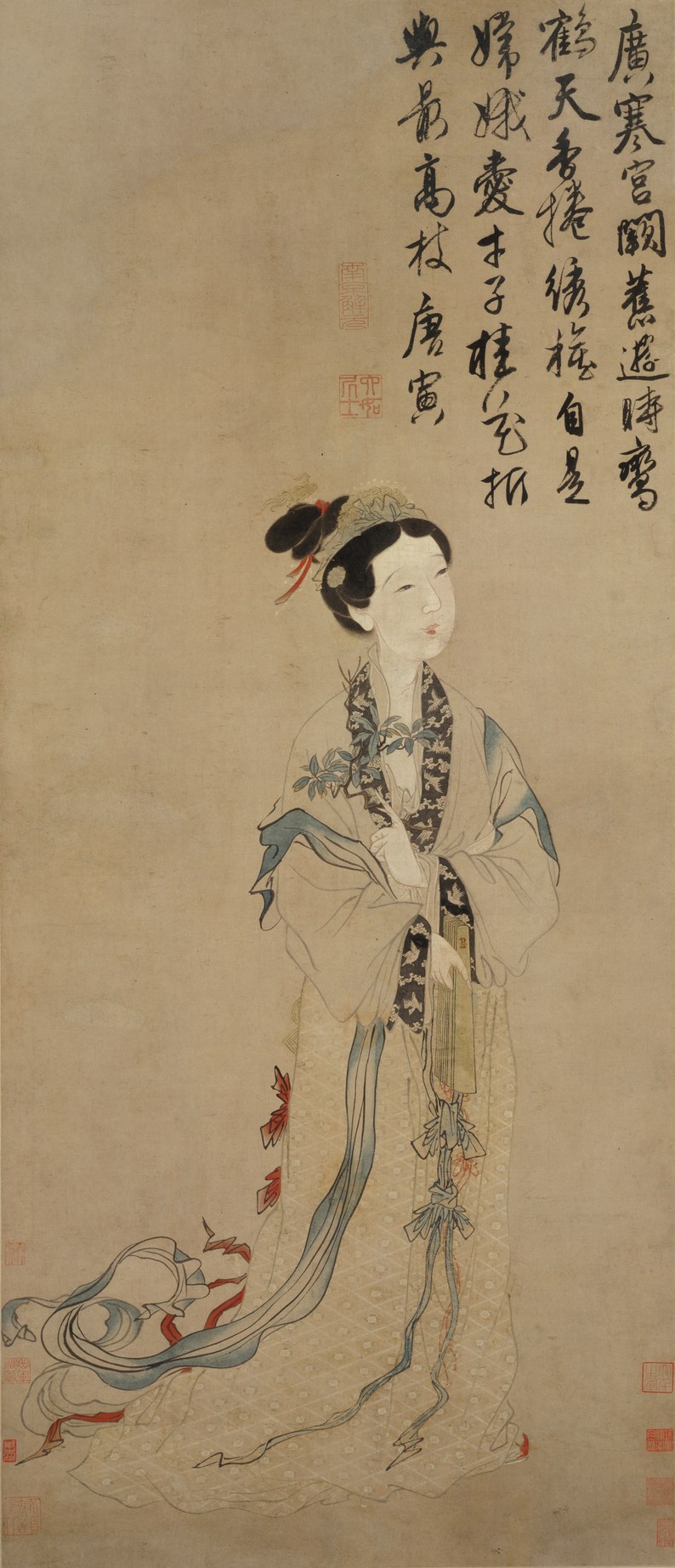
She stole it, and she ran. That is the whole of the oldest surviving telling, one sentence let fall inside a book about something else entirely. The archer Yi had gone to the Queen Mother of the West, who keeps on her far western mountain the drug of no-death, and he had asked her for it and been given it: the one drug of no-death, unrepeatable, the one thing in the world that cannot be got twice. And his wife Heng’e took it while it was in the house, carried it off, and fled to the moon. The word the text uses for what she did is ben, the verb for bolting, running, elopement, the flight of someone who does not mean to come back. She did not ascend in glory. She ran.
Left standing in the emptied house
What the passage records next is not her triumph but his ruin. Yi is left standing in the emptied house, and the four characters that follow are among the bleakest in early Chinese myth: dejected, he suffered a loss, with no means to continue it. The drug was singular and irreplaceable, and now it was gone, carried up into the sky by his wife.
He had bargained his way to the edge of deathlessness and lost it in a single night, and the book does not even pause over his grief. It has raised the story only to make a point about ignorance, that Yi did not understand where the drug of no-death comes from, and so it could not be replaced. The moon-flight is dropped in as a thing the reader already knows. Even at its first appearance in writing, around 139 BCE in the compendium assembled under Liu An, the tale is old.
Notice who these people are before the centuries got to them. The archer is not yet the tragic Hou Yi of the festival stories, the loving husband robbed by a treacherous apprentice; he is simply Yi, the great marksman who shot the excess suns out of the sky, and here he is a man who lost a bet with mortality. The woman is not yet Chang’e.
In the Han texts she is written Heng’e, and the change to the now-standard Chang’e came later, most likely to avoid the personal name of an emperor, Liu Heng, whose name it shared. There is no beautiful loyal wife here, no self-sacrifice, no villain breaking down the door. There is a drug, a theft, and a flight west to the moon.
The sign of the Returning Maiden
The second of the two Han sources tells us more, and what it adds is stranger than any romance. Zhang Heng, the astronomer who set the fullest early version of the flight into his treatise on the cosmos, gives us a Heng’e who does not simply run. Before she goes she stops to divine her fortune, casting milfoil stalks with a diviner named You Huang, and the oracle he reads out is a small dark poem in its own right. It is the sign of the Returning Maiden.
Fluttering, he tells her, the Returning Maiden; alone she will journey westward; she will meet Heaven’s darkness and haze; let her be neither startled nor afraid, for afterward there will be great prosperity. The imagery is precise and eerie: a woman flickering upward like a moth into flight, going west and alone into a dimness at the edge of the sky, told to hold her nerve through the dark for the sake of what waits on the other side.
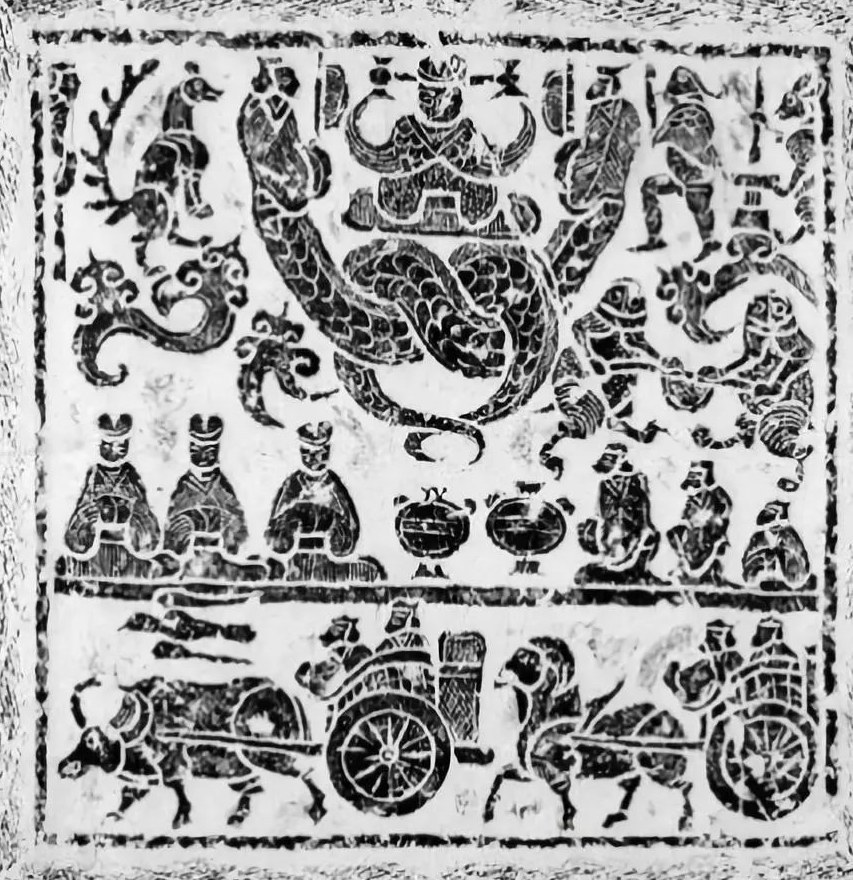
And then the promised prosperity arrives, and it is horror. Heng’e lodged her body in the moon, Zhang Heng writes, and became the toad. The lunar toad, the three-legged creature the ancients saw in the moon’s shadows, was Heng’e herself, the fugitive wife transformed at the end of her flight into a squat cold thing crouched on the face of the moon.
This is the sequel the two Han primary sources actually give us: not a serene goddess enthroned in a jade palace, but a thief who ran with a stolen drug and was fixed, at journey’s end, into the shape of a toad. The oracle was true. She was neither startled nor afraid, and she flourished, after a fashion, forever.
Cakes and fruit under the full moon
Almost everything the modern imagination attaches to this story attaches later. The tender version most people know, in which a good wife swallows the elixir to keep a wicked apprentice named Feng Meng from seizing it while her husband is away, and a heartbroken Hou Yi lays out her favourite cakes and fruit under the full moon, so that the whole tale becomes the origin of the Mid-Autumn Festival, is a folk elaboration of much later centuries, not a Han myth.
So is the rival version in which Hou Yi has become a tyrant and Chang’e drinks the drug to stop him living forever to oppress the people. Neither motive is in any ancient text. The ancient text gives her no motive at all. She stole, and she ran, and the reason went with her.
The rest of the moon’s furniture arrived later still, and from elsewhere. The Vast-Cold Palace where Chang’e is later said to dwell is named only from the Tang onward. The jade rabbit pounding the elixir is a separate lunar motif that drifted into her orbit over time. And the man endlessly chopping the cassia tree that grows on the moon, whose surname is Wu and whose name is Gang, a would-be immortal banished to fell a tree whose wound heals as fast as he cuts it, is a Tang story about a different figure entirely, folded into the lunar landscape long after Heng’e was already there. He was never part of her flight. He simply shares her sky.
A theft, a flight, a transformation
Strip all of it away, and what remains is spare and unsettling and complete. A man wins the one drug of deathlessness and loses it to the person closest to him. A woman, given no reason we are allowed to know, takes the immortality meant for the household and runs west with it into the dark, warned by an oracle to keep her nerve.
She reaches the moon and is not crowned but changed, sealed into the body of a toad. The warm familiar story, mooncakes and devotion and a wife gazing down at a grieving husband, is beautiful and worth telling; it is simply not the oldest one. The oldest one is a theft, a flight, and a transformation, and it leaves the archer standing in an empty room with no means to continue.
Fluttering, the Returning Maiden; alone she journeys westward; she meets Heaven’s darkness and haze; be neither startled nor afraid, and hereafter, great flourishing. (Zhang Heng, Ling Xian, the You Huang oracle; author’s rendering from the Chinese)
- Huainanzi (淮南子), Lanming xun (覽冥訓,
Surveying Obscurities
), c. 139 BCE: the earliest surviving full statement of the myth, a single sentence used as a rhetorical analogy —Yi (羿) requested the drug of no-death (不死之藥) from the Queen Mother of the West (西王母); Heng’e (姮娥) stole it and fled to the moon (竊以奔月). Dejected, he suffered a loss, with no means to continue it
(譬若羿請不死之藥於西王母,姮娥竊以奔月,悵然有喪,無以續之). The point being made is that Yi did not know whence the drug comes and so could not replace it (不知不死之藥所由生也); the moon-flight is assumed already familiar. The archer is named simply Yi (羿), the woman Heng’e (姮娥) — not yet Hou Yi and Chang’e. Chinese read verbatim (zh.wikisource). Standard EnglishJohn S. Major et al., The Huainanzi (Columbia UP, 2010), 6.7. - Zhang Heng (張衡, 78–139 CE), Ling Xian (靈憲), early 2nd c. CE: the fullest early narrative — the theft, the divination scene, and the metamorphosis. Heng’e divines by milfoil with You Huang (有黃), who reads the Returning Maiden (歸妹) oracle
Auspicious. The fluttering Returning Maiden, alone she journeys westward; encountering Heaven’s darkness and dimness, be neither startled nor afraid; hereafter, great prosperity
(翩翩歸妹,獨將西行,逢天晦芒,毋驚毋恐,後其大昌);Heng’e thereupon lodged her body in the moon: this is the toad
(姮娥遂託身于月,是爲蟾蠩). The unromantic Han sequel — a transformation into the lunar toad, not enthronement as a moon-goddess. Chinese read verbatim (zh.wikisource). - Duan Chengshi (段成式), Youyang Zazu (酉陽雜俎), ch. 1
Tianzhi
(天咫), 9th c. (Tang): adjacent lunar lore cited to keep it separate from Heng’e’s flight — the moon holds a cassia (桂) and a toad (蟾蜍), and below the five-hundred-zhang cassia a man perpetually chops it while the wound closes as fast as he cuts (下有一人常斫之,樹創隨合); his surname is Wu, his name Gang (吳剛), a man of Xihe banished for a fault in his study of transcendence to fell the tree. Tang-era, and about Wu Gang, not Heng’e. Chinese read verbatim (zh.wikisource). - (Antecedent, not read verbatim) Guizang (歸藏): the lost Zhou-era divination classic reported to hold the earliest reference to Heng’e’s moon-ascent, alongside Yi shooting the ten suns, recovered from the Wangjiatai Qin bamboo slips. See Li Jiahao (李家浩), Contemporary Chinese Thought 44.3 (2013)42–59. Treated as a genuine but not personally verified antecedent; the recovered slip wording was not read here.