HomeArchiveThemesAbout

Chinese Mythology

The primal creators, the immortals, and the beasts of the wilds — told from the Classic of Mountains and Seas, the Songs of Chu, and the Huainanzi, with every claim kept honest to its source.

Gods & Figures

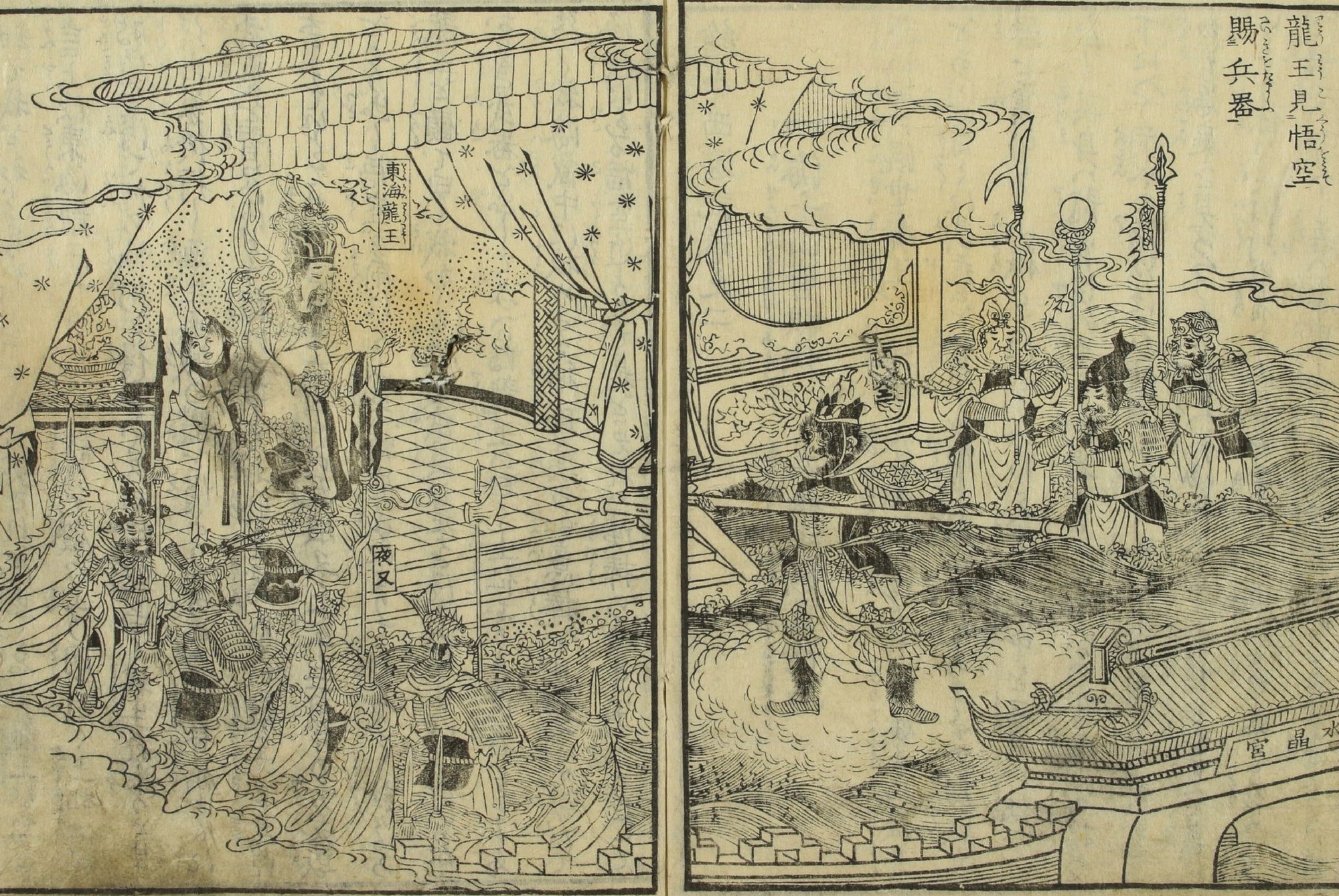
A monochrome woodblock line illustration of the East Sea Dragon King enthroned in his undersea Crystal Palace, bearded and crowned amid tiled halls and rolling waves, attended by courtiers, a fish-headed yaksha and armoured officers, as the monkey Sun Wukong stands on a cloud shouldering the great iron staff bestowed on him; a double-page plate from the Japanese Ehon Saiyūki.
Chinese

The Dragon Kings of the Four Seas

The four brothers surnamed Ao who rule the seas from crystal palaces are the youngest thing about the dragon king: a Ming novelist's quartet laid over a rain-dragon the Han knew seventeen centuries before, and a royal title borrowed from India in between.
7 min*Xiyouji*
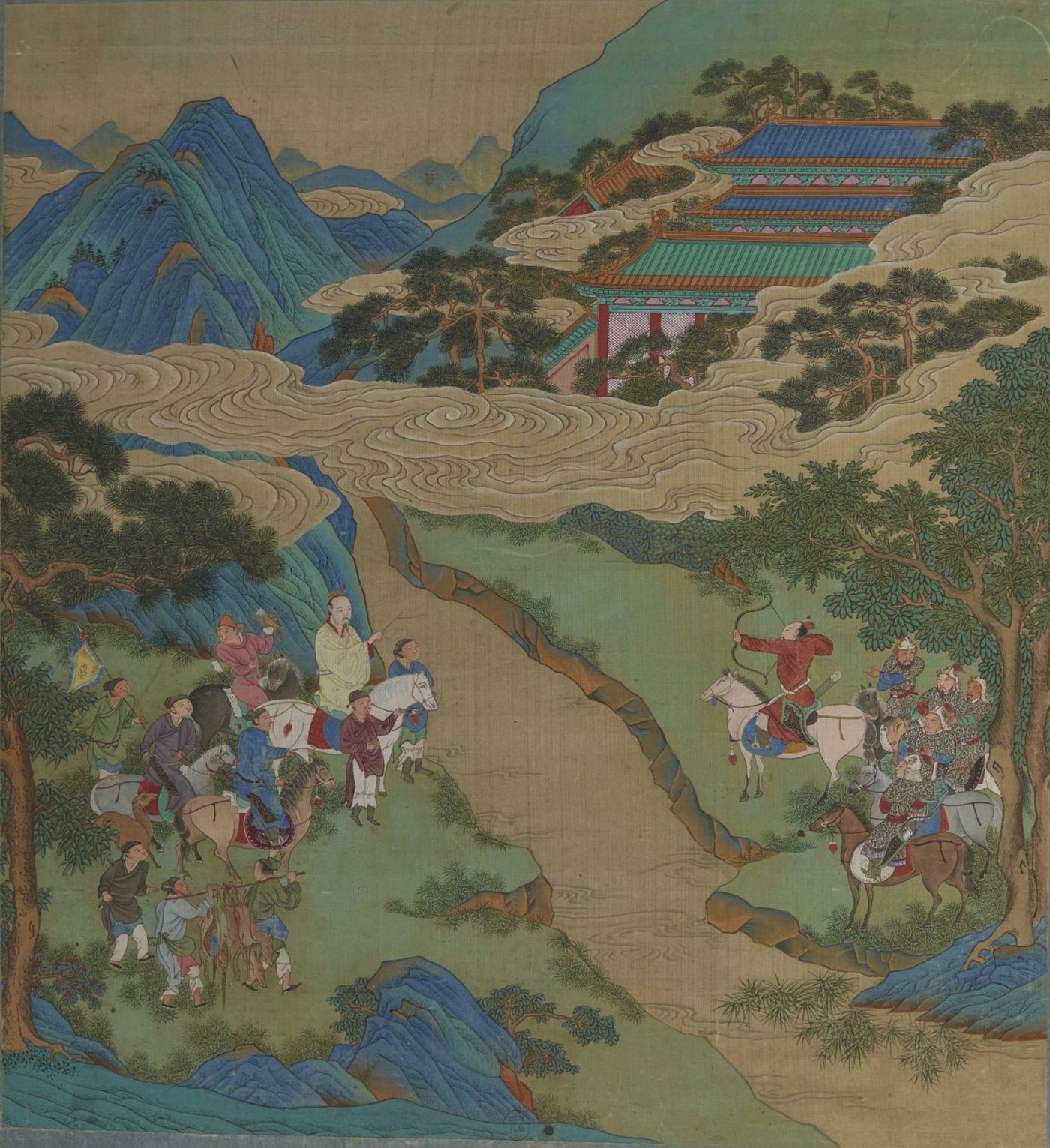
A blue-green silk painting: the archer Yi on a white horse drawing his bow, ringed by armoured horsemen, with a falconing party at left and a palace set among mountains beyond
Chinese

Hou Yi, Archer of the Ten Suns

Every child knows the archer who shot down the suns. Almost no one can say who he was: a god sent from heaven, a mortal who seized a throne, or two men fused into one by centuries of retelling.

6 minHuainanzi
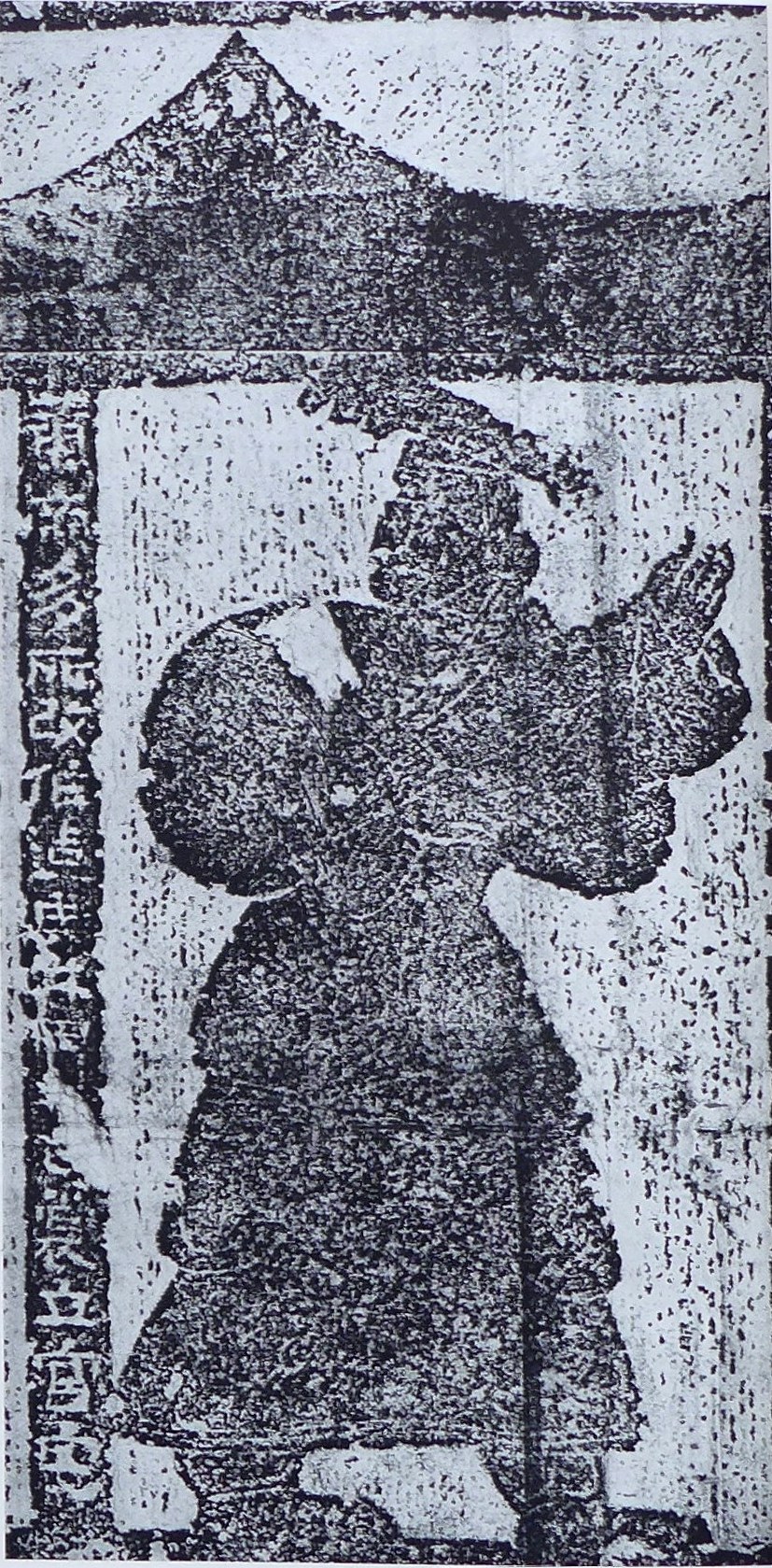
Ink rubbing of a Han-dynasty carved stone relief from the Wu Family Shrines showing the Yellow Emperor as a robed standing sovereign beneath a gabled canopy, one hand raised, a vertical cartouche of incised characters down the left edge naming him and his inventions; the figure and inscription read as light forms against the mottled dark ground of the rubbing.
Chinese

Huangdi, the Yellow Sovereign

He conquered the four quarters, named his ministers after clouds, and fathered the whole line of emperors, then cast a cauldron, mounted a whiskered dragon, and rose into heaven while the people below clutched at his falling bow.

9 minSima Qian
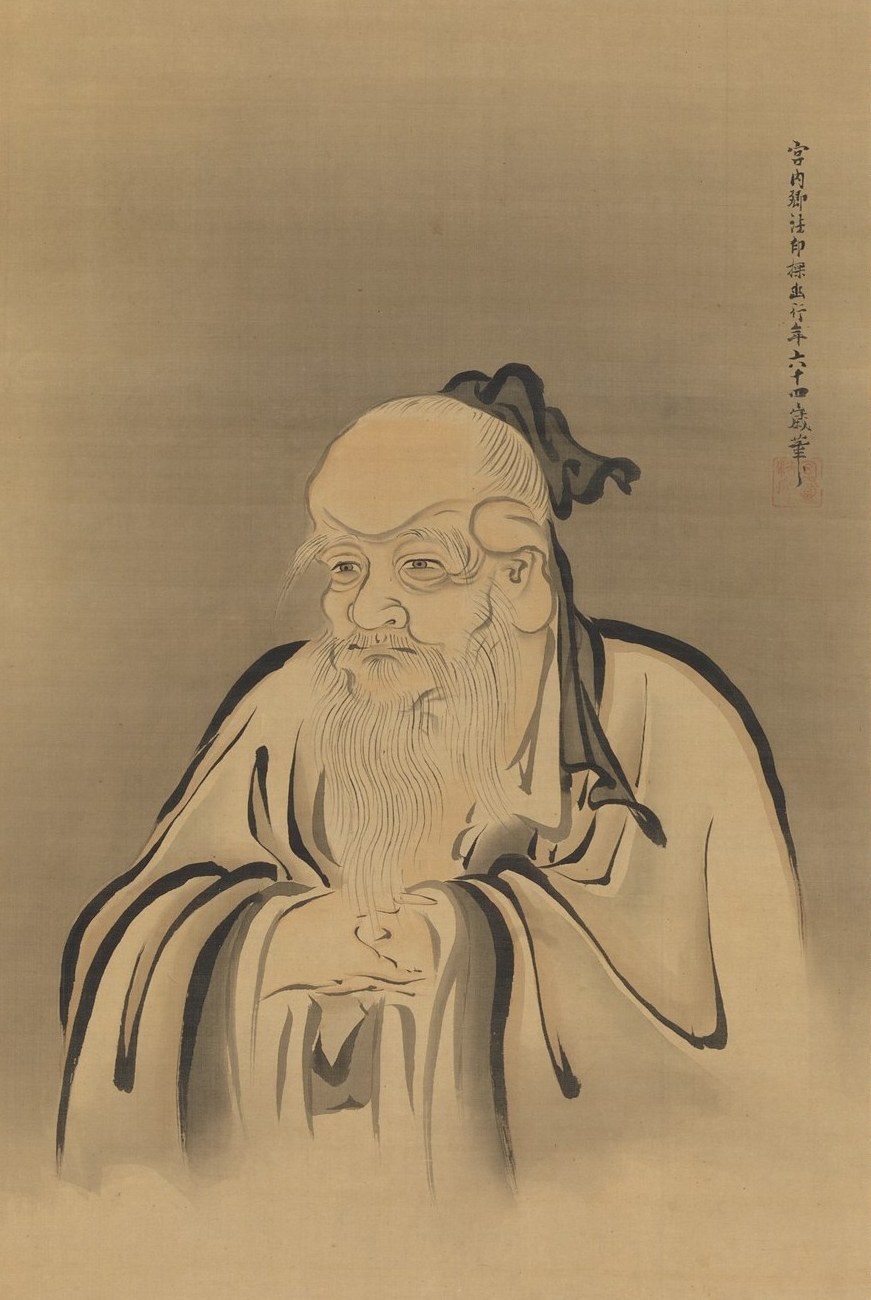
Ink-and-colour portrait of Shennong as a serene white-bearded elder-sage seated with his hands clasped, wild hair bound in a topknot, in a loose pale robe against a plain silk ground, with a brushed inscription and a red seal at upper right.
Chinese

Shennong's Materia Medica: The Book He Never Wrote

The god whose name every herbalist invokes governs a pharmacy of three hundred and sixty-five drugs ranked like a royal court, yet the tradition itself admits he could not have written a word of the book that bears his name.

7 minBaihu Tong
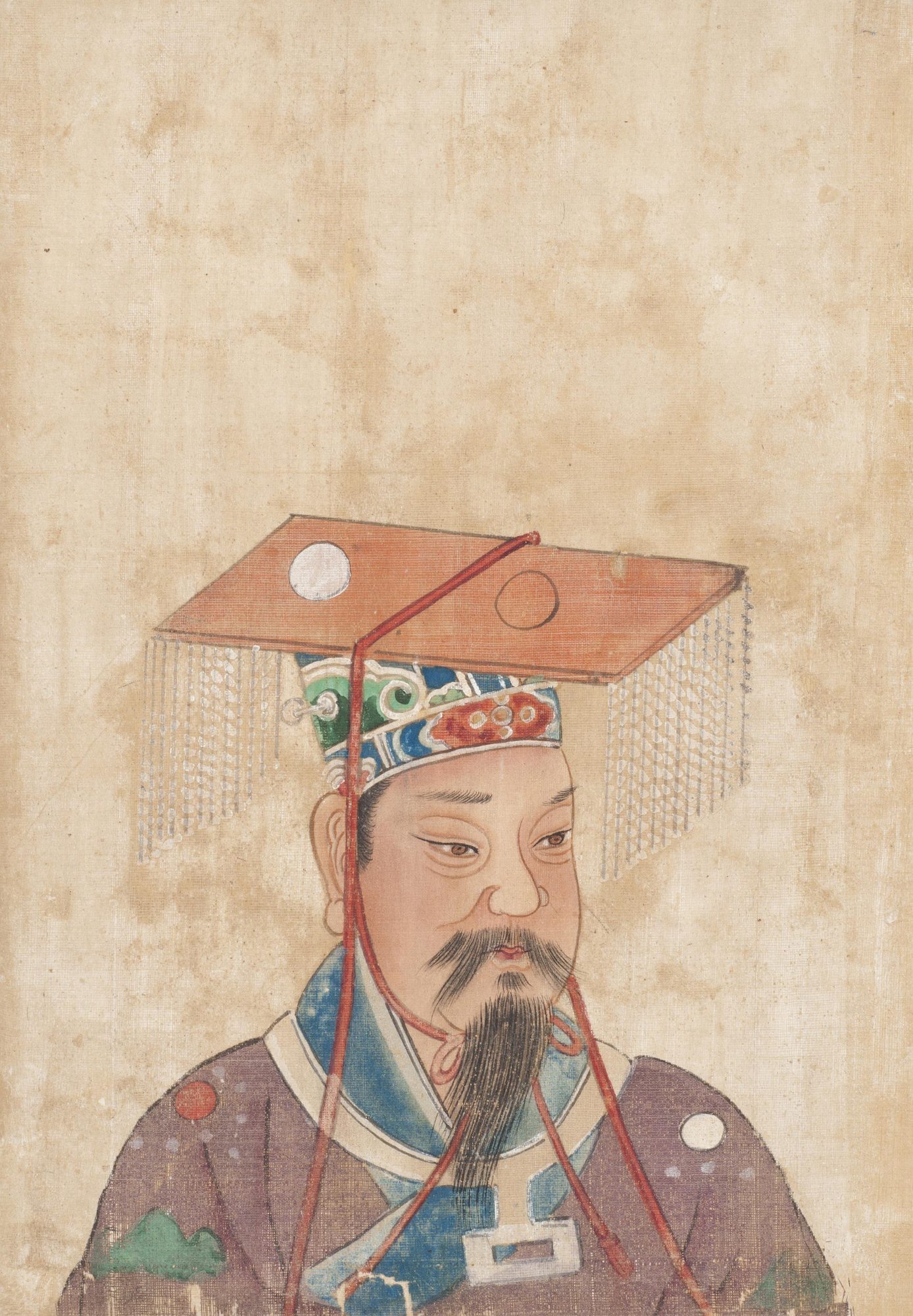
Ink-and-colour album-leaf portrait of the Yellow Emperor as Son of Heaven, shown in bust length wearing the flat-boarded mianguan crown with beaded tassel strings and a dragon-robe over a blue collar, against a plain aged-silk ground.
Chinese

The Yellow Emperor

When the old order collapsed and the fiercest of the warlords could not be subdued, a man who could speak from the cradle trained in shield and dagger-axe, broke the rebel Chiyou on the wilderness of Zhuolu, and was raised up as the first Son of Heaven of a civilised world.

7 minSima Qian
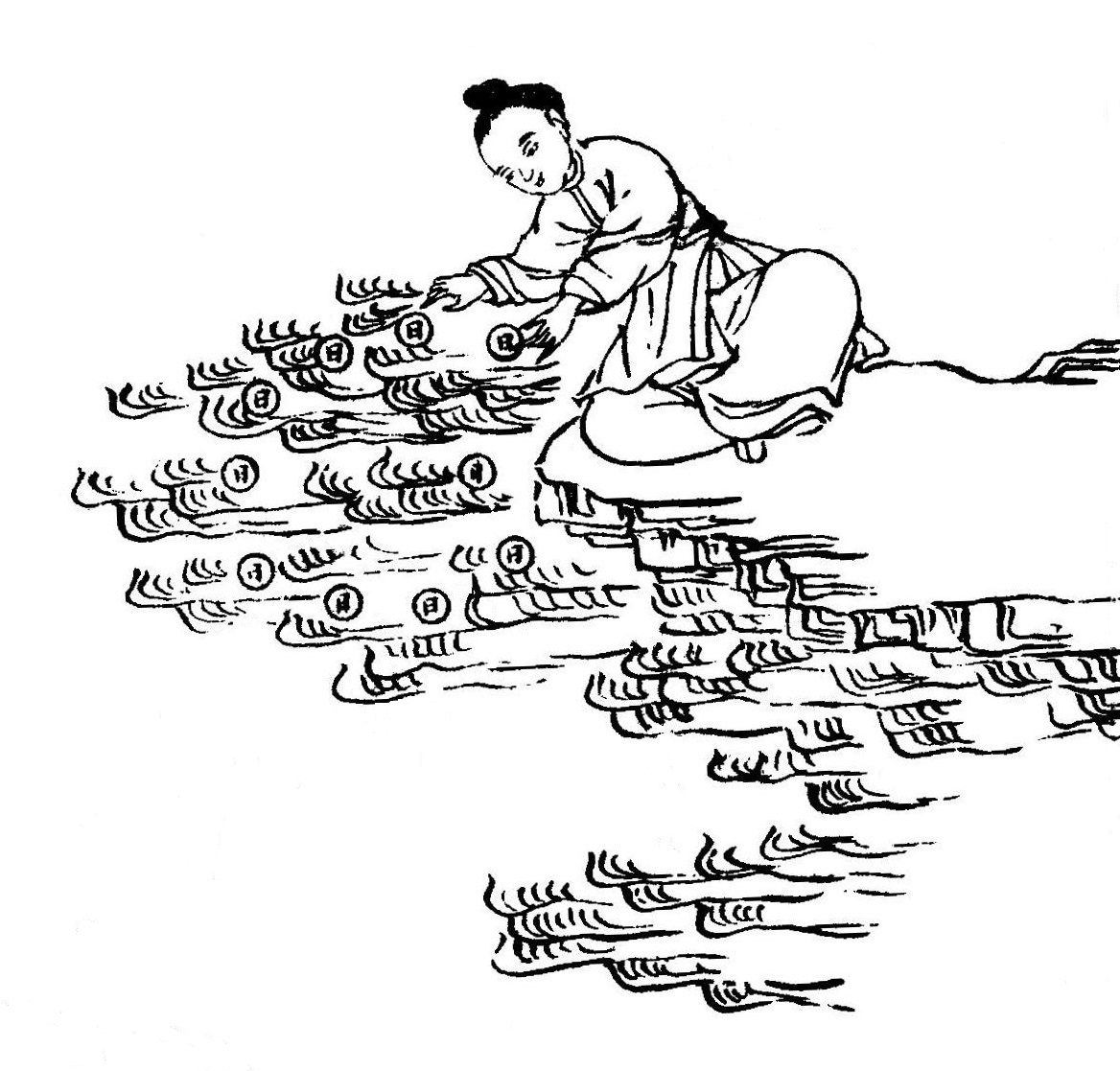
A traditional Chinese line drawing of the solar goddess Xihe kneeling at the water's edge and bathing the suns. She reaches both hands down into a gulf where the ten suns, each drawn as a small disc marked with the character 日 (sun), ride crested waves that fan out across the lower field; her hair is gathered in a topknot and she wears a long flowing robe.
Chinese

Xihe, Mother of the Suns

She had ten children and every one of them was a sun. In a gulf of sweet water at the edge of the world she bathed them, and sent them out one at a time to cross the sky.

5 minShanhaijing
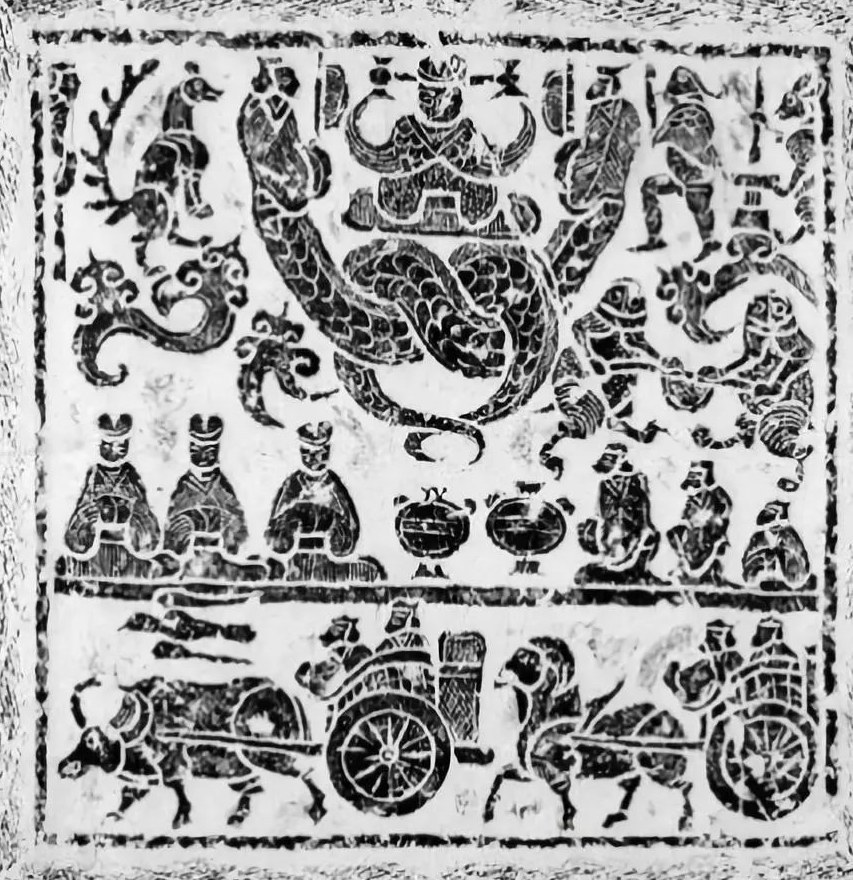
Ink rubbing of an Eastern Han carved stone tomb relief: the Queen Mother of the West sits frontally on a throne formed of a dragon and a tiger whose scaled bodies coil out beneath her, flanked by birds, a nine-tailed creature and attendants; below, rows of kneeling worshippers and offering vessels, and at the base an ox-cart and a horse-drawn chariot procession, all within a carved rectangular border.
Chinese

Xiwangmu, Queen Mother of the West

Before she was the jade-decked matron of the immortals, she was a cave-dwelling numen with a tiger's teeth and a leopard's tail, whistling on a western mountain and presiding over plague and ruin.

5 minShanhaijing
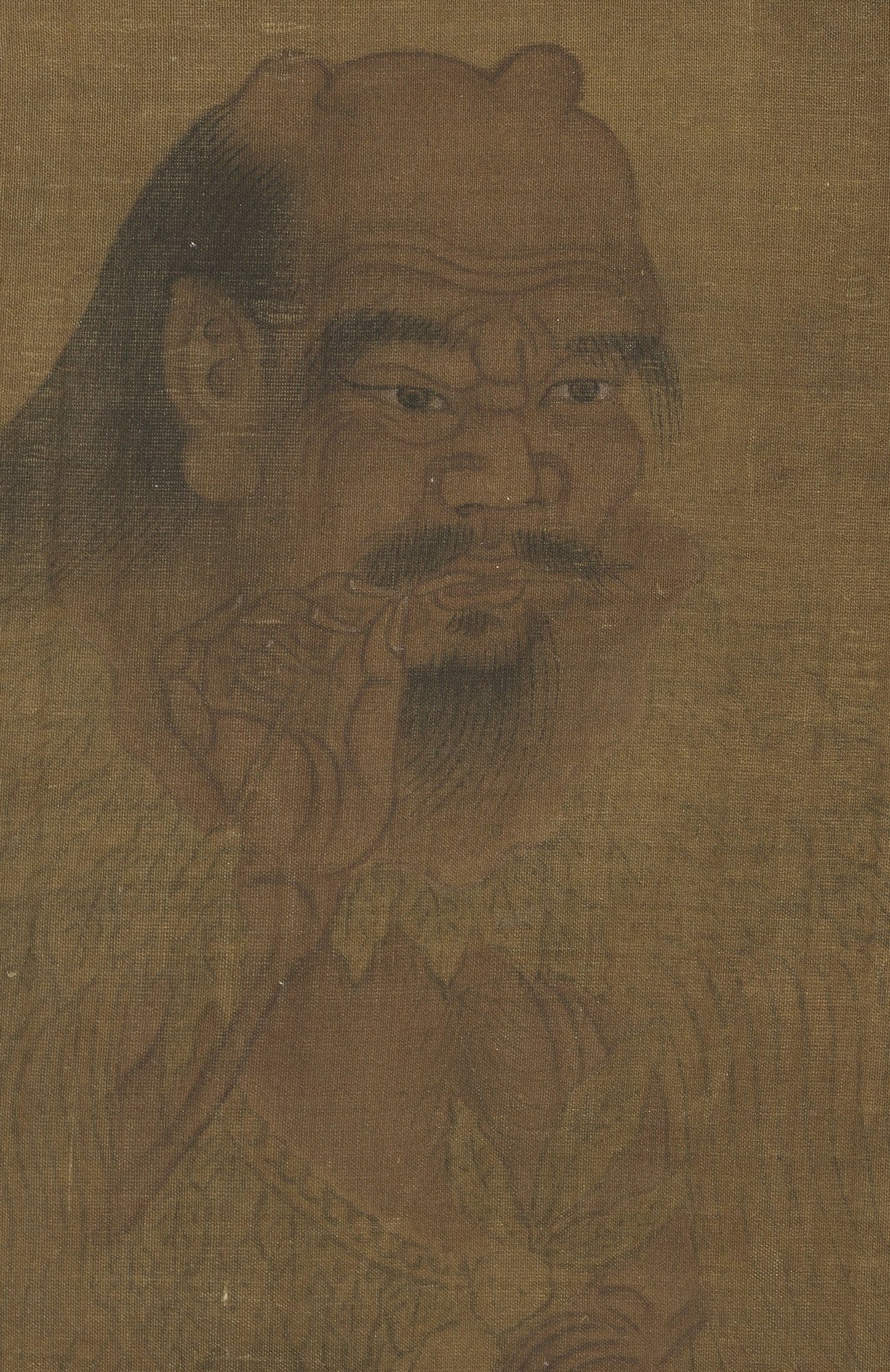
Album-leaf ink portrait on tan silk of the Flame Emperor Shennong as a half-length elder — a broad, wild-eyed bearded face beneath long loose hair, two fleshy horn-like protrusions rising from the crown (the ox-headed 人身牛首 iconography of Yandi), his shoulders clad in a sketchily drawn leaf-and-hide garment; near-monochrome brown line-drawing with no background.
Chinese

Shennong, the Divine Farmer

He hewed the first plough from raw wood, then turned on his own body as a laboratory, tasting the hundred plants and meeting seventy poisons in a single day so that his people would know what to eat and what to fear.

6 minYijing
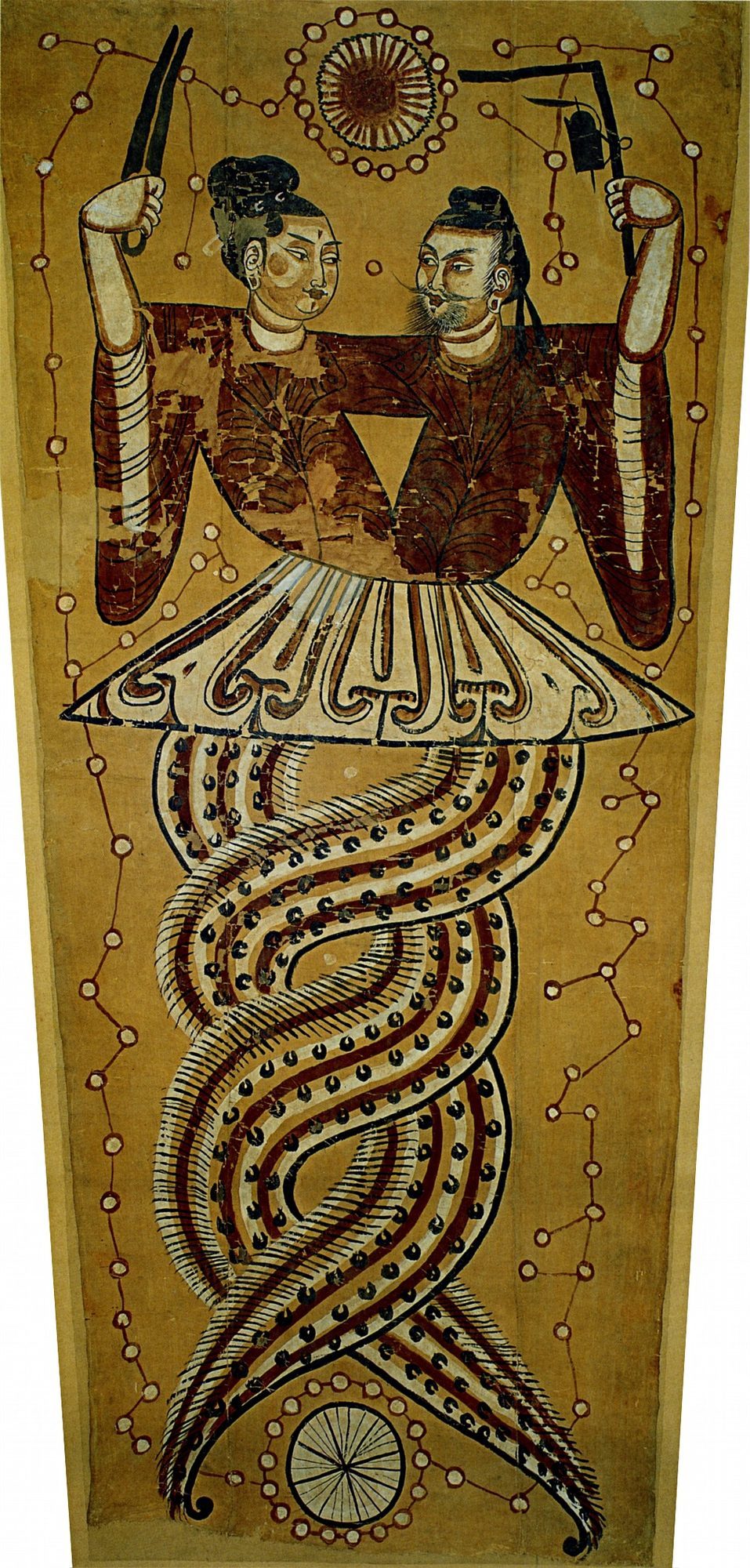
Tang-dynasty silk painting of Fuxi and Nüwa as a human-headed, serpent-bodied pair, their scaled tails entwined in a double helix below a shared white skirt. Nüwa at left raises a compass in her hand; the bearded Fuxi at right raises a carpenter's set-square with an ink-cord; a radiate sun-disc floats above their heads and a spoked moon-disc below the tails, the tan silk ground strewn with linked white dots for the constellations.
Chinese

Fuxi, Bringer of Civilization

He looked up at the images in heaven and down at the patterns on earth, and out of that reading drew the eight trigrams, the fishing-net, and the first law of husband and wife.

5 minYijing
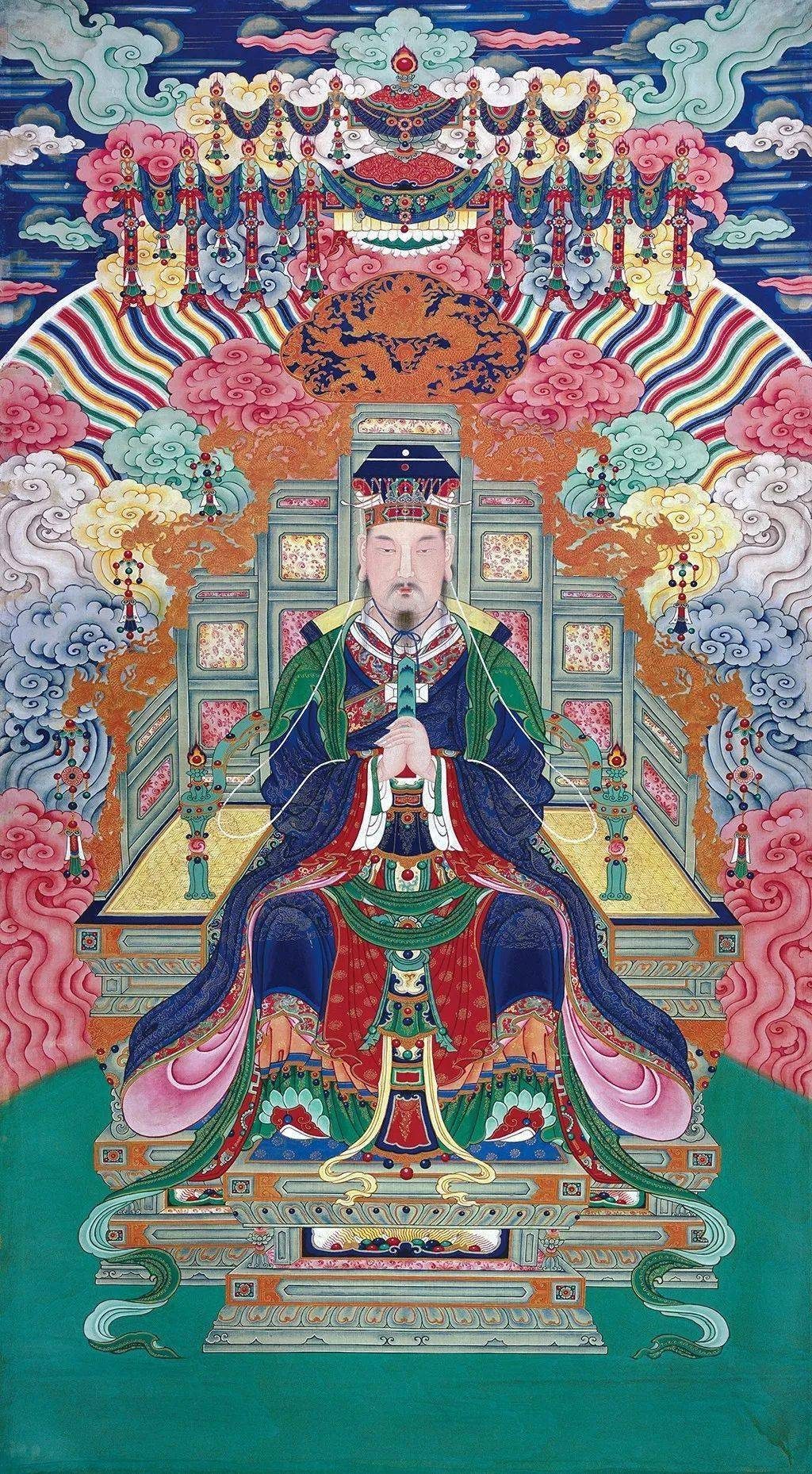
Ming-dynasty Daoist temple painting of the Jade Emperor enthroned in imperial court robes, wearing the flat mortarboard crown (mianguan) with hanging bead-strings and holding a ceremonial gui tablet in both hands, seated beneath a dragon canopy on a stepped throne amid coloured clouds.
Chinese

The Jade Emperor

Supreme sovereign of Heaven and head of a celestial civil service, whose whole war machine could not subdue one stone monkey, and who had to send west for the Buddha to save his own throne.

6 minWu Cheng'en
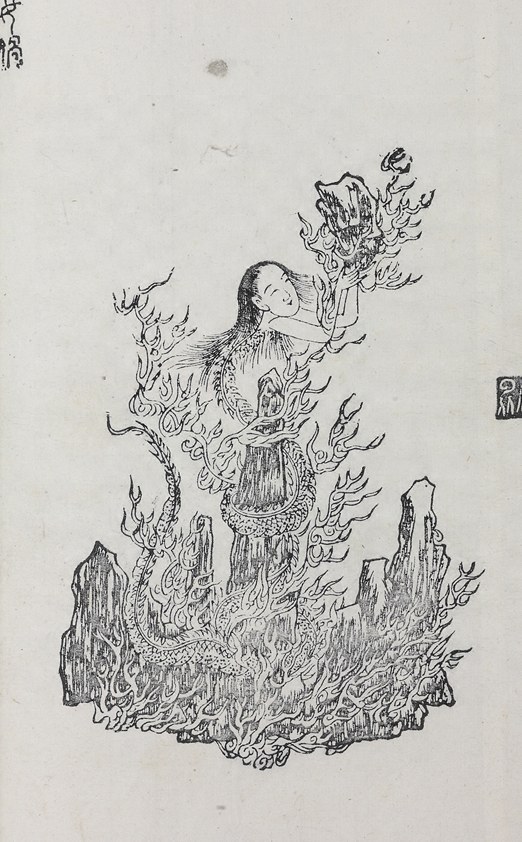
Woodblock-print line drawing of the goddess Nüwa: a human-faced woman with long flowing hair whose lower body is a coiling serpent tail wound among jagged rocks and licking flames, one arm raised overhead holding aloft a stone toward the sky she is mending.
Chinese

Nüwa, the Creator Goddess

Serpent-bodied and human-faced, she patted the first people out of yellow mud, then smelted five-coloured stones to patch a sky that had split from pole to pole.

5 minHuainanzi

Story Retellings

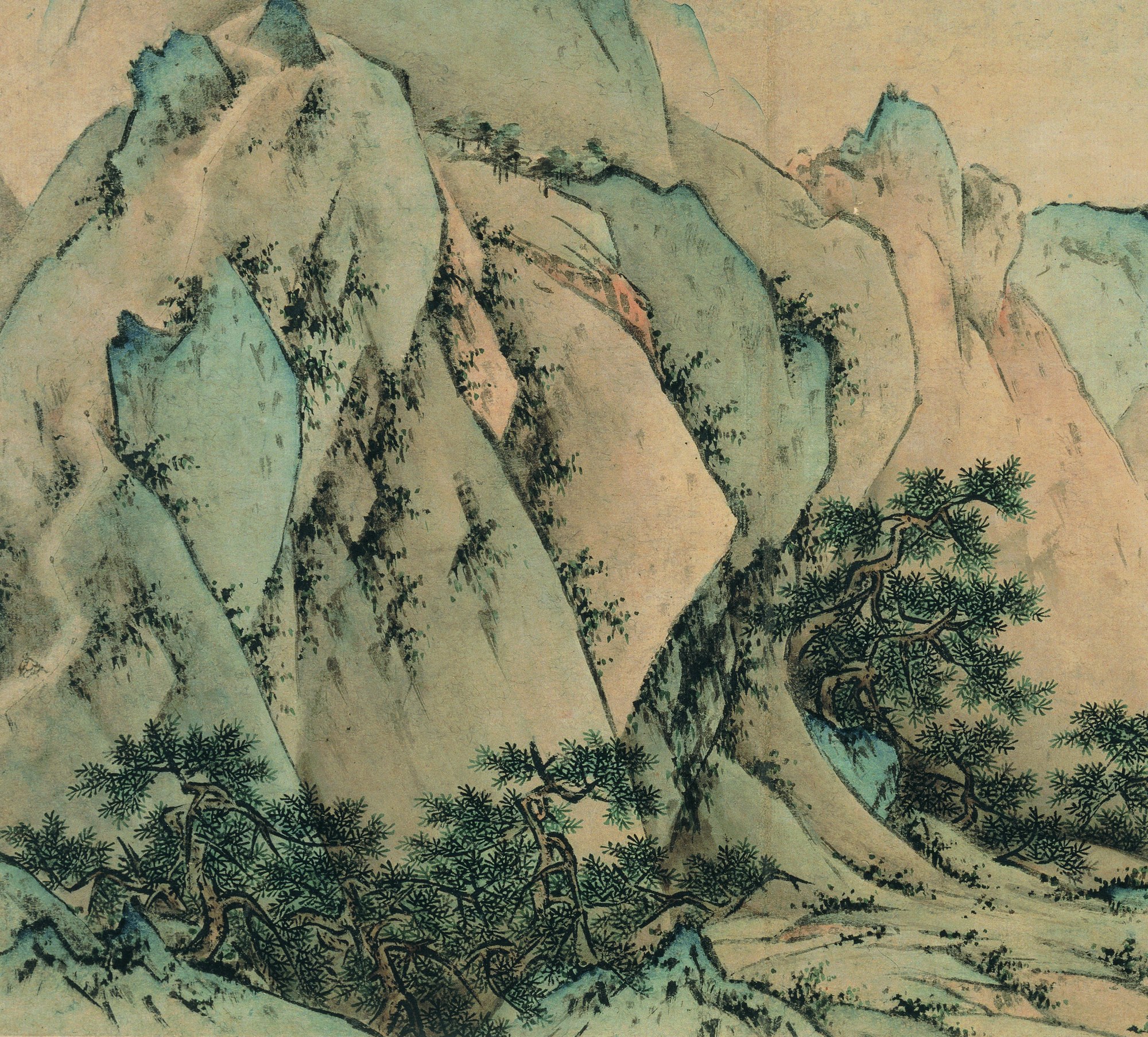
An ink-and-colour landscape of Mount Hua: towering pale blue-green rock walls riven by a dark vertical cleft, with wind-bent pines clustered at their base.
Chinese

Chenxiang Splits the Mountain to Free His Mother

A boy is told his mother lies pinned under Mount Hua for the crime of marrying his father: how a folk-and-theatre tale of the Ming and Qing borrowed its splitting axe from a river-god fifteen centuries older.

8 minZhang Heng 張衡
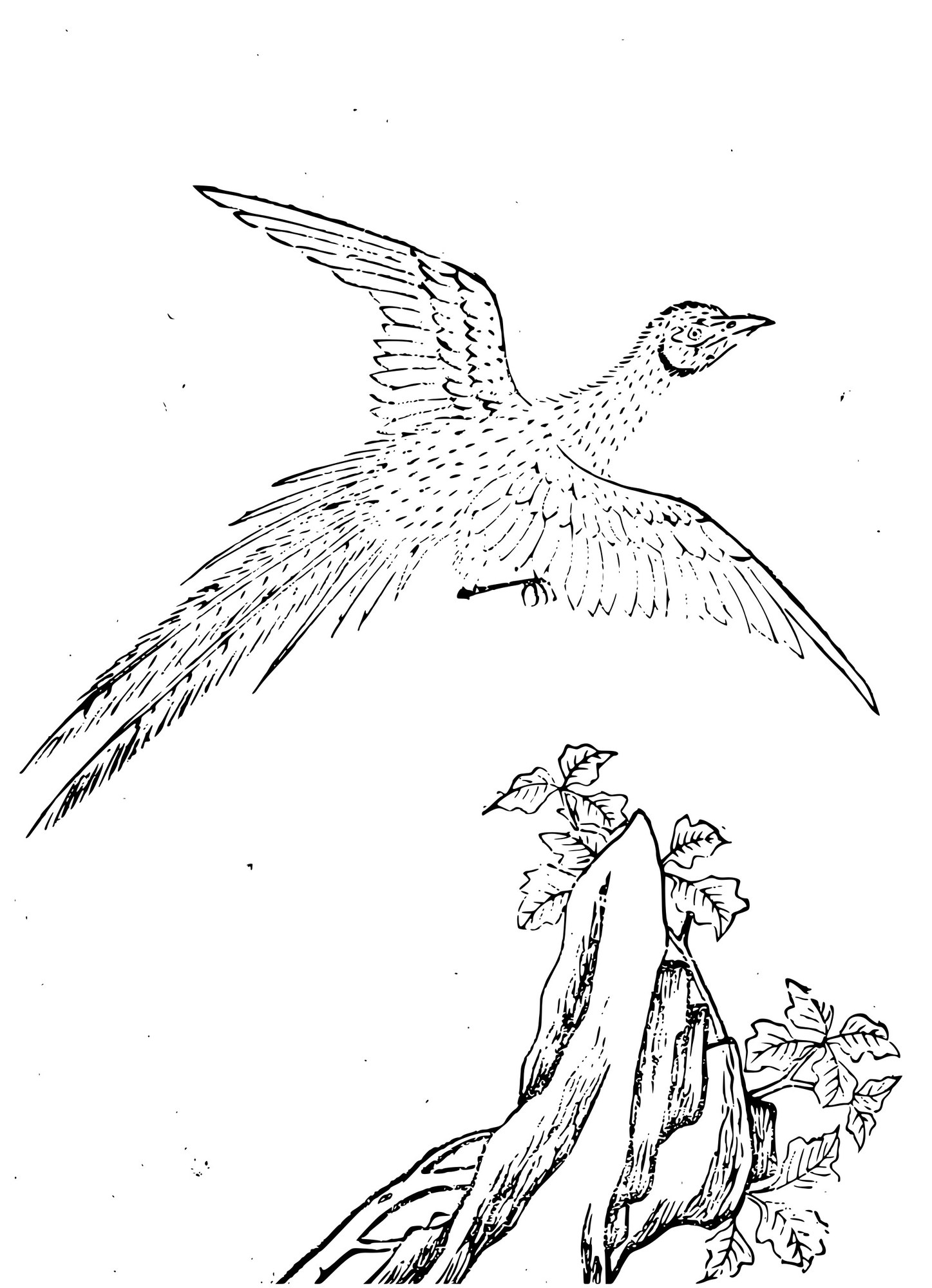
A Chinese woodblock-style line illustration of the bird Jingwei in flight, wings spread and a long streaming tail, gliding above a leafy branch springing from a rock; ink line on a plain ground.
Chinese

Jingwei Fills the Sea

The youngest daughter of the Flame Emperor drowned while playing in the water, and came back as a small bird carrying twigs and pebbles to fill in the sea that took her.

6 minShanhaijing
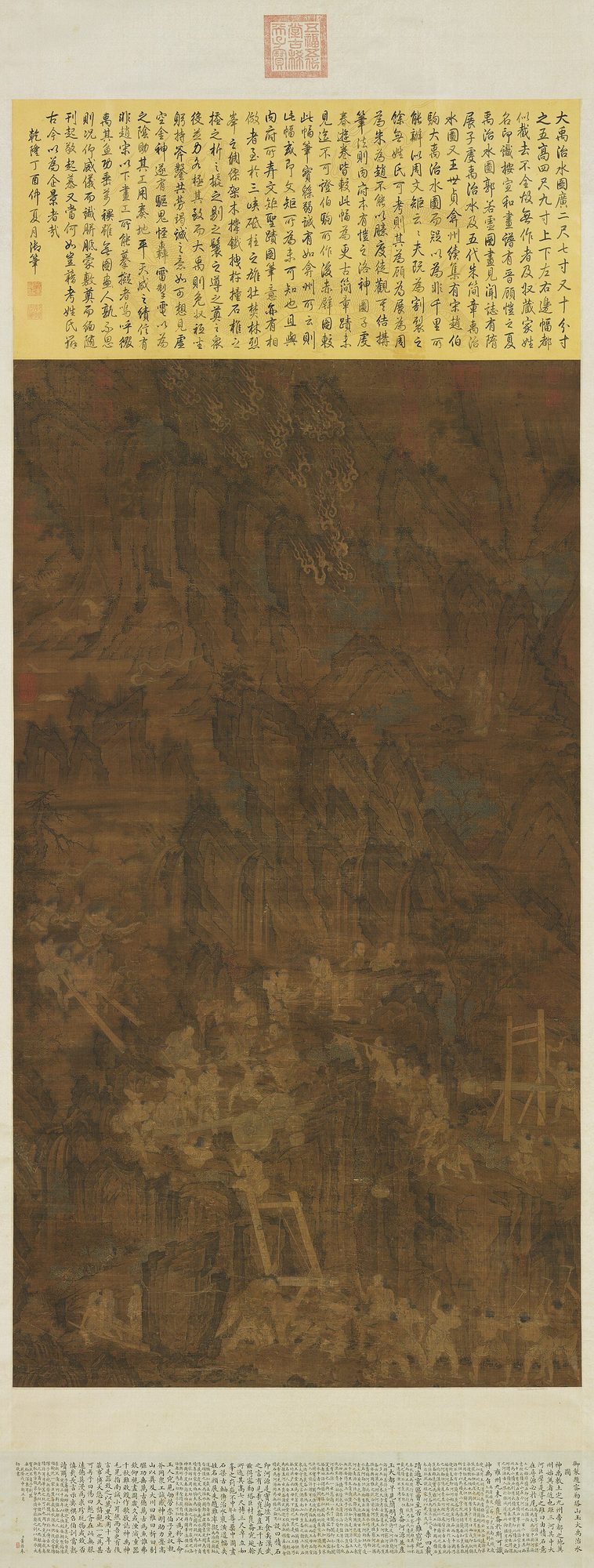
A tall Chinese silk hanging scroll in ink and colour — a towering, mist-wreathed mountain gorge threaded with waterfalls and drifting cloud-dragons, and across the lower half crowds of tiny labourers on timber scaffolding, derricks and ladders cutting the rock to channel the floodwaters away; a robed figure oversees the work from a ledge at the upper right.
Chinese

Gun, Yu, and the Great Flood

The waters had swallowed the hills and were climbing towards heaven, and the father who tried to wall them out failed and died for it; only his son, cut from the same body, found the way to let the flood run home to the sea.

7 minShanhaijing
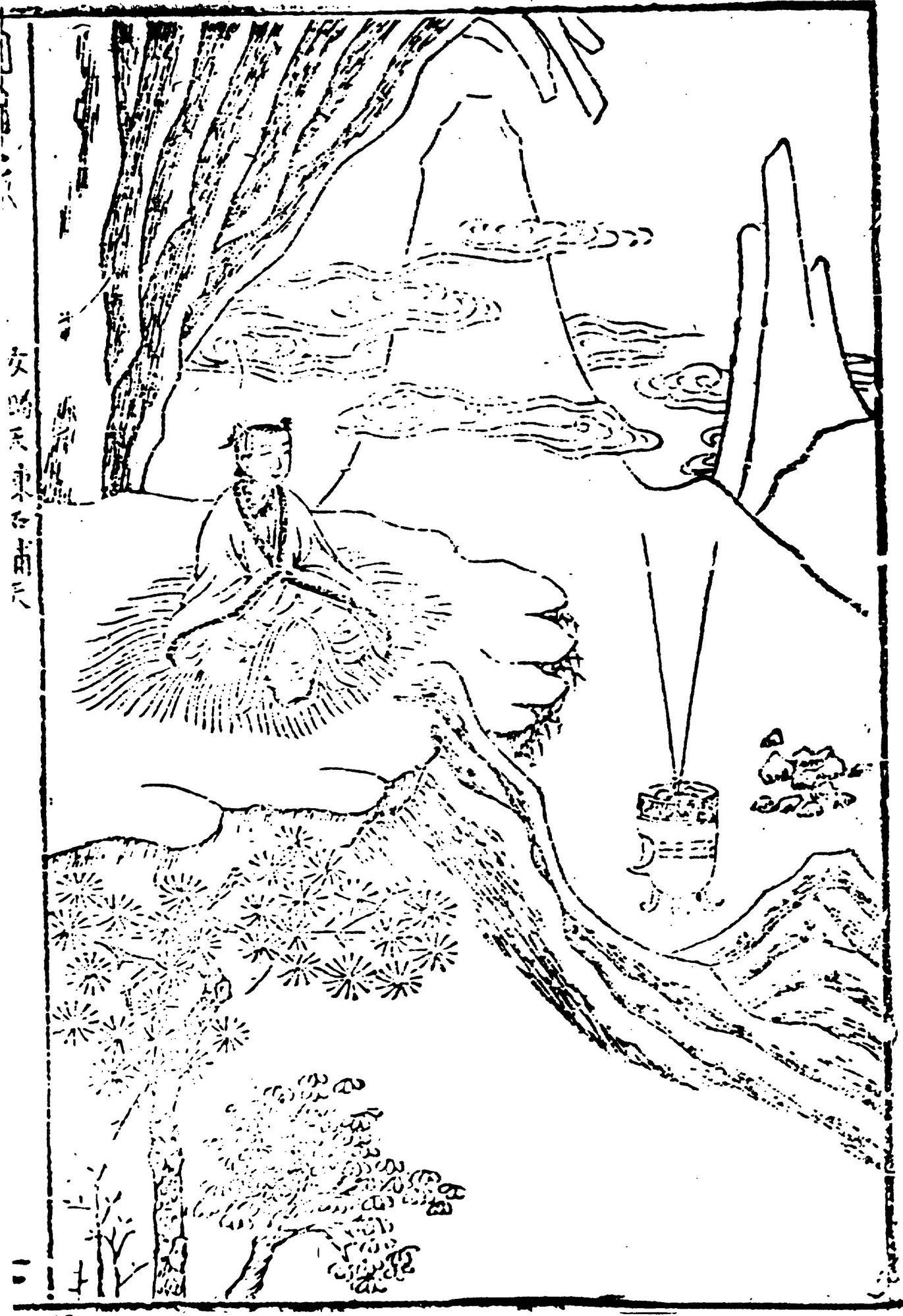
Ming-dynasty woodblock line-print of the goddess Nüwa mending the heavens: a robed, top-knotted figure sits at the upper left on a rock amid drifting clouds, broken mountain-peaks and bare trees around her, while at the right a squat furnace-crucible sends up straight lines of heat as she smelts the five-coloured stones, a small heap of stones piled beside it.
Chinese

Nüwa Mends the Heavens

The four pillars of the sky had snapped and the world was drowning in fire and flood; a serpent-bodied goddess answered not with thunderbolts but with a forge, a butchered turtle, and a heap of burnt reeds.

6 minHuainanzi
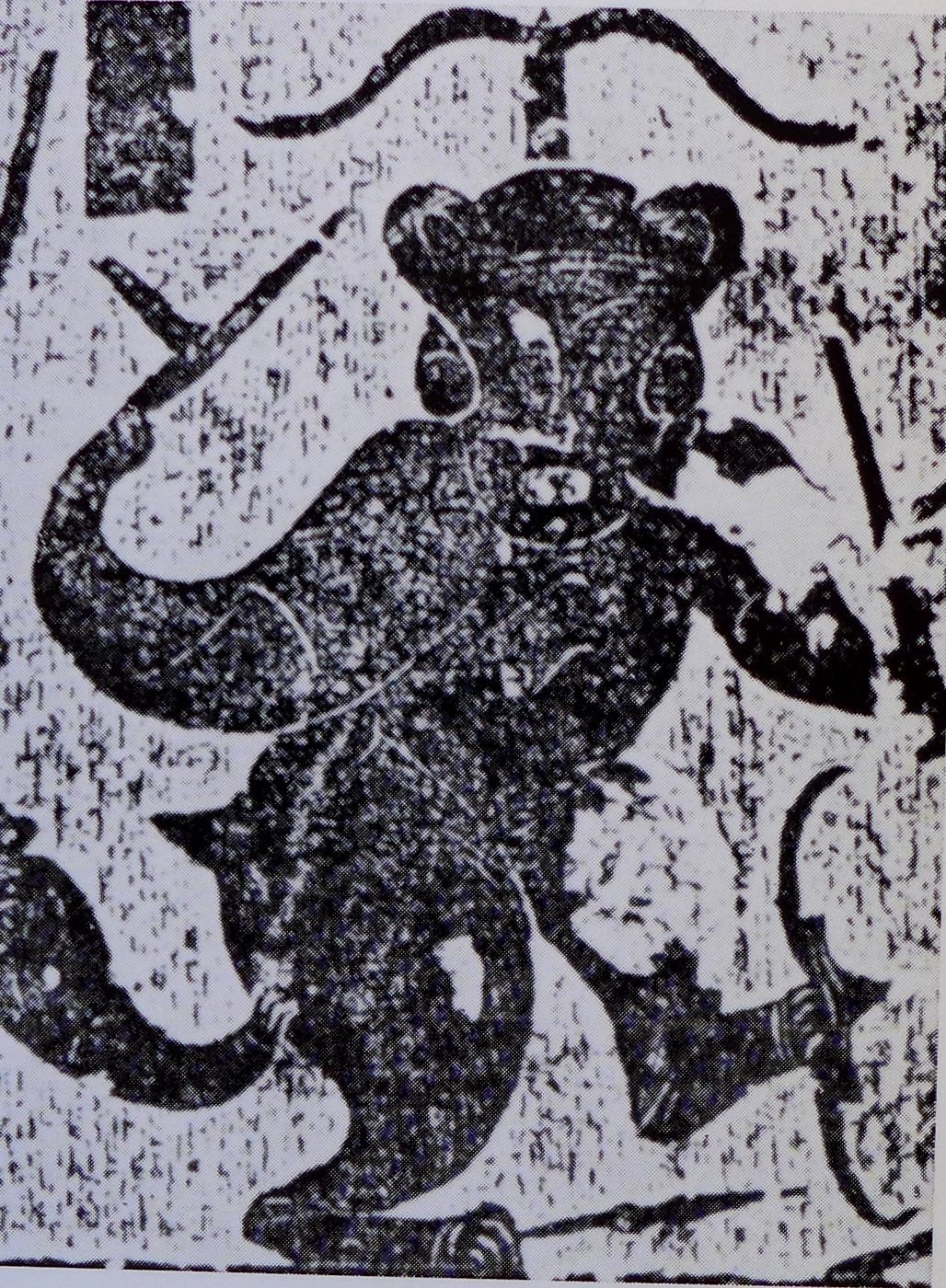
Ink rubbing of a Han-dynasty stone relief depicting the storm-monster Chiyou as a fierce armed warrior: a horned, crested hybrid figure striding frontally, a dagger-axe raised overhead in one hand and a crossbow held out in the other, a shield across his chest and weapons bristling around him, against the mottled ink ground of the rubbing.
Chinese

The Battle of Zhuolu

When the storm-monster Chiyou summoned the Wind Earl and the Rain Master against the young sovereign of heaven, the war for mastery of the world was decided not by armies but by a hoarded flood, a drought-goddess in blue-green, and a drum cut from the hide of a one-legged thunder-ox.

8 minClassic of Mountains and Seas
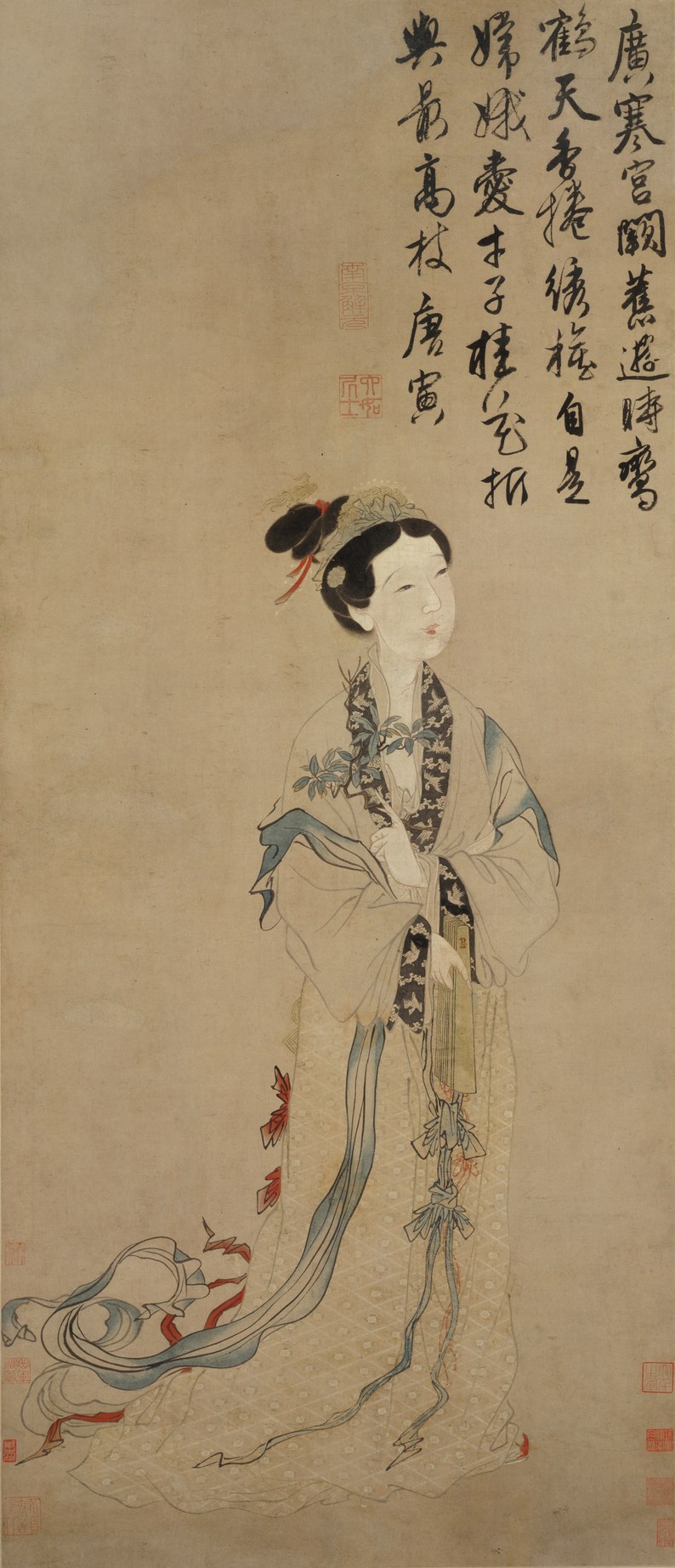
A Ming-dynasty hanging scroll of the moon goddess Chang'e as a single standing figure in pale flowing robes with long trailing sleeves and sashes, an elaborate jewelled coiffure, holding a sprig of cassia at her breast; a running colophon in cursive script fills the upper field.
Chinese

Chang'e Flies to the Moon

The archer won the one drug of no-death from the Queen Mother of the West. His wife stole it, fled to the moon, and left him with nothing to continue: the oldest telling is a theft, not a love story.

6 minHuainanzi
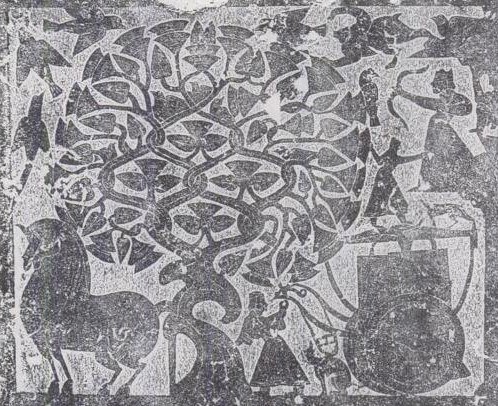
Ink rubbing of an Eastern Han stone relief from the Wu Liang Shrine — the great Fusang mulberry at centre with the sun-crows perched in its branches, the archer Yi at upper right drawing a bow up into the tree, and the solar goddess Xihe with a dragon-horse chariot below.
Chinese

Houyi Shoots the Ten Suns

Ten suns climbed into the sky at once and the world began to cook: the crops charred, the trees died, and the people had nothing left to eat. So the sage-emperor Yao sent for an archer.

6 minHuainanzi

Relationships

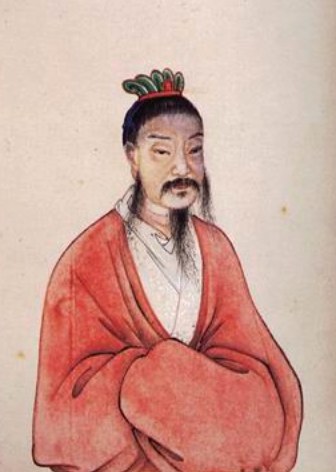
Hand-tinted woodblock portrait of Gaoyao, the upright Minister of Justice under Emperor Shun, shown half-length in red court robes and a crowned headdress, his hands folded within his sleeves.
Chinese

Gaoyao and Shun, the Minister of Justice

A sage-emperor hands the whole apparatus of punishment to one upright man, whose aim is to punish until no one need be punished. The beast that made him famous for smelling out the guilty is known to us only from the pen of a man calling it a fraud.

6 minShujing

Bestiary

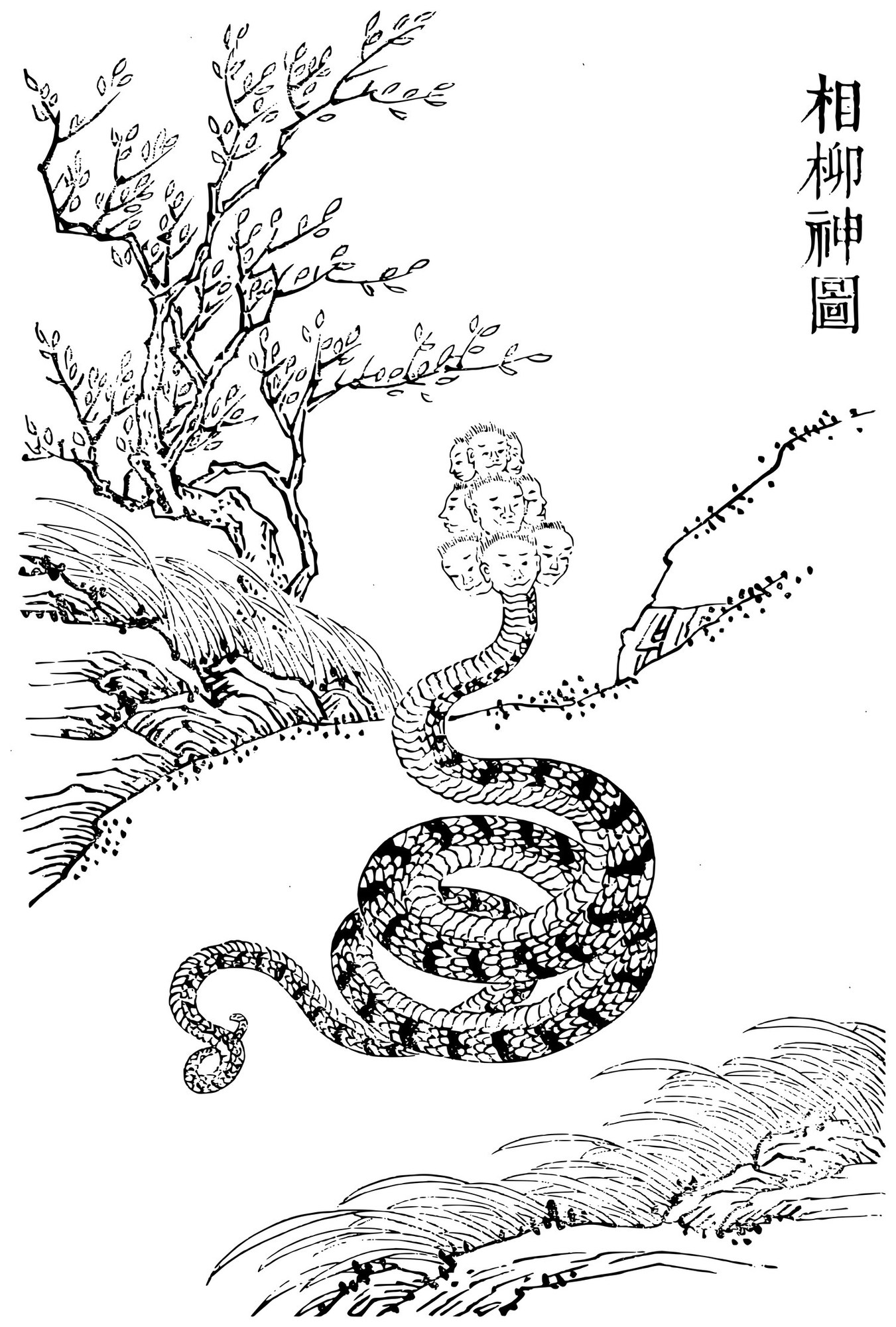
A Chinese woodblock line-illustration of Xiangliu: a cluster of nine human-faced heads rising on a single serpent neck above a heavily coiled, banded snake body with the tail curling free, set against a bare tree, a rocky bank and grassy ground; the title 相柳神圖 (Picture of the God Xiangliu) inscribed at upper right.
Chinese

Xiangliu, the Nine-Headed Serpent

Nine heads on one blue-green coil, feeding on nine mountains at once: Gonggong's minister, whose foul blood poisoned the ground so no grain would grow and no beast could live there.

6 minShanhaijing 山海經
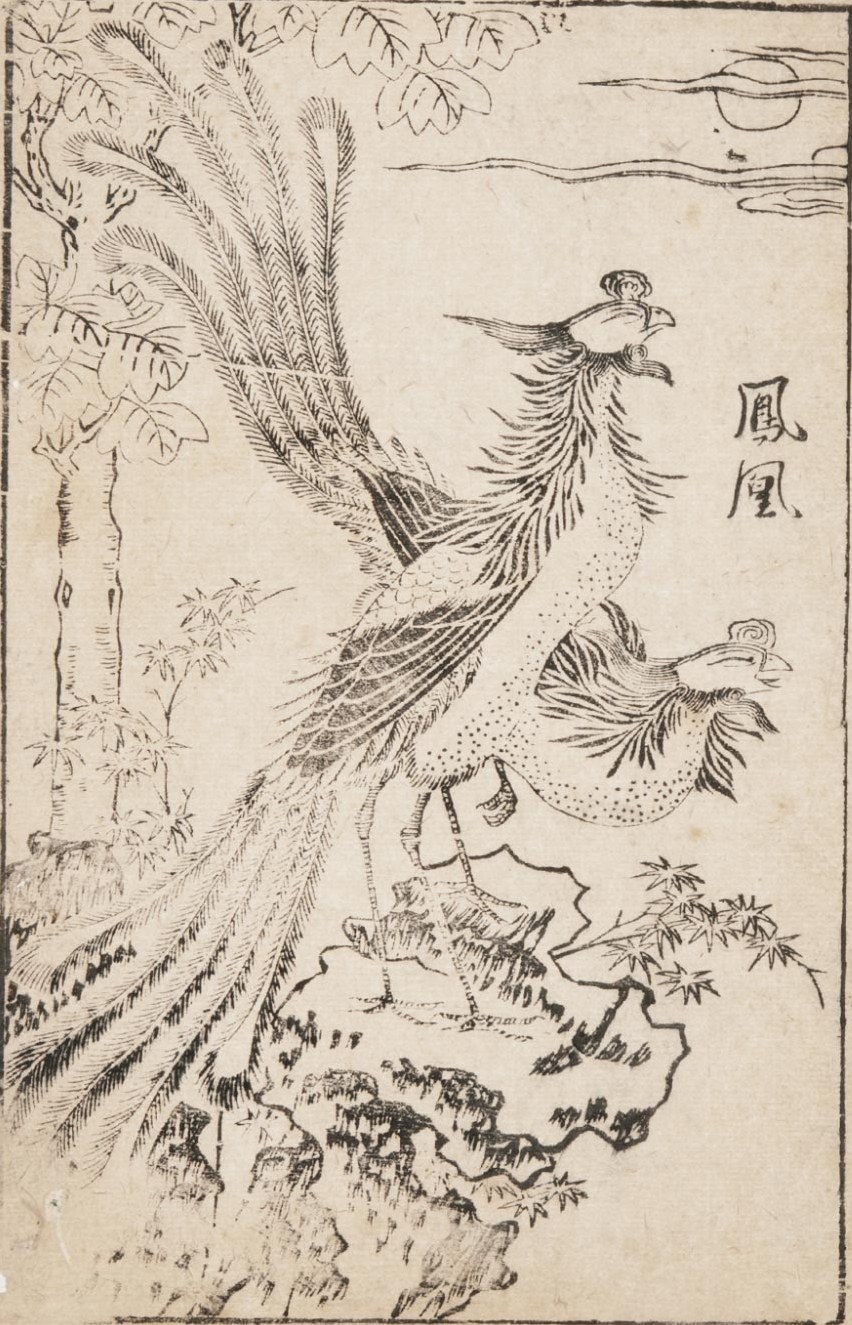
A single long-tailed fenghuang standing on a rock among wutong trees and bamboo, its head raised toward the sun and clouds at upper right, in a Ming woodblock line print; the characters 鳳凰 are inscribed beside it.
Chinese

The Fenghuang, Vermilion Phoenix

A five-coloured bird, the five virtues written in its feathers. It eats and drinks as nature provides and appears only when the realm is at peace.

5 minShanhaijing 山海經
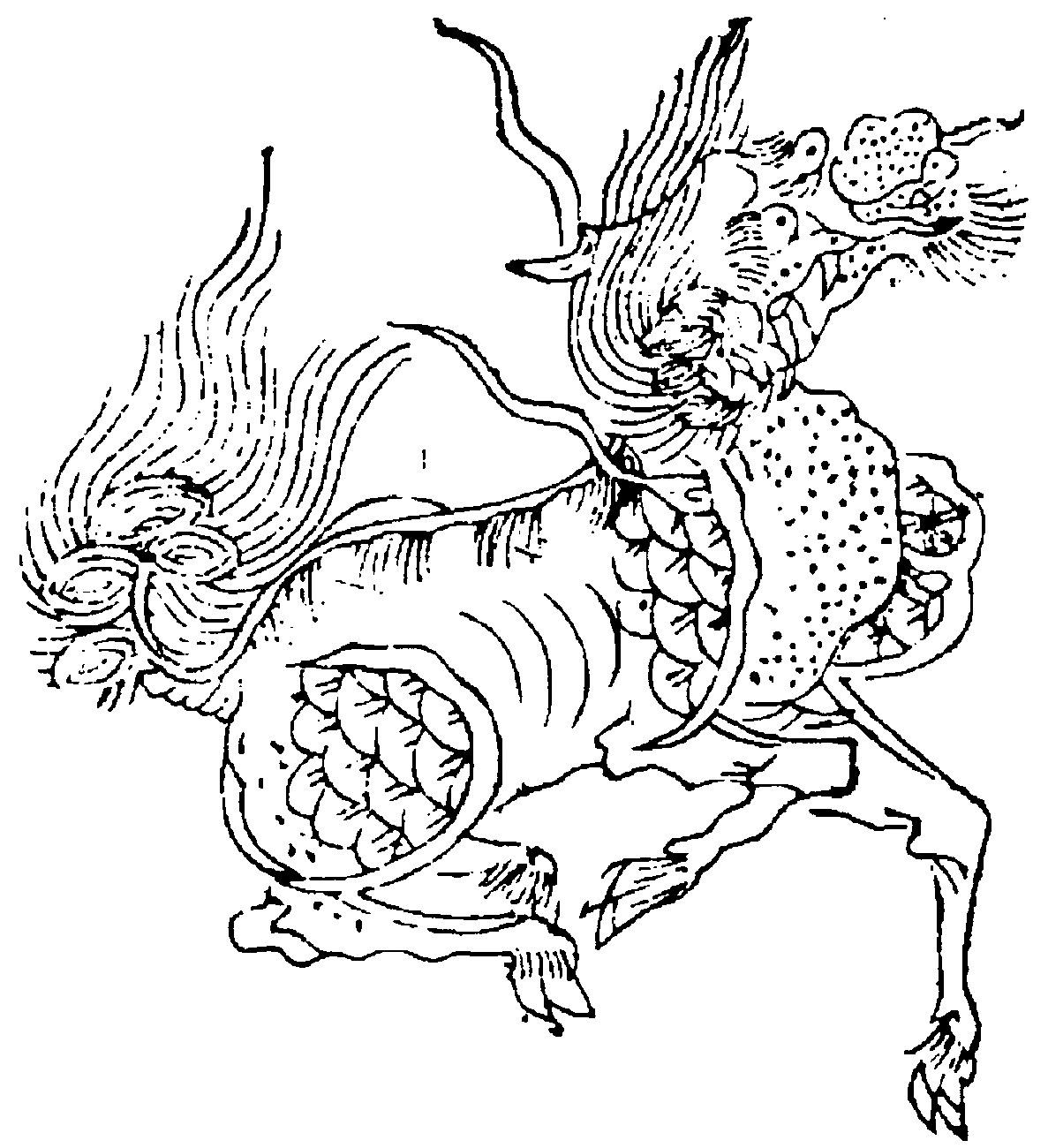
A single one-horned qilin in a Ming woodblock line print, prancing in profile with a scaled body, cloven hooves, a flame-like mane and a bushy upswept tail, its horned head raised.
Chinese

The Qilin, Benevolent Beast

A gentle one-horned beast seen only under a true king. Its capture on a hunt west of Lu forms the closing entry of the Spring and Autumn Annals.

6 minChunqiu 春秋
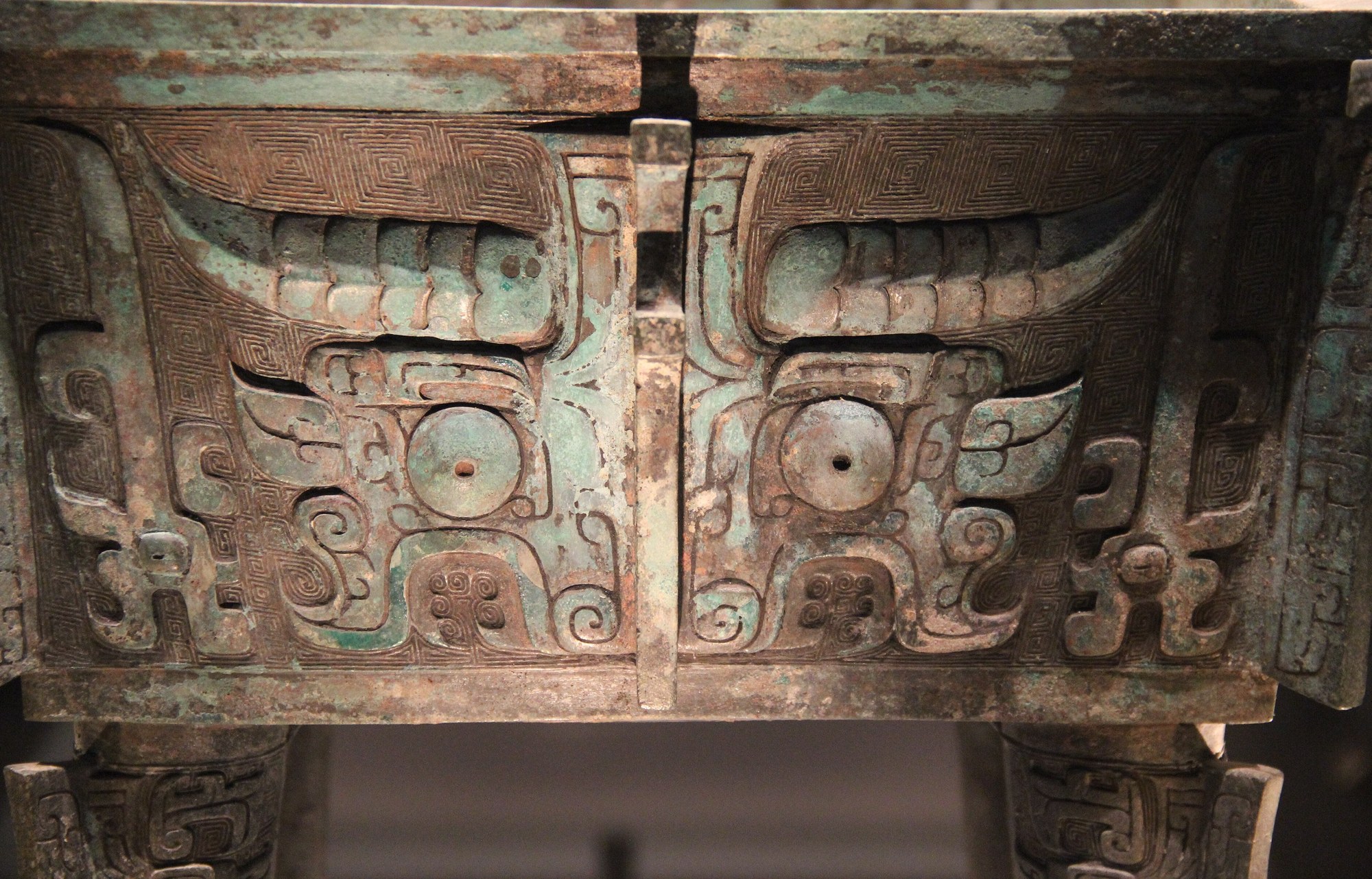
The frontal taotie animal-mask cast in relief on the body of a Western Zhou bronze ding cauldron — a symmetrical face with two great raised bosses for eyes, curling horns and quills above, and a split profile-dragon body flanking a central ridge, all over a fine leiwen (thunder-pattern) ground; two legs of the cauldron show below.
Chinese

Taotie, the Gluttonous Maw

A face that is all mouth and no belly, cast into the bronze of ancient cauldrons: it devours a man and, before it can swallow, the harm rebounds and destroys the devourer itself.

5 min春秋左氏傳
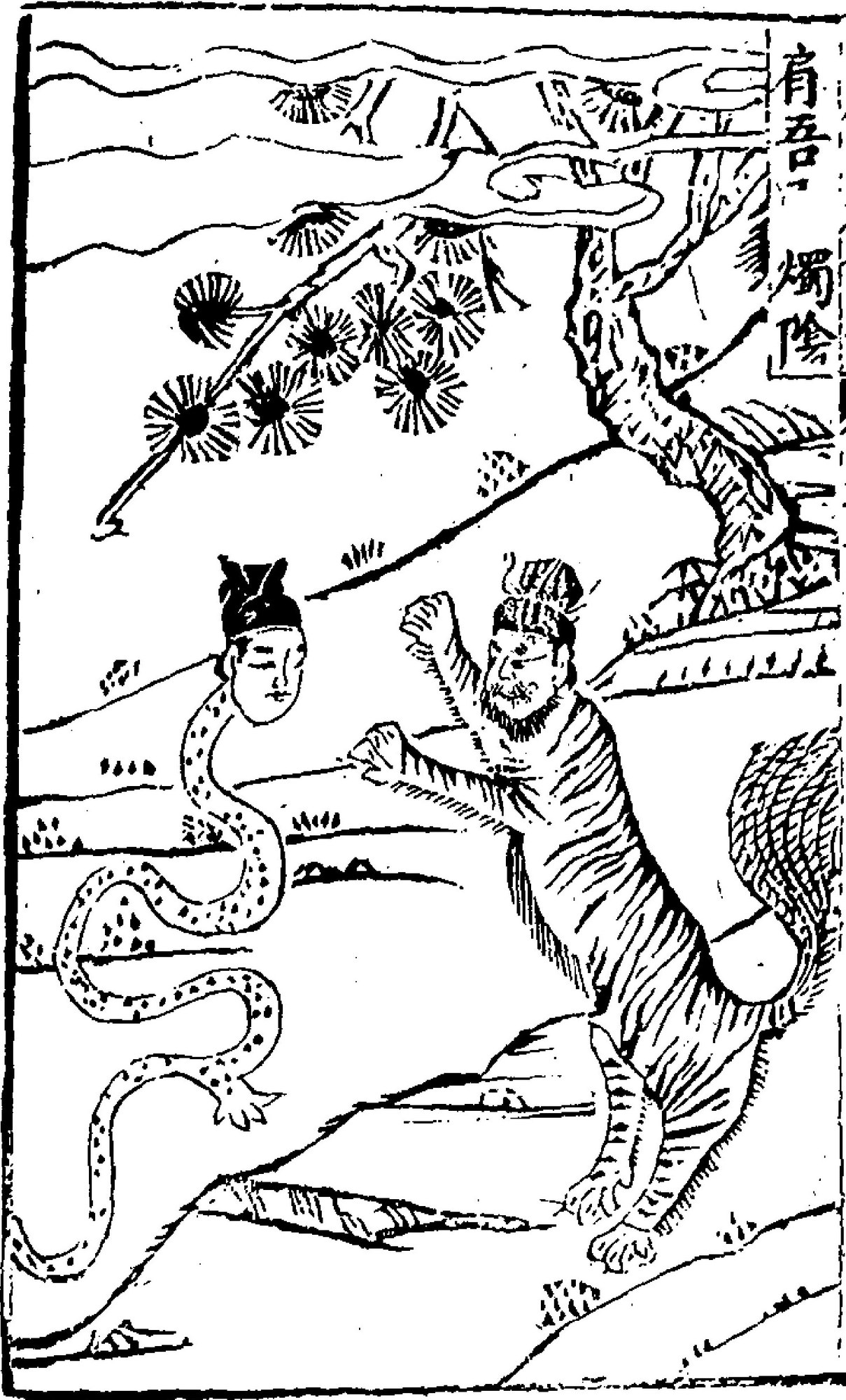
Ming woodblock print: at left the human-faced serpent-god Zhuyin (燭陰), the Torch Shade, his man's head rising from a coiling, spotted snake body, set in a landscape of pine, mountains and river beside the tiger-bodied god Jianwu (肩吾), each named in a small cartouche at upper right.
Chinese

Zhulong, the Torch Dragon

A thousand-li serpent lies in the sunless north: when his eyes open it is day, when they close it is night, and his slow breath is the winter and summer winds.

5 minShanhaijing 山海經
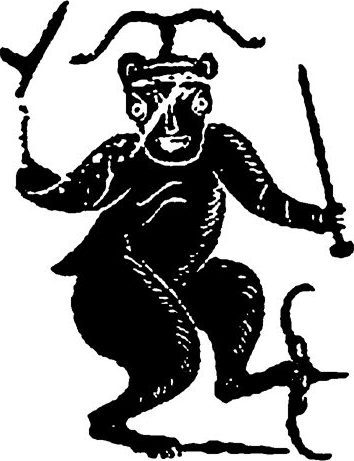
Black line image of the war-monster Chiyou as a horned, shaggy hybrid figure standing frontally, a blade brandished in each raised hand and a third weapon planted point-down at his side, with a long tail and clawed hoof-like feet, on a plain white ground; a rendering of a Han-dynasty stone-relief motif.
Chinese

Chiyou, the War Monster

Dig in the fields of the old north country and you may turn up a skull hard as bronze, or a tooth two inches long that no hammer will break: the bones, people said, of the horned god of war the Yellow Emperor could kill but never quite be rid of.

6 minClassic of Mountains and Seas

Cosmology & Sacred Places

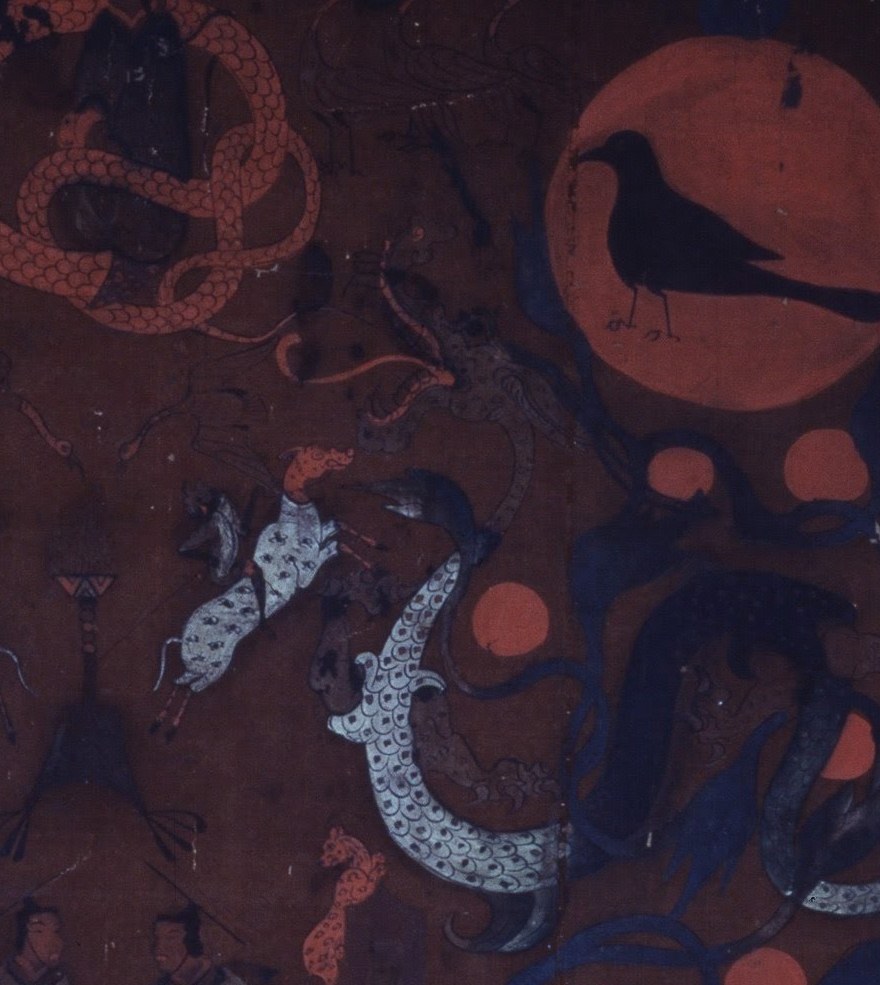
Detail from the upper 'heaven' register of the painted silk funerary banner from Mawangdui Tomb 1. A large red sun disc holds a black crow (the sun-crow), and below it several smaller red discs — the roosting suns — hang among the twisting dark-blue branches of the Fusang mulberry, with a coiled red serpent-bodied deity and dragons filling the field on the brown silk ground.
Chinese

The Ten Suns and the Fusang Tree

In a valley of boiling water at the eastern edge of the world stands a giant mulberry, and in its branches roost ten suns: nine below, one above, waiting its turn to cross the sky.

6 minShanhaijing
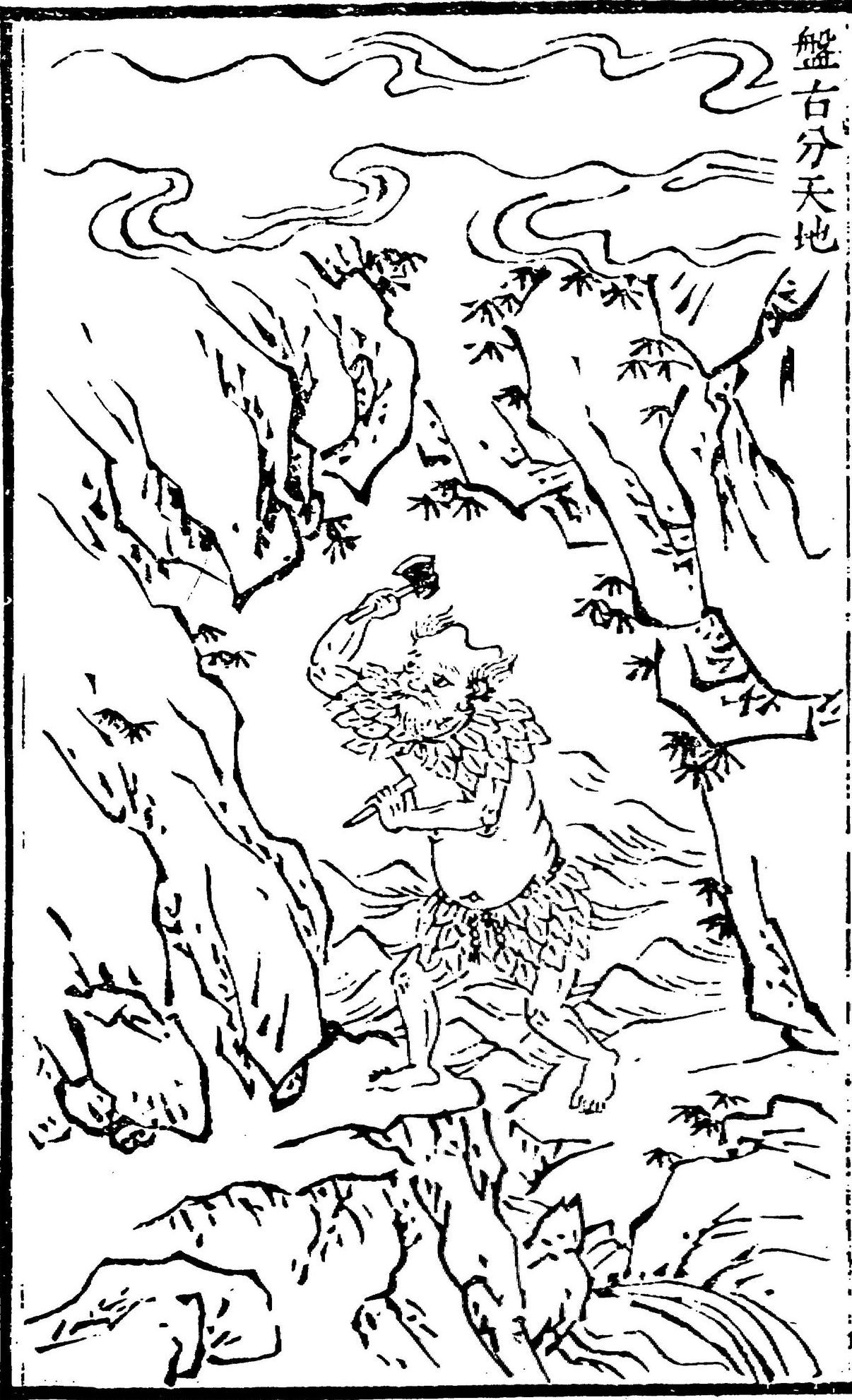
Chinese woodblock line-print of the primordial giant Pangu separating Heaven and Earth: a hairy, horned figure in a leafy skirt stands on a rocky ledge and swings a hatchet overhead with his raised right hand, cleaving apart the swirling cloud-scrolls of the sky above from the crags, bamboo and waves of the earth below; a title cartouche reading 盤古分天地 runs down the upper-right corner.
Chinese

Pangu and the Cosmic Egg

For eighteen thousand years a giant grew inside a shell of chaos, holding the raw sky and the raw earth apart with his own body; when at last he died, there was nowhere left for him to go but into the world.

6 minXu Zheng
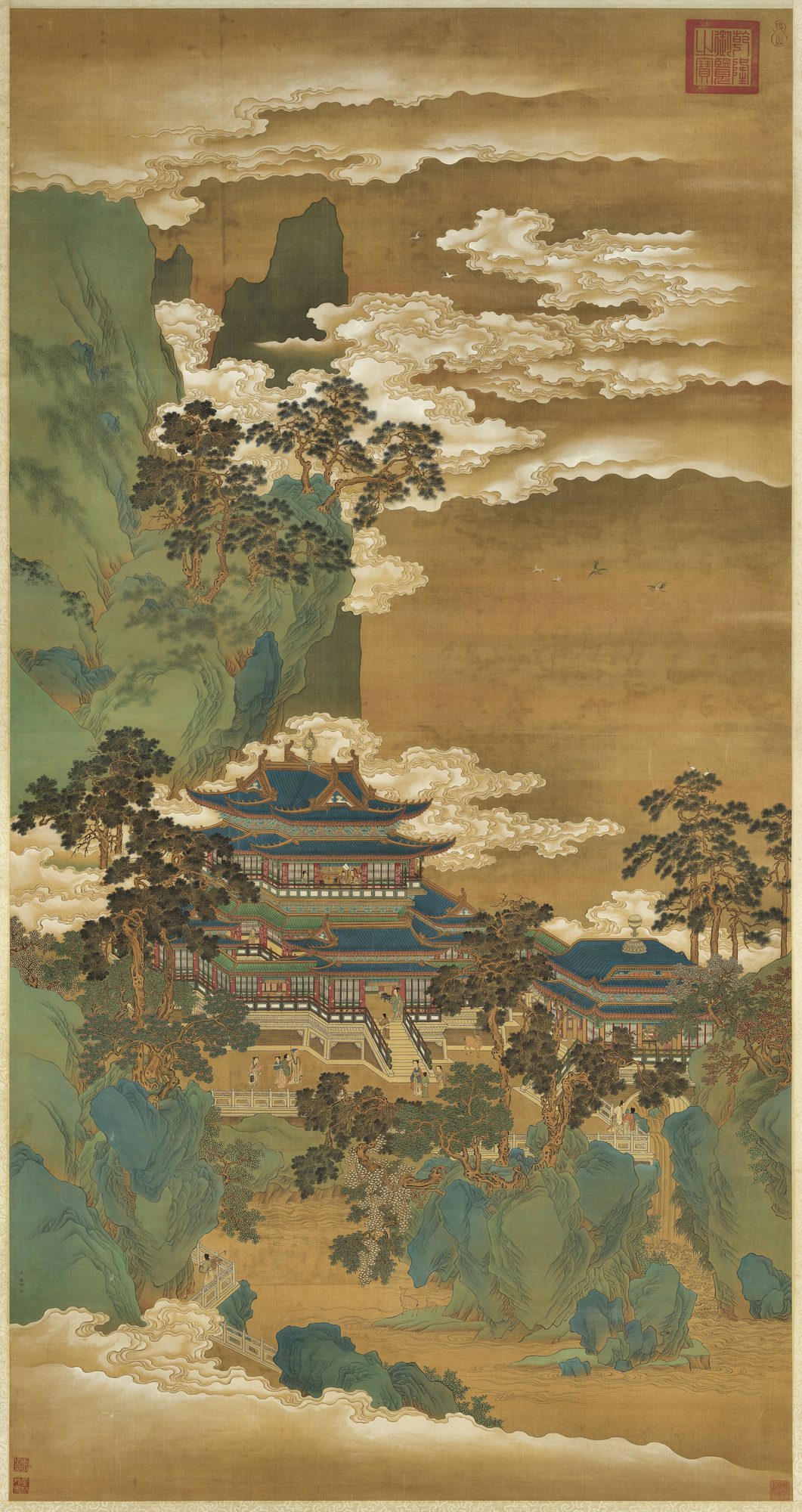
A blue-green Chinese silk landscape of an immortal mountain: jade-blue peaks wreathed in cloud rising above a many-tiered celestial palace with red pillars, blue-tiled roofs and jade balustrades, cranes in flight, deer among the rocks, and tiny figures climbing stone stairs and crossing bridges toward the heights.
Chinese

Mount Kunlun, Axis of the World

A jade-railed paradise in the northwest where four world-rivers rise, deathless trees grow and a stair of three tiers climbs out of the earth and into Heaven itself.

6 minShanhaijing

Worship & Ritual

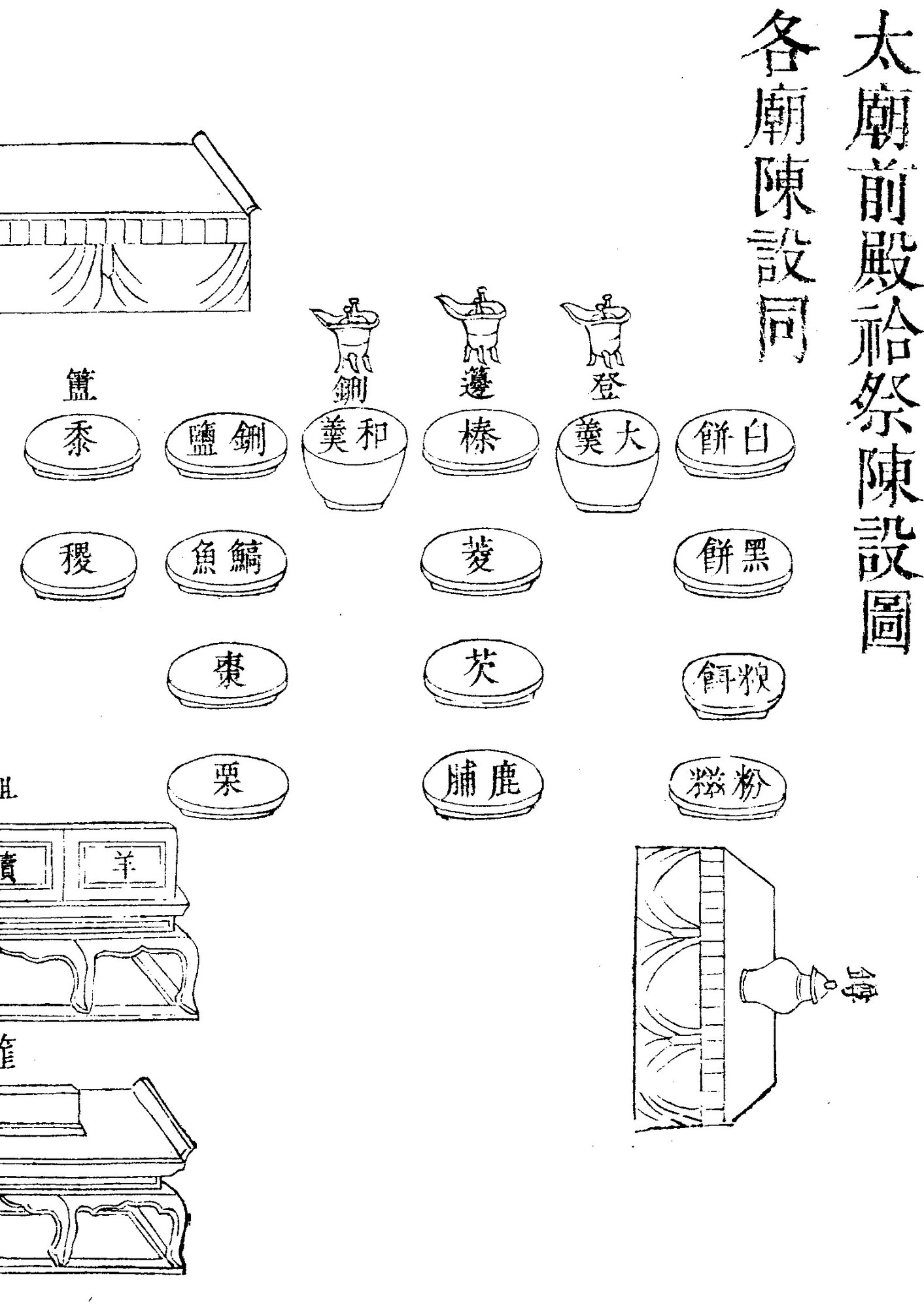
A Chinese woodblock line-illustration titled "Diagram of the Ritual Arrangement for the Great Collective Sacrifice in the Front Hall of the Imperial Ancestral Temple": the temple eaves at upper left and, ranged beneath, rows of labelled ritual dishes and stands — grain and salt, dried fish, dates and chestnuts, the bian, dou, deng and xing offering vessels, a wine-jar (zun), and the great-beast (tailao) meat stands bearing the sheep and pig — set out for the ancestral sacrifice.
Chinese

Ancestor Veneration and the Lineage Temple

The dead did not vanish. One soul rose bright into the air and one sank into the ground, and between them the living built a temple, seated a grandson in the ancestor's chair, and fed him until he spoke the blessing back.

8 min*Liji*

Themes