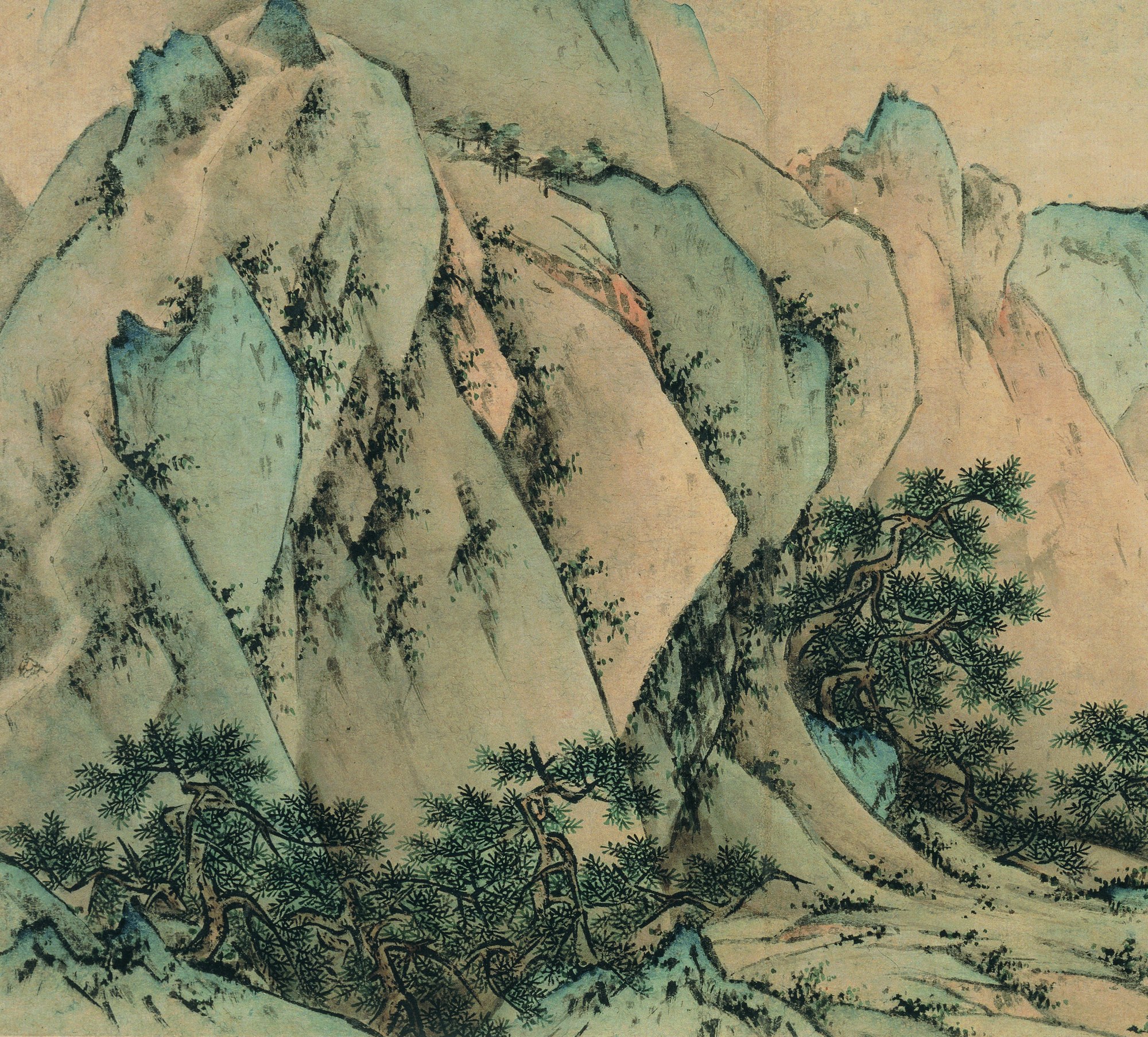
The boy is thirteen years old and standing at the foot of a mountain he means to break open. Somewhere in the rock beneath the Western Peak of Mount Hua his mother has been pinned for the length of his childhood, sealed there by her own family for the crime of having loved his father. He has been trained by an immortal, given a weapon, and told where she lies. Now he lifts it against a wall of stone the height of a small cliff and swings.
It is one of the most beloved rescue scenes in Chinese popular tradition, replayed for centuries on the opera stage and, in our own time, in television serials watched by tens of millions. It is also, in the shape most people know it, a good deal younger than they think. The temptation is to call this an ancient Chinese myth, a Tang fairy tale of gods and mortals. It is not. The story of Chenxiang splitting Mount Hua is an early-modern folk-and-theatre tradition, crystallised in the Ming and Qing dynasties, that stitched itself together out of two much older and entirely separate legends about the same holy peak. To read it honestly you have to watch it being built.
A goddess who marries down
The oldest thread runs back to the Tang dynasty, to a book of marvels called the Guang yi ji, compiled in the eighth century and now surviving only because a later encyclopaedia copied it out. In that early germ there is a goddess and a mortal and a marriage, and almost nothing else the modern story depends on.
A scholar takes a wife who turns out to be divine. She lives with him, bears his children over seven years, and then, her secret spent, tells him plainly who she is and leaves. Her parting line is preserved word for word: she says, I am the third daughter of Mount Hua,
and having spoken she takes her leave, goes out the gate, and vanishes.
That is the whole of the Tang seed. There is no prison in it. There is no son who grows up to avenge her, no forbidden law, no split mountain. The goddess is not punished; she simply departs, as divine consorts in these tales tend to. Everything that makes the later story a rescue, the crime and the sentence and the boy with the axe, is absent here by some seven hundred years. What the Tang gives the tradition is only its heroine: the third daughter of the god of Mount Hua, the figure who will later be called SanshengmuThe "Third Holy Mother", the goddess-mother of this tale; third daughter of the god of Mount Hua, also called Huayue Sanniang., the Third Holy Mother.
The crime of loving a mortal
The rest arrives much later, on the stage and in the chanted religious storytelling of the temples. The earliest surviving trace of the developed plot is a fragment of Ming chuanqiA form of long Chinese opera-drama of the Ming and Qing, running to dozens of scenes, that carried many folk stories onto the stage. opera printed in 1553, and even that preserves only the lovers’ first meeting. The rescue itself is known from lost play-titles and, in full, from an eighteenth-century Qing baojuanA "precious scroll": a genre of Chinese religious storytelling in alternating prose and verse, chanted aloud, in which many folk legends took their fullest written form from the Ming period onward., a precious scroll chanted aloud. By the time the story reaches that mature form, the goddess has a name for her husband, Liu, and a hard new fate.
In the developed telling she does not merely leave. She has broken Heaven’s law by marrying a human being, and Heaven does not forgive it. Her own kin enforce the sentence. Her brother, a guardian deity of Mount Hua in his own right, is the one who imprisons her, sealing her beneath the mountain under the Lotus Peak. Here a caution is owed, because this is the single most tangled point in the whole tradition. The jailer of the original story is Huayue Erlang, the goddess’s elder brother and a Mount Hua god.
He is not the famous three-eyed Erlang Shen, the warrior Yang Jian of the great novels. That identification is a twentieth-century substitution, traceable to a 1959 opera that folded the goddess into the celebrated Yang family and to a 2005 television serial that fixed the mistake in the popular mind for good. The uncle who crushes her under the mountain began as a local Mount Hua deity and was only later given a borrowed and far more glamorous face.
The boy raised on a secret
Their son is Liu Chenxiang, and he is the story’s true centre. In the eighteenth-century scroll he is seven years old when the tale opens and thirteen when he splits the mountain, a child for the whole of it. He grows up not knowing why he has no mother, and the plot turns on the moment he learns the truth: that she is not dead but buried alive beneath the peak, and that the law of Heaven put her there.
What he does with that knowledge is the reason the story has lasted. He sets out to undo a divine sentence by force, and to do it he is trained by an immortal master. Which immortal depends entirely on who is telling the tale. In the Qing scroll it is Lü Dongbin, one of the Eight Immortals, who takes the boy in hand and fights alongside him from the sidelines. In a regional opera line it is the lame immortal Li Tieguai instead; in modern retellings the teacher can be the Monkey King himself, drafted in from a wholly different epic. The master is a slot the tradition fills to taste.
Sword, or axe
The weapon is the same kind of moving target, and it matters, because the axe is the image the whole story is named for. In the fullest classic source, the Qing precious scroll, the immortal Lü Dongbin gives Chenxiang a sword. Not an axe. The famous magic axe, the one the boy raises against the cliff in nearly every picture and screen version, belongs to the modern popular form, cemented by that 2005 television series. It is worth dwelling on why the axe won out over the scroll’s own sword, because the answer reaches back past the whole filial tale into the second and much older Mount Hua legend it quietly annexed.
Long before any goddess married any scholar, the cleaving of Mount Hua already had an owner. The river-god Julingshen, the Giant Spirit of the Yellow River, was said to have split the mountain so the river could flow east, one half becoming a separate peak and his handprint left in the stone. This is a cosmogonic engineering myth, a god reshaping the land, and it is old. It is written down in Zhang Heng’s Rhapsody on the Western Capital around 107 CE, roughly fifteen centuries before Chenxiang’s rescue took its Qing form, and even that near-contemporary telling was looking back at older material.
Zhang Heng’s words survive intact: he describes the Giant Spirit straining with all his might, pressing high with his palm and stamping far with his foot to make the river bend, his traces remaining to this day. Note what the ancient text does not say. It speaks of palm and foot, not of any axe. The axe is a later gloss laid over Julingshen too. Yet the picture of a mighty figure cleaving this exact mountain was there, ready and waiting, when the filial-rescue tale needed a climax. The boy inherited the older god’s splitting gesture, and in time an axe that neither of them originally carried.
The well and the flame
The scroll does not let the rescue come cheaply. Near its end Chenxiang is tricked by the uncle-god and thrown into a deep well alongside his mother, the two of them left to be burned alive, and it is only the immortal Lü Dongbin, intervening at the last, who pulls them clear. When the mountain is finally broken and the family reunited, the resolution comes from the very Heaven that condemned the marriage: the Jade Emperor issues a decree and orders mother and son back to the celestial court. The rebellion against divine law ends, tidily, with divine law’s blessing.
Even the split has a physical shrine on the peak itself. On the Western Peak of Mount Hua stands the Axe-splitting Rock, a stone the better part of a hundred feet high, cut cleanly into three sections, which local tradition points to as the very place the boy cleaved the mountain and freed his mother. It is a fitting relic for this kind of story, an old rock given a new legend, exactly as the old cleaving-myth was given a new hero.
What the tradition would not fix
For all its familiarity, the story never fully settled. One regional line, a Nanyin opera on the Chenxiang prince, is reported to leave out the crushing under the mountain and the splitting rescue altogether, which is a startling thing: the climax that gives the tale its name was not universal even within the tradition that made it. The teacher changes, the weapon changes, the villain changes his very identity across the centuries.
What holds steady through every version is the one thing worth holding: a child who will break a mountain, defy Heaven, and walk into a burning well rather than leave a parent buried alive. The scholarship is honest that this is not an ancient myth. The devotion at its heart, however, is as old as anything the Chinese tradition ever asked of a son.
The princess said, “I am the third daughter of Mount Hua.” Having spoken she took her leave; going out the gate, she vanished. (Guang yi ji, 8th c., preserved in Taiping Guangji juan 302; author’s rendering from the Chinese)
- Zhang Heng 張衡, Xijing fu 西京賦 (Rhapsody on the Western Capital), c. 107 CE: earliest datable account of Mount Hua being cleaved, by the river-god Julingshen so the Yellow River could flow east; the reservoir of
split Mount Hua
imagery the later filial tale borrowed. This is Julingshen, a different god performing a different act, NOT Chenxiang. The verified wording (綴以二華,巨靈贔屓,高掌遠蹠,以流河曲,厥跡猶存) speaks of palm and foot, not an axe. Chinese read verbatim (zh.wikisource 西京賦). - Li Daoyuan 酈道元, Shuijing zhu 水經注 (Commentary on the Water Classic), early 6th c.: cites a still-older lost text for the Julingshen splitting of Mount Hua, evidence the motif long predates its earliest surviving witness.
- Dai Fu 戴孚, Guang yi ji 廣異記 (Great Book of Marvels), 8th c. (Tang): the earliest germ of the goddess, the
third daughter of Mount Hua
(華嶽第三女) who marries a mortal, bears him children over seven years, then reveals her divine nature and departs. It contains NO imprisonment, NO son-hero and NO mountain-splitting rescue. Preserved verbatim in Taiping Guangji 太平廣記 juan 302 (出《廣異記》), compiled 978 CE. Chinese read verbatim (zh.wikisource). - Ming Jiajing-era opera fragment, Fengyue Jinnang 風月錦囊 (1553): earliest surviving publication touching the Liu Xi / Sanniang story; only the lovers’ meeting survives. Related lost Yuan/Ming plays (沉香太子劈華山, 劈華山救母) are known by title and date only and cannot be quoted.
- 《沉香寶卷》 Chenxiang baojuan (Chenxiang Precious Scroll), 18th c. (Qing): the fullest classic narrative form. Chenxiang aged seven to thirteen; the immortal Lü Dongbin gives him a SWORD (not an axe) and fights from the sidelines; the well-and-burning peril; the Jade Emperor’s decree returning mother and son to Heaven. Its plot beats here are summary-sourced via Yuan Haiwang, The Magic Lotus Lantern and Other Tales From the Han Chinese (Libraries Unlimited, 2006), not read in the scroll’s own wording; for the primary text, Wilt L. Idema’s baojuan scholarship is the authoritative anchor.
- Qing chuanqi opera
Baolian Deng
寶蓮燈 (The Precious Lotus Lantern): the theatrical branch that gives the tradition its lantern-and-lamp name and feeds the vast later opera, film and television corpus. Qing to 20th c. - Pop-culture accretions, flagged not as tradition: Erlang Shen / Yang Jian as the villain-uncle is a 20th-c. conflation (1959 Bangzi opera; 2005 CCTV-8 television serial); the original jailer is Huayue Erlang, a distinct Mount Hua deity. The
magic axe
as Chenxiang’s weapon is likewise modern (2005 series); the baojuan gives a sword. Sun Wukong as teacher is one late variant among several. - **Aat Vervoorn,
Cultural Strata of Hua Shan, the Holy Peak of the West,
Monumenta Serica 39 (1990)1–30:** scholarly anchor for the Julingshen strand and the Mount Hua cult. Cited via apparatus.