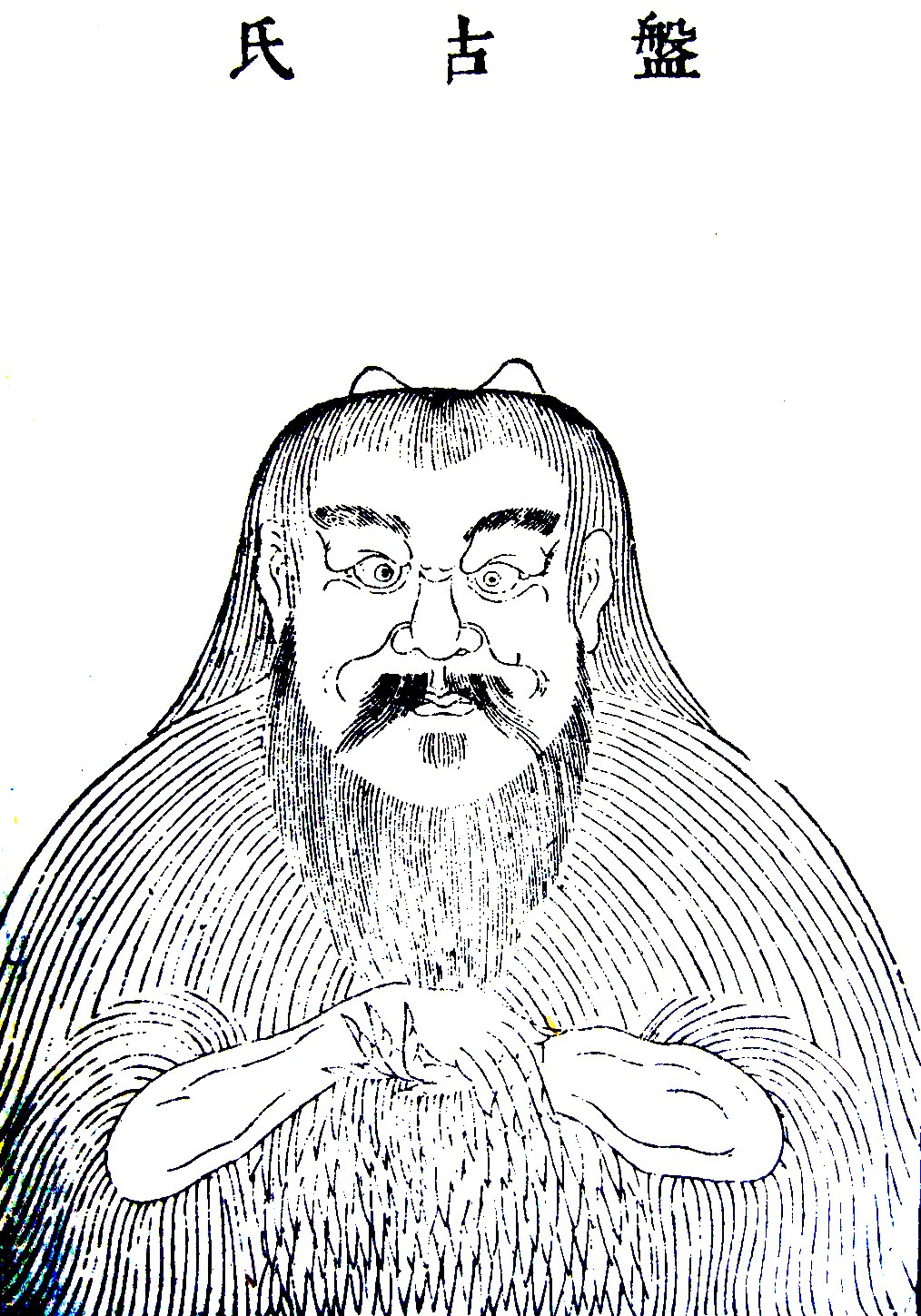
The oldest surviving words about Pangu do not call him a god. They place him, with a precision that is easy to walk past, between two things he is not. Nine transformations in a single day,
the third-century fragment says, and then the line that matters: he is divine in relation to Heaven, sagely in relation to Earth.
Not a god you would pray to for rain, and not a sage-king you could name in a line of succession, but the hinge on which those two categories are told apart. Everything difficult about Pangu is already present in that sentence. He is the being who exists before there is any settled name for what a being can be.
That priority is the first fact the sources insist on. In Xu Zheng’s Sanwu LijiThe 3rd-century record by Xu Zheng, surviving only as quotations in later anthologies, that gives the earliest datable account of Pangu., once Heaven and Earth stand apart, the text adds a careful coda: only afterward were there the Three SovereignsThe first rulers of the human world (三皇), who in the earliest fragment appear only after Pangu, marking his priority to the whole political order., the first rulers of men. The other early fragment opens by naming him outright as the first-born.
He comes before the human order and before the political one. He is not their king; he is the condition that had to be met before either could begin. Kings arrive late in this cosmology. The giant is there before there is anywhere for a king to stand.
What is made of a body
The second fact is stranger, and for a portrait of the figure it is best held as an identity rather than a sequence. Pangu is a being defined by his body in the most literal way a myth can manage: at his death the whole physical world is made out of him. His breath is the wind and cloud, his eyes the sun and moon, his blood the rivers, his bones the metal and stone underfoot.
The catalogue itself, the beat-by-beat dissolution, belongs to the story of the creation. What belongs to the figure is the plain consequence of it. To describe Pangu is to describe the world, because there is no part of the visible world that is not a part of him. He is not a god who makes the world from outside it. He is the material the world is made of, which is a rarer and more uncomfortable thing to be.
Hold those two facts together and the paradox sharpens. Here is a being who is the entire cosmos and who is also, by the sixth century, an ancestor that a living people claimed by name. The clearest ancient statement of what Pangu is, as opposed to what he did, comes not from Xu Zheng at all but from Ren Fang, writing his ShuyijiRen Fang's early-6th-century "Records of Strange Things", the source for Pangu as ancestor, surname, kingdom, tomb and temple, some 250 years after Xu Zheng. around the year 500, roughly two hundred and fifty years after the earliest fragments. It is worth marking that gap in plain years, because the two witnesses are not contemporaries and the later one shows a Pangu who has travelled a long way from the bare cosmic giant.
Ren Fang breaks off the received material to add a note in his own voice: Lord Pangu, he writes, is the ancestor of Heaven, Earth and the myriad things, and so the birth of living beings began with him. That is the first surviving attempt by anyone to say, flatly, what kind of figure Pangu is. It is an interpretation, and Ren Fang signs it as his own.
A family name and a grave
By Ren Fang’s time the cosmic principle had been pulled all the way down into human genealogy. In the Southern Sea, he reports, there is a Kingdom of Pangu, and the people there all take Pangu as their surname. The giant whose body is the world has become a clan patriarch a living family traces itself to, a figure who has been euhemerisedExplained as a real ancestor or ruler who was later exalted into a god, rather than a deity from the start. into an ancestor with descendants who carry his name at market.
And he has a grave. Ren Fang records a tomb of Pangu in the Southern Sea more than three hundred li across, where later people were said to have buried his soul, and a temple of Lord Pangu at Guilin where, he says, people of his own day still made offerings.
This is the defining strangeness of Pangu as a figure, and it does not resolve. A being who is the whole visible world also has a corpse with a marked resting place and receives sacrifice at a shrine. A world, that is also a body, that is also a tomb. Most mythologies keep those roles apart; here they are stacked onto one name. Even what kind of being he is refuses to sit still.
The mainstream fragments make him a solitary first-born, but the same Shuyiji preserves a regional Wu-Chu saying in which Pangu and his wife together were the beginning of yin and yang, a married pair rather than a lone giant. The loneliest figure in Chinese myth is given company in one line of one late source, and the change is quiet enough to miss.
The picture came later
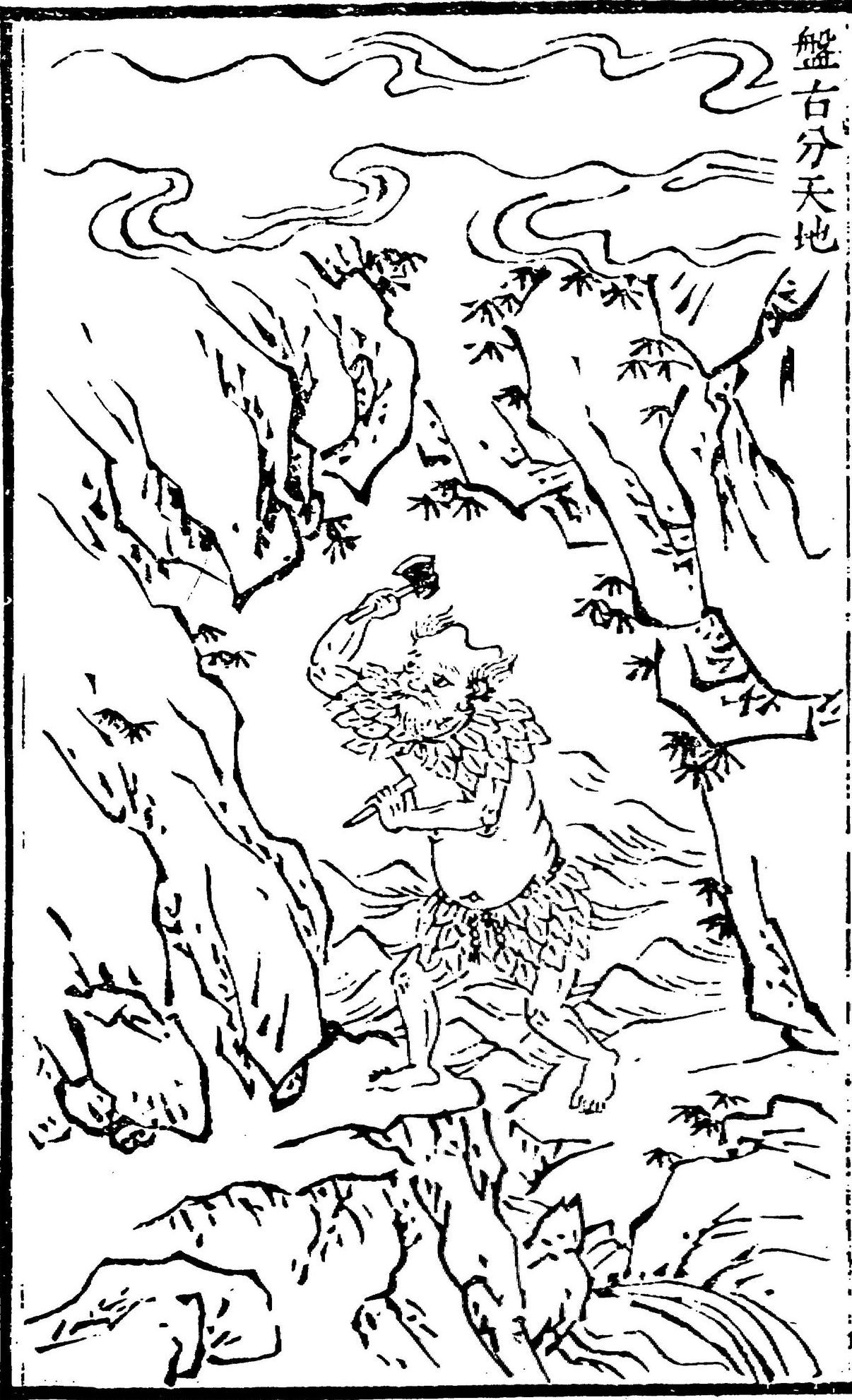
The Pangu most people can picture, the squat and hairy giant with horns who swings an axe to split the chaos, often with a tortoise and a crane and a dragon and a phoenix arranged around him, is not in any of these early texts. That imagery is Ming and Qing woodblock work, printed well over a thousand years after Xu Zheng wrote. The gap is worth stating as bluntly as the textual one: any picture of Pangu is late by something like thirteen centuries relative to the words it claims to illustrate, and the third-century fragment describes no axe, no horns and no companion beasts at all.
The question of where the figure came from is just as unsettled, and here the honest thing is to flag every answer as modern guesswork rather than ancient testimony. Wei Juxian read Pangu as a native inheritance from older Chinese lore about the separation of Heaven and Earth. Derk Bodde and, later, Qin Naichang looked south, tying the figure to the ancestral mythology of the Miao, Yao and Zhuang peoples, with Qin deriving the very name from a Zhuang tale of whetstone and gourd.
Paul Carus, at the other extreme, set Pangu’s world-body beside the Norse Ymir and the Babylonian Tiamat, and modern indexers add the Vedic Purusa, the cosmic man cut apart to make the world. These are the readings of scholars reaching back across a millennium and more, and the comparisons may well illuminate something. None of them is a claim the Chinese sources make. What those sources give us, and all they give us, is a being who came first, who became the world, and whom a southern people buried and worshipped as their own.
Lord Pangu is the ancestor of Heaven, Earth and the myriad things; thus the birth of living beings began with Pangu. (Ren Fang, Shuyiji, juan shang; author’s rendering from the Chinese)
- Xu Zheng (徐整), Sanwu Liji (三五曆紀), 3rd c. CE, preserved verbatim in Yiwen Leiju (藝文類聚) juan 1 (comp. Ouyang Xun, 624 CE)Pangu positioned between categories,
divine in relation to Heaven, sagely in relation to Earth
(神於天,聖於地), and prior to the whole human and royal order, since only afterward were there the Three Sovereigns (後乃有三皇). Chinese read verbatim; the fragment is headed 徐整《三五曆紀》曰. Used here for what Pangu is (the being between god and sage, first in time), not for the separation sequence, which belongs to the sibling cosmology piece. - [Xu Zheng], Wuyun Linian Ji (五運曆年紀), 3rd c. CE, surviving only in later anthology quotationnames Pangu
the first-born
(首生盤古) and identifies his dying body with the substance of the world (垂死化身). Chinese read verbatim. Attribution note: thefirst-born + body-becomes-world
catalogue is conventionally credited to this work, not to the Sanwu Liji; a widely-copied Wikisource page titled 三五曆記 splices both Xu Zheng fragments under one heading, which is an editorial merge, not evidence of shared authorship. - Ren Fang (任昉), Shuyiji (述異記), Liang dynasty (early 6th c.), juan shangthe richest source for Pangu as a figure, and roughly 250 years later than Xu Zheng. Ren Fang’s own note that Pangu is
the ancestor of Heaven, Earth and the myriad things, and thus the birth of living beings began with Pangu
(盤古氏,天地萬物之祖也,然則生物始於盤古); the Southern-Sea Kingdom of Pangu and Pangu-as-surname (南海中盤古國,今人皆以盤古為姓); the tomb300-odd li across
where later people buried his soul (南海有盤古氏墓,亘三百餘里…俗云後人追葬盤古之魂也); the living temple at Guilin (桂林有盤古氏廟,今人祝祀); and the Wu-Chu regional saying that Pangu and his wife were the beginning of yin and yang (吳楚間説:盤古氏夫妻,陰陽之始也). Chinese read verbatim (Siku Quanshu edition, juan shang). - Yiwen Leiju (藝文類聚), comp. Ouyang Xun, 624 CE, juan 1 (天部)the Tang anthology, roughly 350 years after Xu Zheng, that transmits the Sanwu Liji fragment actually read for this piece. Chinese read verbatim.
- Taiping Yulan (太平御覽, 983 CE), juan 2 (天部)the Song imperial encyclopedia, roughly 700 years after Xu Zheng, that also re-quotes the Xu Zheng Pangu fragments; the conventional second witness. Cited as a cross-reference, not read word-for-word for this piece, since the load-bearing facts come from the Yiwen Leiju text that was read.
- Modern scholarship (cited as interpretation, not primary text)Paul Carus (1907), for the reading of the name and the comparative equation of Pangu’s world-body with the Norse Ymir and the Babylonian Tiamat; Derk Bodde,
Myths of Ancient China
(1961), and Anne Birrell, Chinese Mythology (1993), for the Wuyun Linian Ji attribution and the hypothesis tying the cult to the southern Miao, Yao and Zhuang peoples; Wei Juxian (衛聚賢), for a transmitted indigenous origin; Qin Naichang (覃乃昌), for a Zhuang whetstone-and-gourd etymology; and the modern comparative link to the Vedic Puruṣa (Ṛgveda 10.90). None of these is a claim the ancient Chinese sources make.