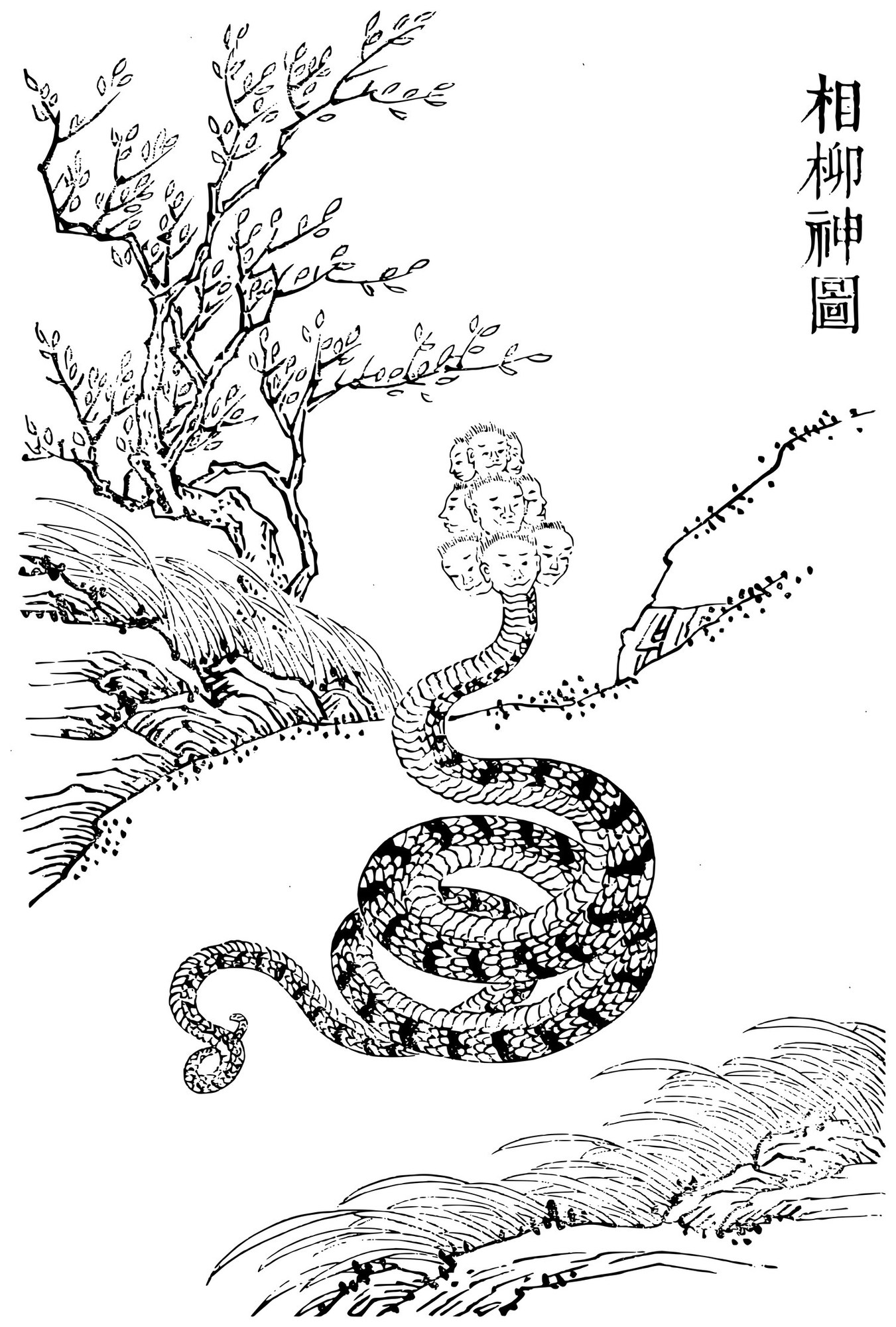
Picture nine heads on a single serpent, each mouth bent to a different mountain, feeding all at once. The body beneath them is the dense blue-green of deep water, coiled back on itself in a ring. This is Xiangliu, minister to the rebel water-god GonggongThe destructive rebel water-god of early Chinese myth; in these passages he is named only as Xiangliu's lord, and the poisoned terrace is called Gonggong's Terrace., and he is one of those creatures the ancient record shows only in glimpses. Everything the classical sources say of him fits into two short passages of a single book, the Shanhaijing, the Classic of Mountains and Seas. Yet those two passages do not quite agree, and the gap between them is itself part of the story.
Nine mouths on nine mountains
The earlier notice sits in the chapter called Beyond the Seas: North, a stratum most scholars place in the Warring States period, somewhere in the fourth or third century BCE. It introduces him with his rank first: Gonggong’s minister, named Xiangliu. Nine heads, it says, feeding on nine mountains. The image is a strange arithmetic of appetite, nine separate summits grazed at one time by one animal, as though a single hunger had been multiplied until it could empty a whole range.
This same passage is the only one that gives him a face, or rather nine of them. Xiangliu, it records, has nine heads with human faces, a serpent’s body, and is blue-green in colour. The word for that colour, qing, sits across the boundary our own languages draw between blue and green, so the creature is neither simply one nor the other but the shifting, water-dark shade the classical eye did not trouble to split. A serpent’s coil, a human face repeated nine times over: the monstrousness is not in any single part but in the multiplication.
Where he passes, the land rots
What makes Xiangliu a menace is not fang or venom but the ruin he leaves behind him. Where he strikes or reaches, the northern chapter says, the ground becomes marsh and gully. He is a walking corruption of the land itself, turning solid earth to sodden waste wherever his body touches it.
The later of the two passages, from the chapter called the Great Wilderness: North, sharpens the picture and shifts it. This stratum is generally held to be younger, added across the late Warring States and into the Han, so that as much as two to four centuries may separate it from the first notice. It even gives the creature a different name, Xiangyao rather than Xiangliu, though the tradition reads the two graphs as versions of one name for one being.
Here he is not said to strike but to breathe and to settle: wherever he belched out and wherever he came to rest, the ground turned to spring-marsh, and the water there was bitter and undrinkable, so that the hundred beasts could not live in it. The two chapters describe the same power from two angles, the first through where he goes, the second through what comes out of him.
The two witnesses do not match
It is worth stopping on that distance, because the Shanhaijing is not one voice but a library bound as a single book, and its layers were laid down over centuries. The nine-mountains reading and the nine-lands reading are not two moods of one author. They are two witnesses to the same creature separated by perhaps two to four hundred years, and where they diverge, the divergence is a fact in its own right.
The first calls his food nine mountains; the second calls it nine lands. The first gives him human faces; the second says only nine heads and a serpent’s body. The first calls him Xiangliu; the second, Xiangyao. Only the later text adds that his body coils back upon itself in a ring. A careful reader holds both, rather than flattening them into one tidy portrait that neither passage actually offers.
Where they agree, they agree on the essentials. Both make him the minister of Gonggong. Both give him nine heads and a serpent’s body. And both agree on how he dies, and on the horror that follows.
The blood that poisons the ground
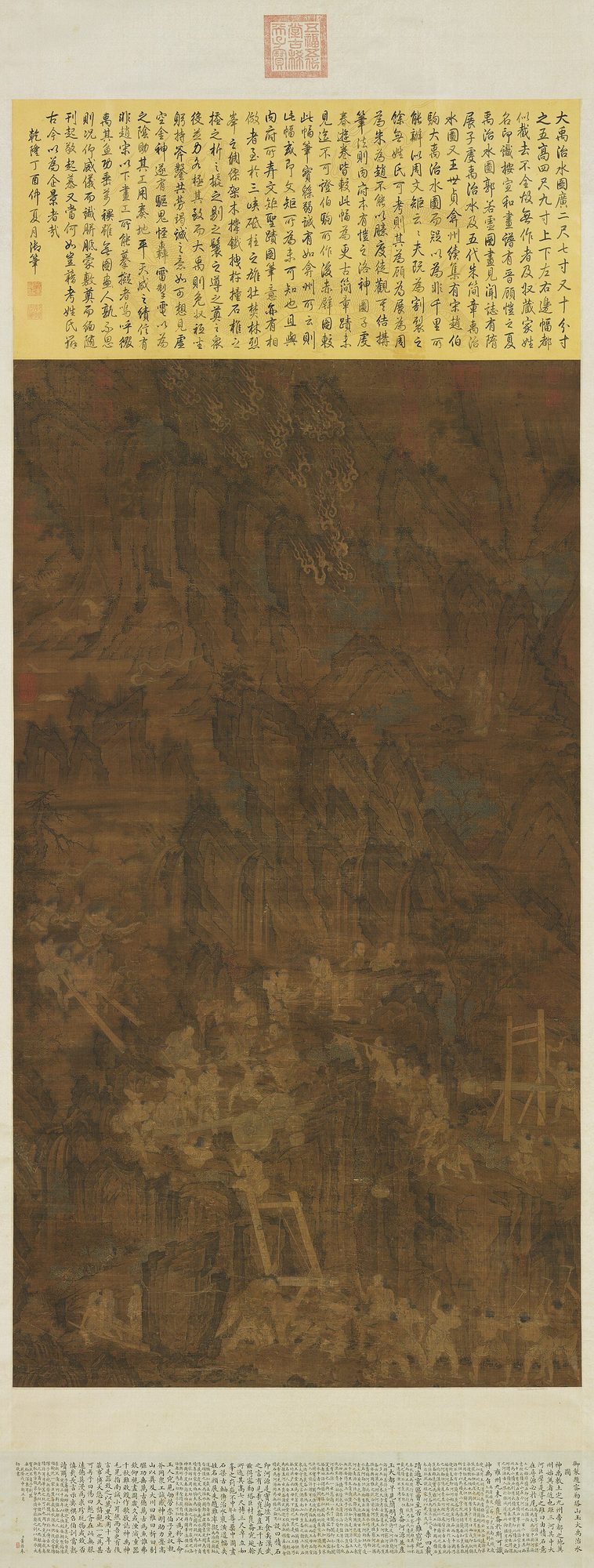
Yu the Great, the culture-hero who tamed the primal flood, is the one who kills him. The earlier chapter states it flatly, in three characters: Yu slew Xiangliu. The later chapter folds the killing into the great work of flood-taming, so that Yu, in damming the floodwaters, slew Xiangyao. In the older stratum the death stands alone; in the younger, the monster has been drawn into the orbit of the deluge itself, one more thing the flood-queller had to master.
Where Xiangliu struck, the land turned to marsh and gully. His blood was rank, so foul that the five grains could not be sown in that ground; and when Yu dug the spot out, three times it heaped up and three times it sank away. (Shanhaijing, Beyond the Seas: North; author’s rendering from the Chinese)
The death is not the end of the danger. It is the beginning of a slower one. Both passages dwell on the blood: rank in the first, rank and stinking in the second, and in either case a poison. Where it soaked in, the five grains would not grow. The land became waterlogged, unfit to live on. Yu, unable to farm ground his enemy’s corpse had ruined, tried to reclaim it by force, and the earth itself refused.
Three times he built the site up and three times it subsided, a spot so spoiled it would not even hold its own shape. In the end he stopped fighting it. He turned the ruined place over to the gods, raising it into a terrace for the assembled DiThe divine sovereigns or thearchs of high antiquity; the assembled Di are the gods for whom the ruined, poisoned ground is finally raised into a terrace., and in the later account making a pool of it as well, north of the great mountain KunlunThe great mythic mountain of the far north-west in early Chinese cosmography, axis of the world and seat of gods; the poisoned terrace over Xiangliu is set to its north.. A taboo settled over the ground: none dared shoot an arrow to the north, for fear of Gonggong’s Terrace, and at its corner coiled a tiger-marked snake, its head thrust always to the south.
What the text will not say
It is easy to let a nine-headed serpent grow in the retelling, and later ages have obliged. In the popular imagination Xiangliu breathes poison as a living weapon, regrows his heads when they are struck off in the manner of the Greek hydra, fights Yu through a long duel. None of that is in these two passages. The poison is tied strictly to two things, the ground he feeds on and touches, and the blood he sheds in death, not to any venom exhaled in life beyond that single detail of the belch that sours a marsh.
There is no severed head that grows back; the only thing in the source that will not stay put is the ground, caving in three times under Yu’s hands. And there is no epic battle. Each passage kills him in a single clause and moves on to the harder problem, which was never the monster but the land he left behind. That is the whole of him in the oldest record: nine hungry heads, a blue-green coil, and a death that poisoned the earth so deeply the gods themselves had to be handed the ruin.
- **Shanhaijing (山海經), Haiwai Beijing (海外北經, Classic of Regions Beyond the SeasNorth), Warring States stratum, c. 4th–3rd c. BCE:** the 相柳氏 (Xiangliushi) passage: Gonggong’s minister with nine heads feeding on nine mountains (「九首,以食于九山」); human-faced, serpent-bodied, blue-green (「九首人面,蛇身而青」); where he strikes the land becomes marsh and gully (「相柳之所抵,厥為澤谿」); slain by Yu (「禹殺相柳」); his rank blood so foul the five grains cannot be planted (「其血腥,不可以樹五穀種」); the ground caving in thrice (「三仞三沮」); the Terrace of the Many Di (「眾帝之臺」) raised north of Kunlun, with the arrow-taboo and the tiger-marked corner snake (「不敢北射,畏共工之臺」;「隅有一蛇,虎色,首衝南方」). Chinese read verbatim; English is the author’s literal gloss.
- **Shanhaijing (山海經), Da Huang Beijing (大荒北經, Classic of the Great WildernessNorth), later stratum, c. 3rd c. BCE–1st c. CE:** the 相繇 (Xiangyao) passage, a variant name for the same creature: Gonggong’s minister with nine heads and a serpent’s body, self-coiling, feeding on the nine lands (「共工臣名曰相繇,九首蛇身,自環,食于九土」); where he spewed and settled became spring-marsh, the water bitter and undrinkable, no beast able to abide (「其所歍所尼,即為源澤,不辛乃苦,百獸莫能處」); slain by Yu amid the damming of the flood (「禹湮洪水,殺相繇」); his rank, stinking blood, the waterlogged, uninhabitable land (「其血腥臭,不可生榖;其地多水,不可居也」); the ruined site made a pool and then a terrace by the assembled thearchs, north of Kunlun (「乃以為池,羣帝因是以為臺。在崑崙之北」). Chinese read verbatim; English is the author’s literal gloss.