
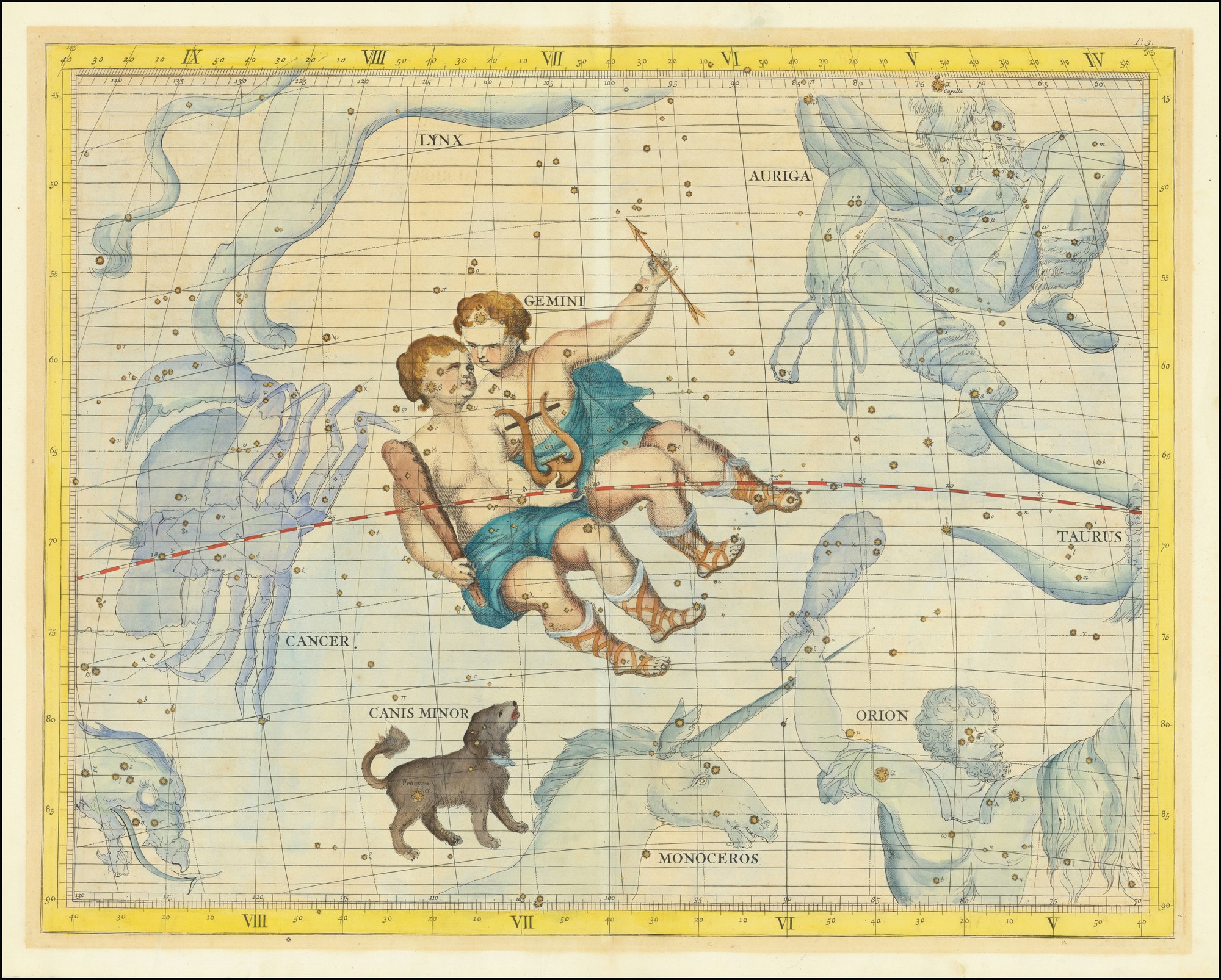
Gemini is the close pair of bright heads, Castor and Pollux, with Alhena marking the foot below, standing high in the south after dark in February. They rise side by side in the winter east, so alike that every tradition that watched them saw a pair. The four traditions on this page each gave the pair a different name.
Four traditions named them, and no two agreed what the pair was.
How four traditions read these stars
Greek — the Mortal and the Deathless
Greek. Castor the mortal horseman and Pollux the deathless boxer, sons of Leda, who split death between them so neither lives wholly without the other. castor-pollux-dioscuri
Mesopotamian — the Great Twins
Mesopotamian. Not twin heroes but the Great Twins (MAŠ.TAB.BA.GAL.GALThe Mesopotamian name of these stars, meaning Great Twins, borne by Lugalirra and Meslamtaea (MUL.APIN I i 5).), the twin gods Lugalirra and Meslamtaea. MUL.APIN I i 5; Hunger & Steele 2019
Chinese — the Northern River
Chinese. The Northern River (BeiheThe Chinese Northern River over these stars, with Castor as its second star and Pollux as its third.), with Castor its second star and Pollux its third, a garrison guarding the crossing of the Milky Way and the ecliptic. Beihe asterism (Sun & Kistemaker; Pankenier)
Hindu — the Station of Return
Hindu. The lunar station (PunarvasuThe lunar station received at these stars in the living tradition, whose deity is Aditi.) at these stars, whose deity is Aditi, set down here as the living tradition receives it. Punarvasu (nakshatra list)
Figure and story retellings link here as they publish.
Sources
- MUL.APIN I i 5 (Hunger & Steele 2019)
- castor-pollux-dioscuri (greek/story; the shared-immortality telling lives there)
- Beihe asterism (Sun & Kistemaker; Pankenier)
- Punarvasu (nakshatra list; living tradition)
Sky — when and where to look
Sky — when and where to look
Key stars. Castor and Pollux, the twin heads, with Alhena at the foot
Visibility. Northern winter and spring evenings, high in the south after dark in February
Traditions on this page (4)
Traditions on this page (4)
- Greek
- Mesopotamian
- Chinese
- Hindu
Full narratives live in the linked retellings below — this hub keeps the comparison on the page and never retells them.
- MUL.APIN I i 5 (Hunger & Steele 2019)
- castor-pollux-dioscuri (greek/story; the shared-immortality telling lives there)
- Beihe asterism (Sun & Kistemaker; Pankenier)
- Punarvasu (nakshatra list; living tradition)