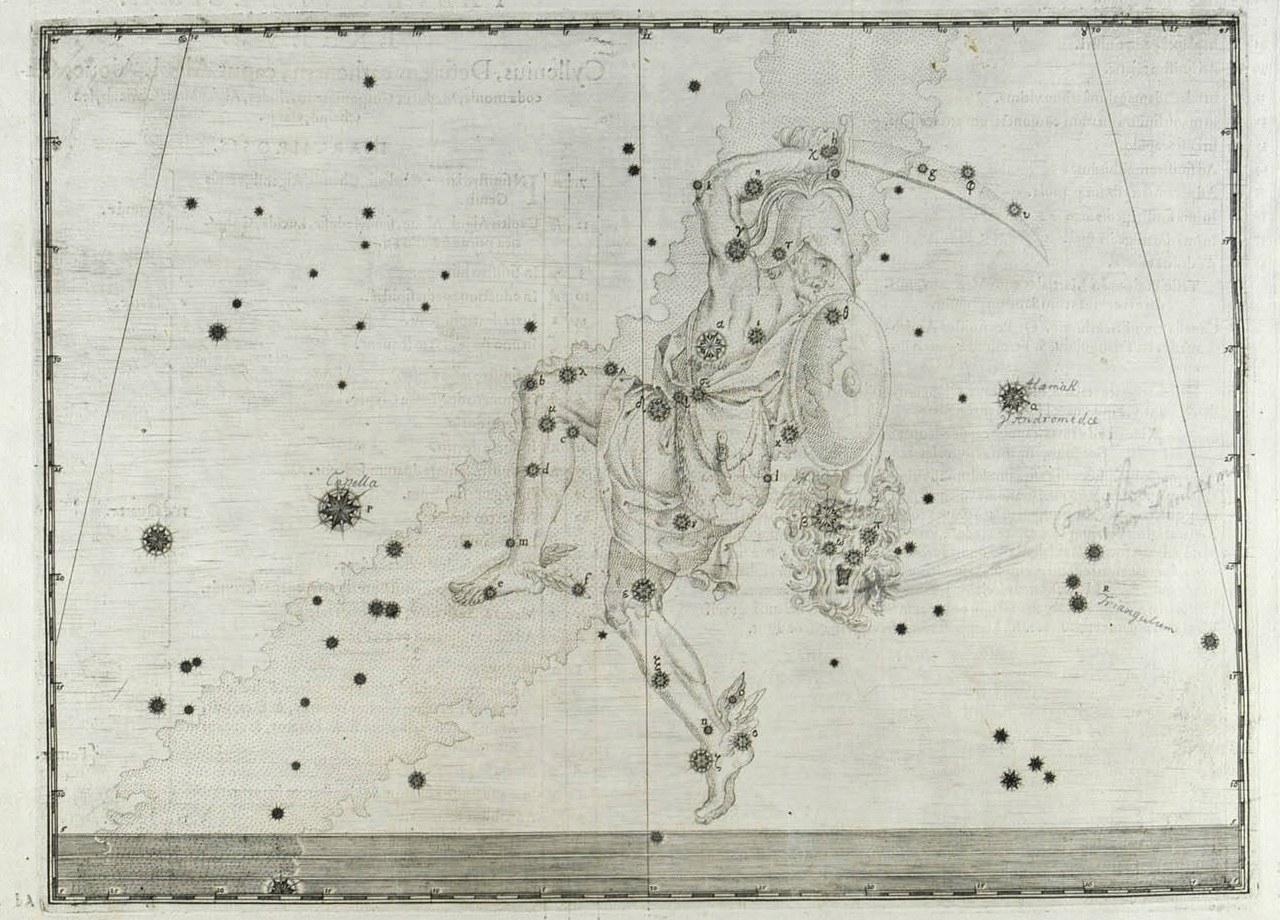
Perseus is the sword-bearer pattern set by Mirfak with Algol winking in the severed Gorgon head, the Double Cluster close by. It rides high overhead on northern autumn evenings near Cassiopeia. The four traditions on this page each gave it a different name.
Perseus holds the autumn sky with sword drawn and the Gorgon’s severed head aloft, and the four traditions that mapped these stars never agreed whose hero he was.
How four traditions read these stars
Greek — the Gorgon-Slayer
Greek. The hero who took the Gorgon head with Athena guiding his hand, then held it aloft to stop the sea-beast and free Andromeda. ApollodorusThe unidentified compiler of the Library, a systematic prose summary of the myths written too late to be the work of the Athenian scholar whose name it carries, and so commonly cited as Pseudo-Apollodorus., Library; Ovid, Metamorphoses 4
Mesopotamian — the Old Man
Mesopotamian. Not a hero but the Old Man (SHU.GIThe Mesopotamian Old Man read at these stars, an elder figure and not a hero (MUL.APIN).): an elder standing where the Greek hero strides. MUL.APIN; Hunger & Steele 2019
Chinese — the Celestial Boat
Chinese. The Celestial Boat (TianchuanThe Chinese Celestial Boat, an asterism of the Stomach mansion spanning these stars (Tianguan shu tradition).), whose stars ferry the sky river, with the Mausoleum (DalingThe Chinese Mausoleum asterism, whose stars include the winking Algol (Tianguan shu tradition).) holding Algol, the winking star. Tianguan shu tradition
Roman — the Rescue in the Sky
Roman. Hyginus set the whole rescue in the sky: hero with sword and Gorgon head, chained girl and sea-beast alongside. Hyginus, Astronomica 2
Perseus, Slayer of Medusa carries the full Greek telling, and Cetus, the Sea Monster of Andromeda carries the rescue; further comparison links land as those posts publish.
Sources
- Apollodorus, Library (myth narrative)
- Ovid, Metamorphoses 4 (rescue narrative)
- Hyginus, Astronomica 2 (Roman star lore)
- MUL.APIN (Hunger & Steele 2019)
- Tianguan shu tradition (Tianchuan and Daling asterisms)
Sky — when and where to look
Sky — when and where to look
Key stars. Mirfak, Algol winking in the Gorgon head, the Double Cluster close by
Visibility. Northern autumn evenings, riding high overhead near Cassiopeia
Traditions on this page (4)
Traditions on this page (4)
- Greek
- Mesopotamian
- Chinese
- Roman
Full narratives live in the linked retellings below — this hub keeps the comparison on the page and never retells them.
- Apollodorus, Library (myth narrative)
- Ovid, Metamorphoses 4 (rescue narrative)
- Hyginus, Astronomica 2 (Roman star lore)
- MUL.APIN (Hunger & Steele 2019)
- Tianguan shu tradition (Tianchuan and Daling asterisms)