
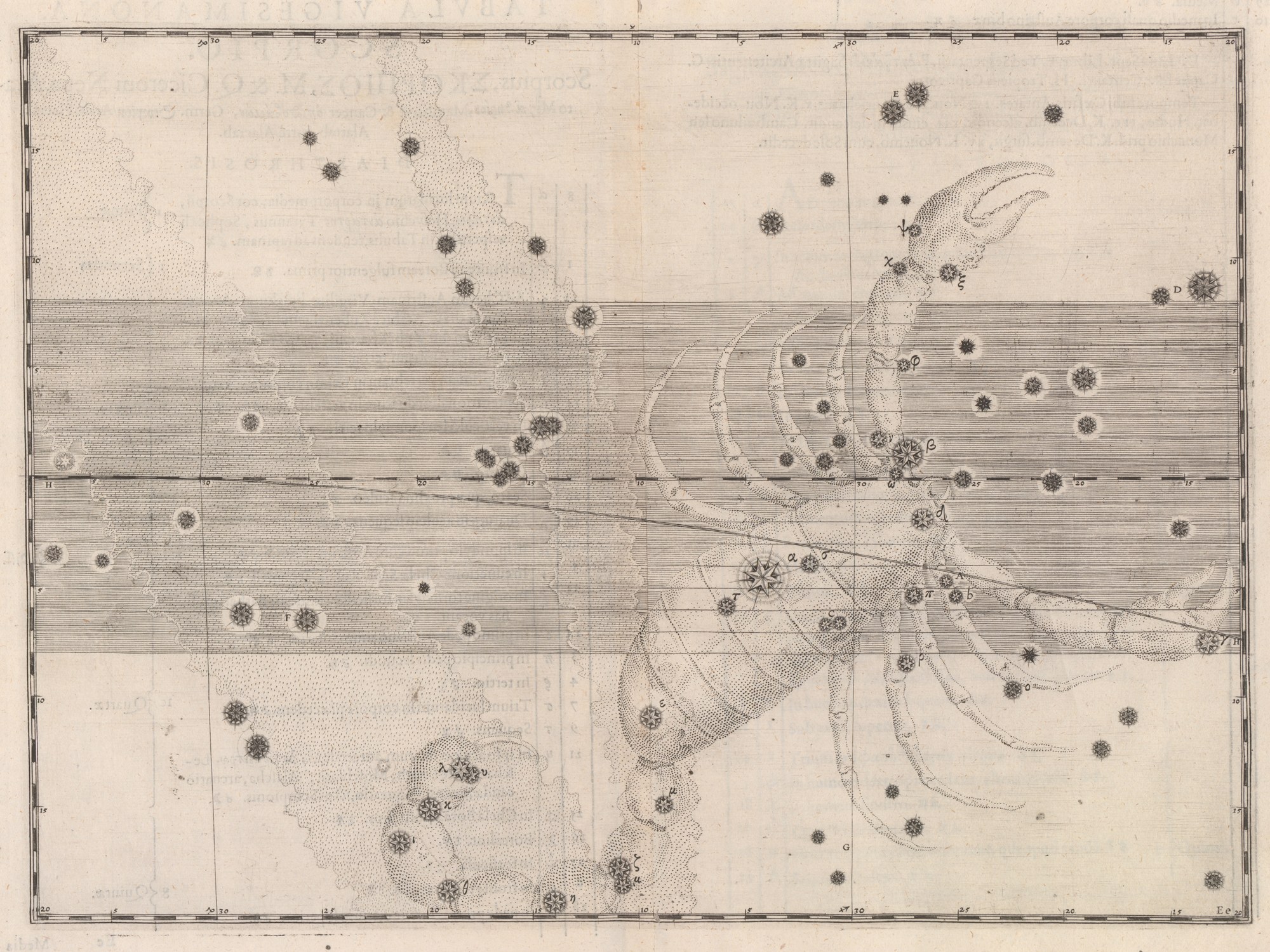
Scorpius is the scorpion pattern set by AntaresThe red heart star of the pattern, Greek for rival of Ares, whose summer risings marked the season turn., the red heart star, with paired claws stretching west and a hooked tail curling to its sting in the east. It climbs low across southern summer evenings, setting as Orion rises. The five traditions on this page each gave it a different name.
The scorpion climbs low across southern summer skies, a hooked tail tipped with a sting and a red star for a heart. Five traditions met these stars, and no two agreed what a scorpion in the sky should mean.
How five traditions read these stars
Greek — the Hunter’s Killer
Greek. The scorpion that stung Orion for his boast against the wild earth, set opposite him so that Scorpius rising drives Orion below the sea; its red heart is Antares, the rival of Ares. Hyginus, Astronomica (Scorpius chapter); ApollodorusThe unidentified compiler of the Library, a systematic prose summary of the myths written too late to be the work of the Athenian scholar whose name it carries, and so commonly cited as Pseudo-Apollodorus., Library 1.4.3–1.4.5
Mesopotamian — the Scorpion
Mesopotamian. Not a killer but the Scorpion (GIR.TABThe Mesopotamian Scorpion of MUL.APIN, these stars read as a scorpion and kept distinct from the scorpion-men of the sun gate.) of MUL.APIN: these same stars read as a scorpion, with no hunter and no moral attached. MUL.APIN; Hunger & Steele 2019
Egyptian — the Seven Guardians
Egyptian. No star match is asserted here: Serqet the scorpion goddess and the seven scorpions guarding Isis are protection lore, never tied to this pattern in the received record. Metternich Stela
Chinese — the Heart Mansions
Chinese. The Heart mansion (XinThe Heart mansion of the Azure Dragon at these stars, with Fang and Wei, a determinative station for tracking the Moon.) with Fang and Wei, three mansions of the Azure Dragon whose determinative stars serve as stations for tracking the Moon; Antares at the Heart is the Great Fire whose risings marked the season turn. Tianguan shu
Hindu — Anuradha, Jyeshtha, and Mula
Hindu. Anuradha, Jyeshtha, and Mula: lunar stations received at these stars in the living tradition, set down here without adjudication. Nakshatra list
Orion the Hunter and the Scorpion carries the full Greek telling, and Girtablullu, the Scorpion-Man with Isis and the Seven Scorpions carry the neighbouring lore; further comparison links land as those posts publish.
Sources
- MUL.APIN (Hunger & Steele 2019, GIR.TAB the Scorpion)
- Hyginus, Astronomica (Scorpius chapter) with Apollodorus, Library 1.4.3–1.4.5 (the sting of Orion)
- Tianguan shu (Xin, Fang, and Wei determinatives, Sun & Kistemaker)
- Nakshatra list (Anuradha, Jyeshtha, and Mula, living tradition)
- Metternich Stela (the seven scorpions of Isis, via isis-and-the-seven-scorpions, no Serqet star equation asserted)
Sky — when and where to look
Sky — when and where to look
Key stars. Antares the red heart, paired claws to the west, hooked tail sting to the east
Visibility. Summer evenings in the northern hemisphere, low in the south, setting as Orion rises
Traditions on this page (5)
Traditions on this page (5)
- Greek
- Mesopotamian
- Egyptian
- Chinese
- Hindu
Full narratives live in the linked retellings below — this hub keeps the comparison on the page and never retells them.
- MUL.APIN (Hunger & Steele 2019, GIR.TAB the Scorpion)
- Hyginus, Astronomica (Scorpius chapter) with Apollodorus, Library 1.4.3–1.4.5 (the sting of Orion)
- Tianguan shu (Xin, Fang, and Wei determinatives, Sun & Kistemaker)
- Nakshatra list (Anuradha, Jyeshtha, and Mula, living tradition)
- Metternich Stela (the seven scorpions of Isis, via isis-and-the-seven-scorpions, no Serqet star equation asserted)