He had crossed the whole ocean for this, and now he made himself small. Hanuman climbed into a single golden Shingshapa tree that stood on a raised dais in a walled pleasure-garden, drew the leaves and blossoms around himself, and looked out over the grove of ashoka trees the demon king kept inside his fortress. It was early spring. Sala and champaka and mango stood in flower; pools held golden lotuses and silver waterlilies, their steps crusted with pearl and coral; cuckoos called and peacocks strutted and bees worked the blossoms. When the great monkey had come leaping through the branches his weight shook down a shower of many-coloured flowers, and the creatures of the garden thought for a moment that the god of spring himself had arrived. None of them saw the spy folded into the leaves, waiting.
A flame wreathed in smoke
Then he saw her, and knew her before he was told. Near a temple as white as a mountain of snow, held up on a thousand pillars, sat a woman in a soiled robe of yellow silk, stripped of every ornament, emaciated by fasting, heaving frequent sighs.
She was, the watcher thought, immaculate as the moon’s disc in its first quarter, and like a flame wreathed in smoke, and like a lotus pool from which every flower had been torn. He had never met her, but Rama had described the ornaments she wore the day she was taken, and by those Hanuman reasoned his way to certainty. This starved and sorrowing captive was Sita, princess of Mithila, wife of the exiled prince he served.
She did not sit alone. A ring of monstrous keepers hemmed her in, the female rakshasiA female rakshasa, one of the flesh-eating shape-shifting demons Shastri renders as 'titans'; a grotesque ring of them is set to guard Sita. guards Ravana had set to watch her. They were a menagerie of nightmares: some with a single eye or a single ear, some with noses set in their foreheads, faces of tigers and camels and goats and jackals, snouts like bears, feet like elephants, hair the colour of soot and smoke. They gorged continually on wine and meat, their bodies spattered with blood, and they ringed the woman at their centre so that she could not stir without a keeper’s eye upon her.
The jewel hidden in her robe
When at last he made himself known, quietly, praising Rama until she dared believe him, she would not let him carry her out on his back. It had to be Rama who came. Instead she gave him two things to take home as proof he had truly stood before her.
The first was a memory only she and her husband held: how a crow had once pecked her at Chitrakuta, and Rama had turned a blade of grass into the weapon of Brahma to punish it, so that the bird gave up its right eye. The crow, she said, was a son of Indra. The second was a jewel, the cudamaniThe crest-jewel Sita once wore on her forehead, which she sends to Rama as proof his envoy truly found her. she had once worn shining on her forehead and had kept hidden in her robe, and she pressed it on him for Raghava. Then she sent her count: one month to live, and no more.
The tail is a monkey’s pride
Hanuman did not slip away when he had what he came for. To take the measure of Lanka’s strength he wrecked the beautiful grove and stood to fight, and the titans came against him in waves. Ravana’s son Aksha rode out on a golden chariot drawn by eight horses, and Hanuman killed him. Then the king sent his greatest son, Indrajita, who found the monkey could not be slain and bound him instead with the brahmastraThe infallible weapon of the god Brahma, whose bond Hanuman honours by letting himself be bound rather than break free at once., the infallible shaft of Brahma.
Honouring the god’s own weapon, Hanuman let himself be taken, wanting in any case to be carried before Ravana. The titans, not trusting the spell, lashed him further with ropes of hemp and bark, and by doing so they quietly cancelled Brahma’s binding, which cannot hold a captive twice; Hanuman gave no sign that he was now free, and let himself be dragged into the ten-headed king’s court and named himself Rama’s messenger.
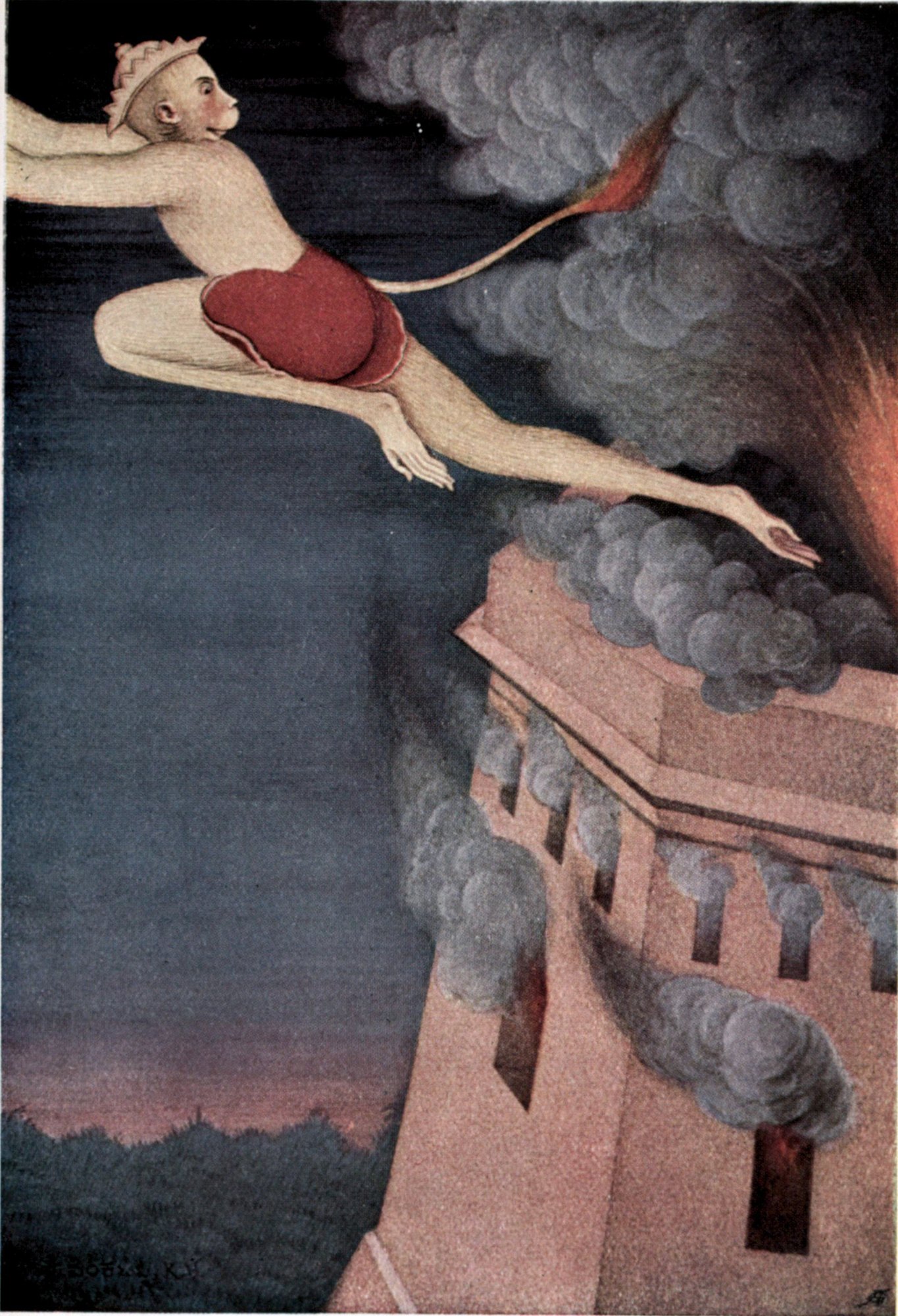
Ravana wanted him dead. It was his brother Vibhishana who stopped it, arguing that the law forbids the killing of an envoy, whatever the message. So the king reached for a humiliation instead of an execution. Since among monkeys, he reasoned, the tail is unquestionably the creature’s most cherished ornament, let Hanuman’s tail be set on fire, and let him be led bound through every street so that his own kind would see him shamed. It was meant to be a slow public degradation. It handed a torch to a giant who had already slipped his bonds.
As if snow had fallen on it
The titans wound his tail in cotton rags, soaked the cloths in oil, and lit them. Wrapped in flame, Hanuman swelled larger, like a forest fire fed on dry wood, and they marched him out to the blare of conches and trumpets, and he let them, because a prisoner paraded by daylight sees the whole of a city’s defences. But the fire did not do its work. Far off in the grove, Sita heard what was being done and prayed to AgniThe fire-god, whom Sita entreats to turn cool so that the flame on Hanuman's tail will not burn him. by the truth of her own devotion: if she had been faithful to her lord, let the fire-god prove cool to this monkey and not burn him.
And Hanuman’s own father, Vayu the wind, breathed ice-cold across the flaming tail. The monkey marvelled that so great a blaze gave him no pain, as if snow had fallen upon it, and he understood he was being kept from harm by three things at once: Sita’s virtue, Rama’s power, and his father’s love. Then he snapped the ropes, shrank small to slip his bonds and swelled again to the size of a mountain, tore an iron bar from the city gate and killed the guards, and stood with the burning plume of his tail spread about him like the rays around the sun.
A million suns on the rooftops
Now the mockery became a weapon. With his tail for a brand, Hanuman went leaping from roof to roof and fired the mansions of the warlords one by one, calling their owners by name, Prahasta and Maha-parshva, Shuka and Sarana and the rest, then Indrajita’s house, and Sumali’s, and last the treasury and Ravana’s own palace, a thing of every gem heaped up like Mount Meru. Fanned by the wind that was his father, the fire ran everywhere. Palaces of gold and jewel toppled, and molten metal streamed from them, silver run together with diamond and coral and emerald and pearl. Titan women fled shrieking through the streets with babies at their breasts; some, caught in the flames with their hair loose and burning, fell from the high balconies like flashes of lightning.
The demons cried out that this was no monkey at all but Agni come in person, or Death, or the wrath of Brahma, or the power of Vishnu wearing a monkey’s shape. Valmiki reaches for his largest images to hold it: as Rudra once burned the demon-city of Tripura, so this creature burned Lanka; the blaze had the fury of a million suns, and a sound like the cracking of the cosmic egg. When it was done, Hanuman sat a moment on the highest roof he had left standing, ringed in his own light like the sun in a nimbus, and then he went down to the water and quenched his flaming tail in the sea, while gods and sages watched in astonishment and sang his praise.
This is no monkey, but Agni, the God of Fire; it is Death himself, come to consume us; it is the wrath of Brahma, or the might of Vishnu in the form of a monkey. (Ramayana, Sundara Kanda 54, tr. Shastri)
- Valmiki, Ramayana, Sundara Kanda (Book V), sarga 14 (Hari Prasad Shastri, The Ramayana of Valmiki, Shanti Sadan, London, 1952–59; read verbatim at wisdomlib.org)Hanuman ranges the abducted queen’s prison-garden, the Ashoka Grove, in early spring, shaking down
a shower of multi-coloured blooms
so the creatures take him forthe God of Spring,
and hides ina single golden Shingshapa tree surrounded by a golden dais,
watching unseen. - Valmiki, Ramayana, Sundara Kanda, sarga 15 (Shastri; read verbatim)the first sight of Sita by the thousand-pillared temple
as white as Mount Kailasha,
ina soiled robe of yellow silk, divested of every ornament,
emaciated through fasting,
immaculate as the moon’s disc in its first quarter
andlike a flame wreathed in smoke,
recognised by the ornaments Rama had described. - Valmiki, Ramayana, Sundara Kanda, sarga 17 (Shastri; read verbatim)the grotesque ring of guarding rakshasis, one-eyed and animal-snouted,
feasting continually
on wine and meat withtheir bodies spattered with blood.
- Valmiki, Ramayana, Sundara Kanda, sarga 38 (Shastri; read verbatim)the two proof-tokens for Rama. The first is the private crow episode at Chitrakuta, where a blade of kusha grass becomes
Brahma’s shaft
and the crowson of Indra
loses its right eye; the second is the crest-jewel (cudamani)which formerly adorned her forehead,
carried concealed in her sari. Sita’s message is that she hasbut one month to live.
- Valmiki, Ramayana, Sundara Kanda, sargas 47–48 (Shastri; read verbatim)the slaying of Aksha on his eight-horse chariot; Indrajita’s capture of Hanuman with the Brahma-weapon; the titans’ hemp-and-bark ropes that
void
the weapon (whichmay not be loosed twice
); and Hanuman dragged before Ravana as a self-declared envoy. - Valmiki, Ramayana, Sundara Kanda, sarga 53 (Shastri; read verbatim)Vibhishana’s plea against killing an envoy; Ravana’s judgement that
in the case of monkeys, the tail is unquestionably the most cherished embellishment,
and his order to burn it and parade the captive; the tail wrapped in oil-soaked cotton; Sita’s prayer to Agni and Vayu’sice-cold breath,
so the fire feelsas if the snow had fallen upon it
; and the escape with the iron bar, the tailresembling an aureole.
- Valmiki, Ramayana, Sundara Kanda, sarga 54 (Shastri; read verbatim)Hanuman firing the named mansions and Ravana’s palace (
resembling Mount Meru or Mandara
); the molten metalmixed with diamonds, coral, emeralds, pearls and silver
; the titan-women fleeingwith babies at their breasts
and falling burninglike flashes of lightning
; the similes of Rudra consuming Tripura,a million suns,
and the cleaving ofthe mundane Egg
; and the quenching of the tail in the sea before the amazed gods and sages. - Valmiki, Ramayana, Sundara Kanda, sargas 18–37, 39–46, 49–52 (Shastri)the connecting narrative summarised here, namely Ravana courting Sita and her refusal, Hanuman revealing himself and then wrecking the grove and fighting the titan waves, and the audience with Ravana at which Rama’s warning is delivered. Not read word-for-word for this piece.
- Variant traditions. The crest-jewel is the cudamani, a hair or forehead jewel, and it travels from Sita to Rama; it is not a ring. Rama’s engraved signet ring is the reverse token, given to Hanuman earlier (Sundara Kanda 36) to show Sita, and popular retellings sometimes swap the two. Valmiki has the whole city burnthe notion that Hanuman deliberately spared the Ashoka Grove or Vibhishana’s house is a later vernacular elaboration, and in the very next sarga (55, not narrated here) Hanuman is seized by the fear that Sita too may have burned. The crow of the recognition-sign is named Kakasura or Jayanta in later tradition; this passage says only that it was a son of Indra. Shastri’s diction is a 20th-century English rendering of an ancient text roughly two thousand years older than the translation:
titans
stands for rakshasa,God of Fire
for Agni,the Wind-god
for Vayu.