Sixty thousand princes went into the earth and did not come out. They had been digging for a horse. Their father, King Sagara of Ayodhya, had set a stallion loose for the great horse-sacrifice that would crown him among kings, and the animal had vanished from beside the empty seabed, and Sagara sent all sixty thousand of his sons to find it. They were an army in themselves, and they dug the way an army marches, delving straight down through the crust of the world for sixty thousand leagues, tearing the ground open on every side, slaughtering whatever crawled or reared up in their path until the very gods went in fear of them.
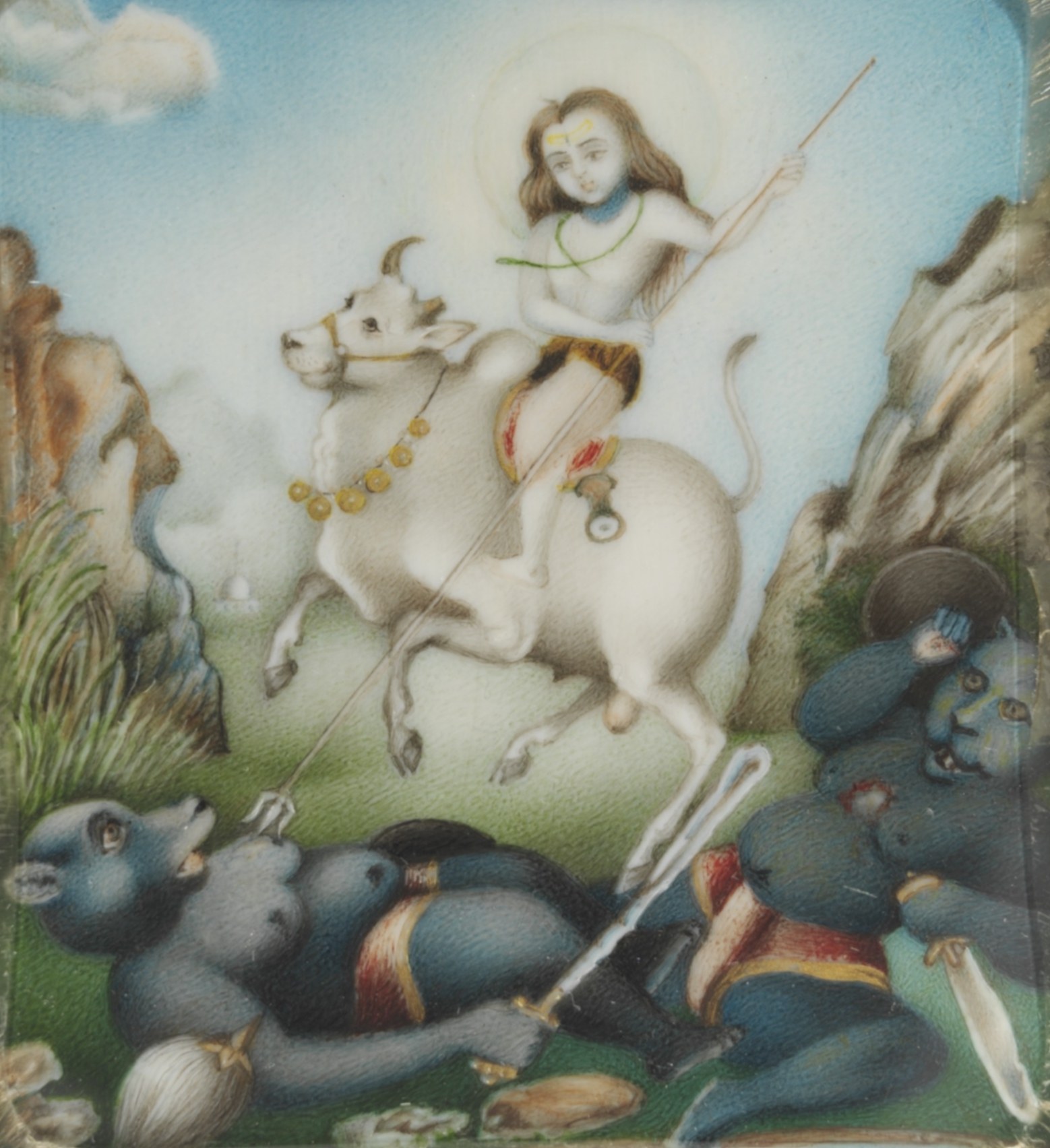
Down in the north-eastern deep they came at last on the horse, cropping grass beside a seated sage sunk in meditation. Certain they had found the thief, they rushed him with a roar. The sage was Kapila, and in him lived the eternal Vishnu. He lifted his eyes. What came out of them was fire, and in a single breath the sixty thousand were sixty thousand heaps of ash.
An heirloom nobody could lift
So the labour was never really about a river wanting to come down. It was about the dead. Ash cannot climb to heaven on its own, and the sons of Sagara lay unfreed at the bottom of the world, their rites unperformed, their road up barred. When Sagara’s grandson Aṃśumat went down to fetch the horse and finish the interrupted sacrifice, he honoured Kapila and was told the one thing that could redeem the sixty thousand: the celestial Ganges, the great river that ran through heaven, must be brought down to wash their ashes. Only her waters could carry them upward. That was the debt handed down through the family like an heirloom nobody could lift.
What two lifetimes could not do
Aṃśumat could not bring her down. His son Dilīpa could not bring her down. Two lifetimes of longing and effort spent themselves against the sky and failed, and the ash lay where it lay. Then Dilīpa’s son was born, and his name was Bhagīratha, and he gave up everything to finish it.
He walked away from his kingdom. He went up onto the mountains and stood in the posture of a man asking the universe for the impossible: arms raised, ringed by five fires under the vertical sun, eating once a month, and he held that for a thousand years. It was the kind of austerity that bends the order of things, and at the end of it the creator Brahmā came to him and granted the descent of Gaṅgā.
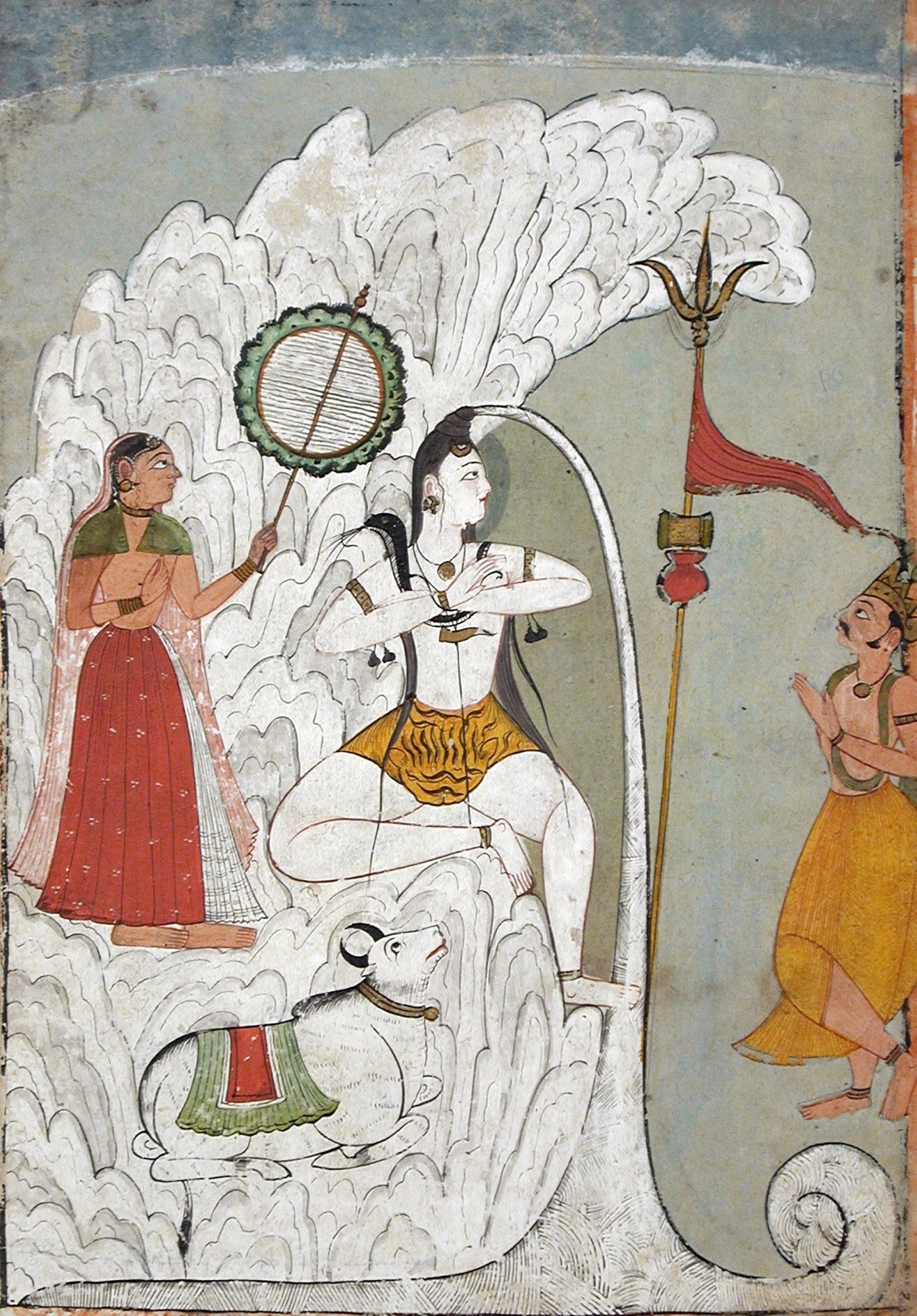
But the boon carried a warning inside it, the way Kapila’s answer had. The earth, Brahmā said, could not take the shock of her landing. She fell from heaven; nothing below could stand under that weight of water crashing out of the sky. One power alone could catch her and break the force of the fall, and that was Śiva, the great god, the wielder of the trident, who might let her strike his head and live.
So the labour was not finished; it had only found its next stage. Bhagīratha set himself to a fresh penance, this time to move Śiva, and Śiva, propitiated, agreed to stand under the sky and take the river on his head. Then Gaṅgā came down.
Fish and tortoises tumbling through the air
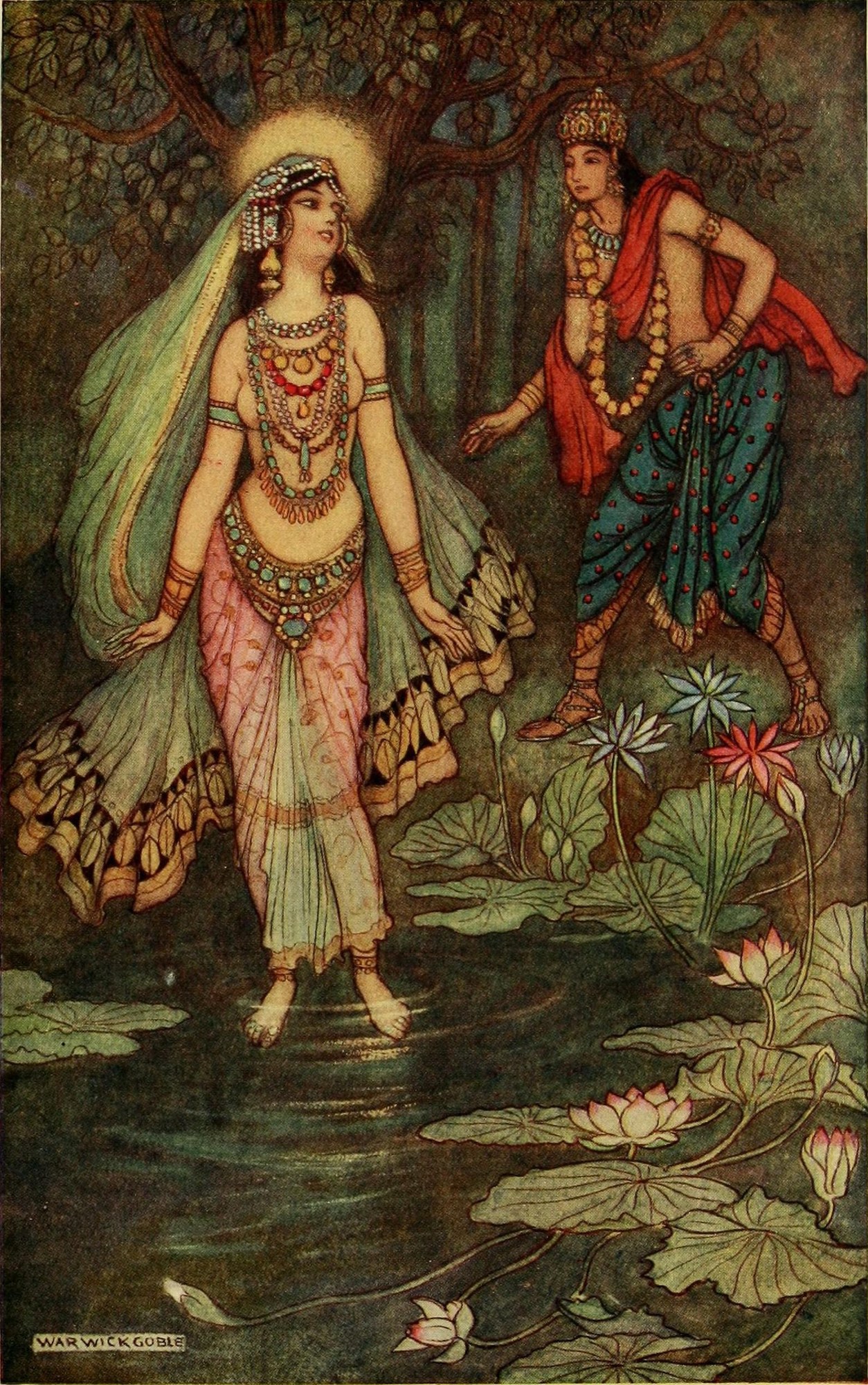
She came down as spectacle. The heavens emptied their onlookers to watch it: gods and sages, the celestial musicians and the tree-spirits, riding elephants and chariots and hanging in the bright air, and the sky itself shone as though a hundred suns had risen at once.
The water fell in a single vast column, and the whole living cargo of the river fell with it — fish and tortoises and porpoises tumbling and flashing through the air, torn loose from their heaven-river and dropping toward the world. Foam broke off the cataract in flakes like autumn clouds crowded with cranes. The Ganges ran as she fell, now straight and rushing, now swerving wide, water clashing against water, and struck the head of the waiting god.
Turned and turned in that dark maze
Here the two great tellings part. In the Mahābhārata it is simple and merciful: Śiva plants himself under the torrent and sustains it, and she comes through him gentled and separates into three streams and flows on, foam wrapped about her like a robe, going forward, the poem says, the way a woman walks when she is drunk. But in the Rāmāyaṇa the river had come down proud. She had meant to smash through Śiva and sweep the god himself away into the netherworld beneath her, and Śiva, reading her arrogance, answered it.
He shut her inside the labyrinth of his matted hair. And there the whole triumphant flood simply stopped. Gaṅgā, who had fallen to save sixty thousand souls, wandered lost in the coils of the god’s tangled locks, turned and turned in that dark maze and could not find the ground, for many a year, until Bhagīratha, who had given a thousand years already, gave still more penance to soften the god a second time. Only then did Śiva loose her, letting her spill free toward the earth, where she broke apart into seven running streams.
A river drunk in one draught
Even then she was not done making trouble. Loosed at last and following Bhagīratha’s chariot across the land, she poured across the sacrificial ground of the sage Jahnu and swept his offerings away, and the sage in his fury drank the entire river down in a draught. She had vanished a second time, now inside a man.
The gods and Bhagīratha pleaded, and Jahnu relented and let her out again through his ears, and for that second birth she carries a second name, Jāhnavī, the daughter of Jahnu. On she went behind the chariot, down at last to the sea, and down again below it into the deep places of the world where the ash was waiting. Her waters found the sixty thousand and washed them, and the sons of Sagara rose up out of their long ruin and went to heaven.
That is why the river bears the name of the man who would not stop. Brahmā decreed that Gaṅgā should be reckoned Bhagīratha’s own eldest daughter, and she is called after him Bhāgīrathī to this day, and Tripathagā, the one who flows through three worlds, having run through heaven and hair and earth to reach the dead. What began as a father’s ambition for a splendid sacrifice ended, five generations later, as a single man’s thousand-year refusal to leave his ancestors in the dark.
As soon as she reached that best of mountains, she fell upon the surface of Sankara’s head… Wandering there for many a year, the goddess was unable to reach the earth. And she wandered round and round. (Rāmāyaṇa, Bāla Kāṇḍa 43, tr. Manmatha Nath Dutt)
- Vālmīki, Rāmāyaṇa, Bāla Kāṇḍa, chapters 38–44 (Manmatha Nath Dutt, trans., 1891; read at wisdomlib)the fullest epic version, told as a tale-within-a-tale by the sage Viśvāmitra to Rāma. Sagara’s childless austerity and the double boon; Asamañja and the sixty thousand born from a burst gourd and reared in jars of clarified butter; the stolen horse-sacrifice; the sons delving through the earth past the four world-guardian elephants until Kapila’s fiery glance reduces them to ash; Aṃśumat’s recovery of the horse and Kapila’s promise of deliverance by Gaṅgā; the failure of Aṃśumat and Dilīpa; Bhagīratha’s thousand-year, five-fire penance; Brahmā’s boon and the warning that only Śiva can bear her fall; Gaṅgā’s proud descent, Śiva’s wrath, and her years of wandering in his matted locks until further penance frees her toward Bindu lake; the seven streams; the flooding of Jahnu’s sacrifice and the name Jāhnavī; and the laving of the ashes so the sixty thousand ascend.
- Vyāsa, Mahābhārata, Vana Parva (Book 3), Tīrtha-yātrā Parva, Sections CVI–CIX (Kisari Mohan Ganguli, trans., for the P. C. Roy edition; read at archive.org, mahabharataofkri02roypuoft, Vol. 2)the parallel account, embedded in the pilgrimage narrative beside the tale of Agastya draining the ocean dry to expose the hidden asuras, which is why a river is needed to refill it. Here Śiva, not Bhṛgu, grants the boon of sons; a princess of the Śivi line replaces Sumati; the sons’ digging empties the seabed; Kapila (named
Kapila Vasudeva
) burns them; and at the climax Śiva willingly and calmly sustains the fall with no wrath and no imprisonment, Gaṅgā separating into three streams and going forwardlike a woman drunk,
covered with foam as with a robe.
- Variant traditions. The famous image of a proud Gaṅgā humbled and locked in Śiva’s jaṭā for years is the Rāmāyaṇa line (Bāla 43), later amplified in Purāṇic retellings; the Mahābhārata (Vana CIX) has no wrath and no entrapment. The Jahnu episode and the name Jāhnavī, the seven streams, and the four world-guardian elephants are Rāmāyaṇa-only details, absent from the Vana Parva account read here. The two epics also disagree on the boon-giver (Bhṛgu vs Śiva) and on which of Sagara’s wives bears the gourd of sixty thousand (the Rāmāyaṇa’s Sumati vs the Mahābhārata’s Vidarbha princess), assigning it to opposite wives; this retelling names no wife and does not merge the genealogies. Purāṇic versions (Bhāgavata, Devībhāgavata, Śiva Purāṇa) were not consulted and are not attributed to the two epics.