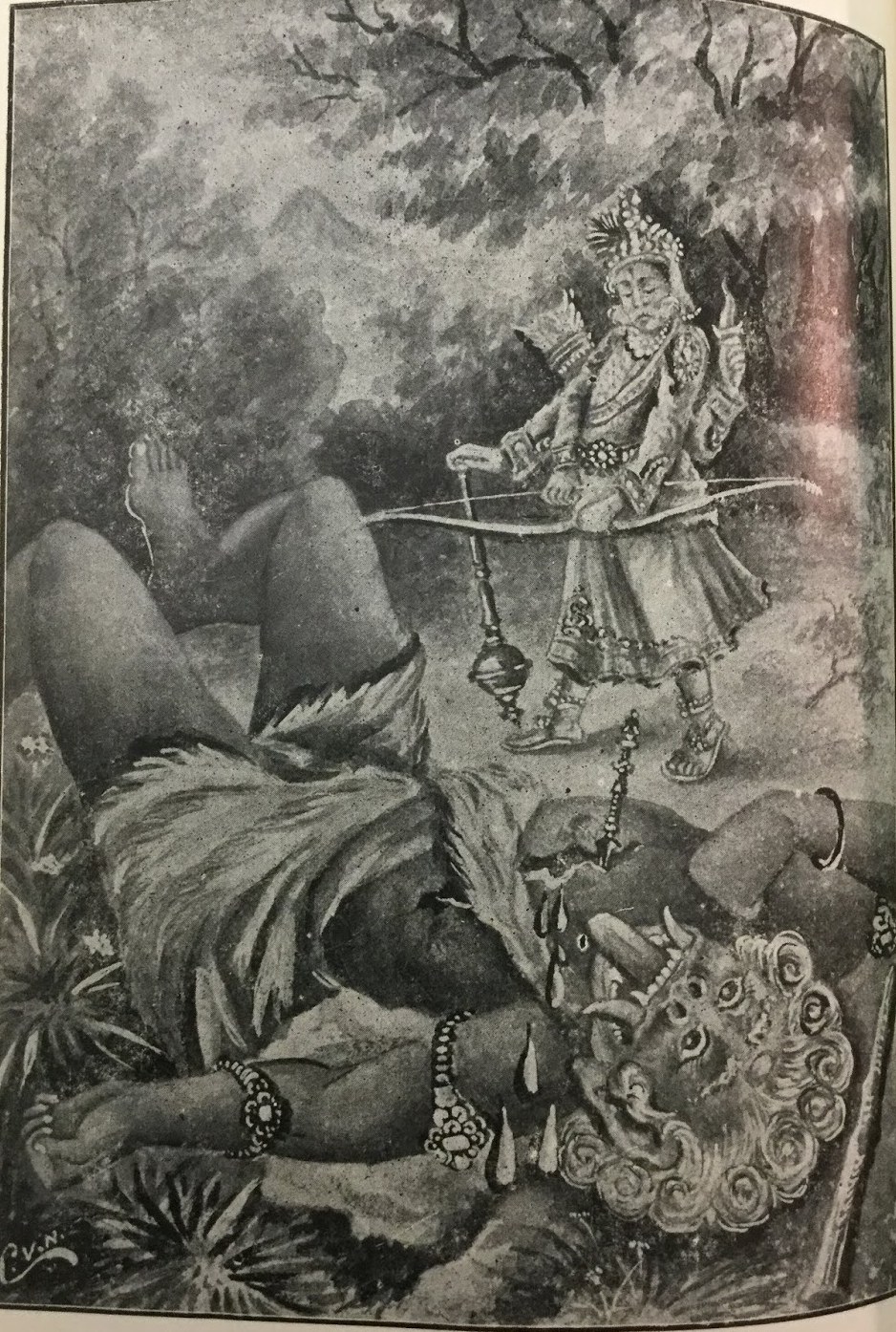
The waters would not run. Somewhere on the flank of a mountain a great serpent lay coiled over the springs of the world, and behind him the rivers stood dammed and the earth went thirsty. He was called Vritra, the Encloser, and shutting things up was his whole nature. He held the cosmic waters penned like cattle behind a robber’s gate, and while he held them nothing flowed and nothing grew. This is where the oldest hymns of his people begin the story, on a world gone dry under a serpent that would not let it drink.
Soma in three sacred beakers
Then a god drank. Impetuous as a bull, Indra chose the Soma and took the pressed juices in three sacred beakers, and the draught went to work in him. In the hymns the drinking always comes first and the killing follows. The mighty flowing Soma-draught, one singer declares, brought by the Hawk, has gladdened you, so that in your strength, O Thunderer, you have struck down Vritra from the floods. It was a falcon that fetched the sacred drink down out of heaven, and once it was in him the storm-king was ready for the one thing no other god could do.
He took up the weapon that had been forged for exactly this. The divine craftsman Tvashtar had turned it on his anvil: a bolt of thunder, iron, hundred-jointed, falling with a thousand points. It was a thing of terror in its own right, and the smith who made it would tremble at the wrath it served. With the bolt in his grasp Indra went up the mountain against the dragon, the storm-gods riding at his side. These were the Maruts, the host of the winds, and the hymn calls him Marut-girt as he came on to the kill. The whole pair of worlds shook in fear at what was about to happen.
A dragon with neither foot nor hand
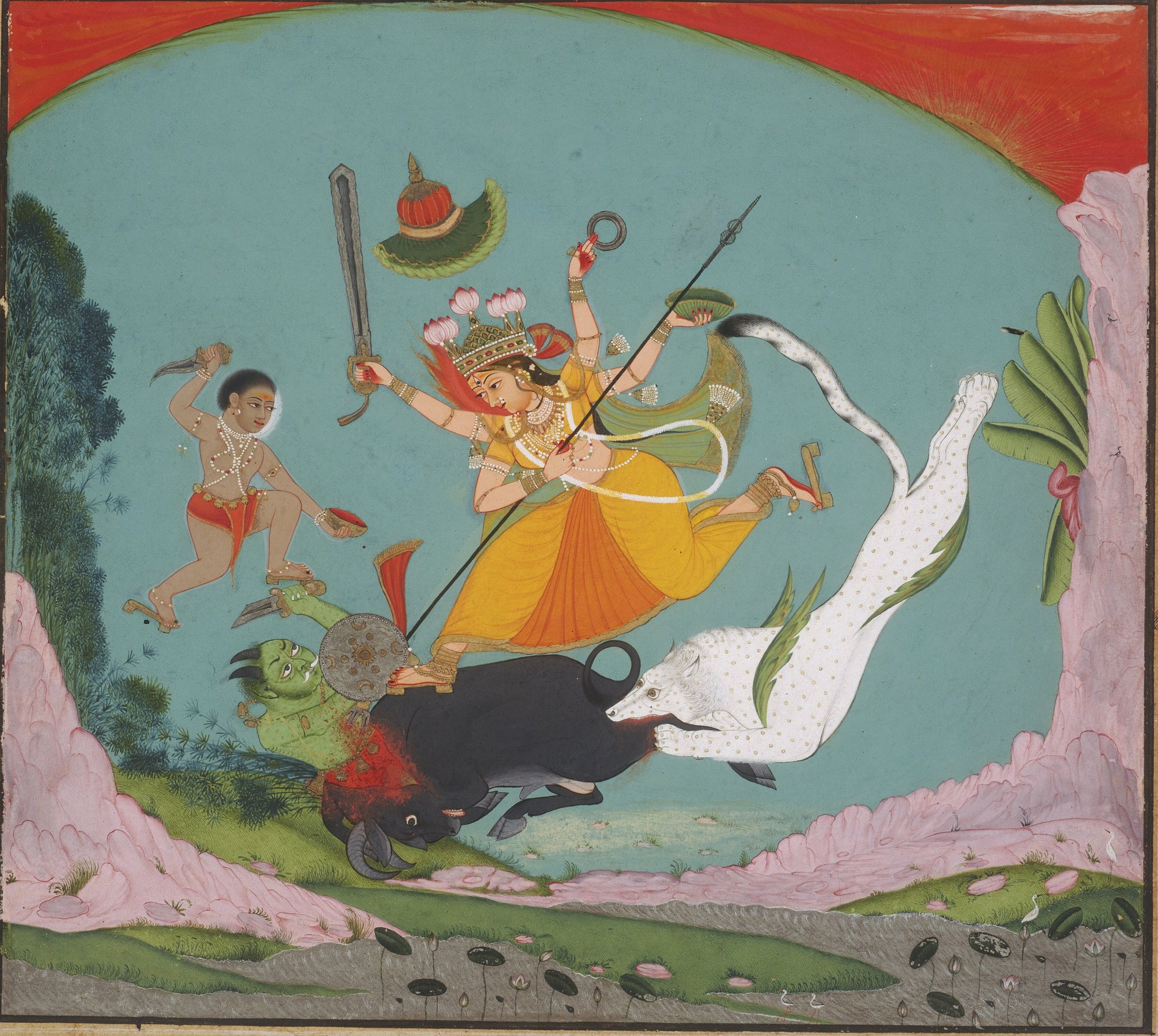
Vritra met him like a mad, weak warrior who had mistaken his strength. He could not bear the clashing of the weapons; his own shattered forts came down and crushed him where he stood. Then the bolt fell. Indra smote the serpent between the shoulders, and the dragon who had neither foot nor hand went down with his limbs scattered and dissevered, emasculate yet still claiming a hero’s vigour.
He fell as a tree falls: as trunks of trees, the poet says, what time the axe has felled them, low on the earth so lay the prostrate dragon. And that is the shape the whole story turns on. Indra is the one who breaks open what has been shut, and here he had broken open the thing that shut the waters.
Lowing like cattle loosed to pasture
The rivers answered at once. Taking courage, they rose and ran, and they closed over the body of the one who had penned them. Like a bank-bursting flood they flowed above him, lowing as they went like cattle loosed to pasture, streaming downward to the ocean. The dragon who had dammed the world lay drowned beneath the very waters he had withheld, and the hymn names the prize plainly: you have won back the kine, it sings to Indra, you have won the Soma, you have let loose to flow the Seven Rivers.
Nor was Vritra the only one to fall. Indra cast the deadly bolt at his mother as well. Her name was Danu, and when she was struck she was left lying over her dead son like a cow beside her calf, the mother above and the son beneath. The waters bore off the nameless body, and the foe of Indra sank down into the dark.
Fleeing across nine-and-ninety rivers
What follows the victory is one of the strangest turns in all the hymns, and the singers did not hide it. Having killed the dragon, Indra fled. A fear seized his heart the moment the deed was done, and like a hawk affrighted through the regions he crossed nine-and-ninety flowing rivers in his flight, as though some avenger were behind him. The old commentators explain that he ran believing he had committed some great sin in the killing.
The number should not be pressed too hard: nine-and-ninety, in this poetry, means simply a great many and not a tally, the same formulaic largeness as the ninety spacious floods the bolt was cast across. But the fear is real, a seam of dread running clean through the triumph, the slayer bolting in terror across the world he has just set free.
Against that flight stands the crown the deed wins him. By this one killing Indra becomes king, and the Rig Veda says so in its plainest terms. When Indra and the dragon strove in battle, the hymn declares, the Bountiful One gained the victory for ever; and Indra is King of all that moves and moves not, the Thunder-wielder, ruling over all living men as sovereign. This is the line that makes him lord of the gods, and the crown rests squarely on the dragon.
He is king not by inheritance but because he did the thing no one else could do, and the running rivers are his warrant. In another hymn altogether, at the very pitch of the battle, he even calls on a companion god to press forward with him: O my friend Vishnu, he cries, stride full boldly forward. It is a small line in the oldest text, and a large one later, when Vishnu’s three world-spanning strides would grow into a myth of their own.
A gloss laid over the poem
A word of caution belongs at the end, because this dragon-fight has been read and re-read for a very long time. To later scholars it looked like a weather report in disguise. On their reading Vritra is nothing but the massed vapour shut up in a cloud, and Indra with his thunderbolt divides the mass so the pent rain can fall, the whole hymn an allegory of the coming of the monsoon.
The imagery of dammed waters and bursting floods invites it. But that is a gloss laid over the poem, not the poem’s own voice, and the hymn itself gives us a dragon: footless and handless and firstborn, dying with his limbs strewn on a mountain while a god with a forged bolt and a belly full of Soma stands over him.
Killed at twilight with sea-foam
The centuries after the Veda would not leave the story so lean. Later epic and Puranic tellings rebuild it entirely, and they do not agree with the hymn or always with each other. In them Vritra is no longer the son of Danu but a creature made by Tvashtar to avenge a murdered son; the bolt is fashioned not on the smith’s anvil but from the bones of a sage who gives his body for it; the duel drags on for hundreds of days and ends by a loophole, a killing at twilight with sea-foam that is neither wet nor dry.
In one late and startling version the dragon is a devotee who welcomes the blow and ascends to heaven, the drought-demon of the Rig Veda turned inside out into a saint. These are real traditions, and they are worth their own telling, but they are not this one. The Rig Veda’s Vritra is a serpent who withheld the water, and the god who split him open loosed the seven rivers and was crowned for it.
When Indra and the Dragon strove in battle, Maghavan gained the victory for ever. Thou hast won back the kine, hast won the Soma; thou hast let loose to flow the Seven Rivers. (Rig Veda 1.32.13, 1.32.12, tr. Ralph T. H. Griffith, The Hymns of the Rigveda)
- Rig Veda 1.32 (Griffith trans., The Hymns of the Rigveda, Vol. I)the fullest single account of the slaying —
I will declare the manly deeds of Indra, the first that he achieved
; the dragon coiled on the mountain damming the waters;his heavenly bolt of thunder Tvashtar fashioned
; the Soma drunkin three sacred beakers
; Vritrafootless and handless
struckbetween the shoulders
and felledas trunks of trees
; the waters flowingabove him
asa bank-bursting river
; the mother Danu slain and leftlike a cow beside her calf
; the flightlike a hawk affrighted
acrossnine-and-ninety flowing rivers
; the Seven Rivers loosed; andIndra is King of all that moves and moves not.
Griffith’s notes identify Danu as Vritra’s mother (per Sayana), glossnine-and-ninety
asused indefinitely for a great number,
and preserve the tradition that Indra fledthinking that he had committed a great sin in killing Vritra.
- Rig Veda 1.80 (Griffith, same edition)the Soma-empowered slaying —
The mighty flowing Soma-draught, brought by the Hawk, hath gladdened thee, that in thy strength, O Thunderer, thou hast struck down Vrtra from the floods
; the hundred-jointed, thousand-pointed iron bolt; the Marut host attending the freed waters;far over ninety spacious floods thy thunderbolts were cast abroad
; and the war-shout at whiche’en Tvashtar trembled.
- Rig Veda 4.18 (Griffith, same edition)read here for context — the Falcon that
brought me the pleasant Soma,
and Indra’s call to his ally at the moment of battle,O my friend Vishnu, stride full boldly forward
(the Vedic seed of Vishnu’s three strides). The hymn’s obscure father-slaying anddog’s intestines
stanzas are genuinely disputed among translators (Griffith records Sayana, Roth and Ludwig disagreeing) and are not built into this retelling. - Interpretive note (Wilson and Sayana, preserved in Griffith’s footnotes to RV 1.32)the weather-allegory reading in which
Vritra… is nothing more than the accumulation of vapour… shut up in, or obstructed by, a cloud,
released as rain when Indra’s boltdivides the aggregated mass
— given here as later scholarship, not as the plain narrative of the hymn, whichthe Pauranik writers
laterconverted… into a literal contest.