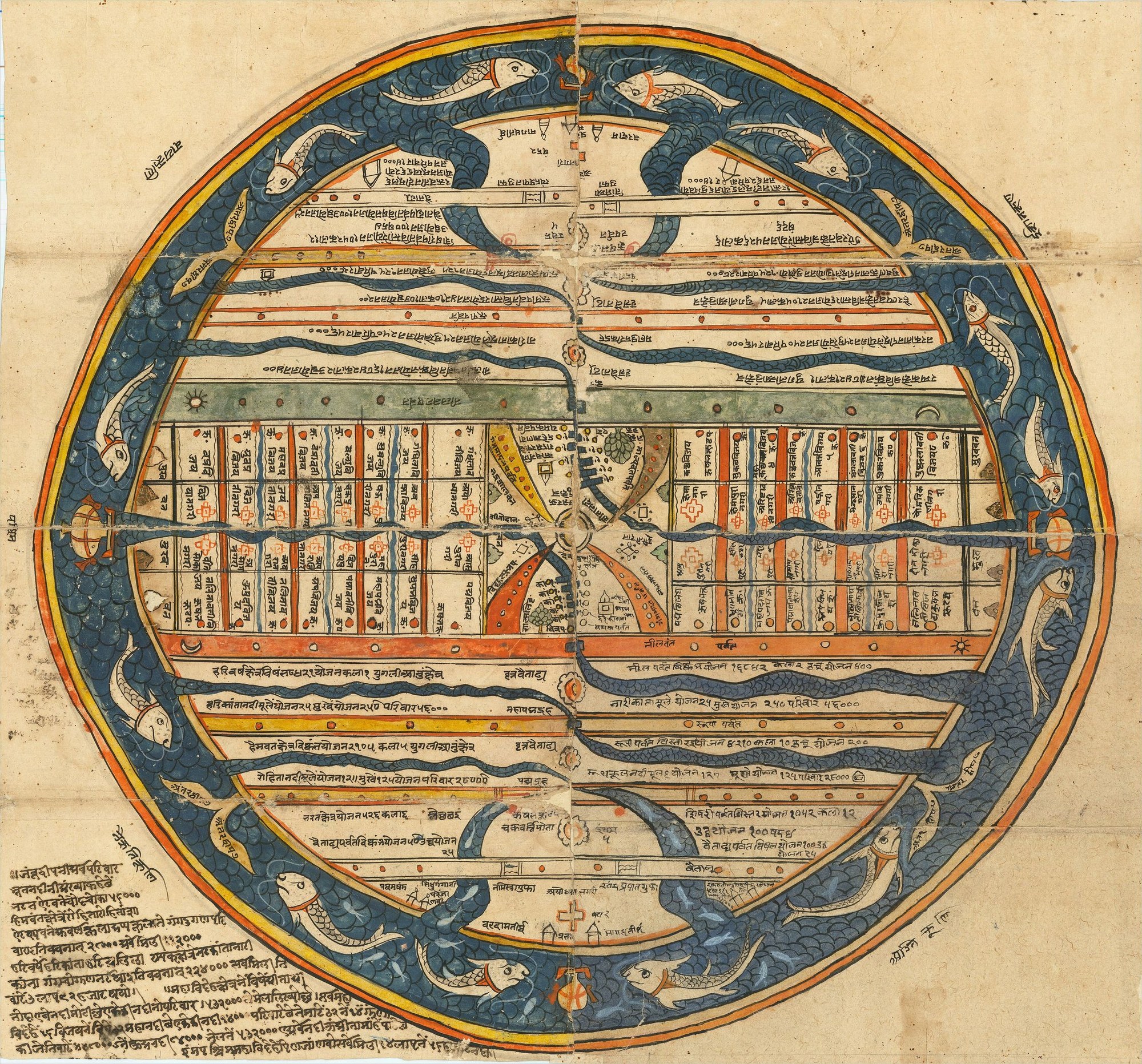
A king drives a chariot round and round the earth, and where his wheels bite in they leave two long ruts running clean around the world. The ruts fill. They do not fill with rainwater. One brims with salt, the next with the juice of crushed sugar-cane, the next with wine, then clarified butter, then curds, then milk. Between the ruts stand the ridges the wheels threw up, and each ridge is a continent, a ring of land wrapped around the land inside it. This is the earth of the Purāṇas seen from far enough above to take it in whole: not a globe and not a plain but a target, a set of nested rings of land and liquid, widening out from a single golden mountain at the dead centre to a wall of stone at the rim where the sunlight ends.
The king is PriyavrataThe primal king, eldest son of the first Manu, whose chariot circling the earth is said to have cut the ruts that became the seven seas., and the image of the chariot-ruts is the Bhāgavata Purāṇa’s own account of how the seas got their shape. It is worth pausing on how literal the whole picture is. The texts do not mean that the earth is like a set of rings. They mean the outermost ocean is made of sweet water, the one inside it of milk, the one inside that of curds, and so on inward, each a genuine sea of its own liquid, each holding a continent the way a moat holds the garden it encircles.
A ridge for every rut
The land comes in seven pieces, and they nest. At the centre sits Jambudvīpa, the rose-apple continent, a disc a hundred thousand yojanas across; around it runs the first sea; around that the second continent; around that the second sea, and so on, land and water alternating outward to the seventh ring of land and the seventh and last sea beyond it. A dvipa in this scheme is never a landmass with a coastline you could sail around. It is an annulus, a band of ground closed into a ring, its inner edge on one ocean and its outer edge on the next.
The seven, counted outward from the centre, are Jambu, Plakṣa, Śālmala, Kuśa, Krauñca, Śāka and Puṣkara. The Mārkaṇḍeya Purāṇa, the oldest of the witnesses gathered here, lays them out in exactly that order and then states the rule that governs the whole diagram: each dvīpa is twice the size of the one it encloses. The seas double too. So the figure is not merely concentric but geometric, every ring twice the last, the land and the water swelling by powers of two as they move away from MeruThe golden world-mountain at the exact centre of the earth-disc, around which all seven ring-continents and their seas are arranged. until the numbers pass any distance a body could imagine walking.
The oceans of ghee and wine
The strangest part of the design is what the seas are made of. The Mārkaṇḍeya Purāṇa gives the fullest and plainest list, and it is worth quoting for how matter-of-fact it is: the continents, it says, are surrounded by oceans of salt water, sugar-cane juice, wine, ghee, curdled milk, and milk, which increase double and double. Six named liquids for the six inner boundaries, and beyond the last continent a seventh sea of fresh, sweet water closing the whole. In Sanskrit they carry names as concrete as the substances: Lavaṇa the salt, Ikṣu the cane-juice, Surā the wine, Sarpi the ghee, Dadhi the curds, Dugdha the milk, and Jala the plain water at the edge.
It would be easy to flatten this into a single tidy roster and hang it on the Purāṇas
as though one voice had spoken it. The honest picture is messier, and the mess is instructive. The complete ordered list of six liquids rests, among the texts read here, on one verbatim witness: the Mārkaṇḍeya. The Bhāgavata, which elaborates the same scheme, names only some of the seas in the form its text has come down to us: the salt sea, the sea of milk out beyond Śāka, the sea of curds, and the outermost sweet water.
The verses that would have described the sugar-cane, wine and ghee seas in the Bhāgavata are simply missing from the transmitted text, which jumps from its third verse straight to its twenty-second. So the oceans of ghee and wine
of the design belong securely to the Mārkaṇḍeya and the standard schema; they cannot be pinned on the Bhāgavata’s surviving lines, and it is worth saying so rather than smoothing the gap over.
That the three Purāṇas broadly agree on this ringed, doubling, liquid-sea earth is real, but it is not three independent witnesses corroborating a fact. The Mārkaṇḍeya’s geography is generally placed in the third to sixth centuries of the common era; the Bhāgavata is later, usually the ninth or tenth. Between them lie four to six hundred years. Their agreement is the persistence of one inherited schema across roughly half a millennium, a single design copied and elaborated down the generations, not the meeting of far-apart observers who happened to see the same thing.
Trees, kings, and a fire with seven tongues
Each continent is far more than a bare ring. The Bhāgavata describes the outer dvīpas in rich detail, and the pattern repeats from ring to ring: every continent is named for a colossal tree standing at its heart, is ruled by one of King Priyavrata’s sons, and is divided by that son among seven sons of his own into seven sub-regions.
Plakṣa-dvīpa, the second ring, out beyond the salt sea, takes its name from a golden Plakṣa fig-tree as tall as the Jambu tree at the world’s centre, and at that tree’s foot dwells a fire-god with seven tongues. Its first king is Idhmajihva, a son of Priyavrata, who split the continent into seven lands and set a son over each. Far out at the sixth ring, Śāka-dvīpa lies past the ocean of milk and is named for a fragrant Śāka tree whose scent, the text says, perfumes the entire continent; its king is Medhātithi.
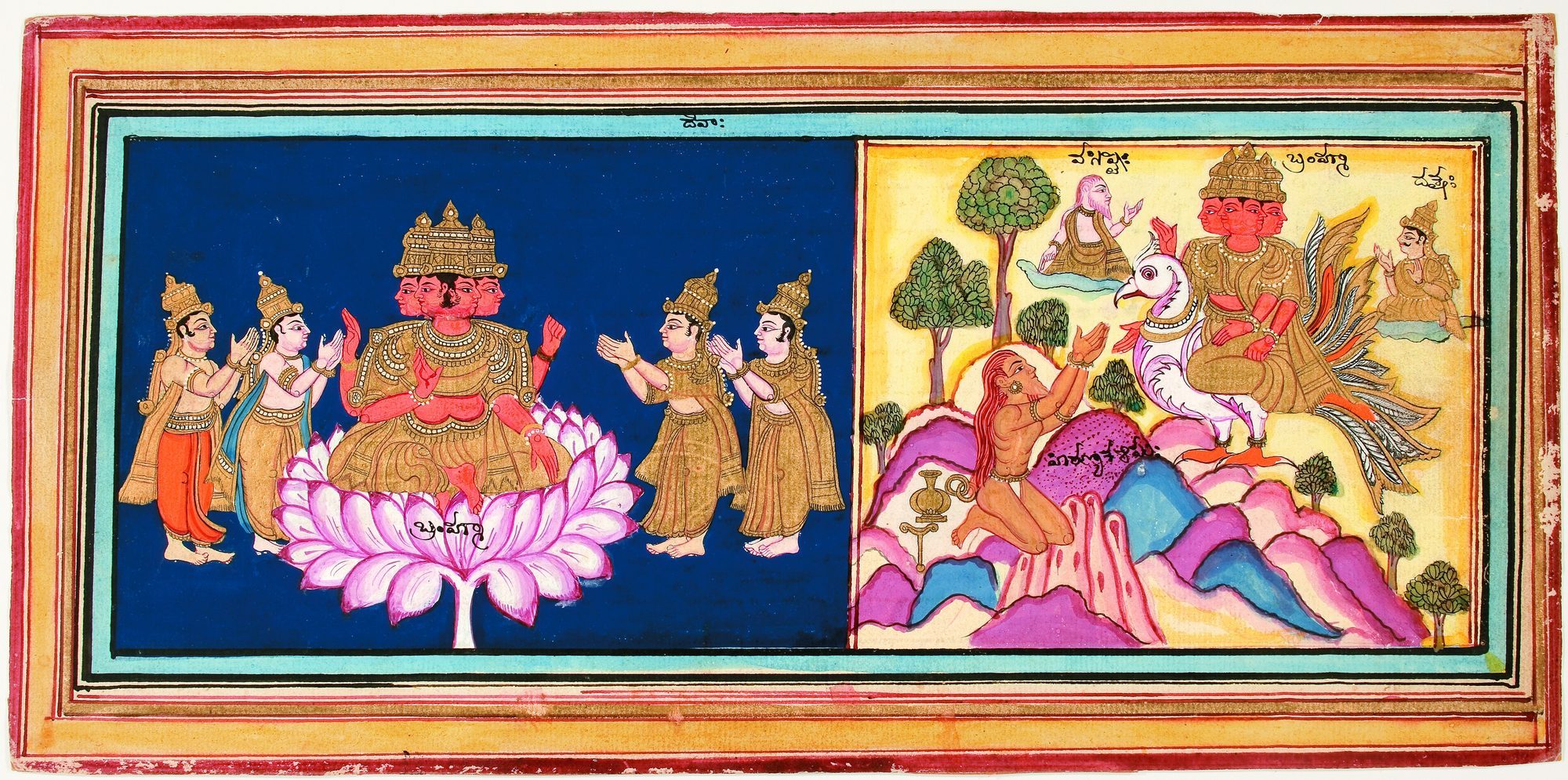
Then comes the seventh and last land, Puṣkara, beyond the sea of curds and inside the final sweet-water sea. At its centre grows a lotus of a hundred million golden petals, shining like fire, meant as the throne of Brahmā himself; a single mountain, Manasottara, ten thousand yojanas high, walls its two halves apart, and its king is Vītihotra. The three continents between Plakṣa and Śāka (Śālmala, Kuśa and Krauñca) belong to those very verses the Bhāgavata’s text has lost, and so they keep their names from the Mārkaṇḍeya’s list and little more.
Where the light stops
Past Puṣkara and the sweet-water sea, the design reaches its edge, and the edge is the most vivid thing in it. First there is a belt of land made all of gold, level and shining like a mirror, from which, the Bhāgavata says, nothing that falls ever returns; no living being goes there, and it is reserved for the gods. Beyond that gold stands a single vast ring-mountain, LokālokaThe outermost ring-mountain, walling off Loka, the region the sun lights, from Aloka, the sunless dark beyond which no ray reaches., and its whole reason for being is written into its name.
It divides Loka, the region the sun lights, from Aloka, the region that gets no light of the sun. The rays of every luminary, from the sun to the pole-star, reach only the worlds on the near side of the mountain and cannot pass to the far side. Lokāloka is the wall at the end of the lit world, and past it is simply the dark.
The scale of the whole disc, out to that wall, is given as fifty crore yojanas, five hundred million, across in every direction, with the land from Meru to Lokāloka reckoned at a quarter of that. It is tempting to reach for a modern conversion, since one translator glosses a yojanaA Puranic unit of great distance, used here for cosmic measurement; its real-world length is itself disputed and is left unconverted. at about eight miles, but the length of a yojana is itself disputed, and another scholar working on the Mārkaṇḍeya used a value many times larger. The figures are best left as the texts give them, enormous and unconverted, numbers meant less to be measured than to be marvelled at.
At the four cardinal points on the great ring-mountain stand four world-guardian elephants, posted there to hold the worlds in balance.
The taste of the outer seas, brewed at the centre
The oceans of milk and ghee are not only a feature of the far rings. They have a smaller echo at the very heart of the design, inside Jambudvīpa itself, and noticing it shows how coherent the whole conception is. Mount Meru, the golden world-mountain at the centre, rises 84,000 yojanas, sixteen thousand of them sunk below the earth, and widens cup-like from its foot to thirty-two thousand yojanas across at the summit, where Brahmā’s city stands.
Four buttress-mountains brace it, and each feeds a river or lake of a different sweet liquid: a current of mango-juice, the juice of the Jambu tree’s own fruit, a stream of honey from a Kadamba tree, and from a wish-granting banyan a flow of milk and curds and honey and ghee and sugar, together with food and clothes and ornaments for the taking. The rivers of juice at the centre are a foretaste in miniature of the liquid seas at the rim: the same idea, sweetness where a traveller expects water, worked once small at the hub and once vast around the whole world.
The continent takes its very name from one of these. On Mount Gandhamādana grows the Jambu, the rose-apple tree, whose fruit are the size of elephants; when they fall and burst they form the Jambu river, and the sun and wind working on the juice-soaked banks turn the earth there to gold. That gold, called Jambūnada, is what the gods are said to wear as crowns and bangles, the metal of the world’s centre carried up to adorn its rulers.
Two Puranic details refuse to be harmonised, and the honest course is to let them stand apart. The Bhāgavata gives Brahmā’s capital on Meru’s summit as about ten thousand yojanas across, but its own translator flags in a footnote that the Viṣṇu Purāṇa’s parallel verse gives fourteen thousand, and that the Bhāgavata’s own commentators dispute the reading.
That is a genuine numerical disagreement between two of the texts, not a slip to be quietly corrected. So too the count of continents itself: the seven-ring scheme is standard in all three Purāṇas here, yet the same texts elsewhere carry an older reckoning of an earth of only four continents, a memory of an earlier and simpler cosmos overlaid, not erased, by the developed model of the seven doubling rings.
The continents began with Jambudvīpa and ended with Puṣkaradvīpa… and they are completely surrounded by oceans of salt water, sugar-cane juice, wine, ghee, curdled milk, and milk, which increase double and double, compared with each preceding one. (Mārkaṇḍeya Purāṇa 54, tr. F. E. Pargiter)
- Mārkaṇḍeya Purāṇa, Canto 54 (
The description of Jambudvīpa
), trans. F. E. Pargiter, 1904 (Bibliotheca Indica), public domainthe seven dvīpas named in outward order (Jambu, Plakṣa, Śālmala, Kuśa, Krauñca, Śāka, Puṣkara); the rule thateach dvīpa is twice the size of the dvīpa which precedes it
; the verbatim ordered list of the seas, the dvīpascompletely surrounded by oceans of salt water, sugar-cane juice, wine, ghee, curdled milk, and milk, which increase double and double
; Jambudvīpaa hundred thousand yojanas in breadth and length, it being of a circular shape
; the earthfifty times ten million yojanas broad in every direction
; and the Jambu-tree, Jambu-river and Jambūnada gold. The fullest verbatim witness for the complete seven-sea list. Geography cantos generally placed c. 3rd–6th century CE; among the older strata of this Purāṇa. - Bhāgavata Purāṇa 5.16 (
Mythological Geography — the Terrestrial Globe
), trans. G. V. Tagare (Motilal Banarsidass)King Priyavrata’s chariot-ruts forming the seven seas (5.16.2); Meru’s dimensions, 84,000 yojanas high with 16,000 below the surface and widening cup-like to 32,000 at the summit (5.16.7); the four flank-mountains feeding rivers of mango-juice, rose-apple juice, honey, and a wish-granting banyan streaming milk, curds, honey, ghee and sugar (5.16.11–24); and the Jambu-river gold (5.16.19–20). The 10,000-vs-14,000-yojana figure for Brahmā’s summit-city is given at 5.16.28 with a footnote citing Viṣṇu Purāṇa 2.2.30 for the larger reading. Usually dated c. 9th–10th century CE, some 400–600 years later than the Mārkaṇḍeya geography it elaborates. Tagare’s English is in copyright and is cited for verse location and content, not reproduced. - Bhāgavata Purāṇa 5.20 (
Description of the remaining six Dvīpas
), trans. G. V. Tagare (Motilal Banarsidass)the moat-and-garden simile,just as a moat is surrounded by an outlying garden, the Salt Sea is enclosed by a dvīpa called Plakṣa,
and the doubling (5.20.2); Plakṣa-dvīpa’s golden fig-tree, its seven-tongued fire-god and king Idhmajihva (5.20.2–3); Śāka-dvīpa beyond the ocean of milk and its king Medhātithi (5.20.24–26); Puṣkara-dvīpa’s lotus of a hundred million golden petals, the mountain Manasottara and king Vītihotra (5.20.29–31); the ring-mountain Lokāloka dividing lit Loka from sunless Aloka (5.20.34–37); the mirror-gold land from which nothing returns (5.20.35); and the fifty-crore-yojana total (5.20.38). Note: verses 4–21, which would describe Śālmala, Kuśa and Krauñca and their seas of sugar-cane juice, wine and ghee, are absent from the transmitted text read here, so the fullghee and wine
naming rests on the Mārkaṇḍeya and the standard schema, not on the surviving Bhāgavata verses. In copyright; cited for location and content, not reproduced. - Viṣṇu Purāṇa 2.2–2.4 — the parent account of the seven dvīpas and seven seas and of their Sanskrit ocean-names (Lavaṇa, Ikṣu, Surā, Sarpi, Dadhi, Dugdha, Jala). Core generally dated c. 4th–5th century CE, among the older Mahāpurāṇas. Consulted here only in an abridged modern prose paraphrase, not in H. H. Wilson’s verbatim 1840 translation; used for the Sanskrit name-list and the confirmation that the Viṣṇu Purāṇa transmits the same seven-dvīpa, seven-sea scheme, and not quoted as primary text. The abridged prose lists the dvīpas out of the standard concentric order, an artefact of the abridgement rather than a genuine ancient variant; any Viṣṇu Purāṇa ordering or wording should be re-verified against Wilson before it is treated as primary.