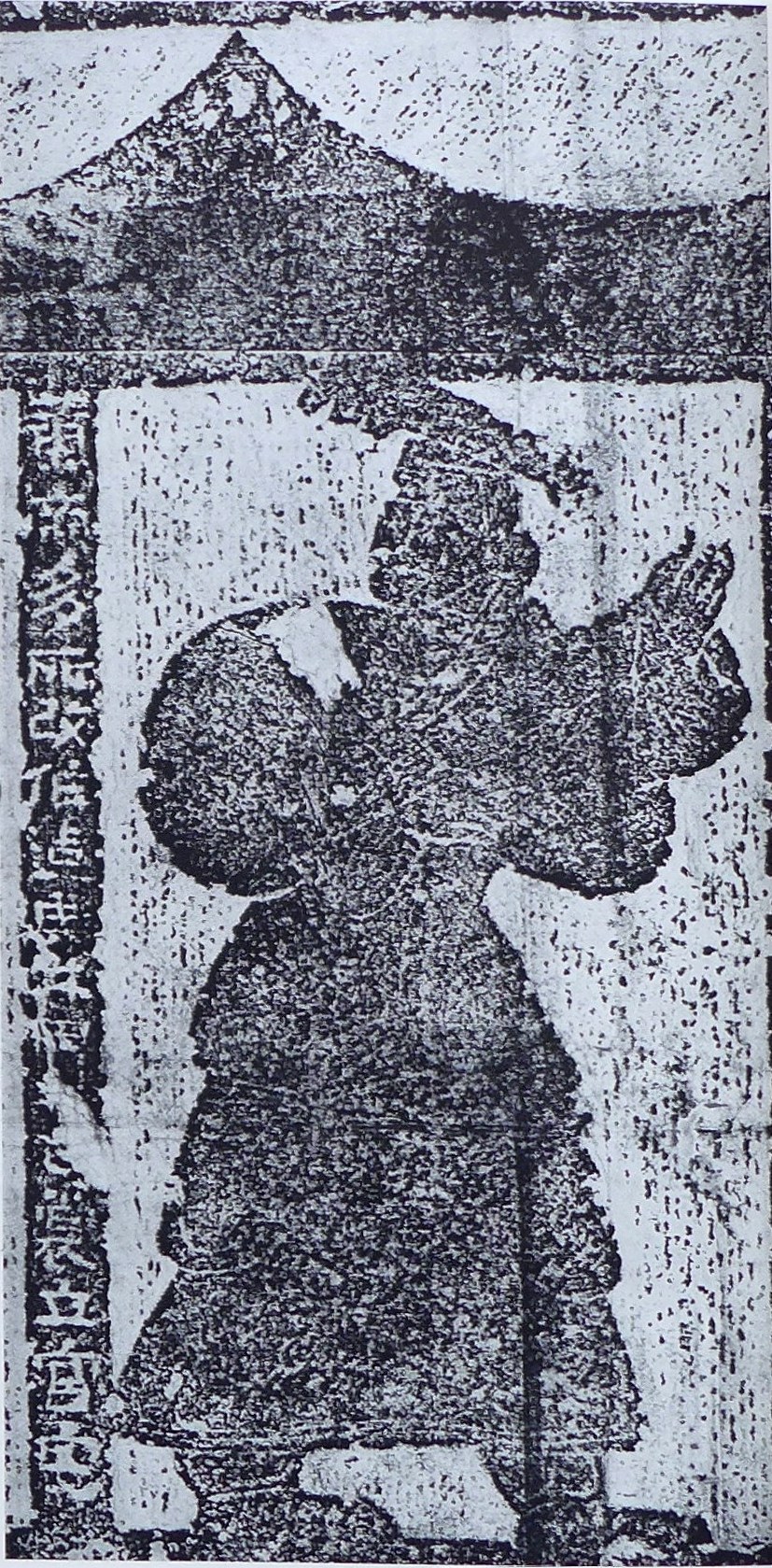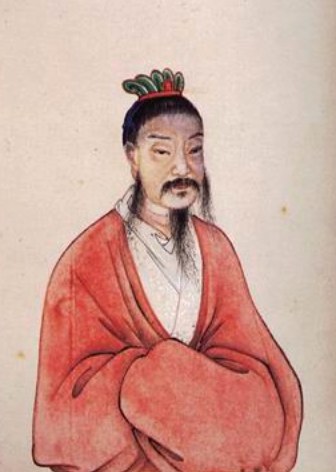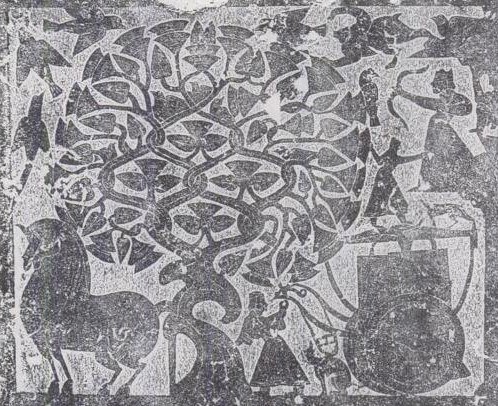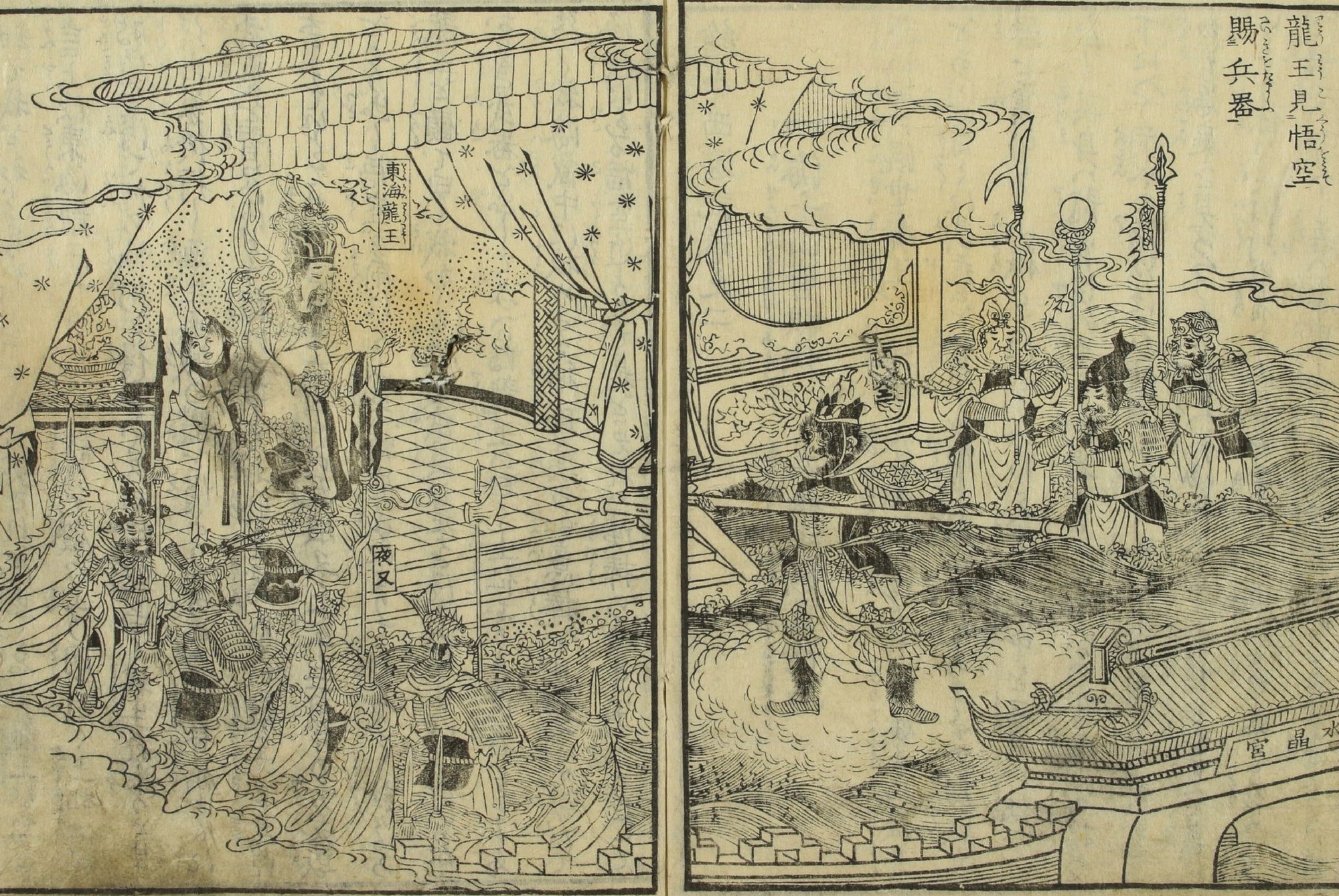
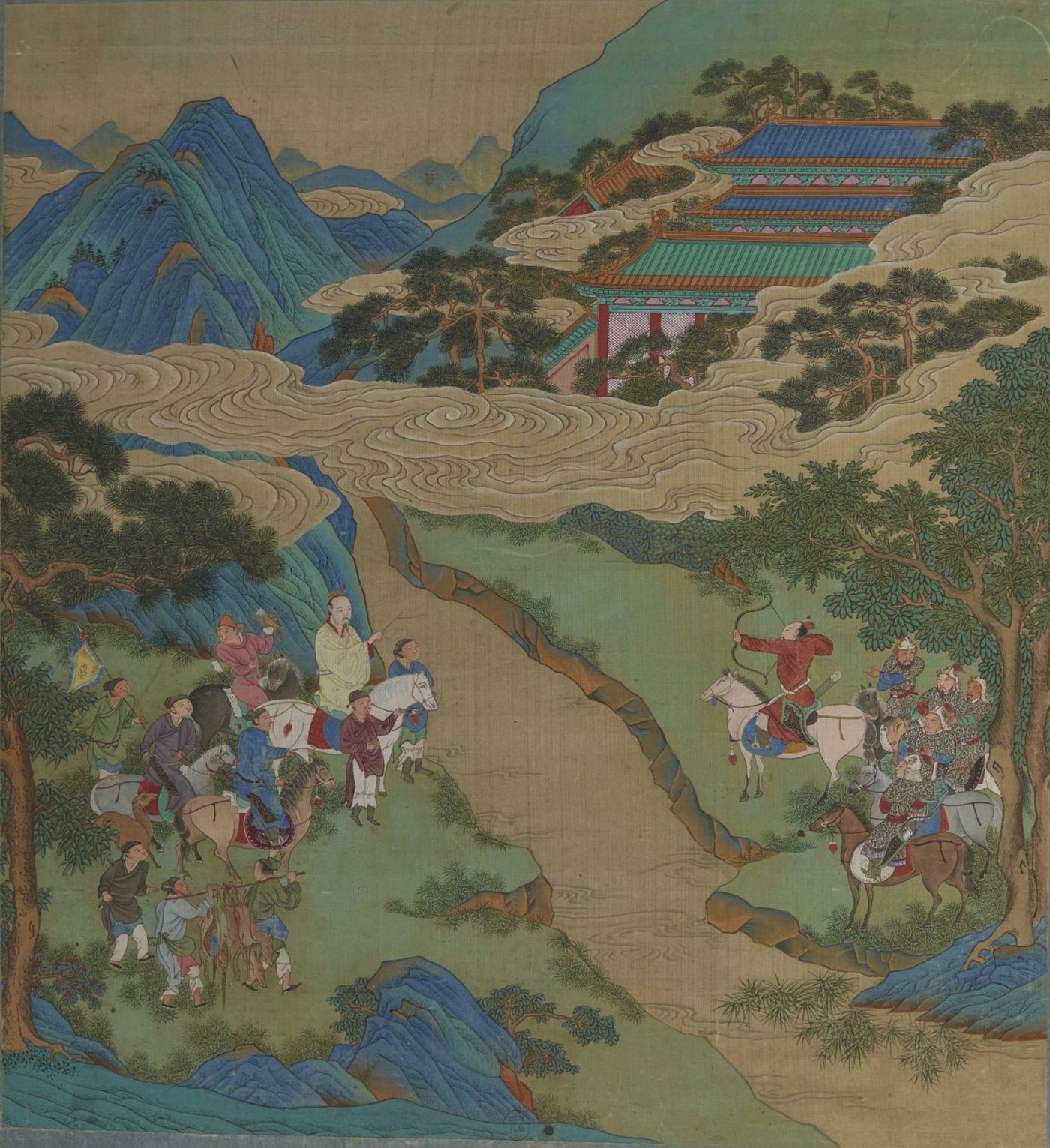
The high god Di JunThe high god (帝俊) who arms Yi with the vermilion bow; in the Shanhaijing also the husband of Xihe and father of the ten suns. put a bow into the archer’s hands, and the bow was the colour of blood. It was vermilion, with a quiver of white-corded arrows to match, and it came with a commission: go down to the lands below and relieve the hundred hardships of men. That is the oldest clear picture of the figure the later ages would call Hou Yi. Not a boy who taught himself to draw, not a warlord who fought his way up, but a marksman handed a divine weapon and sent from heaven with a job to do. Everything difficult about him grows out of that first act of trust, and the trouble it caused.
Most readers meet Yi through a single feat: the day ten suns rose together and he shot nine of them out of the sky. That episode has its own telling. What the archer’s own portrait must hold is everything the sun-shooting leaves out, and it turns out to be a great deal, because the ancient texts never treat the suns as his one labour. They treat it as one item on a list.
A list of monsters, laid across a map
The fullest account of what Yi did survives in a single Han text, the Huainanzi, compiled around 139 BCE, and it reads almost as a gazetteer of disasters. In the reign of the sage-emperor Yao, six monstrous scourges were abroad in the land, and Yao sent Yi against all of them. He executed Zaochi, the Chisel-Tooth, in the wilds of Chouhua.
He killed Jiuying, the Nine-Baby, on the Xiong waters. He netted Dafeng, the Great Wind given a body, in the marsh of Qingqiu. He cut the vast serpent Xiushe in two at Lake Dongting, and he took the giant boar Fengxi alive in the Mulberry Grove. Somewhere in that campaign, set down as one entry among the rest, he shot at the ten suns above and slew the man-eating Yayu below.
Read the passage cold and the suns almost vanish into the catalogue. Each beast comes with a named ground, so the whole cycle maps onto real geography, the marshes and lakes and groves of an ancient China gone wrong all at once. Nor is Yi only an archer of impossible distances.
Against Zaochi the combat is close and personal: the Shanhaijing has Yi holding bow and arrows while Zaochi holds a shield, a duel between marksman and defender rather than a shot from the clouds. Dafeng he does not simply pierce; the Great Wind is caught with a corded arrow, a line paid out to snare a thing of storm. This is a hunter with a range of methods, not a single trick.
And the labours have a political point. When they end, the Huainanzi says, the myriad people all rejoiced and set up Yao as the Son of Heaven. Yi’s violence is what makes Yao’s reign legitimate. The archer clears the world of monsters so that a king can be crowned over a world worth ruling.
The problem of who he is
Here the figure fractures, and the fracture is the most interesting thing about him. The Yi of the Huainanzi and the Shanhaijing is a celestial deliverer, armed by a god and sent to save mankind. But the Chuci, in the riddling Tianwen, speaks of a different Yi entirely: the Emperor sends down Yi the Yi-tribesman
to reform the people of Xia, and then asks, in the same breath, why he shot Lord HeHebo (河伯), god of the Yellow River, whom the darker Yi of the Chuci shoots before carrying off the Luo nymph., the god of the Yellow River, and took the Luo nymph to wife. This is no saviour. This is a man who wounds a god and seizes his consort.
The Tianwen was set down around the third century BCE, perhaps a century and more before the Huainanzi wrote out the full labours, so the darker riddles are in fact the older witness, and the tidy heroic catalogue the later one. The chronicle tradition, gathered in the Bamboo Annals, sharpens the shadow: there a mortal ruler, Yi of Youqiong, usurps the Xia throne and is in turn murdered by his own lieutenant, Han Zhuo.
The Tianwen preserves that ending too, in a line that follows hard on the Hebo couplet: Zhuo married Chunhu, and the beguiling wife then plotted the archer’s death. Whether the divine marksman and the mortal usurper were ever one man, or two figures fused by a shared name, is a question the ancient readers could not settle and the modern ones still cannot. The title itself carries the confusion. Hou means lord or sovereign, and it belongs as much to the Xia-era ruler as to the heaven-sent archer.
The drug that had no second dose
Yi’s fall, in the earliest datable telling, needs no usurpation and no treacherous minister. It needs only a wife and a theft. The Huainanzi records that Yi obtained the drug of deathlessness from the Queen Mother of the West, and that Heng’e, his wife, stole it and fled to the moon, leaving him desolate with no way to obtain more.
That is the whole of it in the Han text: no explanation of why she drank it, no cruelty on his part named as her reason, only the flat fact of a loss that cannot be undone. The moon and what became of her there belong to her own story. What belongs to his is the shape of the ending: the man who could shoot nine suns out of a burning sky could not hold on to the one thing that would have made him a god.
There is a quiet irony threaded through the whole cycle, and the sources leave it for the reader to notice rather than stating it. The high god who armed Yi, Di Jun, was also, in the Shanhaijing, the husband of the goddess XiheThe solar goddess (羲和) of the Shanhaijing, wife of Di Jun and mother of the ten suns., who was mother of the ten suns. The god who gave the archer his bow was the father of the targets. Whether that tension was ever felt as tragedy or was simply the way the fragments fell together, no ancient text pauses to say, and the honest portrait holds it as a coincidence of the record rather than a plotted grief.
Strip away the later accretions and a stark figure remains. Not the smiling folk hero who spares the last sun out of mercy, and not the disciple’s victim beaten to death with his own bow, both of which are late embroidery on a plainer cloth. What the oldest texts give is harder and stranger: a marksman lent divine power, who used it to rid the earth of monsters and to legitimise a king, who then turned that same power against a river-god and lost everything to a theft in his own house. The bow was a gift. It was never quite his.
The Emperor sent down Yi the Yi-tribesman to reform the people of Xia. Why did he shoot Lord He, and take to wife the Luo nymph? (Chuci, “Tianwen”; author’s rendering from the Chinese)
- Huainanzi (淮南子), Benjing xun (本經訓), comp. c. 139 BCE: the only early source preserving the full commission. Yao sends Yi to execute Zaochi in the wilds of Chouhua, kill Jiuying on the Xiong waters, net Dafeng in the marsh of Qingqiu,
shoot the ten suns above and slay Yayu below
(上射十日而下殺猰貐), cut the Xiushe at Dongting, and take Fengxi the boar in the Mulberry Grove (堯乃使羿誅鑿齒于疇華之野…禽封豨于桑林); the six pests are named together as harmful to the people (猰貐、鑿齒、九嬰、大風、封豨、修蛇皆為民害); and when the labours end the people rejoice and install Yao as Son of Heaven (萬民皆喜,置堯以為天子). The sun-shooting appears here as one item in a list of labours, not as a standalone tale. Chinese read verbatim. Standard EnglishMajor, Queen, Meyer & Roth, The Huainanzi (Columbia UP, 2010), ch. 8. - Huainanzi (淮南子), Lanming xun (覽冥訓), c. 139 BCE: the earliest datable form of the elixir strandYi requests the drug of deathlessness (不死之藥) from the Queen Mother of the West, Heng’e steals it and flees to the moon, and Yi is left desolate with no way to obtain more (羿請不死之藥於西王母,姮娥竊以奔月,悵然有喪,無以續之). The Han text gives no motive for the theft. English: Major et al. 2010, ch. 6.
- Shanhaijing (山海經), Hainei jing (海內經): the divine mandateDi Jun bestows on Yi a vermilion bow and white-corded arrows to succour the lands below, and Yi first goes to relieve the hundred hardships of the lower earth (帝俊賜羿彤弓素矰,以扶下國,羿是始去恤下地之百艱). Haiwai nan jing (海外南經): the duel with Zaochi, Yi holding bow and arrows against Zaochi with a shield (羿持弓矢,鑿齒持盾). Composite text; core strata c. 4th c. BCE to early Han, with the Hainei jing among the latest layers. Chinese read verbatim. English: Anne Birrell, The Classic of Mountains and Seas (Penguin, 1999).
- Chuci (楚辭), Tianwen (天問), Heavenly Questions, c. 3rd c. BCE: the darker Yi, posed as questions rather than narrativethe Emperor sends down Yi the Yi-tribesman to reform the people of Xia, then asks why he shot Lord He (Hebo, god of the Yellow River) and took the Luo nymph to wife (帝降夷羿,革孽夏民。胡䠶夫河伯,而妻彼雒嬪?); and the betrayal that follows, Zhuo marrying Chunhu while the beguiling wife plots the archer’s death (浞娶純狐,眩妻爰謀). This witness is roughly a century or more older than the Huainanzi’s fuller labours. Chinese read verbatim. English: David Hawkes, The Songs of the South (Penguin, 1985).
- Zhushu Jinian (竹書紀年), the Bamboo Annals: the chronicle strandHou Yi as a mortal Xia-era ruler, Yi of Youqiong, who seizes power early in Taikang’s reign, occupies the capital, and is deposed and killed by his lieutenant Han Zhuo. The transmitted
current
recension is textually much later than its Warring States core, so its regnal chronology should not be read as contemporaneous with the events it dates. Cited here, not read word-for-word.