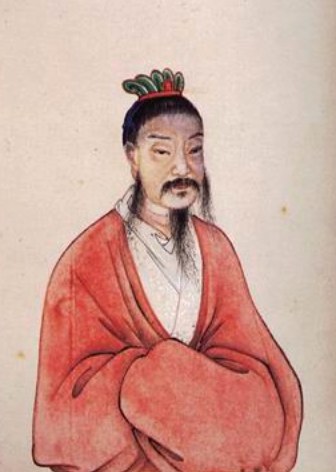
A sovereign turns to one man and hands him the ugliest instrument of rule. The people are troubled by robbers, by murderers, by insurgents and traitors, the emperor says, and it is yours to meet them: use the five punishmentsThe graded canonical penalties of the old law, given in Legge's note as branding, loss of the nose, loss of the feet, castration and death, which Gaoyao administered., and use them with intelligence, and you will bring the guilty to a sincere submission. The man who receives that charge is Gaoyao, and the emperor is Shun, and the office being conferred is nothing less than the whole authority to maim and kill in the name of order. What is strange, and what the tradition never tired of repeating, is that this grant of the harshest power in the state is remembered as the founding image of mercy. The judge so charged became the pattern to which every later administrator of justice in China was held.
The bond between the two men is a relationship of a peculiar kind: not blood, not marriage, not the succession from one throne to the next, but the trust a ruler places in a servant and the doctrine that servant hands back up to him. It is worth setting down carefully, because the single image most people carry of Gaoyao, the one-horned beast that sniffed out the guilty, comes to us in a form almost nobody expects.
Shun names him Minister of Crime
In the account the Book of Documents preserves, Shun distributes the great offices of his reign one by one, naming a different worthy to each. To Gaoyao he gives the administration of crime. The word the old text uses is a single archaic character, shì, which Legge renders Minister of Crime
and which later writers glossed with the grander title of Grand Judge.
Sima Qian, setting the same scene down in his court history around 91 BCE, keeps the wording almost intact: the same barbarous tribes troubling the land, the same robbers and traitors, the same charge to wield the five punishments. Across the roughly two millennia that separate the legendary reign from the historian who recorded it, and the further century and a half from the historian to the sceptic we will come to, the appointment itself stays remarkably fixed.
What the office meant in practice is not softened anywhere. Legge’s note spells the five punishments out in full: branding on the forehead, cutting off the nose, cutting off the feet, castration, and death inflicted in various ways, with banishment allowed as a mitigation and lesser correction reserved for lesser courts. This is the apparatus placed in Gaoyao’s hands. He is not an abstract figure of fairness. He is the man who orders the knife.
Knowing men, and giving the people rest
Set against that, the doctrine attached to his name runs in the opposite direction. In the chapter the tradition calls the Counsels of Kâo-yâo, Gaoyao states the whole of good government in two clauses: it lies in knowing men, and in giving repose to the people. The one who knows men, he says, is wise, and can put each person into the office he is fit for; the one who gives the people rest is felt as kind, and the black-haired folk cherish him in their hearts.
Even the sovereign, his listener Yu answers, finds both hard. From there Gaoyao expounds his nine virtues, the paired temperaments a good officer holds in balance — affable yet dignified, mild yet firm, and so down the list — a portrait of character, not of procedure.
This is the reason his name outlasted the machinery of the five inflictions. Legge, introducing the chapter, records that Gaoyao is still celebrated in China as the model for all administrators of justice,
and the ground of that fame is his claim that justice begins in reading men rightly and leaving the governed at peace, rather than in the severity of the penalties he could impose. The relationship between judge and sovereign is built on this doctrine passing upward: Gaoyao formulates it, and Shun, in turn, praises him for it.
Punishment that ends punishment
Shun’s praise, when it comes, states the paradox on which the whole bond rests. In the chapter of the Great Yu’s counsels the emperor turns to Gaoyao and says that of all his ministers and people scarcely one now offends against the government, and that this is owing to Gaoyao’s intelligence in the use of the five punishments, so that through punishment there may come to be no punishments, and the people fall in with the path of the mean. The aim of punishing, in other words, is to make punishing unnecessary. The knife is justified only insofar as it works itself out of a job.
A caution belongs here, because it is exactly the kind the sources reward. This celebrated line sits in one of the chapters that later scholarship treats with suspicion: the Great Yu’s counsels belongs to the Old TextThe guwen stratum of the Book of Documents, a group of chapters widely judged to be a later reconstruction rather than a genuinely archaic layer.
stratum of the Documents, widely regarded since the Qing philologists as a reconstruction of perhaps the third or fourth century CE rather than a genuinely archaic layer. The sentiment is old and much repeated; the chapter as we have it may be a millennium younger than it presents itself. The ideal of punishment ending punishment is real to the tradition. Whether Shun ever said it is another matter, and the honest telling keeps the two apart.
Painted beside a horned beast
Then there is the image everyone remembers. In the courtyards of government buildings, a first-century writer tells us, Gaoyao was painted alongside a strange animal, and scholars in his day explained the pairing with a marvel. The beast was a one-horned goat that knew the guilty by instinct. When Gaoyao, sitting in judgement, was in doubt whether an accused man had done the deed, he had the animal butt him.
It would gore the guilty and spare the innocent, an unerring instrument of proof born with a single horn, and Gaoyao held it in such reverence that he served it, rising and seating himself in its presence, and relied on it in every doubtful case. This is the xiezhiThe one-horned beast said to gore the guilty, later the embroidered emblem of the imperial judiciary, though its earliest teller reports the ordeal only to reject it., the horned creature that would become the badge of the imperial judiciary, embroidered on the robes of censors and regional magistrates, worn by the very men who judged.
Everything about that picture invites belief, and it comes to us from a man who set it down in order to tear it apart. Our earliest surviving account of the goat-ordeal is not an affirmation of it. It is a demolition.
The witness who calls it a fraud
The writer is Wang Chong, a rationalist of the Eastern Han whose book takes exactly this sort of marvel as its target. He reports the scholars’ claim in full, and then turns on it. A goat, he objects, must have two horns; the one-horned beast has a bodily defect, and a defect is a poor foundation for a miracle. Why should an animal that can gore a man have any knowledge of whether the man is guilty?
Far more likely, he argues, that Gaoyao, wanting to lend his administration the weight of the supernatural so that the punished would not resist their sentences, made use of the creature: when it gored a man, he punished that man, and let the people take fright and keep from wrongdoing. The beast, Wang Chong concludes, is of a piece with other frauds got up to overawe a crowd. It has an empty name and no real effect.
This is the fact that a straightforward retelling gets exactly backwards. The oldest voice we have does not tell us the magic beast detected guilt. It tells us the magic beast did nothing of the kind, and that a shrewd judge exploited a credulous crowd’s belief that it could. The story of Gaoyao and his goat is not, at its root, a wonder the ancient sources vouch for. It is a wonder the earliest source we possess was written to expose.
What later ages did was invert Wang Chong entirely. The sceptic’s fraud became the tradition’s emblem of pure justice, the horned beast turned from a con into a courthouse guardian, and the modern xiezhi presides over law and order as if no one had ever doubted it. The relationship at the centre of all this stays intact through every version.
A sovereign trusts an upright man with the power to punish; the upright man answers that the point of the power is to spend itself into disuse. Whether he leaned on a horned beast to do it, or only let men believe he had, is the one thing the tradition could never keep straight, and the one early witness who addressed it said plainly that the beast was theatre.
Perhaps the monoceros was so organised that it merely could gore a man, but there is no necessity why it should have known whether he was guilty. (Lunheng, “Shiying,” tr. Alfred Forke)
- Shujing (Book of Documents / Shang Shu 尚書),
Canon of Shun
(Shun Dian 舜典) (trans. James Legge, The Sacred Books of China, Part I, SBE vol. 3, Oxford, 1879, pp. 40–41)Shun’s charge to Gaoyao as Minister of Crime (士), to meet the robbers, murderers, insurgents and traitors with the five punishments usedwith intelligence
; Legge’s note detailing the five inflictions (branding, loss of the nose, loss of the feet, castration, death) and their mitigation; Shun’s refrainLet compassion rule in punishment
; the banishment of the four great offenders. The narrative is set in the legendary reign of Shun (conventionally c. 23rd c. BCE); the chapter itself is far younger. - Shujing,
The Counsels of Kâo-yâo
(Gao Yao Mo 皋陶謨) (Legge, SBE 3, pp. 53–56)Gaoyao’s governing doctrine that good rule liesin knowing men, and giving repose to the people
; his exposition of the nine virtues; and Legge’s head-note celebrating Gaoyao asthe model for all administrators of justice.
- Shujing,
The Counsels of the Great Yu
(Da Yu Mo 大禹謨) (Legge, SBE 3, pp. 48–49)Shun’s praise of Gaoyao’s use of the five punishments and the ideal thatthrough punishment there may come to be no punishments
(刑期于無刑). In the received text this chapter belongs to theOld Text
(guwen) group widely judged by philologists, since Yan Ruoqu in the Qing, to be a later reconstruction, probably of the 3rd–4th c. CE, so the celebrated line is younger than it looks. (That philological verdict is later scholarship, not a claim of the text itself.) - Sima Qian, Shiji 史記 1,
Basic Annals of the Five Emperors
(Wudi Benji 五帝本紀), composed c. 91 BCEthe appointment of Gaoyao as 士 in wording almost identical to the Shujing; the summary thatGaoyao acted as Grand Judge (大理); [justice] was balanced, and the people each submitted and got the truth of their cases
(皋陶為大理,平,民各伏得其實); and, as backdrop, Shun’s own rise from a household that repeatedly tried to kill him. Chinese read verbatim (zh.wikisource 史記/卷001); no complete public-domain English of the Shiji, so renderings from it are the author’s. - Wang Chong, Lunheng 論衡,
Auguries Verified
(Shiying 是應, Bk. XVII), composed c. 80 CE (trans. Alfred Forke, Lun-hêng, Part II, Berlin/London, 1911, pp. 321–322)the fullest early account of the one-horned beast (the xiezhi 獬廌, Forke’smonoceros
) that gores the guilty, given as ascholars say
claim and then refuted. Wang Chong holds that the beast at most gored men indiscriminately, that Gaoyao exploited it to overawe wrongdoers, and that it hasan empty name, without real effect
(蓋有虛名,無其實效也). Chinese read verbatim (zh.wikisource 論衡/52).