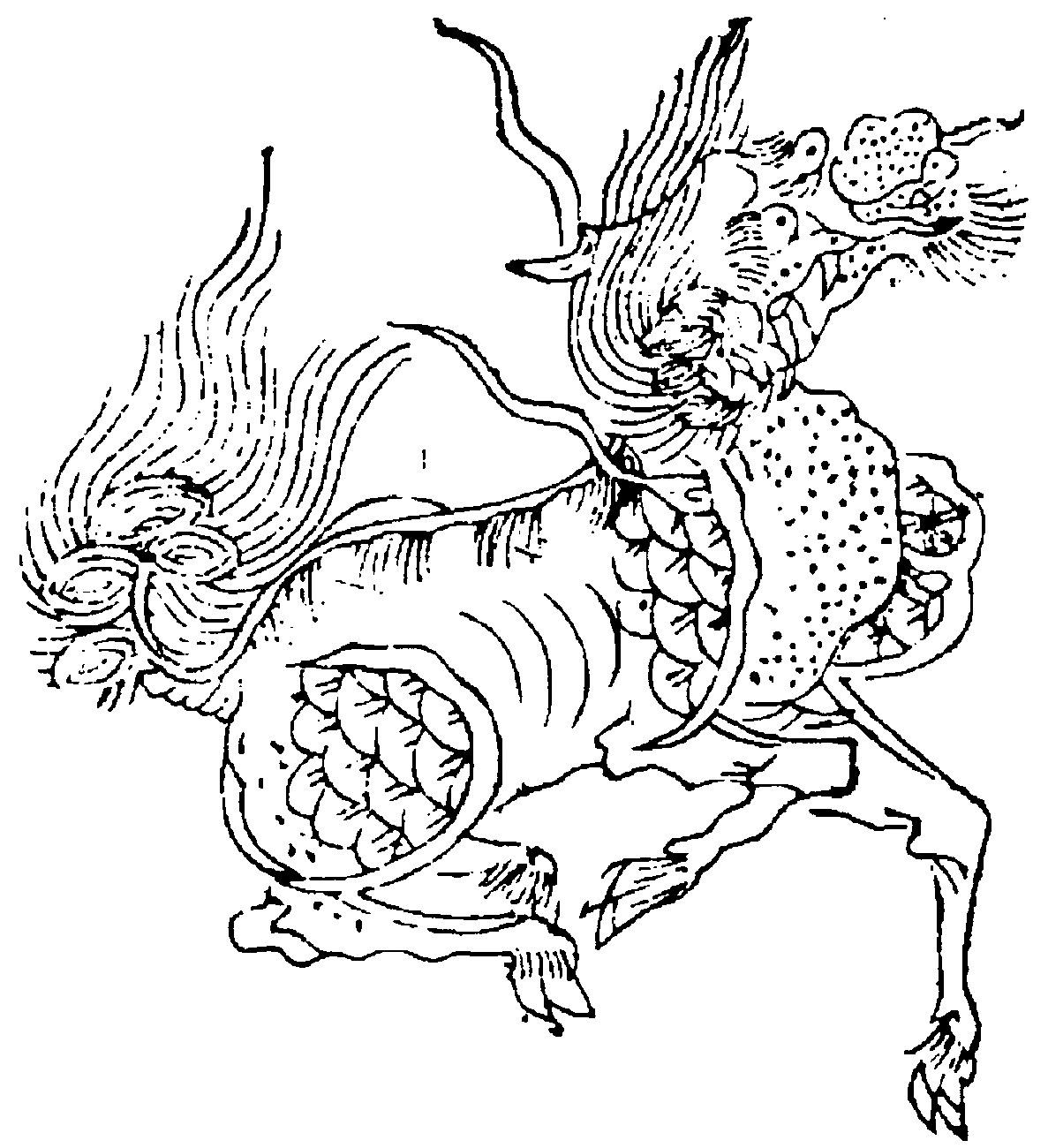
In the spring of a year that answers to 481 BCE, a hunting party in the western marches of the state of Lu ran down a strange beast. It had the body of a deer and a single horn, and no one who took it knew what to make of it. They decided it was unlucky and handed it off to the gamekeeper, the way one gets rid of a bad omen. Then an old teacher walked over, looked at it, and said one word that changed everything: lin. This is the qilin, the gentlest creature in the Chinese bestiary, and almost everything the classical sources say about it turns on that single afternoon.
A large doe, or the benevolent beast
The oldest layer of the word is thinner than the legend. In the Shijing, the Book of Odes, an ode of the eleventh to seventh century BCE named Lin zhi zhi
invokes the lin three times as an image of a flourishing noble line, pairing the beast’s foot, its forehead and its horn with the sons, the kin and the clan of a great house, each stanza closing on the sigh Ah, the lin!
There is no omen doctrine here yet, no moral machinery, only the lin as a byword for a fine lineage.
By the time Xu Shen compiled the Shuowen Jiezi, presented to the throne in 100 or 121 CE, the beast had a definition and a body. Xu Shen calls the qi a benevolent beast: mi-deer body, ox tail, one horn. That one horn is the single fixed physical fact the classical record offers. It is worth noticing how careful the dictionary is with names.
It files the numinous creature under 麒 for the male and 麐 for the female, and gives the graph 麟, the one the chronicles actually use, a completely separate and ordinary sense: a large doe. The fabulous beast and the big deer are two entries, not one. Only later usage collapsed them into the compound qilin and let 麟 stand for the marvel.
Whatever it looked like, the quality that mattered was moral. The word the sources reach for is renThe Confucian cardinal virtue, benevolence or humaneness; the word that names the qilin a benevolent beast (仁獸) in both the Gongyang and the Shuowen., the benevolence that sits at the centre of Confucian ethics. The qilin is the 仁獸, the benevolent beast, and its gentleness carries the weight of a moral character rather than mere docility.
The familiar later claim that it will tread on no living blade of grass and crush no insect underfoot is a beautiful elaboration of exactly this idea, but it belongs to the developed tradition, not to these early texts. The classical warrant for its gentleness is that one loaded word, and the Liji’s picture of a realm so well ordered that when the lin is kept among the sage-king’s charges the other beasts do not bolt.
The Liji’s four numinous creatures
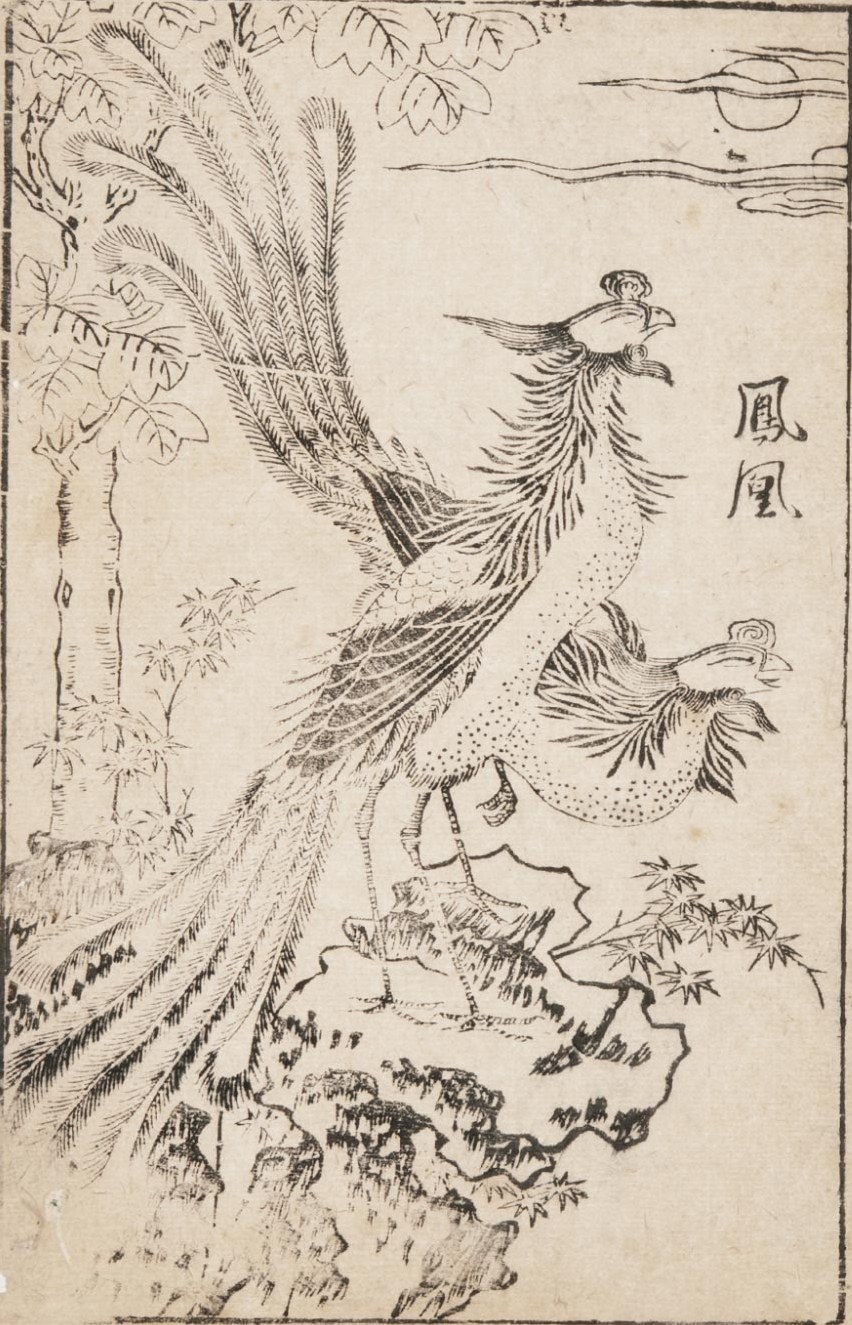
Because it is benevolent, the qilin appears in the best company Chinese cosmology can assemble. The Liji, in its chapter on the conveyance of rites, names the four numinous creatures, the silingThe four numinous creatures of Chinese ritual thought (qilin, phoenix, tortoise and dragon), whose presence the Liji reads as the mark of a sage-king's reign.: the lin, the phoenix, the tortoise and the dragon.
This scheme belongs to the Han redaction of the ritual books around the first century BCE, and it sets the qilin inside a tableau of the world set right, where sweet dew falls and sweet springs well up, where the phoenix and the qilin stand in the suburban meadows and the tortoise and the dragon rest in the palace pools. The qilin here is not a monster to be fought or a wonder to be caught. It is one panel in a picture of good government, a sign that the age deserves it.
That is the doctrine the Han commentators bring to the capture, and it is the doctrine that turns a hunting anecdote into a tragedy. The Gongyang commentary states the rule plainly: the lin is a benevolent beast; when there is a true king it appears, and when there is no king it does not appear. The creature is a barometer of legitimate rule. It should surface only in a golden reign, walking unafraid at the edge of a well-governed realm. The whole weight of the capture story rests on a single contradiction pressing against that rule.
For whom has it come
Here the layers of the record pull apart, and the honest reading has to hold them at arm’s length. The bare fact is early. The chronicle of Lu, the ChunqiuThe court chronicle of the state of Lu whose terminal entry records the lin's capture; by tradition edited by Confucius, and so later nicknamed the Lin Classic., closes its final entry under Duke Ai’s fourteenth year with one terse clause: in spring, in a hunt in the west, someone caught a lin. That is 481 BCE, and by tradition Confucius himself edited the chronicle it ends.
The story that makes the clause ache, though, is younger by roughly three centuries. The Zuozhuan, compiled around the fourth century BCE, supplies the scene: the hunt at Daye, the Great Wild; the chariot-driver Chushang of the Shusun clan seizing the beast; the party judging it inauspicious and passing it to the gamekeeper; and Confucius, coming to look, naming it and only then letting them keep it. The tears come later still, from the Gongyang of the second or first century BCE, some three hundred years downstream of the entry it explains.
In that latest layer the scene becomes unbearable. Someone brings word of a horned roe-deer, a creature that should not be. Confucius understands at once what it means: the benevolent beast has come, but it has come into a kingless, broken age, an age with no true ruler to deserve it, and it has been caught and thought unlucky and thrown away. He cries out, For whom has it come! For whom has it come!
He turns back his sleeve and wipes his face, and his tears wet his robe. And at the western capture of the lin, the Gongyang has him say the line that has echoed ever since: My Way is exhausted.
He turned back his sleeve and wiped his face, his tears wetting his robe, and said: My Way is exhausted. (Gongyang zhuan, Duke Ai 14; author’s rendering from the Chinese)
One caution belongs beside that scene, because it is easy to misplace. This weeping Confucius is a Han commentator’s Confucius. The Analects, the oldest collection of the Master’s sayings, contains no such episode; its nearest note has him lament that the phoenix does not come and the River gives up no chart, with the lin nowhere in it. The grief over the qilin is powerful and old, but it is exegesis composed generations after the man, not something he set down himself.
What the earliest chronicle actually records is the single clause, and the Gongyang explains why the whole book stops there with an answer as spare as the entry: because with this, it says, the work is complete. The catch that ended the Annals became, by long tradition, the catch at which the sage laid down his brush, and the Chunqiu earned its nickname, the Lin Classic. A one-horned beast, caught by accident, mistaken for bad luck: and in the reading that outlasted all the others, the last thing an old teacher wept over before he closed his book.
- Chunqiu (春秋, Spring and Autumn Annals), Duke Ai year 14 (481 BCE; received text trad. ascribed to Confucius, late 5th c. BCE): the terminal entry 「十有四年春,西狩獲麟」, the capture in the western hunt that ends the Annals, preserved as the 經 lemma in all three commentaries. Chinese read verbatim; English is the author’s literal gloss.
- Zuozhuan (左傳, Zuo Commentary), Duke Ai 14 (comp. c. 4th c. BCE): the fullest capture narrative — the hunt at Daye (大野), the chariot-driver Chushang of the Shusun clan (叔孫氏之車子鉏商) taking the beast, its rejection as inauspicious (以為不祥) and handing to the gamekeeper, and Confucius (仲尼) identifying it, 「麟也」, before it is kept. Chinese read verbatim; English is the author’s literal gloss.
- Gongyang zhuan (春秋公羊傳), Duke Ai 14 (Han, c. 2nd–1st c. BCE): the
benevolent beast, appears only for a true king
doctrine (「麟者仁獸也。有王者則至,無王者則不至。」), the low-born firewood-gatherer as catcher, Confucius’s cry 「孰為來哉!孰為來哉!」, his wiping his face until his tears wet his robe (「反袂拭面,涕沾袍」), his 「吾道窮矣」, and the terminus rationale 「何以終乎哀十四年?曰:備矣!」. Chinese read verbatim; English is the author’s literal gloss. - Guliang zhuan (春秋穀梁傳), Duke Ai 14 (Han): the magnified-notice reading, insisting the lin is not foreign to the central states (「不外麟於中國也」). Chinese read verbatim; English is the author’s literal gloss.
- Liji (禮記), Liyun (禮運, The Conveyance of Rites), Western Han compilation (c. 1st c. BCE): the lin among the four numinous creatures (「麟、鳳、龜、龍,謂之四靈」), the beasts-do-not-bolt claim (「麟以為畜,故獸不狘」), and the peace tableau (「鳳皇、麒麟皆在郊棷」). Chinese read verbatim; English is the author’s literal gloss.
- Shuowen Jiezi (說文解字), Xu Shen (許慎), presented 100/121 CE (Eastern Han): the headword 麒,
a benevolent beast; mi-deer body, ox tail, one horn
(「仁獸也。麋身牛尾,一角。」); 麐 asthe female qi
(「牝麒也。」); and, distinct from both, 麟 asa large doe
(「大牝鹿也。」). Chinese read verbatim; English is the author’s literal gloss. - Shijing (詩經), Zhou-nan ode
Lin zhi zhi
(麟之趾), Western–early Eastern Zhou, c. 11th–7th c. BCE: the oldest 麟 attestation, pairing the beast’s foot, forehead and horn with the sons, kin and clan of a noble house, refrain 「于嗟麟兮」. Chinese read verbatim; English is the author’s literal gloss.