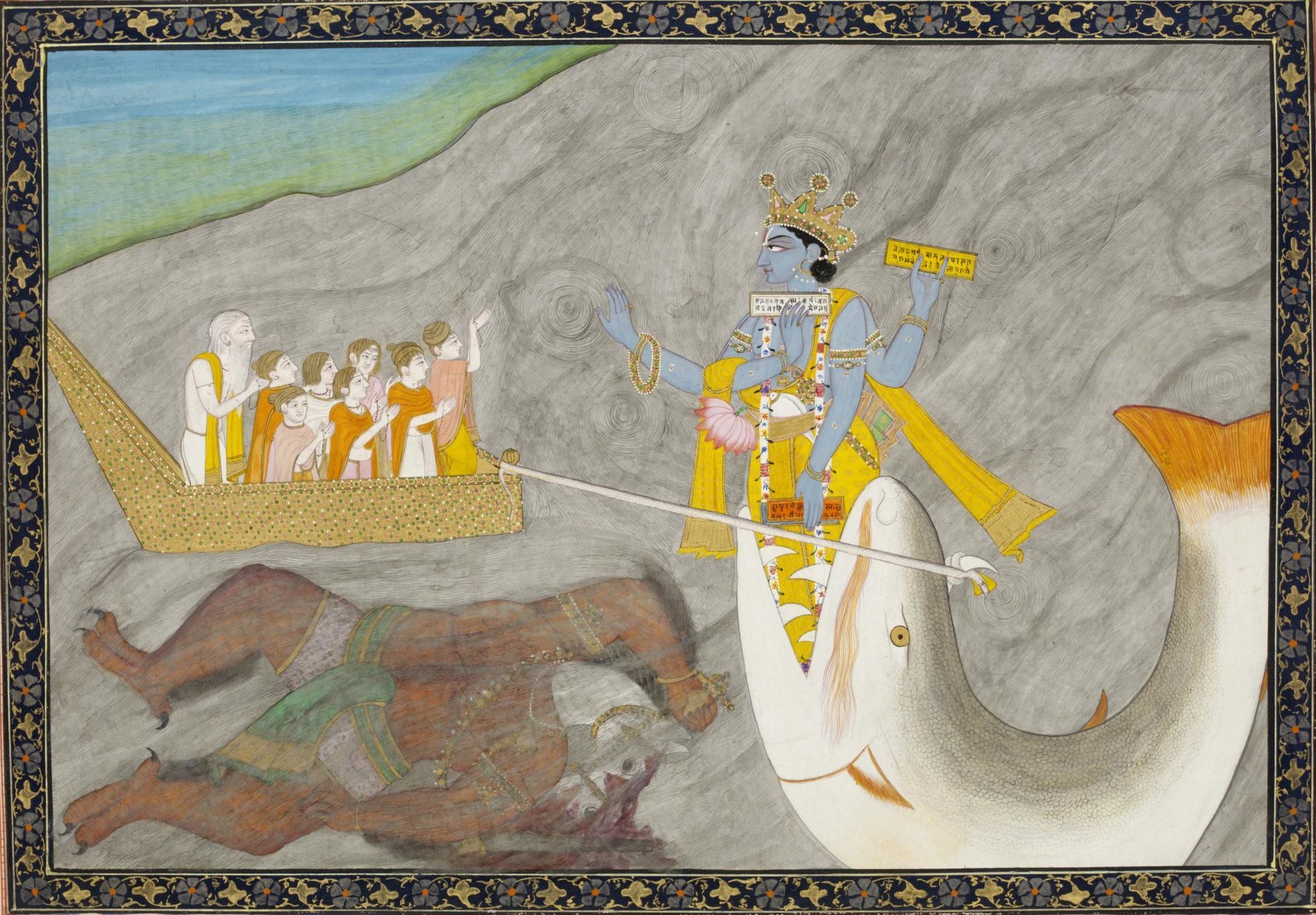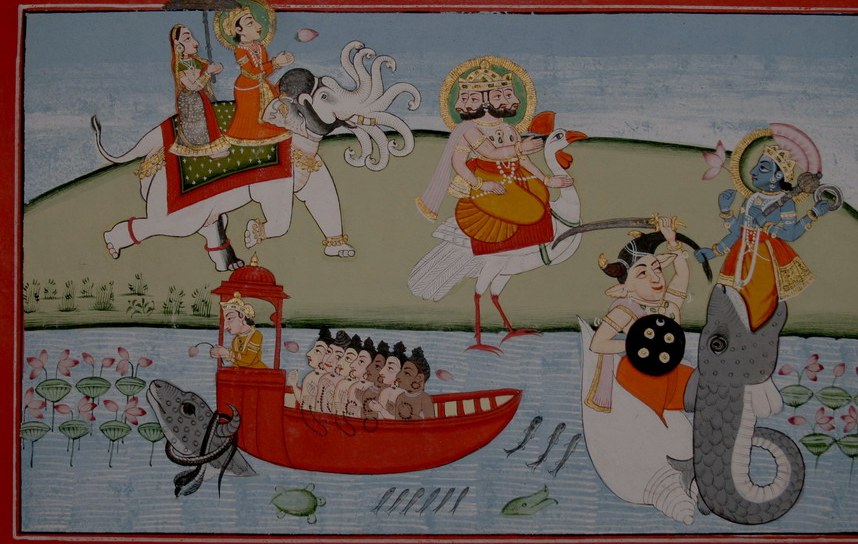
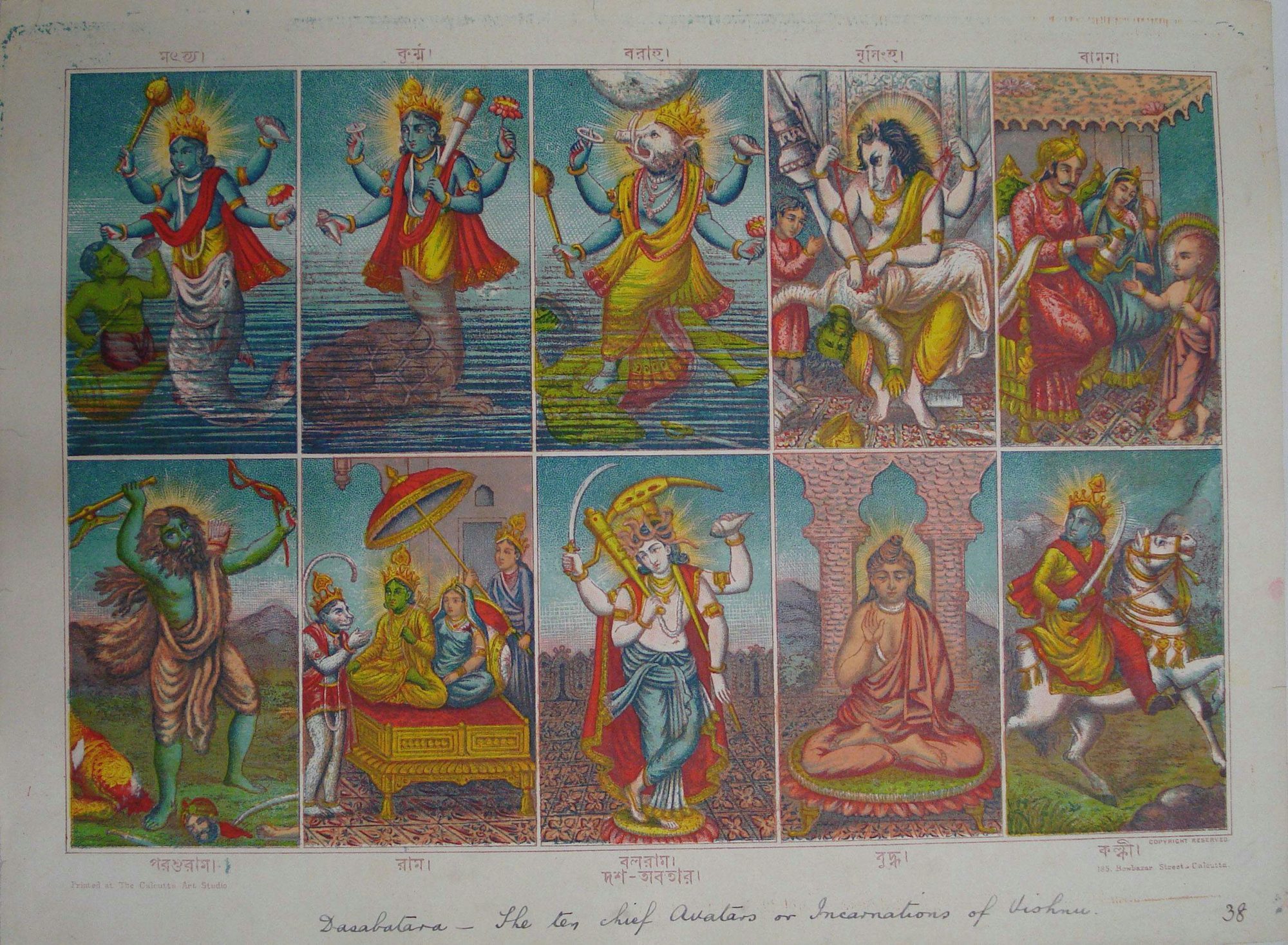
The waters rose until there was no shore left anywhere, and one man had been warned. Vaivasvata Manu, the father of the present age of the world, rode out the deluge in an earth-boat while everything else drowned, and what towed him through that endless grey water was a fish. Not an ordinary fish: the god himself had taken the shape of one, and would drag Manu and the seed of the coming world to safety on the far side of the flood. This is the first of the great descents, and it sets the pattern for all of them. When the world tips toward ruin, the god who preserves it does not send help from a distance. He comes down into it, takes a body, and does the work with his own hands.
The Sanskrit word is avatāra, and it means exactly that: a coming-down. The doctrine behind it is stated most famously in the Bhagavad Gītā, where the god, speaking on the edge of a battlefield, lays out the law of his own returns. Whenever dharma declines and disorder rises, he says, he manifests himself; for the protection of the good, the destruction of the wicked, and the re-establishment of right order, he is born, age after age.
That last phrase, sambhavāmi yuge yuge, is the hinge of the whole idea. The descents are not scattered rescues but a rhythm keyed to the turning of the ages, a promise that however far the world falls, the god will be there to catch it.
Ten names for a deathbed
Tradition counts ten of these descents as the principal ones, the Daśāvatāra, and the most quoted list of them comes from an unexpected place. The Garuḍa Purāṇa is a text of the death-rites, concerned with what the dying should hear and what their kin should chant at the bedside, and it is there, among instructions for the deathbed, that the ten names are set down as a litany: the Fish, the Tortoise, the Boar, the Man-lion, the Dwarf, Paraśurāma, Rāma, Kṛṣṇa, Buddha, and also Kalki.
These ten names, the text says, should always be meditated upon by the wise, and those who recite them beside the sick are called relatives. It is a strange and moving frame for a roll-call of cosmic saviours, that the shape of the whole descending order is something you say to a person as they leave the world.
Bracing the whirling mountain on his shell
Run down the list and a sequence emerges, rising out of the deep. Behind Matsya, the fish who saved Manu, comes Kūrma, the tortoise, who lends his back as a pivot when gods and demons churn the ocean for the nectar of deathlessness, bracing the whirling mountain Mandara on his shell so the great labour can turn. Then Varāha, the boar, who dives after the Earth herself when she has sunk down into the cosmic waters and heaves her up on his tusks out of the region called Rasātala.
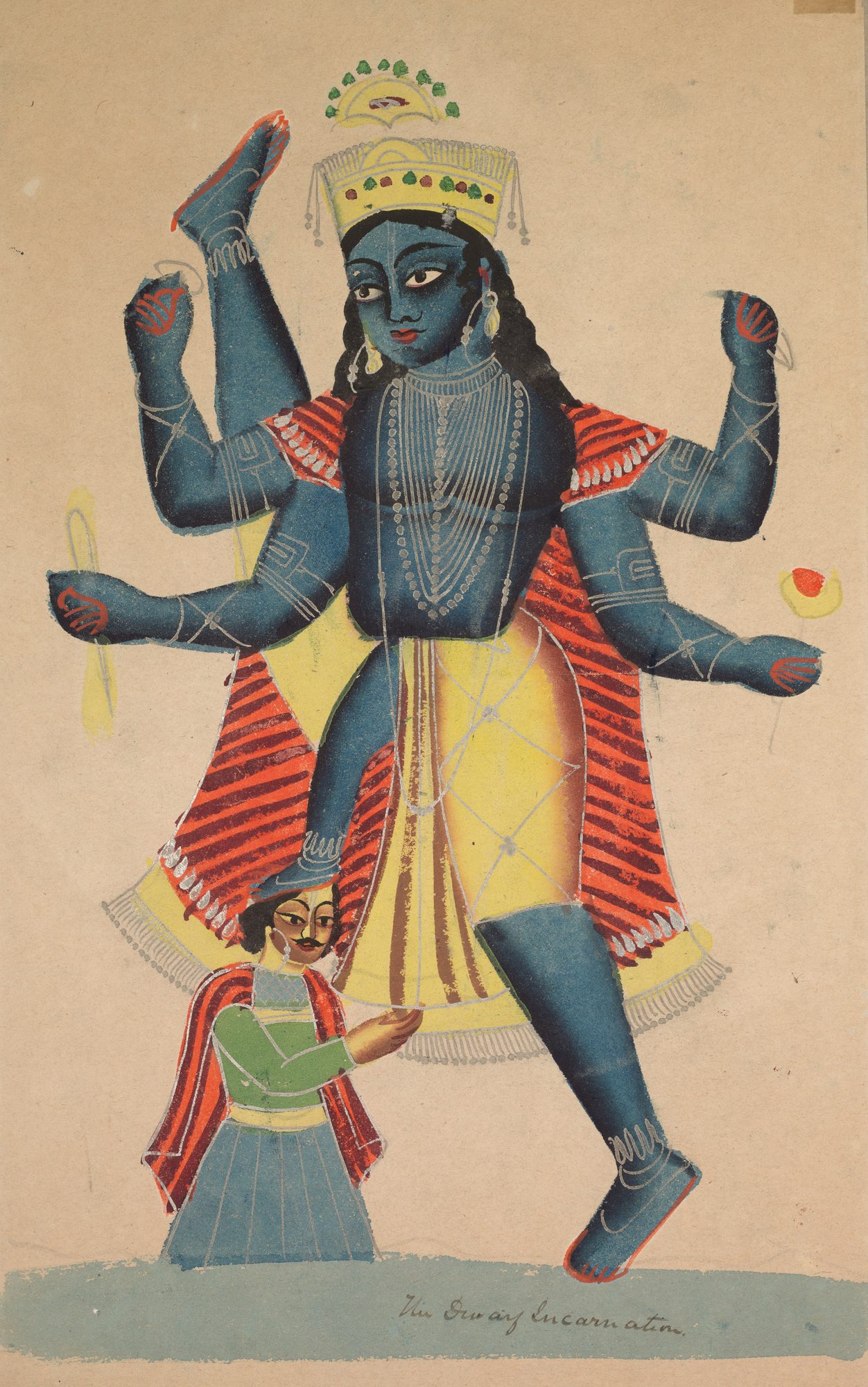
Then Narasiṃha, the man-lion, neither wholly man nor wholly beast, who answers the boast of a tyrant no man and no animal could kill by being both and neither, and tears open the chest of the demon-king with his claws to save a child who would not stop loving the god. Then Vāmana, the dwarf, who comes to the sacrifice of the generous demon-king Bali begging only three paces of ground, and then swells until three of his strides step across the whole of the three worlds and take them back.
Kings as good as robbers
Halfway down, the descents cross into forms fully human and enter the world of the epics. Paraśurāma, Rāma-with-the-axe, is the brahmin who takes up a warrior’s weapon against the arrogance of kings and clears the warrior class from the earth, the texts say, twenty-one times over. Rāma, the hero of the Rāmāyaṇa, is born to bring down the demon Rāvaṇa, and performs feats of valour that include bridging the very sea to reach him.
Kṛṣṇa, the eighth, is born into the Vṛṣṇi clan to lift a burden grown too heavy for the Earth to bear, and it is he who will speak the Gītā’s doctrine of descent, the avatar explaining the logic of avatars. Ninth in this list stands the Buddha, born, the Bhāgavata says, as a son of Añjana in the Kīkaṭa country once the Kali age has fully come. And tenth, alone among them, is Kalki, who has not yet been born at all. He waits at the far end of the darkening present age, to be born of a man named Viṣṇuyaśas in the twilight of the Kali, when, in the text’s phrase, kings will be as good as robbers.
The order is often read backwards from our own century, as if the fish-to-tortoise-to-boar-to-man sequence were an ancient anticipation of evolution, life crawling up out of the sea toward the human. It is a seductive reading and a modern one, no older than the nineteenth century, and the texts themselves do not think in those terms at all. The logic they follow is not biological but cosmological: each descent answers a specific breach in the order of things, and the forms ascend from beast toward man because the crises do, from the drowning of the whole world down to the moral rot of a single failing age.
The dwarf placed in the second age
That cosmological logic is what fastens the descents to the four great ages, the yugas, through which the world grinds from a golden dawn to an iron ruin before beginning again. The traditional scheme sets the first four descents in the perfect first age, the dwarf and the two axe-and-bow Rāmas in the second, Kṛṣṇa at the close of the third, and the Buddha and Kalki in the fourth and worst, our own.
It is worth being honest that this tidy one-age-at-a-time table is a teaching framework laid over the sources rather than a single line lifted from any one of them. What the texts pin down firmly is narrower: the Bhāgavata’s own translator places Vāmana and Paraśurāma in the second age, and the text itself sets the Buddha and Kalki explicitly in the Kali. The full four-age map is the tradition’s way of making the descents legible as a single cosmic history, and it deserves to be presented as exactly that, a scheme, not smuggled in as scripture.
Thousands of canals from one lake
Nor is the number ten as solid as it looks. It is a curated set, an iconographic and devotional canon, not a census. The Bhāgavata Purāṇa, where most of these seed-stories are told, does not stop at ten; it runs through some twenty-two successive descents, the ten folded in among sages and seers and a physician and an enchantress, and then it refuses even that number.
Just as thousands of canals flow out from one inexhaustible lake, the text says, so innumerable are the incarnations of Hari, the ocean of goodness. Ten is a shape the devotion settled on, a set small enough to hold in the mind and paint on a temple wall, not a claim that the god came down only ten times.
The membership of the list is unsettled too, precisely where you would expect a tradition to disagree, near its own present. The Garuḍa Purāṇa’s list, quoted above, gives Kṛṣṇa eighth and the Buddha ninth. Many other traditions, the Śrī Vaiṣṇavas and much of the south among them, drop the Buddha entirely and put Balarāma, Kṛṣṇa’s brother, in the eighth seat with Kṛṣṇa ninth. The Buddha’s presence at all, the founder of a rival path folded into the descents of Vishnu, was contested from the moment it appeared and is contested still.
And the devotional streams that centre on Kṛṣṇa unsettle the whole scheme from the other end. For them Kṛṣṇa is not one descent among ten but the source from which the rest flow, and the Bhāgavata itself, immediately after listing the avatars, says as much: Kṛṣṇa is the Supreme Being himself, and all these others are his parts and the parts of his parts. These are not confusions to be tidied away. They are the living disagreements of a tradition that has always carried several answers at once.
An arc from flood to renewal
What holds the ten together, in the end, is the arc they trace from first to last. Matsya opens the sequence at a deluge that ends one world; Kalki closes it at the age-ending fire and flood that will end another. He is not a rescuer working inside history like the descents before him.
He is the one who ends the Kali age and restarts the golden Kṛta, the hinge on which the whole cosmos turns over. So the Daśāvatāra is not a loose gallery of divine cameos but a closed cosmological figure, an arc from the first flood to the final renewal, ten shapes the one preserving god takes as he walks his world down through its ages and, at the last, lifts it back to gold.
The Fish, the Tortoise, the Boar, the Man-lion, the Dwarf, Paraśurāma, Rāma, Kṛṣṇa, Buddha, and also Kalki: These ten names should always be meditated upon by the wise. Those who recite them near the diseased are called relatives. (Garuḍa Purāṇa Sāroddhāra VIII.10–11, tr. Wood & Subrahmanyam, 1911)
- Garuḍa Purāṇa Sāroddhāra, Ch. VIII, vv. 10–11 (Ernest Wood & S. V. Subrahmanyam trans., Sacred Books of the Hindus vol. IX, 1911)the canonical ten-name Daśāvatāra litany,
The Fish, the Tortoise, the Boar, the Man-lion, the Dwarf, Paraśurāma, Rāma, Kṛṣṇa, Buddha, and also Kalki: These ten names should always be meditated upon by the wise. Those who recite them near the diseased are called relatives,
set within a chapter of deathbed recitation, with the editor’s own note framing the set as cosmological history: the descentswhich appeared in archaic and ancient times, except Kalki, who is still to come.
- Bhāgavata Purāṇa, Skandha I, Ch. 3, vv. 1–28 (G. V. Tagare trans., Motilal Banarsidass, Ancient Indian Tradition & Mythology series)the enumeration of some twenty-two successive descents in which the ten are embedded; the Puruṣa as
the indestructible seed and the receptacle… of different incarnations
(I.3.5); the seed lines for Varāha raising the Earth from Rasātala (I.3.7), Matsya and Manu’s earth-boat (I.3.15), Kūrma bearing Mandara during the churning (I.3.16), Narasiṃha tearing the Daitya king’s chest with his claws (I.3.18), Vāmana begging three paces at Bali’s sacrifice (I.3.19), Paraśurāma clearing the warrior classtwenty-one times
(I.3.20), Rāma’s control of the sea against Rāvaṇa (I.3.22), Balarāma and Kṛṣṇalessening the burden of the earth
(I.3.23), the Buddha bornson of Añjana in the Kīkaṭa country
(I.3.24), and Kalki bornof Viṣṇuyaśas
in the Kali twilightwhen kings will be as good as robbers
(I.3.25); theinnumerable are the incarnations of Hari
/ lake-and-canals verse (I.3.26);Kṛṣṇa is the Supreme Being himself
(I.3.28); and the translator’s notes placing Vāmana and Paraśurāma in the Tretā age (notes 100, 102). - Bhagavad Gītā 4.7–8 (within the Mahābhārata)the locus classicus of the avatāra doctrine,
Whenever there is a decline of dharma… I manifest Myself; for the protection of the good, for the destruction of the wicked, and for the establishment of dharma, I am born age after age
(the Sanskrit closing sambhavāmi yuge yuge,I am born from age to age
). Read verbatim in the linked figure profile of Vishnu; the elegant Victorian verse renderings of this passage are paraphrase, not literal, and are not presented as such. - Vishnu Purāṇa, Book III, ch. ii (H. H. Wilson trans.)Vishnu’s successive appearances mapped onto the four ages of the cosmic cycle, closing with Kalki: at the end of the Kali (or fourth) age
he appears as Kalki, and reestablishes the iniquitous in the paths (of rectitude).
Read verbatim in the linked Vishnu and yuga-cycle pieces; cited here for the yuga-mapping frame.