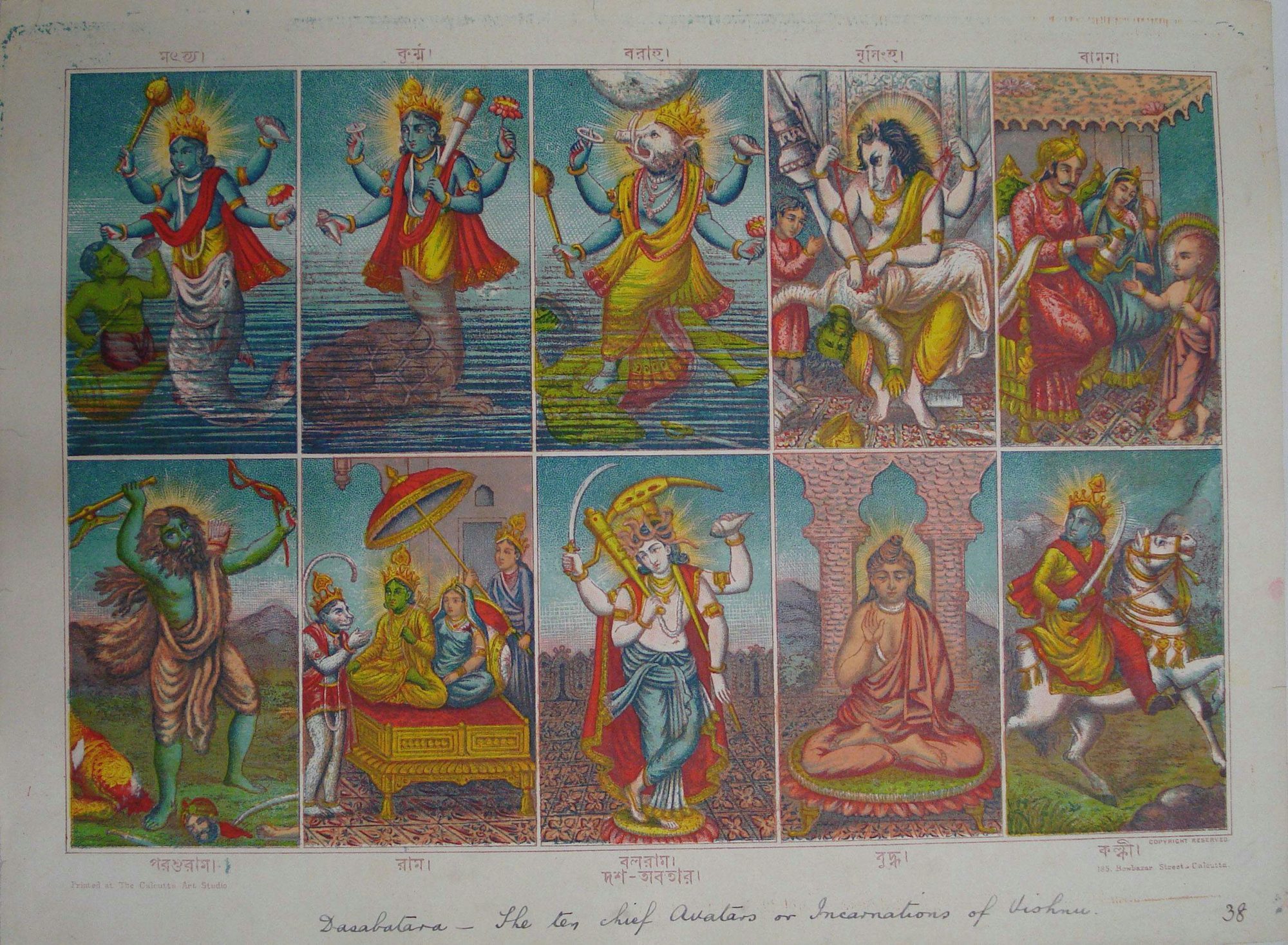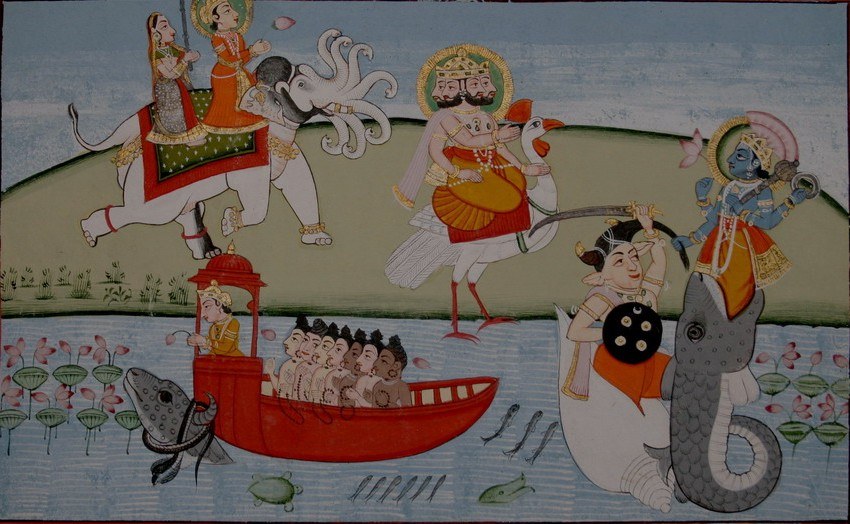
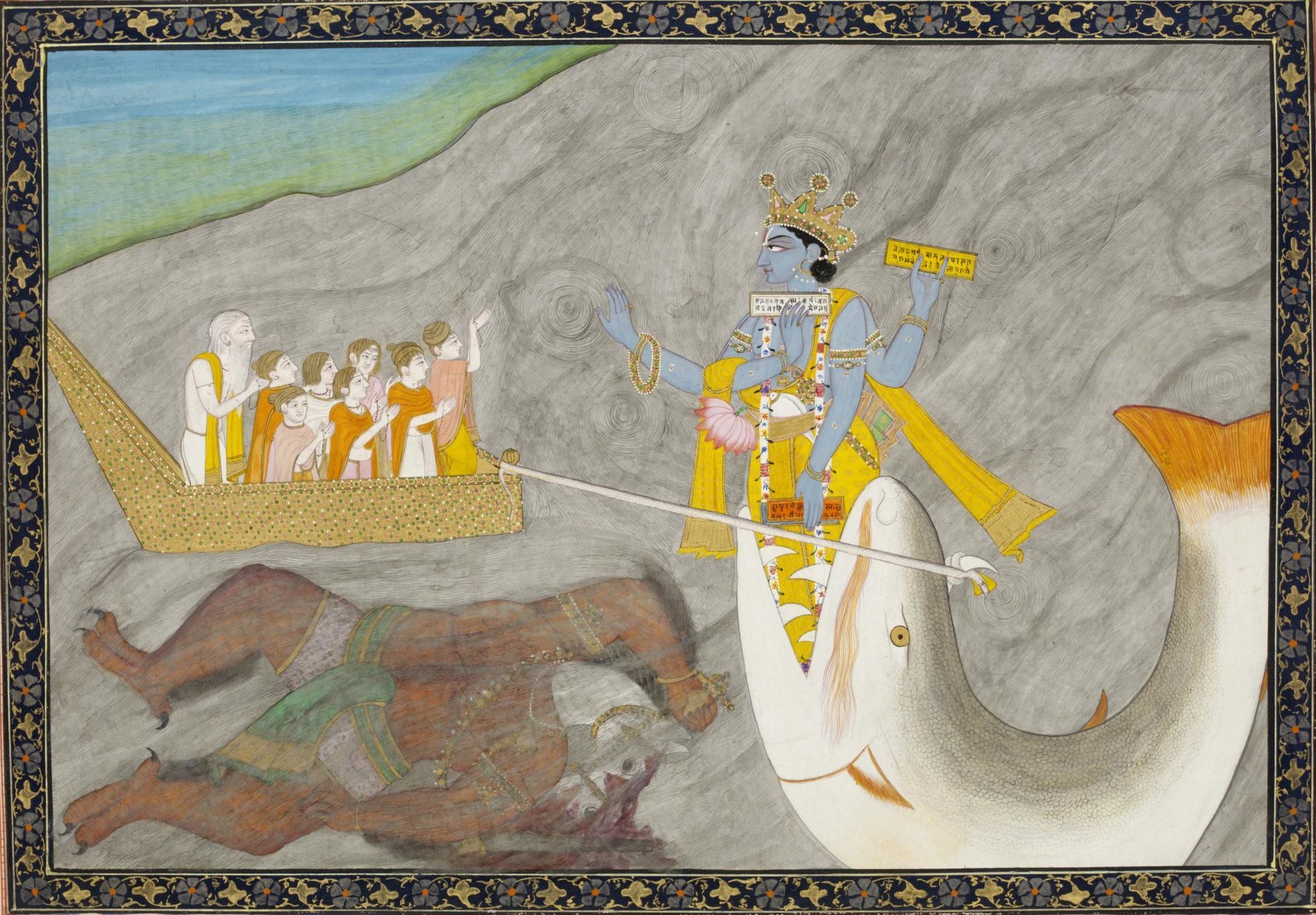
Water brought for ManuThe first man and sole survivor of the flood in Indian myth, from whom mankind is descended; in the epic and Purana he is Vaivasvata Manu, son of the Sun.’s morning washing held a talking fish, begging for its life and promising to save his. That bargain, struck at a riverbank while the man washes, is the seed of the whole Indian flood story. The fish grows past every vessel that holds it, warns of a deluge that will sweep the world clean. When the waters rise it comes back grown enormous and horned, and tows the lone survivor to a mountaintop. Devotion knows this fish as Matsya, the first of the ten descents of Vishnu, come down into the shape of a carp to preserve the seeds of life through the drowning of the world. But that name and that god are a thousand years younger than the story. In the oldest telling the fish has no name at all.
Rear me, I will save thee
The earliest form is stark and domestic. In the Śatapatha Brāhmaṇa, a late-Vedic ritual text set down around 700 to 600 BCE, water is brought to Manu one morning for washing, and a fish comes into his hands. It speaks a single blunt line: Rear me, I will save thee.
Manu asks from what, and the fish explains a plain terror of the small. As long as it stays little, it says, one fish devours another, and it needs protection to grow.
So Manu keeps it, first in a jar, then in a pit dug for it, and at last carries it down to the sea when it has outgrown the land. There is no divinity claimed here, no avatar, no god behind the scales. It is a bargain between a man and a helpless animal, and it holds because the man keeps his word.
The fish keeps its own. It tells Manu the year the flood will come and instructs him to build a ship and wait. When the water rises he boards, ties the ship’s rope to the horn the fish has grown, and is towed across the drowned world to a northern mountain. As the flood falls away he climbs down its slope, and the place is named Manu’s Descent for the man who came down there alone. The flood swept away all these creatures,
the text says, and Manu alone remained.
He is the last of humankind and the first of a new one.
A daughter drawn from butter and curds
What Manu does next, in this oldest version, has nothing to do with saved seeds or rescued sages. Wanting offspring, he makes an offering into the waters of clarified butter, sour milk, whey and curds. A year passes, and from the offering a woman rises, so bound to the rite that butter is said to have gathered in her footprint.
She is Iḍā, and through her Manu fathers the race that bears his name. The whole point of the oldest tale is her: an origin story for a woman and a sacrifice, with the flood as its dramatic setting rather than its subject. There is no ark full of species here, no crew of holy men, only one man, one fish, and the daughter he draws out of the water afterward.
When the fish becomes a god
Move forward through the centuries and the anonymous fish acquires first a rank and then a name, and the distance is large enough that it should be stated plainly. Roughly a thousand years separate the Śatapatha Brāhmaṇa from the Purana that finally calls the fish Vishnu, and across that gap the theology of the story is rebuilt.
In the Mahābhārata, whose relevant layers were composed somewhere between the fourth century BCE and the fourth CE, the ascetic is now Vaivasvata Manu, son of the Sun, and the fish that comes to him glistens like the rays of the moon.
It grows through an earthen vessel, a tank, the Ganga and the sea, then commands Manu to build a strong massive ark,
to load it with every kind of seed and to take aboard the seven Rishis, the ancient sages.
It tows them for many a long year
to the highest peak of the Himalaya, ever after called NaubandhanaThe mountain peak where the fish moors the ark, its name meaning 'the tying of the ship'; the Himalayan summit of the epic's telling., the tying of the ship. Only then does it name itself, and the name is not the one devotion expects: I am Brahma, the Lord of all creatures; there is none greater than myself. Assuming the shape of a fish, I have saved you.
The saving fish here is Brahmā, the creator, not Vishnu.
The identification with Vishnu is later still. In the Matsya Purāṇa, whose core belongs to roughly the third to fifth century CE, the fish is a tiny śapharī carp that drops into Manu’s cupped hands as he pours a tarpaṇaThe water-offering poured from cupped hands to gods and ancestors; the rite during which the tiny carp falls into Manu's palms in the Puranic version. libation to his ancestors on Mount Malaya.
As it swells past pitcher and well and tank and river and ocean, an awed Manu asks whether this is God, and it answers that it is, and he hails it by Vishnu’s names: Keśava, Hṛṣīkeśa, Janārdana. This fish foretells a lurid end of the world, a hundred years without rain, seven suns burning the earth, seven vast clouds drowning it, and it bids Manu save the seed of creation and the sacred Vedas in his boat.
For the towing-rope it takes Śeṣa, the cosmic serpent-king, in serpent form. The Purana is even framed as the sermon this fish-god preached to Manu on the water. Here at last is Matsya as the first of Vishnu’s avatars, and it is worth resisting the pull to read that identity back onto the older texts that plainly do not carry it.
Three floods, three renewals
The through-line is remarkably stable and the details are not, and the differences are more than ornament. The fish always asks protection while small, always outgrows its vessels, always grows a horn and tows the ark to a mountain by a rope. But who is saved, and how the world is repeopled afterward, changes with each telling. In the oldest, Manu alone survives and mankind is drawn from an offering as the woman Iḍā. In the epic, the seven Rishis ride with him and creation is restored from the seeds they carried.
In the Purana, it is the seed of creation together with the Vedas, the sacred knowledge itself, that the fish-god preserves through the fire and the flood. No single source holds all three. To braid the sages and the seeds and Iḍā into one crowded ark is to invent a scene no text describes. Each flood renews the world in its own way, and the fish that pulls the boat is by turns a nameless animal, the creator, and the preserver, depending on how many centuries you stand from the riverbank where it first begged to be reared.
The vessel reeled about like a drunken harlot. And neither land nor the four cardinal points of the compass could be distinguished. And there was water everywhere. And none but Manu, the seven Rishis and the fish could be seen. (Mahābhārata, Vana Parva CLXXXVI, tr. Kisari Mohan Ganguli)
- Śatapatha Brāhmaṇa I.8.1.1–11 (
The Iḍā
), trans. Julius Eggeling, Sacred Books of the East vol. 12 (Oxford, 1882)the oldest surviving form of the Indian flood myth. A fish comes into Manu’s hands as water is brought for washing and asks to be reared (Rear me, I will save thee!
), explaining that while smallfish devours fish
; it grows from jar to pit to sea, foretells the flood, and tows Manu’s ship by a rope tied to its horn to the northern mountain, whose slope is calledManu’s descent.
The fish is anonymous, no divinity stated, and the tale ends in the birth of Iḍā from Manu’s offerings of butter, sour milk, whey and curds. Late-Vedic, c. 700–600 BCE. - Mahābhārata, Vana Parva, Section CLXXXVI (
the Legend of the Fish
), trans. Kisari Mohan Ganguli (P. C. Roy ed.)Vaivasvata Manu, son of the Sun, at penance by the river Cīriṇī; the little fish glistenslike the rays of the moon
; it grows through vessel, tank, Ganga and sea, bids Manu build astrong massive ark,
embark with the seven Rishis andall the different seeds,
and tows themfor many a long year
to the peak Naubandhana; the flood in whichthe vessel reeled about like a drunken harlot.
The fish reveals itself as Brahmā:I am Brahma, the Lord of all creatures.
Epic accretion, c. 400 BCE – 400 CE. - Matsya Purāṇa, Chapters I–II, trans.
A Taluqdar of Oudh
, Sacred Books of the Hindus vol. 17 (Allahabad, 1916)a tiny śapharī carp falls into Manu’s cupped hands during a tarpaṇa libation on Mt. Malaya; it grows through jar, pitcher, well, tank, Ganga and ocean; hailed as Keśava, Hṛṣīkeśa, Janārdana, it is Vishnu. It foretells a hundred years of no rain, seven suns and seven doom-clouds, bids Manu savethe seed of creation and the sacred Vedas,
and takes Śeṣa the serpent-king for a rope. The Purana is framed as the fish-god’s own discourse to Manu in the boat. Here Matsya is the first of Vishnu’s ten avatāras. Puranic core, c. 250–500 CE.