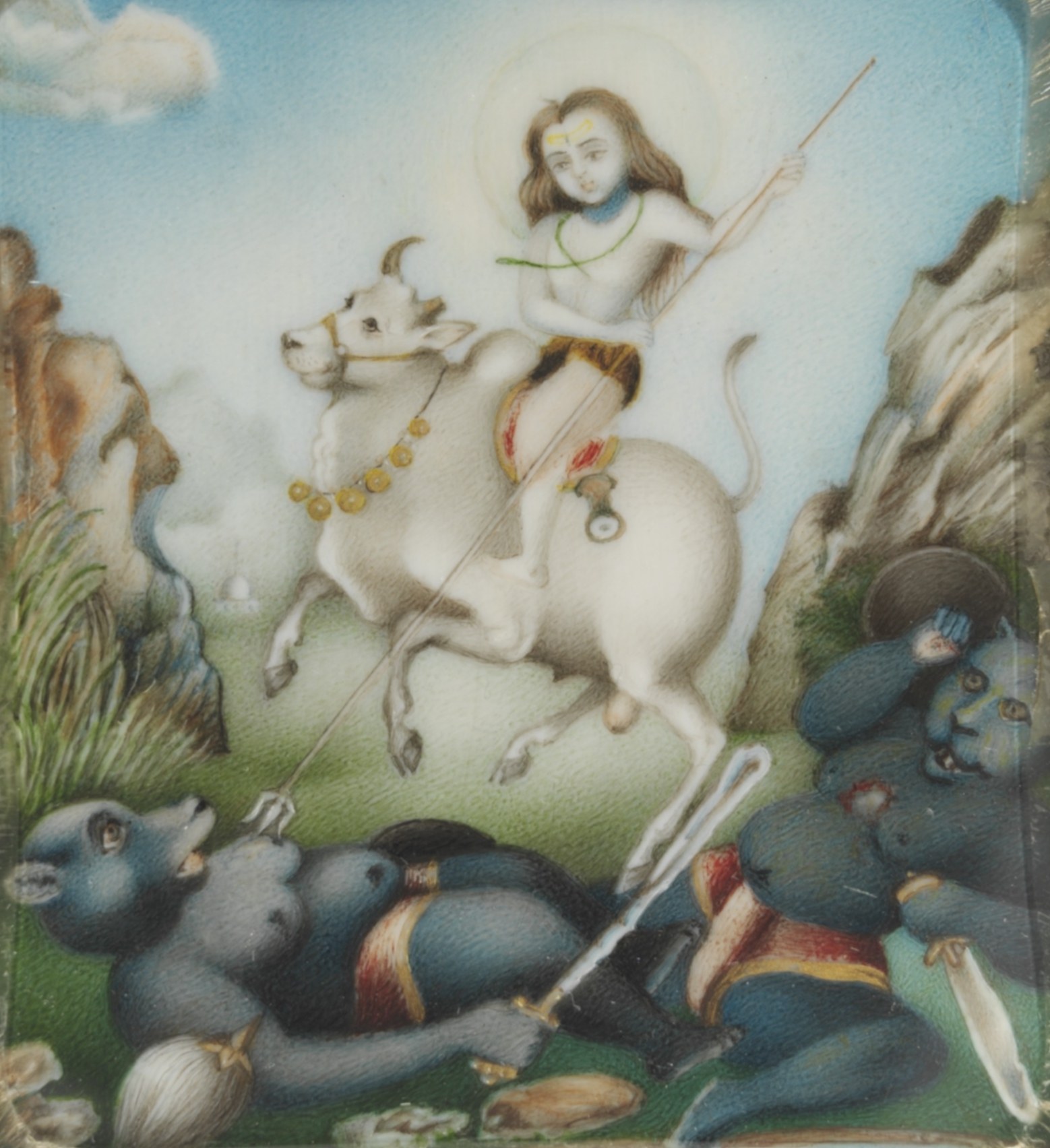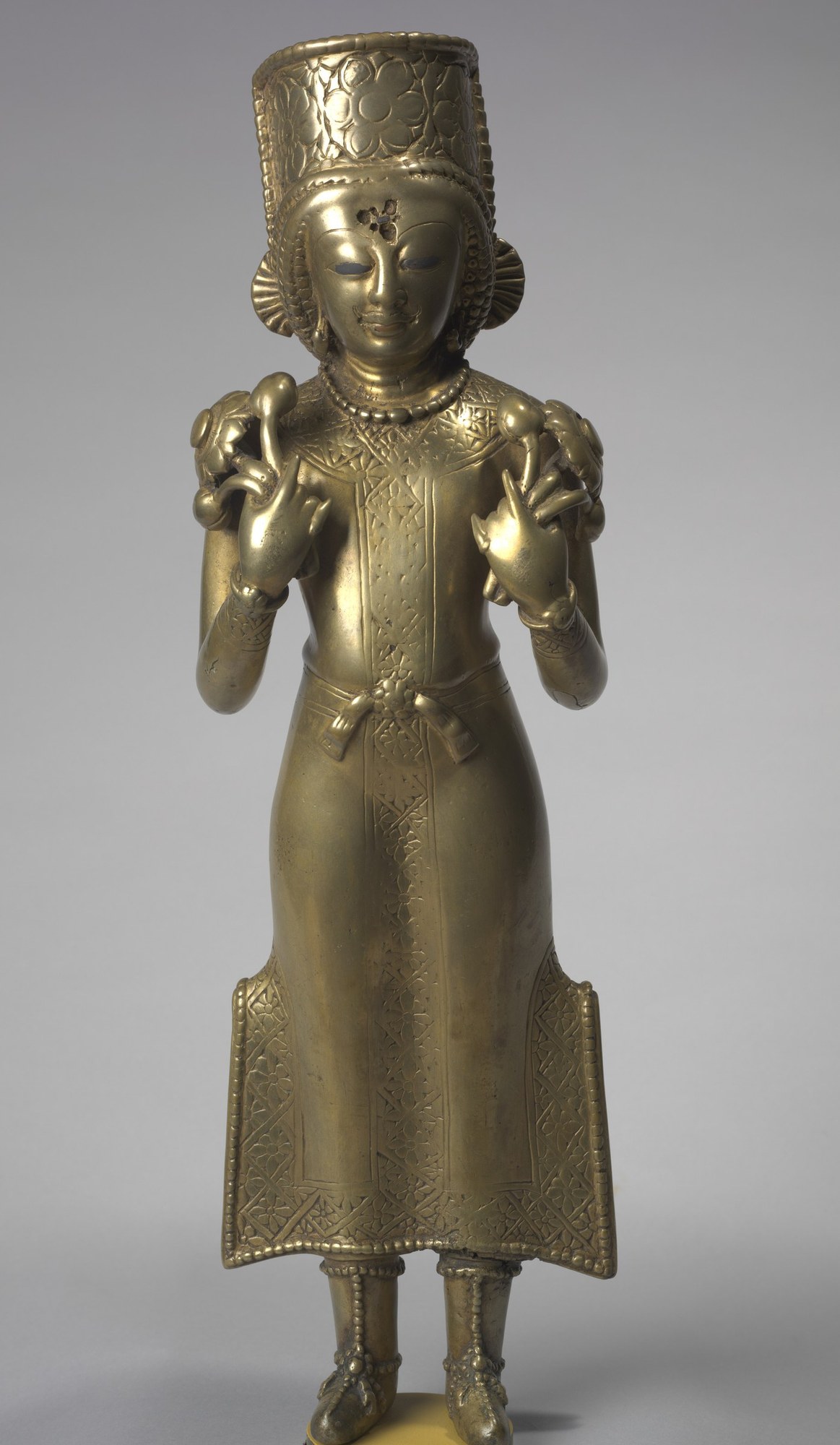
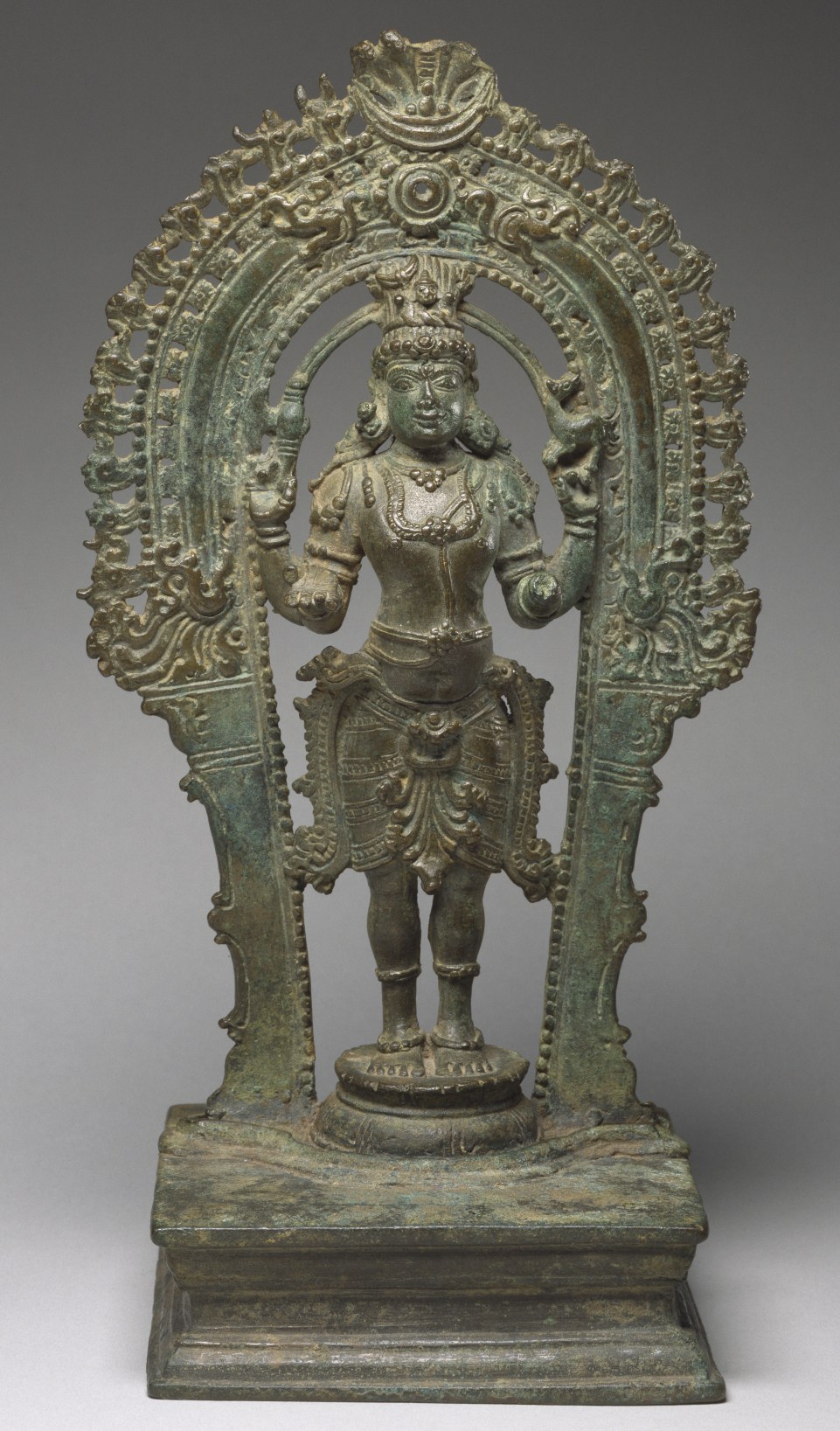
Far to the north, above the labour, a god sat still. While gods and demons hauled a serpent back and forth at the shore of the milk-sea, spinning a mountain to wring the nectar of deathlessness out of the deep, Śiva was not among them. He was seated on his own cold mountain with his consort beside him, sunk in penance, as far from the churning as calm is from frenzy. This is where the Bhāgavata Purāṇa chooses to begin the story of the poison, and the choice matters: it wants a god at rest, so that what he is about to do will read as something chosen rather than merely suffered.
What came up before the nectar
The churning was meant to yield amritaThe nectar of immortality the churning is meant to raise from the sea of milk; the poison comes up first, before any drinker is made deathless., the drink that makes its drinker deathless. It yielded something else first. As the two hosts wrenched VasukiThe serpent-king wound round the churning-mountain as a rope; wrenched back and forth, he vents the fire and fumes from which the poison is bred. the serpent-king to and fro for a rope, the strained snake vented fire and smoke from his mouth, and out of that torment the sea bred a venom. The oldest account, in the Mahābhārata, is blunt about what that meant. The poison Kālakūṭa blazed up like a fire attended with fumes,
and at its rising the three worlds were stupefied.
There was no drinker yet, no immortality won; the first thing the labour produced was a thing that could end the world before the reward was ever shared.
The later Bhāgavata lingers on the horror where the epic hurries past it. In its telling the venom is effervescent, irresistible, unbearable,
spreading in each and every direction, above and below,
and the creatures of the worlds, with nowhere to go, run to the one god who was not at the rope. They flee to Śiva on KailasaThe northern mountain where Śiva sits in penance with his consort, apart from the churning, when the terrified creatures come to him. and beg him for shelter. Already the two texts are doing different work. The Mahābhārata has a crisis to resolve; the Bhāgavata has a congregation to gather, and it gathers them at the feet of the god it means to exalt.
One line in the oldest telling
Watch how briefly the oldest version disposes of the rescue. In the Mahābhārata it is Brahmā who turns to Śiva, and the whole act is over almost before it begins: then Siva, being solicited by Brahman, swallowed that poison for the safety of the creation.
Then the single sentence that the entire cult of the blue-throated god hangs upon: The divine Maheswara held it in his throat, and it is said that from that time he is called Nilakantha, the blue-throated.
That is the load-bearing line, and it is an etymology first and a drama second. The epic is explaining a name. Something happened, the venom stayed in the throat, the throat went dark, and so the god carries the word for it. There is no scene, no speech, no hesitation. A god was asked, a god swallowed, a god got a name.
Roughly half a millennium to a full millennium separates that spare account from the Bhāgavata’s version of the same instant. The epic core took shape across a long window running to about the fourth century of our era; the Bhāgavata is a work of perhaps the ninth or tenth. In that gap the one-line rescue swells into a set-piece, and the difference between the two is the whole story of how a myth deepens under devotion.
The god says why
In the Bhāgavata nobody solicits Śiva. He decides, and he says why, and he says it to his wife. Before he drinks he turns to his consort, named across the passage as Satī, Umā, Pārvatī and Bhavānī all at once, one goddess under four names, and speaks to her almost as a man might justify a fatal errand to someone who has the standing to refuse it.
The protection of the afflicted,
he tells her, is the sole concern of those who are powerful.
Saintly persons, he goes on, protect the lives of beings by giving up their own. I, therefore, swallow up this poison. May blessings proceed from me to all the creatures.
Only then, with her approval, does he take it.
Everything the epic left implicit has been drawn out into the open. The bare fact that Śiva absorbs the poison becomes a reasoned act of self-sacrifice, spoken aloud, weighed by a god who calls himself powerful and concludes that power’s only meaning is to spend itself for the helpless. The consort’s assent is a purely Bhāgavata touch; the epic has no such dialogue, no such witness. What was an etymology has become a homily on why the strong owe their lives to the weak, and that homily is the reason the later telling is the one most people remember.
The stain that became an ornament
The two texts even part company over the wound. The Mahābhārata leaves it as an injury dressed up in a name. The Bhāgavata refuses to call it damage at all: the poison reduced his throat blue, though it became an ornament of that benevolent Deity.
The mark of the world’s death, on this god, is not a scar but jewellery. And here is a quiet honesty worth flagging, because the two texts do not perfectly overlap: the famous name Nīlakaṇṭha, the blue-throated, comes from the Mahābhārata line, not from this Bhāgavata chapter, which describes the blue throat without ever using the word. The etymology and the elaboration live in different books, and the tradition remembers them fused.
The latest telling adds one detail neither older text has, and it is the most physical of all. A little of the venom leaked down from Śiva’s palms as he drank, and that spillage did not vanish. It was conserved by scorpions, serpents, poisonous herbs and plants, cobras and other biting animals.
The single act of swallowing thus seeds the whole world’s smaller poisons; every sting and every venomous root is a drop the god could not quite contain. The Bhāgavata has turned a rescue into an origin story for venom itself.
Where the third witness sends the poison elsewhere
One text refuses the whole scene. The Vishnu Purāṇa, though it tells the churning in full, does not have Śiva drink at all. In Wilson’s translation of its running narrative the venom rises and poison was engendered from the sea, of which the snake-gods, the Nāgas, took possession.
No swallowing, no blue throat, no Nīlakaṇṭha; the serpents simply claim what is theirs by nature.
Curiously, Wilson’s own editorial footnote to that very passage records the swallowing tradition as the standard one, noting the first churned product as the Halahala or Kālakūṭa poison, swallowed by Śiva.
The editor knows the version the whole subcontinent tells; the text he is translating gives the poison to the snakes. So even the claim that the sources agree Śiva drank it
needs an asterisk. Two of the three witnesses put the venom in his throat; the third, in its actual words, hands it to the Nāgas and never names a blue-throated god at all.
What survives across the centuries, then, is not one fixed scene but a name and a gesture that the tradition kept re-explaining to itself. The epic gave the barest account and a word to hang it on. The devotional Purāṇa, a thousand years later, gave the god a reason, a witness, and an ornament where the wound had been. The same throat, darkened by the same poison, means something a little larger each time the story is told.
Then Siva, being solicited by Brahman, swallowed that poison for the safety of the creation. The divine Maheswara held it in his throat, and it is said that from that time he is called Nilakantha (blue-throated). (Mahābhārata, Ādi Parva, Āstīka Parva, Section XVIII, tr. Kisari Mohan Ganguli)
- Mahābhārata, Ādi Parva, Āstīka Parva, Section XVIII (trans. Kisari Mohan Ganguli, ed. Pratap Chandra Roy)the oldest witness read here and the sole source for the name. The poison Kālakūṭa that
blazed up like a fire attended with fumes,
by whichthe three worlds were stupefied
;then Siva, being solicited by Brahman, swallowed that poison for the safety of the creation
;the divine Maheswara held it in his throat, and it is said that from that time he is called Nilakantha (blue-throated).
A spare account: a solicitation, a swallowing, an etymology. - Vishnu Purāṇa, Book I, Chapter IX (trans. H. H. Wilson, 1840)the divergent witness. In Wilson’s translated narrative the poison is NOT drunk by Śiva —
poison was engendered from the sea, of which the snake-gods (Nāgas) took possession.
Wilson’s editorial footnote to the passage, by contrast, records the swallowing as the standard cross-tradition, listing the first product asthe Halahala or Kālakūṭa poison, swallowed by Śiva.
Cited for the divergence between the VP’s own text (poison to the Nāgas, no Nīlakaṇṭha) and the footnote’s record of the wider tradition. - Bhāgavata Purāṇa (Śrīmad Bhāgavata), Skandha VIII, Chapter 7 (trans. G. V. Tagare, Motilal Banarsidass)the latest witness and the fullest scene. Vāsuki’s fire and smoke; the
most deadly poison called Halāhala
(8.7.18) spreadingabove and below
; the creatures whoflew to Lord Sadāśiva for protection
(8.7.19); Śiva seated in penance with his consort on Kailāsa (8.7.20); his own words thatthe protection of the afflicted is the sole concern of those who are powerful… I, therefore, swallow up this poison
(8.7.38–40); the swallowing with the consort’s approval (8.7.41); the venom thatreduced his throat blue, though it became an ornament of that benevolent Deity
(8.7.42 — WITHOUT the name Nīlakaṇṭha); the leaked dropsconserved by scorpions, serpents, poisonous herbs and plants, cobras
(8.7.45). - Dating (composition, not translation)Mahābhārata core c. 4th c. BCE – 4th c. CE; Vishnu Purāṇa c. 4th–5th c. CE; Bhāgavata Purāṇa c. 9th–10th c. CE. The span from the epic’s line to the Bhāgavata’s set-piece is roughly half a millennium to a full millennium; the consort-dialogue, the self-sacrifice speech and the venom-aetiology are late elaborations, not the primordial form of the myth. Wilson’s VP footnote notes the Rāmāyaṇa and Mahābhārata as the oldest extant churning accounts.