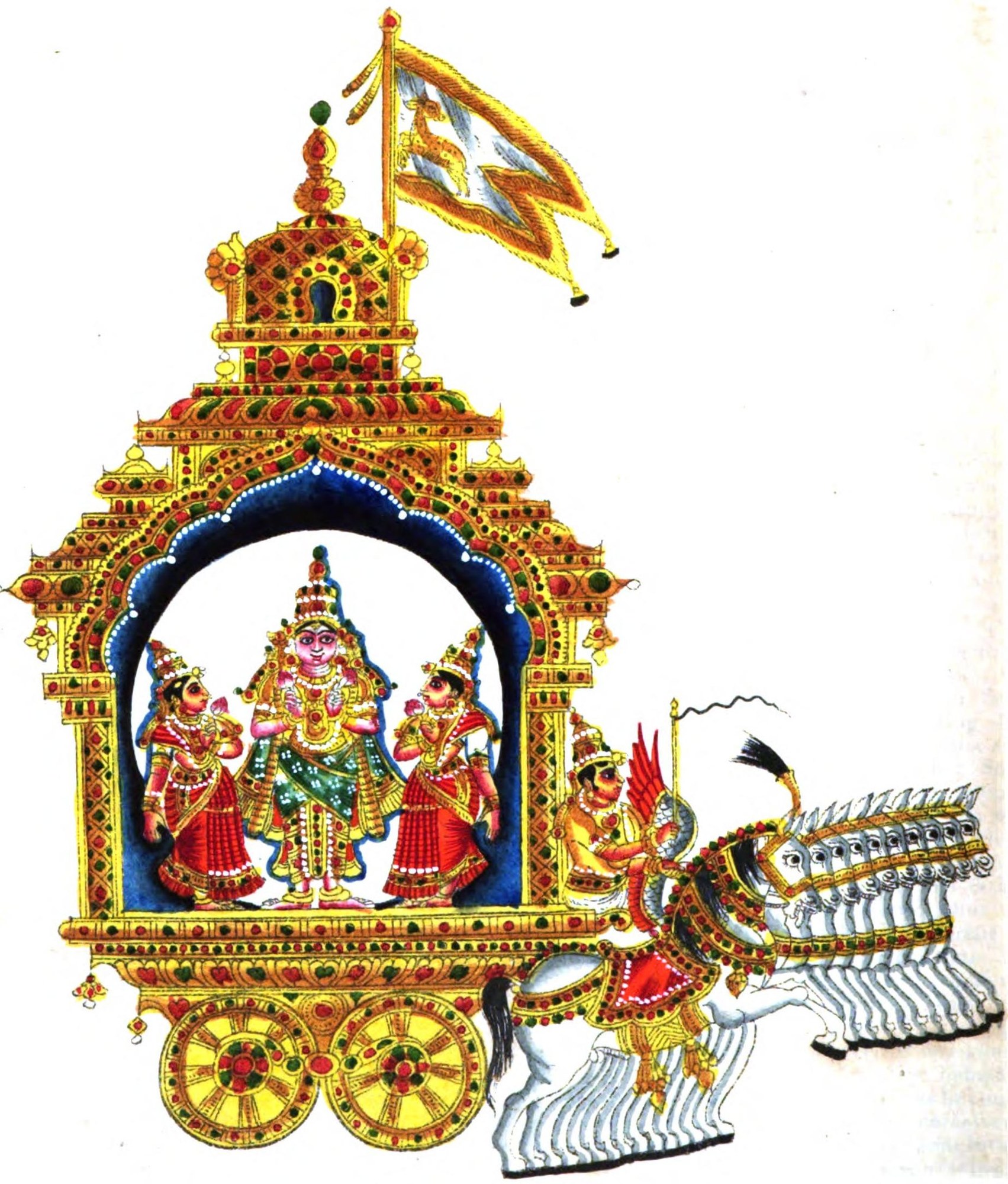
Ten fingers close on the stalk and crush it against the pressing-stones, and the juice runs out foaming. It falls through a stretched fleece of sheep’s wool that strains it clear, drop by drop, into a wooden vat, where it is mixed with cow’s milk until it is ready for a god to drink. That golden liquid, pressed and purified before dawn at the altar, is itself a god. The Rig Veda gives him the whole of its ninth book, one hundred and fourteen hymns in a single unbroken sequence, and hymns him above all under one recurring name: Soma Pavamana, Soma flowing-clear, the juice as it purifies itself in the straining. The singers do not describe the god from outside. They watch him being made, and sing to the liquid in the vat.
This is the strangest thing about Soma, and the first thing to hold on to: he is at once a drink, a plant, and a person, and the hymns move between the three without ever settling. In one line Soma is the stalk crushed under stones; in the next he is a king addressed with reverence; and behind both stands the drink itself, the thing poured out and swallowed. This is not a confusion the poets failed to resolve. It is the whole point. The god is not a figure who happens to have a sacred drink. The god is the drink.
The ten sister maids at the press
The pressing is described again and again, always in the same concrete images. The ten fingers that seize and squeeze the stalk are called ten sister maids of slender form, the virgins who send him forth; the woollen strainer is this eternal fleece; the vat is his iron-fashioned home, the wood in which he clamours like a newborn. Through all of it Soma foams and runs and is made clean, and the purpose is never in doubt. In the first hymn of the ninth book he is pressed out for Indra, for his drink, and the milk is folded in for the same reason: inviolable milch-kine round about him blend, for Indra’s drink, the fresh young Soma with their milk.
Indra is the great drinker, and nearly every hymn of the ninth book is pressed for his sake, because it is on Soma that the storm-king’s strength depends. In the wild raptures of this draught, one hymn says, Indra slays all the Vritras: the drink is what carries him into the fight against the dragon that dams the waters. Soma does not swing the thunderbolt. Soma is what a god drinks before he swings it.
We have drunk, and become immortal
But the draught is not only for gods. Its most famous promise is made to the man who drinks it. Outside the ninth book, in a single blazing hymn, the human singer speaks in the first person: We have drunk Soma and become immortal; we have attained the light, the Gods discovered. Now what may foeman’s malice do to harm us?
It is the most-quoted Soma line in the whole Rig Veda, and it is a claim about the drinker’s own body. The drops give freedom; they knit my joints as straps secure a car; they are asked to preserve me from disease, and the maladies feared, and passed away into the darkness. Soma heals and lengthens life as much as it intoxicates.
The god who does this is addressed as a person and a king: King Soma, a kind father, a wise Friend. And at the far end of the ninth book the singer asks him the greatest gift of all, a place in the deathless world. Make me immortal in that realm, the poet prays, where the light of heaven is set and everlasting lustre shines, where Yama the king of the dead holds court. Each verse of that wish falls back on one refrain: Flow, Indu, flow for Indra’s sake. The drink that makes the body immortal is the same drink poured into the vat at dawn.
A pillar that holds up the sky
The hymns reach past the altar, too. Soma is a far-extended pillar that supports the sky, the filled stalk that moves every way; from the animated cloud of butter and milk, one verse says, is amritaThe deathless drink of the gods, the nectar of immortality, which the Rig Veda's singers identify with the pressed Soma itself. produced, the centre of sacrifice. The drink pressed between two stones is also the deathless nectar of the gods and the axis of the world.
Bought from the sky, and called seed
There is a story of where Soma came from, but it is not in the ninth book. It belongs to a much later layer, the prose of the Shatapatha Brahmana, composed roughly five to eight centuries after the hymns and in a wholly different genre: not liturgical poetry but ritual commentary, a text already re-reading and systematising the old songs. The Brahmana is not a fellow witness standing beside the hymns; it is a late explainer, and its Soma myths are its own, not the ninth book’s.
In its telling, Soma dwelt in the sky and the gods on earth wanted him. Gayatri, the sacred metre in the shape of a bird, flew up and carried him off, but a GandharvaA class of Vedic celestial being, guardian of the heavenly Soma; in the later origin myth one of them steals the drink and has to be bought off. named Visvavasu stole him away. Knowing that the Gandharvas love women, the gods sent VacSpeech personified as a woman, whom the gods send to win Soma back from the Gandharvas in the Shatapatha Brahmana's story., Speech in a woman’s form, and she came back bringing Soma, on the bargain that Soma shall be yours, and Vac ours.
This story is a charter for a rite: it is why the Soma-plant, in the later sacrifice, must be ceremonially bought and then received as an honoured guest, driven in on a cart, unyoked, and feasted even as for a king. And the same book makes a flat identification the hymns never do, that Soma is seed, the generative essence itself, so sacred it must not be struck by the ghee-thunderbolt of the rite.
The moon he became
One thing the modern reader expects is barely here at all. We think of Soma as the moon-god, and in the later tradition he plainly is: Chandra, lord of the lunar mansions. But in the ninth book that equation is present only in germ.
The name Indu, the bright drop, will come to mean the moon, and one verse names the radiant moon in the deathless world; yet even there the Sanskrit rests on an adjective the old commentator Sayana read as the sun, and scholars still dispute which is meant. The clean statement that Soma is the moon belongs to the Brahmanas and the ages after them. In the hymns, Soma is first of all the drink: golden, foaming, strained through wool, and swallowed.
What is the plant? The Rig Veda never says. It gives a mountain-born stalk pressed between stones, and no botany. The modern guesses, a mushroom, an ephedra, a desert rue, are exactly that, modern guesses, attested nowhere in the ancient texts. The song is not about a species. It is about the moment the juice runs clear through the fleece and a god is poured into the cup.
We have drunk Soma and become immortal: we have attained the light, the Gods discovered. Now what may foeman’s malice do to harm us? (Rigveda 8.48.3, tr. Ralph T. H. Griffith, The Hymns of the Rigveda)
- Rigveda, Mandala 9 (Griffith trans., The Hymns of the Rigveda, Vol. II)the
Soma Pavamana
cycle, one hundred and fourteen hymns given almost wholly to the deified drink — the pressing between stones, theten sister maids
(the priest’s fingers) at the press, theeternal fleece
straining the juice clear, the wooden vat, the milk-mixingfor Indra’s drink
(9.1.1, 9.1.6–10); Soma asa far-extended pillar that supports the sky
and the source ofAmrit… centre of sacrifice
(9.74.2, .4); the great immortality wish,O Pavamana, place me in that deathless, undecaying world,
with its refrainFlow, Indu, flow for Indra’s sake
(9.113.7–11); and the close of the book namingKing Soma… the Sovran Ruler of the plants
(9.114). - Rigveda 8.48 (Griffith, same edition)the drinker’s own testimony —
We have drunk Soma and become immortal; we have attained the light, the Gods discovered
(8.48.3); the drops thatgive me freedom
andknit my joints as straps secure a car
and are prayed topreserve me from disease
(8.48.5); the maladies thatfeared, and passed away into the darkness
(8.48.11); and King Soma addressed askind father
andwise Friend
(8.48.4, .7, .9). - Shatapatha Brahmana III.2.4 (Eggeling trans., The Satapatha-Brahmana Part II, Sacred Books of the East Vol. 26)the later prose layer, roughly five to eight centuries after the hymns and a different genre — the origin myth in which Gayatri (the metre, as a bird) fetches Soma from the sky, the Gandharva Visvavasu steals him, and Vac (Speech), sent as a woman, ransoms him, with the bargain
Soma shall be yours, and Vac ours.
The charter for the ritualbuying
of the plant. - Shatapatha Brahmana III.4.1 and III.4.3 (Eggeling, same edition)the purchased Soma received
as his guest
and feastedeven as for a king or a Brahman one would cook a large ox or a large he-goat
(III.4.1.2); and the theological identificationSoma is seed
(III.4.3.11), a Brahmana-layer statement absent from the hymns.