The dead do not simply go. A person, the Chinese ritualists held, was a union of two souls, and death broke them apart. One rose. The bright, intelligent spirit, the shenThe bright, rising component of a person that survives death and issues forth on high, addressed in the temple as the ancestral spirit., lifted away from the body and was displayed on high in a condition of glorious brightness.
The other stayed. All the living must die,
the text says, and dying, return to the ground; this is what is called guiThe component that sinks with the body into the ground at death; in these texts the term slides between soul-of-the-dead and one of the living person's two energies..
The bones and the flesh mouldered down and became, in the same plain words, the earth of the fields. Two departures, in two directions, from one death. Everything the living then did in the lineage temple, the zongmiaoThe ancestral or lineage temple, the walled compound of inner apartments in which a family's honoured dead were housed as spirit-tablets and fed., was built to answer both.
That answer was an institution, and it is worth saying at the outset how far apart in time our witnesses to it stand. The oldest, the temple hymns of the Sacrificial Odes of Zhou, are Western-Zhou court liturgy from around the eleventh to tenth century BCE; Legge dated the occasion behind the hymn Qing miao
to roughly 1108 BCE. The tidy metaphysics of the two souls comes from the Liji, a Han-dynasty anthology edited in the first century BCE. Close to a thousand years separate the ode that describes the rite in motion from the treatise that explains what it means.
When a Han theorist and a Zhou hymn seem to agree, they are not two contemporaries nodding at each other across a table; they are voices a millennium apart. The doctrine of the rising and sinking souls is the late systematiser’s; the oldest hymns simply address the spirits as they come and go, and lay out no theory at all.
Why a house for the dead was built
The two-soul account was not idle speculation. The Liji draws the whole ancestral cult directly out of it: because a human being splits in two at death, the sages built temples with their different apartments, and framed their rules for ancestors who were always to be honoured, and those whose tablets should be removed.
The temple exists because the dead exist in two modes, and each mode has to be served.
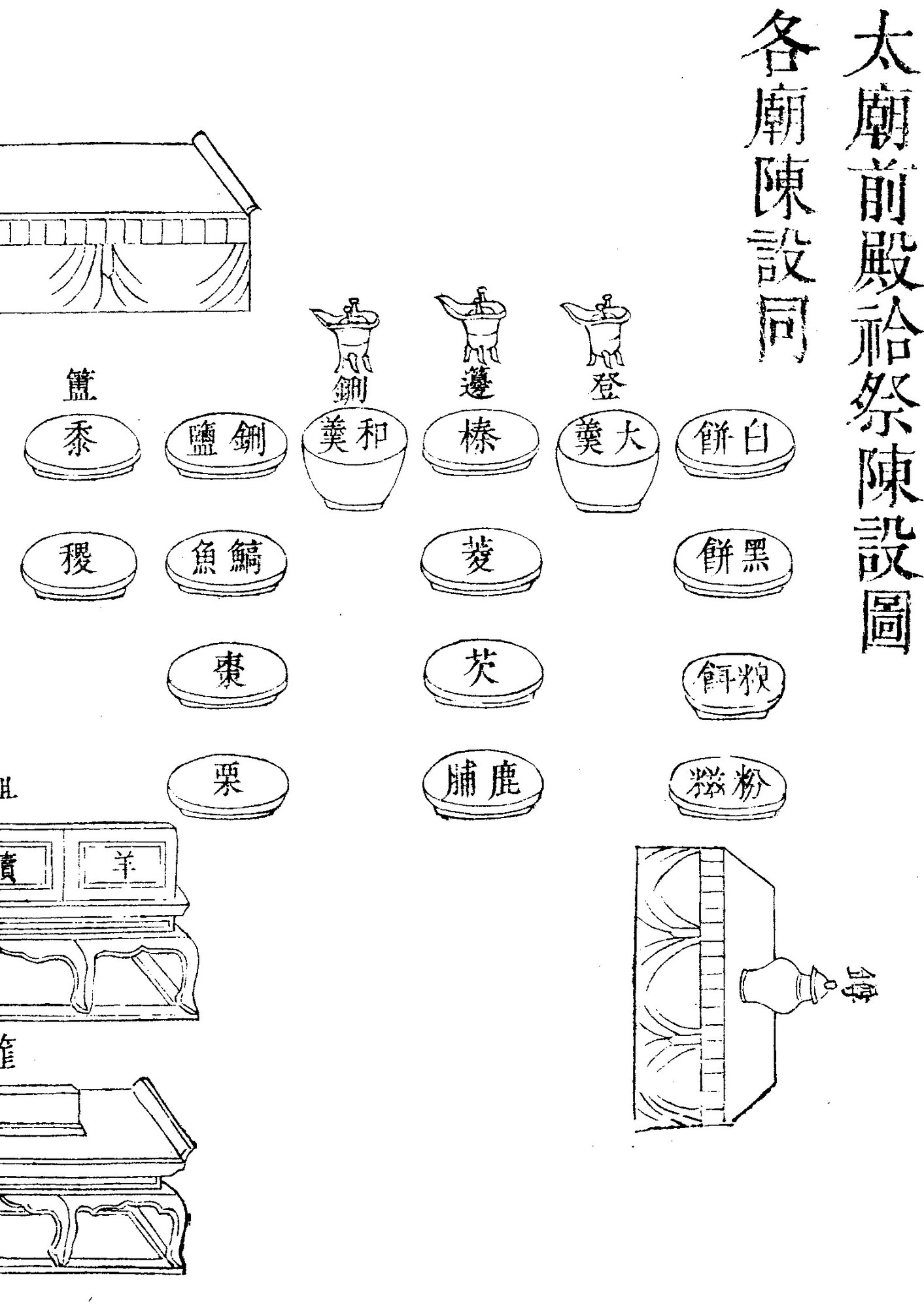
So the offerings came in matching pairs. The fat of the inwards was burned with fragrant southern-wood so that its scent would rise, a tribute climbing to the spirit that had gone up; and millet, rice, liquor and the choice organs, the liver and lungs and heart, were set out below as a tribute to the soul that had gone down. One gift ascended and one gift stayed on the mat, because the person they honoured had done both.
None of this belonged to everyone. Sacrifice in the ancestral temple was a graded privilege of rank, not a common right, and the Liji fixes the scale exactly. The king maintained seven ancestral temples; a feudal prince five; a great officer three; an officer of the highest grade two; a lesser officer one. Below them the line simply ran out: the mass of ordinary officers and the common people had no ancestral temple. Their dead were left in their ghostly state.
A commoner’s father did not become an honoured ancestor with a house and a season of his own. He became a ghost, unfed.
The register that kept moving
Even for those who had temples, the roll of ancestors was never fixed. Only the nearest generations held standing shrines. As the generations accumulated the older tablets were displaced, shifted back into the receptacles of the more remote ancestors, and the most distant of all were left with nothing but an altar or a cleared patch of ground, sacrificed to only if some specific need prompted a prayer, and otherwise left, again, in their ghostly state. The temple was a moving register of memory: a father crowded a grandfather back a place, and the founder alone sat permanently at the top. For the house of Zhou that apex was King Wen, the ancestral progenitor, with King Wu behind him.
The rhythm of it was disciplined. Sacrifices, the Liji warns, should not be frequently repeated,
for that breeds weariness and irreverence, nor should they be at distant intervals,
for that breeds forgetting. The gentleman offered the seasonal sacrifices of spring and autumn, and the turning weather itself moved him, until in the spring rite he felt as if he were seeing his departed friends.
Before the rite came the vigil, three days of inward fasting spent thinking of how the dead had sat, how they had smiled and spoken, what their aims had been, until the mourner-son could see them.
Then, on the day itself, entering the apartment where the tablet stood, he will seem to see the deceased in the place where his spirit-tablet is,
and moving about and leaving at the door will seem to be arrested by hearing the sound of his movements, and will sigh as he seems to hear the sound of his sighing.
The rite worked by summoning presence out of absence, and the tablet was the point at which absence agreed to be seen.
The grandson in the ancestor’s chair
At the centre of the rite sat a living person playing a dead one. The ancestor was impersonated by the personator of the dead, the shi, a designated kinsman, in the officer’s rite chosen by divination and ideally of a grandson’s generation, who took the ancestor’s seat, was fed the offerings, and spoke the ancestor’s blessing back to the family. This was no folk accretion or later theatre; it is attested across all three of the classics, sober and divinely sanctioned.
The Yili preserves the slow choreography of it: the personator washes his hands, ascends, is invited to sit, and the attendant hands him millet and lung, which he offers, waves, and tastes, course upon course, the liver raised after the third serving of grain, each morsel deposited with exactness. A grandson ate as his grandfather, so that the grandfather might be present to eat.
The whole occasion turned on an exchange, and the fullest picture of it is the oldest one, the ode Chu ci.
It begins in the field, clearing the thorny tribulus to plant the sacrificial millet, the barns filled and the stacks counted by tens of myriads.
Then the rite: We seat the representatives of the dead, and urge them to eat.
Some flay the victims, some cook; the officer of prayer sacrifices inside the temple gate to draw the approaching spirits near. And the ancestors come. Grandly come our progenitors; their spirits happily enjoy the offerings; their filial descendant receives blessing.
The living have fed the dead, and the dead answer.
What the spirits gave back
The answer was spoken aloud, through the personator and announced by the officer of prayer. In Chu ci
the verdict is delivered like a judgement returned: the spirits have enjoyed your spirits and viands,
and so they confer on you a hundred blessings; each as it is desired, each as sure as law.
Long life, myriad descendants, an abundant harvest, all of it laid on the filial descendant as a matter almost of contract.
Then the close, when the feast is done: The spirits have drunk to the full.
The personators rise, bells and drums escort their withdrawal, and the spirits tranquilly return to wherever they came from. Where that is, the ode does not say; a later commentator glossed it as heaven, but the words on the page leave the destination open.
The Yili gives the blessing its most concrete form, the guciThe formal blessing the personator commands the liturgist to carry back to the filial descendant, promising him riches, harvests, and a myriad years., in the ordinary officer’s rite. The personator commands the liturgist to pass it on: He calls you, filial grandson, to come near and receive riches from heaven. Sow these in your fields, and may you live in your descendants a myriad years, for ever and ever.
At which the descendant bows his head to the ground twice, tastes the blessed millet, and tips the rest into his left sleeve, keeping it shut with his little finger so as to carry the luck home in his clothing. The transaction is complete. The living have given food and reverence; the dead have given, through a grandson’s mouth, the grain and the years and the descendants that will one day kneel and feed them in turn.
Fragrant has been your filial sacrifice, and the spirits have enjoyed your spirits and viands. They confer on you a hundred blessings; each as it is desired, each as sure as law. (Shijing, Xiaoya, “Chu ci”)
- Liji (Book of Rites 禮記),
Ji fa
祭法 (The Law of Sacrifices) = Li Ki Book XX — trans. James Legge, *The Sacred Books of ChinaThe Li Ki*, Sacred Books of the East vol. 28 (Oxford, 1885). The source of the graded temple hierarchy above (seven temples for the king, five for a feudal prince, three for a great officer, two and one for the lesser grades, none for the common people,their dead left in their ghostly state
), the displacement of tablets into the receptacles of the remote ancestors, the founder’s permanent place, and King Wen and King Wu as the Zhou apex ancestors. Han recension (1st c. BCE) of older material. - Liji (Book of Rites 禮記),
Ji yi
祭義 (The Meaning of Sacrifices) = Li Ki Book XXI — Legge, SBE 28 (1885). The source of the two-soul doctrine (the bright spiritdisplayed on high,
the flesh thatmoulders below
to becomethe earth of the fields
), the derivation of the temple institution from it, the two matching offerings (the rising fragrance of burned fat with southern-wood, the millet and liquor and organs set below), the rule against sacrifice too frequent or too rare, the spring and autumn seasons, the three-day vigil, and the vision of the deceased at the spirit-tablet (he will seem to see the deceased… and will sigh as he seems to hear the sound of his sighing
). Han recension. - Shijing (Book of Odes 詩經),
Zhou song
周頌 (Sacrificial Odes of Zhou), OdeQing miao
清廟 — trans. James Legge, The She King, Sacred Books of the East vol. 3 (Oxford, 1879). The temple-stillness hymn; Legge assigns the occasion to c. 1108 BCE (King Cheng’s sacrifice to King Wen at the completion of the city of Lo). Cited here as the oldest layer of witness against which the Han metaphysics is dated. Western-Zhou court liturgy, c. 11th–10th c. BCE. - Shijing (Book of Odes 詩經),
Xiaoya
小雅 (Minor Odes), OdeChu ci
楚茨 — Legge, SBE 3 (1879). The fullest verbatim account, and the source of the offering feast abovethe clearing of tribulus and the millet planted, the barns and the stackscounted by tens of myriads,
We seat the representatives of the dead, and urge them to eat,
the officer of prayer sacrificing inside the temple gate, the progenitors whohappily enjoy the offerings,
the spoken verdict (a hundred blessings; each as it is desired, each as sure as law
), and the close (The spirits have drunk to the full… the spirits tranquilly return
). Thereturn to heaven
is a commentator’s gloss (Zheng Xuan, per Legge), not the ode’s own words. Later stratum, c. 9th–7th c. BCE. - Yili (Etiquette and Ceremonial 儀禮),
Shi yu li
士虞禮 (The Sacrifices of Repose for an Ordinary Officer) — trans. John Steele, The I-Li, or Book of Etiquette and Ceremonial (London, 1917). The source of the personator’s eating sequence (washing, ascending, being handed millet and lung, offering, waving, tasting course by course, the liver raised after the third serving of grain). Warring-States compilation, c. 5th–3rd c. BCE. - Yili (Etiquette and Ceremonial 儀禮),
Tesheng kuishi li
特牲饋食禮 (When the Single Beast is Presented as Food to the Ancestor) — Steele (1917). The ordinary officer’s periodic sacrificethe divining of the day and the personator, and the guci blessing the personator commands the liturgist to carry (come near and receive riches from heaven… may you live in your descendants a myriad years
), with the descendant’s double kowtow, his tasting of the blessed millet, and his tipping the rest into his left sleeve. Warring-States compilation.