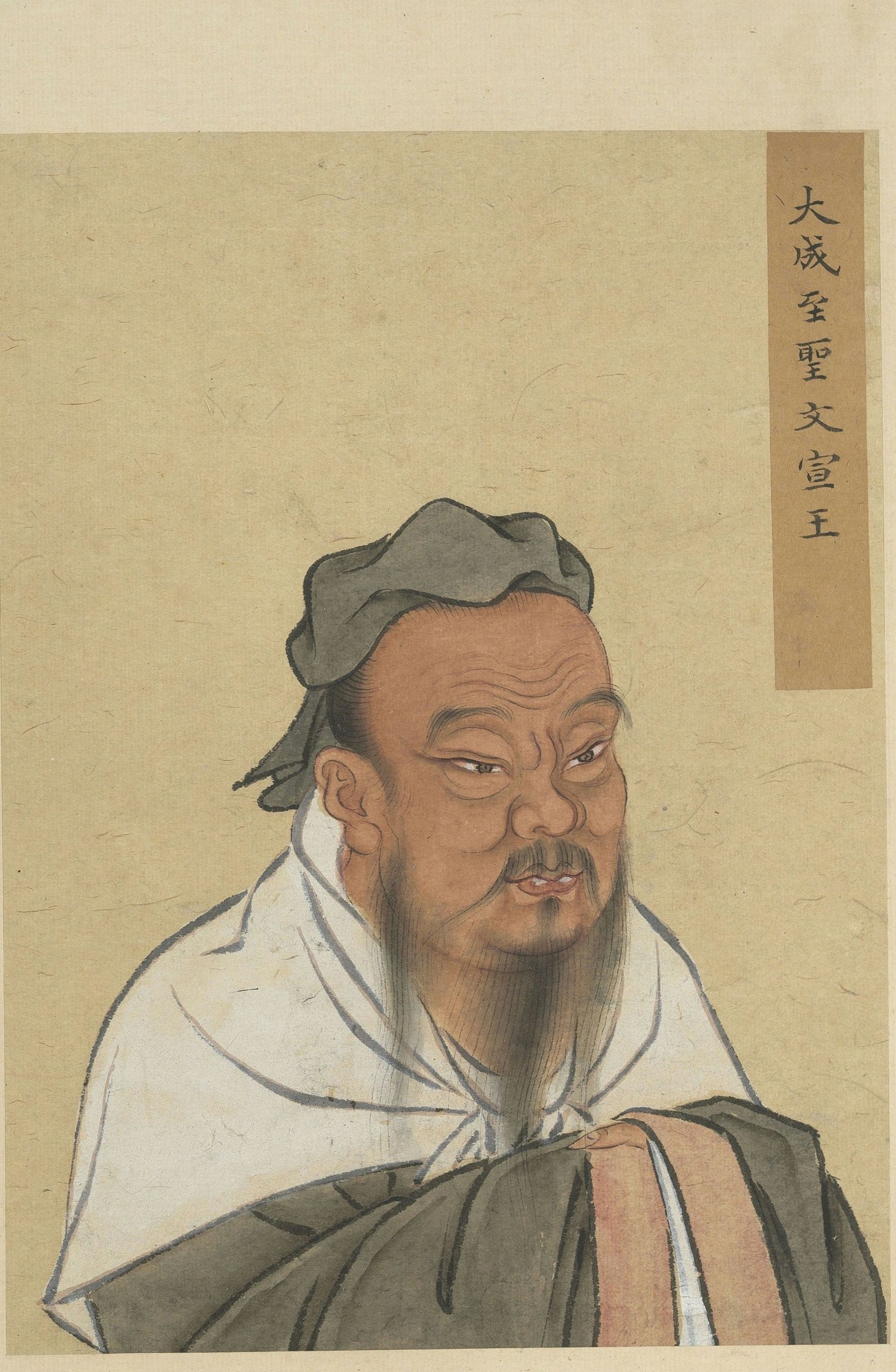
A disciple named Fan Chi once asked the Master the largest question in the whole tradition, and got the shortest answer in it. He asked what ren was, the virtue that Confucius held above every other, the thing he spent a lifetime pointing at and almost never found fully realised in a living person. Two graphs came back: 愛人. Love others. That is all. The summit of the moral life, the quality so exacting that Confucius would not certify even the ancient sage-kings as having reached its full measure, is named in the space it takes to say two syllables. The brevity is not evasion. It is the whole paradox of ren in miniature: a thing set impossibly high and lying impossibly near, at once the work of a lifetime and one act of the will away.
Two graphs for the summit of virtue
The word itself resists translation. James LeggeJames Legge (1815 to 1897), the Scottish missionary-scholar whose public-domain Victorian translation of the Confucian classics carries most of the English quoted here., whose Victorian English still carries most of these lines into our own, called ren perfect virtue
and benevolence.
Later hands have tried Goodness,
humaneness,
authoritative conduct,
co-humanity.
None is wrong and none is quite right, because there is no English word for a quality that means, at once, the finest thing a person can be and the ordinary decency of treating a stranger as a fellow human. This retelling uses humaneness,
and the reader should hold it loosely: one choice among several, not the meaning of ren but a handle on it.
There is a story people love to tell about the character, that the graph is built from the sign for person
set beside the sign for two,
so that ren means, at root, two people together, humanity as the space between selves. It is a lovely reading and a genuinely old one, and it captures something true about the doctrine.
But it is a reading of the written character by later commentators, not a claim Confucius makes anywhere in the Analects, and it is worth keeping the two apart. What Confucius actually says is plainer and harder. Asked by his favourite disciple Yan Yuan, he defines ren as subduing the self and returning to propriety, and adds a question that turns the whole enterprise inward: is the practice of it from a man himself, or is it from others?
Even Yao and Shun found it hard
That question is the door into the first half of the paradox, which is that ren is set almost out of reach. Confucius is famously stingy with the word. When his disciple Zigong asked whether a ruler who conferred benefits broadly and could relieve the whole people might be called humane, the Master would not even keep the conversation at that level: why speak only of ren, he answered, such a man would surely be a sage, and even Yao and Shun found this hard.
Yao and Shun are the legendary perfect kings of high antiquity, the tradition’s own measuring-stick for goodness. To say that even they fell short of the full standard is to set the ceiling higher than the highest thing the culture had.
He is no more generous with the living. Asked in turn whether the capable disciples Zilu, Ran Qiu and Gongxi Hua were humane, Confucius grants each of them real, specific competence, this one could run a state’s military, that one could manage its administration, and then declines each time to go further: I do not know that he is ren. Asked whether a famously loyal minister and a famously pure-minded one had reached it, he allows the loyalty and the purity and still refuses the name.
Loyalty is not yet humaneness; neither is incorruptibility. The one person he comes near to praising is Yan Hui, the beloved disciple who died young, and even there the praise is fenced with a clock: Hui’s heart does not depart from ren for three months together, while the rest attain it for a day, or a month, and no longer. Three months is the ceiling for the best of them; for everyone else the virtue flickers in and out like a held breath.
I desire it, and it is here
And then, without warning, the same Master who withholds the name from sage-kings turns and says the opposite. Is virtue a thing remote? I wish to be virtuous, and lo, virtue is at hand. The Chinese is even more startling in its compression: 我欲仁,斯仁至矣, I desire ren, and ren has arrived. The summit that even Yao and Shun could not fully scale is, it turns out, one movement of the will away. There is no contradiction here, only the deepest thing Confucius has to say about the moral life.
Ren is hard the way a lifetime is hard, not the way a locked door is hard. Nothing external bars it. He says as much twice over: the practice of it is from oneself and not from others, and, more bluntly, he has never once seen the man whose strength was insufficient for ren for a single day. The obstacle is never ability. It is only ever will. The virtue is far because we do not reliably want it, and near because the instant we do, it is already present.
This is why the definition given to Fan Chi can be two graphs long. Ren is not a body of doctrine to be mastered before one may begin. It is a direction the heart can turn at any moment, in any encounter, and the turning is the thing itself.
The one word to live by
If ren were only an inward posture it would stay private. What makes it a virtue of being fully human is that it faces outward, toward the person in front of you, and Confucius gives it a working shape twice, in a positive form and a negative one. The positive is expansive: the humane person, wishing to establish himself, establishes others; wishing to be enlarged himself, enlarges others. To judge others by what is near in oneself, he says, that may be called the method of ren. What you want for yourself, you want for them, and you act on it.
The negative form is the one Confucius names as the single word to live for. When Zigong asked whether there was one word that could serve as a rule of practice for a whole life, the Master answered with shuReciprocity: the rule Confucius names as the single word to live by, 'what you do not want done to yourself, do not do to others'., reciprocity, and unpacked it in five graphs that have travelled the world: 己所不欲,勿施於人, what you do not want done to yourself, do not do to others.
It is the older cousin of the golden rule, cast as a restraint rather than a command, a fence around harm rather than a spur to good. The Analects holds both the fence and the spur, the do-not and the do, and it is worth being exact about which is which, because popular retellings tend to quote the warm positive version and forget that the word Confucius himself picked as the one to live by is the cautious negative one. Humaneness begins in what you are willing not to do.
The whole teaching, one of his disciples believed, hung on this single thread. Confucius once told his students that his way was strung together by one unifying principle and left the room; when the others asked what he had meant, it was Zengzi who supplied the gloss they have carried ever since, that the Master’s way was nothing more than zhong and shu, being true to oneself and extending that truth to others.
These are Zengzi’s words about Confucius, the earliest and most authoritative reading of the one thread,
not a definition from the Master’s own mouth. But it has stood for two and a half thousand years because it fits: conscientiousness turned inward, reciprocity turned out, and humaneness the name for the two together.
Kill the self to complete it
None of this is soft. The virtue that arrives the moment you want it is also the one Confucius says you must never set down, not for the length of a single meal. In moments of haste the superior man clings to it; in seasons of danger, tripped up and falling, he clings to it still. It is a domestic yardstick and a brutal one at once, measured in the time it takes to eat, and holding even when the world comes apart.
At its furthest edge it costs everything. The determined scholar and the man of ren, Confucius says, will not seek to live at the expense of injuring ren; there are those who will sacrifice their lives to keep it whole. Four graphs of that saying, 殺身成仁, kill the self to complete ren, became an idiom the Chinese language still uses for principled self-sacrifice.
One caution the tradition itself insists on. This is not a doctrine of loving everyone alike. Confucian humaneness is rooted in the family and radiates outward through the graded bonds of kin and rank and rite; it begins with those nearest and reaches the stranger by extension, not by erasing the difference between them. A rival school, the MohistsFollowers of Mozi, a rival school who preached impartial love for all alike and attacked the Confucians for making humaneness begin with one's own kin., would later attack Confucians on exactly this point and preach an impartial, undifferentiated love in its place. To read ren as that impartial love is to mistake it for the doctrine of its opponents. It is the humaneness of a particular person toward a particular other, learned at home and carried out into the world, one encounter at a time.
Which returns us to Fan Chi and his two-word answer. Love others. It is the honest floor and ceiling of the thing at once: a virtue so high that Confucius would not grant it to the sage-kings, and so near that it is present the instant one turns toward the person in the room and wishes them well.
Fan Chi asked about benevolence. The Master said, “It is to love all men.” He asked about knowledge. The Master said, “It is to know all men.” (Analects 12.22, tr. James Legge)
- Analects (論語) 12.22 (Legge XII.22) — Fan Chi asks about ren; the Master answers in two graphs, 愛人,
to love others,
pairing it with wisdom asto know others.
The central definition. ChineseWikisource 論語/顏淵第十二. English: James Legge, The Chinese Classics vol. 1, Confucian Analects (1861, rev. 1893), Bk XII ch. 22. - Analects 6.30 (Legge VI.28) — the sage/ren distinction (
even Yao and Shun found it hard
) and the positive rule (wishing to establish himself, establishes others… the method of ren
). ChineseWikisource 論語/雍也第六; Legge Bk VI ch. 28. - Analects 7.30 (Legge VII.29) —
Is virtue a thing remote? I wish to be virtuous, and lo! virtue is at hand
(我欲仁,斯仁至矣). ChineseWikisource 論語/述而第七; Legge Bk VII ch. 29. - Analects 12.1 (Legge XII.1) — Yan Yuan; ren as
subduing the self and returning to propriety
(克己復禮), andis the practice of it from a man himself, or from others?
ChineseWikisource 論語/顏淵第十二; Legge Bk XII ch. 1. - Analects 12.2 (Legge XII.2) — Zhong Gong; reverence and the negative rule, 己所不欲,勿施於人. ChineseWikisource 論語/顏淵第十二; Legge Bk XII ch. 2.
- Analects 15.24 (Legge XV.23) — Zigong asks for one word for a lifetime; the Master gives shu (恕), reciprocity, glossed as the negative rule. ChineseWikisource 論語/衞靈公第十五; Legge Bk XV ch. 23.
- Analects 4.15 (Legge IV.15) — the
one thread
(一以貫之); Zengzi’s gloss that it is zhong and shu (忠恕). ChineseWikisource 論語/里仁第四; Legge Bk IV ch. 15. - Analects 4.5 (Legge IV.5) — the superior man does not depart from ren
for the space of a single meal,
clinging to it in haste and in danger. ChineseWikisource 論語/里仁第四; Legge Bk IV ch. 5. - Analects 4.6 (Legge IV.6) — no one who applies his strength to ren has been found to lack the strength for it. ChineseWikisource 論語/里仁第四; Legge Bk IV ch. 6.
- Analects 6.7 (Legge VI.5) — Yan Hui’s heart does not depart from ren
for three months together
; the rest reach itfor a day or a month.
ChineseWikisource 論語/雍也第六; Legge Bk VI ch. 5. - Analects 5.8 & 5.19 (Legge V.7 & V.18) — Confucius declines to certify the disciples Zilu, Ran Qiu and Gongxi Hua, and the ministers Zi Wen and Chen Wenzi, as ren (
I do not know that he is ren
). Chinese read verbatimWikisource 論語/公冶長第五; Legge’s English of these two paraphrased from the Chinese this pass, numbering V.7/V.18 per the standard mapping. - Analects 15.9 (Legge XV.8) — the man of ren
will sacrifice his life to preserve ren complete
(殺身成仁). ChineseWikisource 論語/衞靈公第十五; Legge’s exact English of XV.8 not read word-for-word this pass, so the rendering here is a faithful standard translation rather than a verbatim Legge quotation. - Analects 12.3 (Legge XII.3) — Sima Niu; the man of ren
is cautious and slow in his speech
(其言也訒). ChineseWikisource 論語/顏淵第十二; Legge Bk XII ch. 3. - Numbering. This piece follows the D. C. Lau / Chinese Text Project chapter count. Legge’s numbering, which his quoted English carries, differs by a verse or two in several books (6.30 = VI.28, 7.30 = VII.29, 15.24 = XV.23, 6.7 = VI.5, 15.9 = XV.8); the Legge chapter is bracketed above. These are the same verses under two editions, not different ones.
- Editions. Original Chinese from Chinese Wikisource (zh.wikisource.org), 論語 subpages, public-domain classical text. English from James Legge, The Chinese Classics, vol. 1, Confucian Analects (OxfordClarendon, rev. 1893; 1st ed. 1861), public-domain, via English Wikisource. Legge’s diction (
perfect virtue,
superior man
) is Victorian and is quoted as his; where his exact English of a verse was not read word-for-word this pass, the rendering is flagged above as a faithful standard translation, not a Legge quotation.