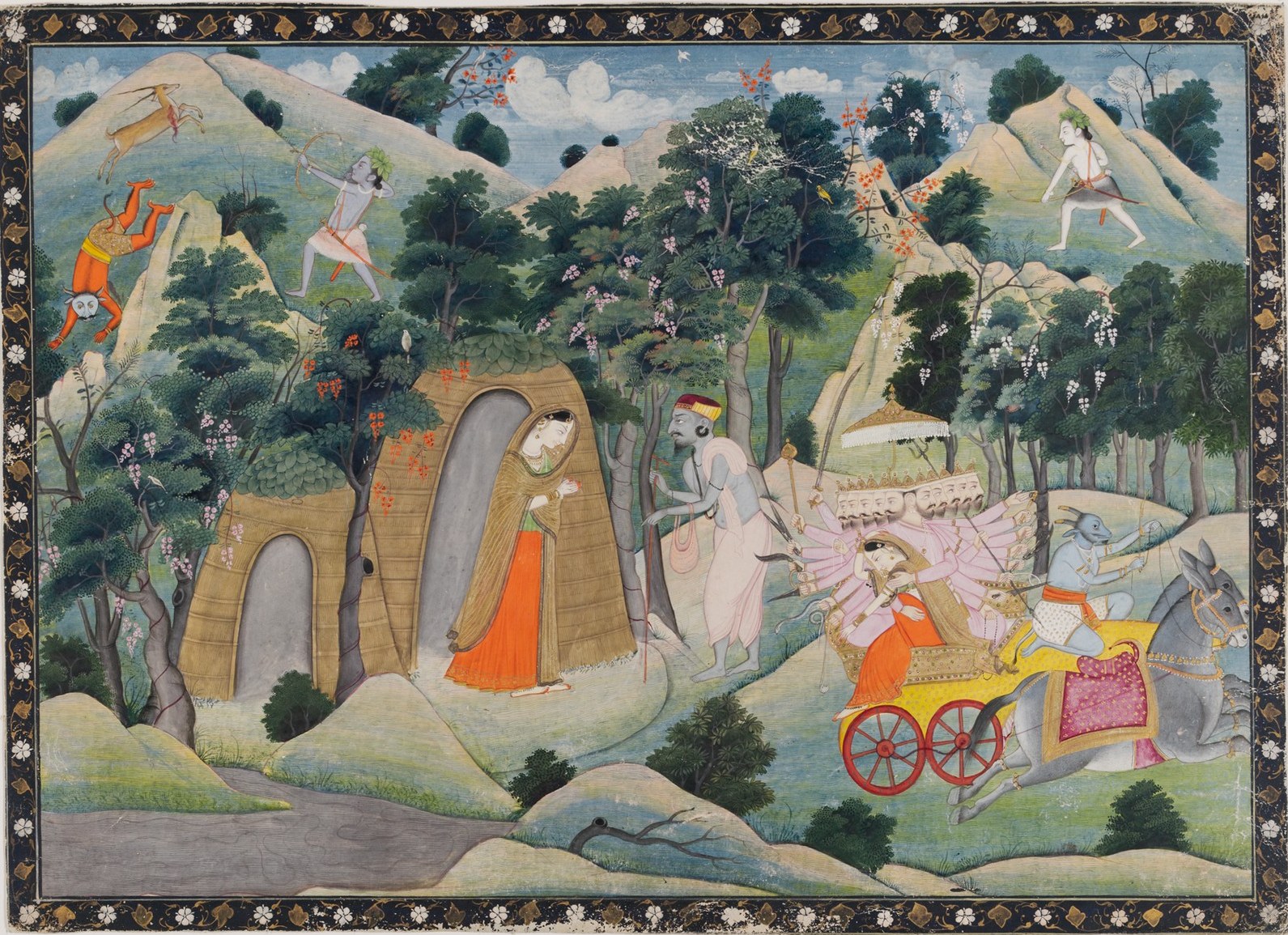
The demon was already afraid before the plan was spoken aloud. Ravana, king of Lanka, had come to Maricha to press him into a scheme, and Maricha, who had felt the edge of Rama’s power before, tried to talk his way out of it. He who opposes Rama, he warned, will not return alive; for you he will prove the Rod of Death. But there is no refusing the ten-necked lord of the rakshasaA shape-shifting flesh-eating spirit of Hindu myth, rendered "titan" in Shastri's translation; Ravana is their king. when his mind is set.
Maricha bent his head and gave the only answer left to a cornered servant. May prosperity attend you, O Ranger of the Night, he said, and went to his death as a work of art. The two of them rose into a winged chariot harnessed to mules with goblins’ heads and flew to the Dandaka forest, where a wife was gathering flowers outside Rama’s hermitage.
A deer with a mouth like a red lotus
Maricha did not merely become a deer. He became the most beautiful deer that had ever grazed the earth, a creature that existed nowhere in nature. His horns were tipped with gems. His hide was dappled and silver-spotted, his belly a sapphire hue, his hooves like emerald, his ears washed with azure, and his mouth was like a red lotus. He walked out before the hermitage and described a thousand frolicsome circles in the grass, close enough to be seen, never close enough to be caught, and Sita, looking up from her flowers, was lost the moment she saw him.
She called for Rama and Lakshmana at once. Lakshmana knew the thing for what it was. Undoubtedly the titan Maricha has assumed the form of a deer, he said; such a deer does not exist on earth; it is an illusion, born of cunning. But Sita would not be argued out of her longing. She wanted the creature alive, as a plaything for their forest home, and if it could not be taken alive then she wanted its golden skin to sit upon. Rama, charmed himself, chose to indulge her. He took up his bow, told Lakshmana to stay and guard her, and went after the deer.
The voice that was not his
The deer led him a long way. It feigned exhaustion and sank into the grass, then sprang up and bounded on; it mingled with real herds and vanished, then flickered back into view in a far-off thicket, drawing Rama deeper the way stray autumn clouds cross and re-cross the moon. At last Rama understood he was being played, and loosed an arrow fashioned by Brahma himself. It went through Maricha’s heart. And as the demon fell he did the one thing his death was for. He threw his voice, and in Rama’s own tones he screamed across the forest: O Sita, O Lakshmana! Then the deer-shape dropped away and he died in his own monstrous body.
The cry did its work. Sita, hearing what she believed was her husband in mortal terror, turned on Lakshmana and begged him to go. He refused: the voice was an illusion, and Rama was beyond any danger that could wring such a sound from him. So she said the cruellest thing she could reach for. She accused him of wanting his brother dead so that he might have her for himself. It was unbearable, and it was meant to be. Wounded past bearing, Lakshmana went, looking back at her again and again, and the hut stood open with no one in it but a woman alone.
A guest at dusk
Ravana had been waiting for exactly this. He came at dusk, when the light fails, and he came disguised as a sannyasiA wandering ascetic who has renounced the world, marked by matted hair, an ochre robe and a beggar's staff.: matted locks, an ochre robe, a triple staff and a water-pot, the very picture of a holy man to whom no door in the forest would be shut. Nature saw through him even if Sita could not. The leaves of the trees ceased to move, the wind grew still, and the turbulent course of the river Godavari subsided, as though the forest were holding its breath.
Here the story turns on the oldest law of the wilderness, and it is the reason the abduction is a violation and not merely a theft. Sita received him as a guest. She honoured the guest-custom that binds host to stranger, brought him water for his feet and food to eat, and told him plainly who she was: the wife of Rama of Ayodhya. He answered her hospitality with a long flattery of her beauty, likening her to Lakshmi and to Rati, and urged her to come away with him.
When she would not, the holy man fell away. He revealed his gigantic form, ten heads and twenty arms, eyes glowing like burning coals, a blood-red robe, and demanded she surrender herself to a husband worthy of her. Then he took her. With his left hand he grasped the hair of the lotus-eyed Sita, and with his right, her thighs, and swung her up into a golden chariot drawn by braying mules, and rose into the air.
The vulture who was too old to win
She did not go silently. She cried out to Rama and to Lakshmana, and when no man answered she cried out to the world itself, to the trees and the Godavari and the forest gods, begging them to carry word of what was being done to her. And one of them was awake. On a tree perched Jatayu, king of the vultures, sixty thousand years old and a friend of Rama’s dead father Dasaratha, and when he heard her he woke and rose to bar the sky.
He fought the king of Lanka not with strength alone but with an argument. How can a king, fixed in his duty, look upon another’s wife? he demanded, throwing Ravana’s own dharmaOne's bound duty and the right order of things; in the epic, the law a king is meant to embody rather than break. back at him, the law a ruler is sworn to keep. Then, being a vulture and not a philosopher, he closed with him.
With beak and talons Jatayu broke the jewelled bow, shattered the shield, killed the goblin-headed mules and wrecked the chariot, so that Ravana crashed to the ground clutching Sita to him. But the old bird could not win, and knew it, and fought anyway. When Ravana took to the air again Jatayu ripped away his ten left arms, which grew back like serpents issuing from an ant heap. In the end Ravana drew his sword and cut off the vulture’s wings and feet, and Jatayu fell out of the sky, alive just long enough to matter later.
A trail of pearls and five watching monkeys
Ravana flew on toward the sea with Sita in his arms, and she began, deliberately, to leave a trail. She let her ornaments fall as she went. Her pearl-crusted anklet struck the earth like a flash of lightning; the moon-bright chain of pearls dropped from her breast; a shower of flower-petals shook loose from her hair and settled over her captor.
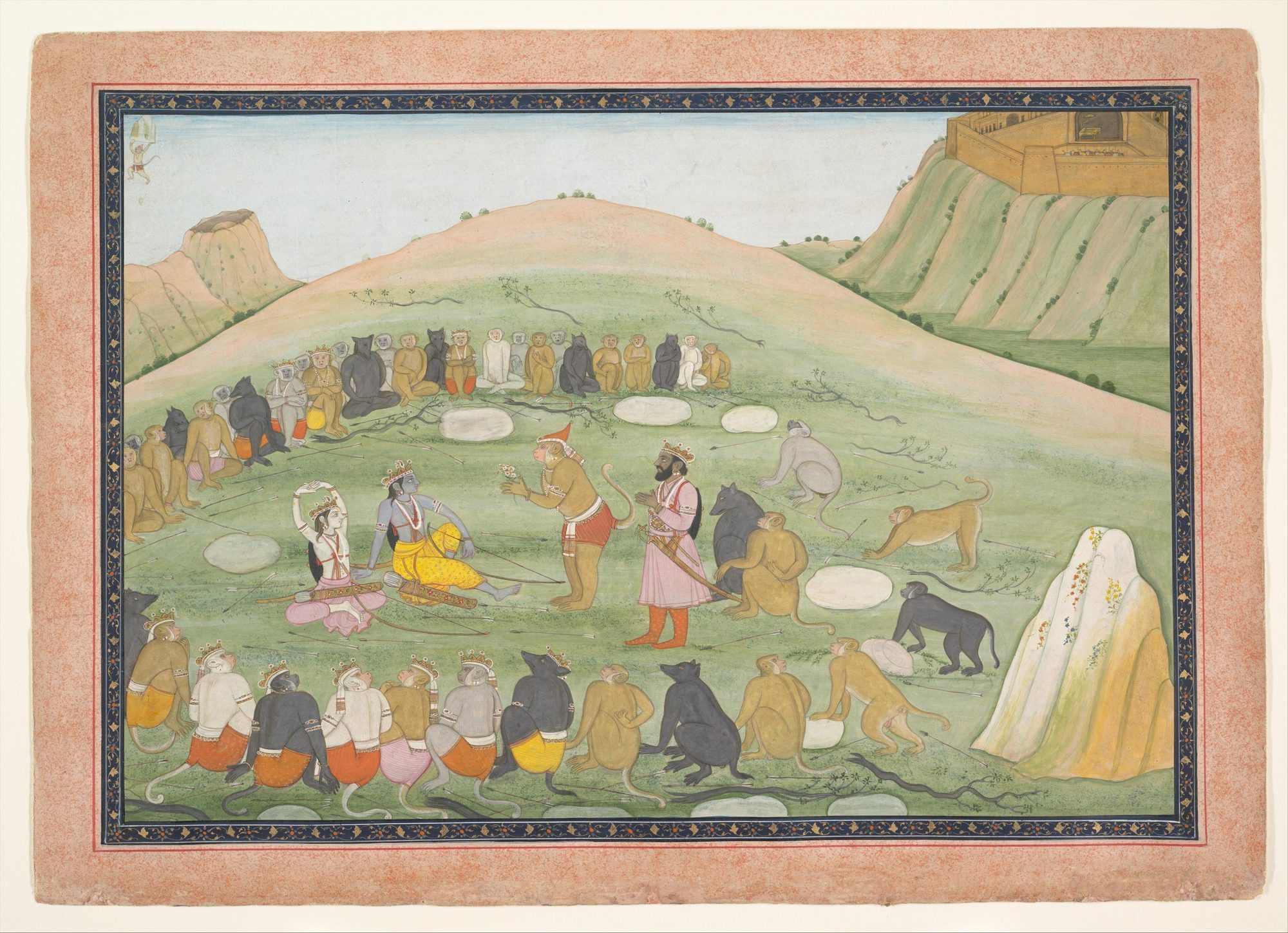
Passing over a mountain she saw five powerful monkeys watching from below, and let her silk mantle and her remaining jewels fall among them, reasoning that these strangers might carry the tidings to Rama. She could not have known she was right, or that those five were the ministers of an exiled monkey king, and that the bundle would one day be the token that proved where she had gone.
Then the land ran out. Ravana crossed the ocean, the abode of the sea-god Varuna, and came down in Lanka, and set Sita in the inner apartments of his palace. He was, in his way, courtly about it. He forbade anyone to look on her or speak harshly to her, and he offered her pearls and rubies and robes and every ornament, and he begged her to become his queen.
She answered by laying a single blade of grass on the ground between them, refusing even to address him directly across it, and told him Rama would come and destroy him. His patience had a floor. Yield to me within twelve months, he told her, or my cooks shall cut you to pieces for my morning repast. And he had her carried to the Ashoka groveThe walled pleasure-garden of ashoka trees inside Ravana's palace where Sita is held under guard., the walled garden inside his fortress, and set flesh-eating rakshasa women of ferocious aspect around her with orders to break her will by menaces and soft speech in turn. Overwhelmed at last, the princess of Mithila swooned away, and the crime was complete, and the war had not yet begun.
How can a king, fixed in his duty, look upon another’s wife? While I still live, you shalt not bear away the lovely Sita. (Ramayana, Aranya Kanda 50, tr. Shastri)
- Valmiki, Ramayana, Aranya Kanda (Book III), sargas 42–44 (Hari Prasad Shastri, The Ramayana of Valmiki, 1952; via wisdomlib.org)Ravana’s coercion of the terrified Maricha, who warns that Rama will prove
the Rod of Death
yet obeys; the golden-deer transformation, the gem-tipped horns andmouth like a red lotus
; the luring of Rama deep into the forest; the Brahma-made arrow through the heart; and the dying demon’s counterfeit cry in Rama’s own voice,O Sita, O Lakshmana!
- Valmiki, Ramayana, Aranya Kanda (Book III), sargas 45–48 (Shastri)Sita’s accusation that Lakshmana desires her and wishes Rama dead, and his departure
looking back again and again
; Ravana’s arrivalin the guise of a mendicant
at dusk and the stilling of leaf, wind and the river Godavari; the guest-welcome Sita gives him; and the revelation of histen heads and twenty arms
and the seizure, left hand in her hair and right hand on her thighs, into the mule-drawn golden chariot. - Valmiki, Ramayana, Aranya Kanda (Book III), sargas 50–52 (Shastri)Jatayu the vulture-king,
sixty thousand years old,
challenging Ravana on grounds of a king’s duty; the aerial battle in which the bird breaks the bow, wrecks the chariot and tears off Ravana’s ten left arms, whichregrow like serpents issuing from an ant heap
; and Ravana’s sword severing the vulture’s wings and feet. The falling ornaments, the pearl ankletlike a flash of lightning,
are told here. - Valmiki, Ramayana, Aranya Kanda (Book III), sargas 54–56 (Shastri)the
five powerful monkeys
on the mountain and the mantle and jewels dropped among them as a token; the crossing of the oceanthe abode of Varuna
into Lanka; theblade of grass
Sita sets between herself and Ravana; the twelve-month ultimatum (my cooks shall cut you to pieces for my morning repast
); and her confinement in the Ashoka grove under the flesh-eating rakshasa women. - Variant traditions. The famous
Lakshmana Rekha
, the protective line drawn round the hut that Sita is lured across, is not in Valmiki’s Sanskritin the Aranya Kanda Lakshmana simply leaves and Ravana simply approaches. The line enters with Tulsidas’s Hindi Ramcharitmanas (c. 1574 CE) and regional oral Ramayanas, roughly 1,800 years after Valmiki’s core, and is not narrated here. Theshadow Sita
(Maya-Sita), the device by which the real Sita is hidden with the fire-god and only an illusion is carried off, is likewise a later Puranic and devotional development (the Adhyatma Ramayana; Tulsidas): in Valmiki the woman Ravana seizes is Sita herself. Note also that Valmiki’s Jatayu is a gridhra, a vulture, andKing of the Vultures
, not theeagle
of many English retellings.