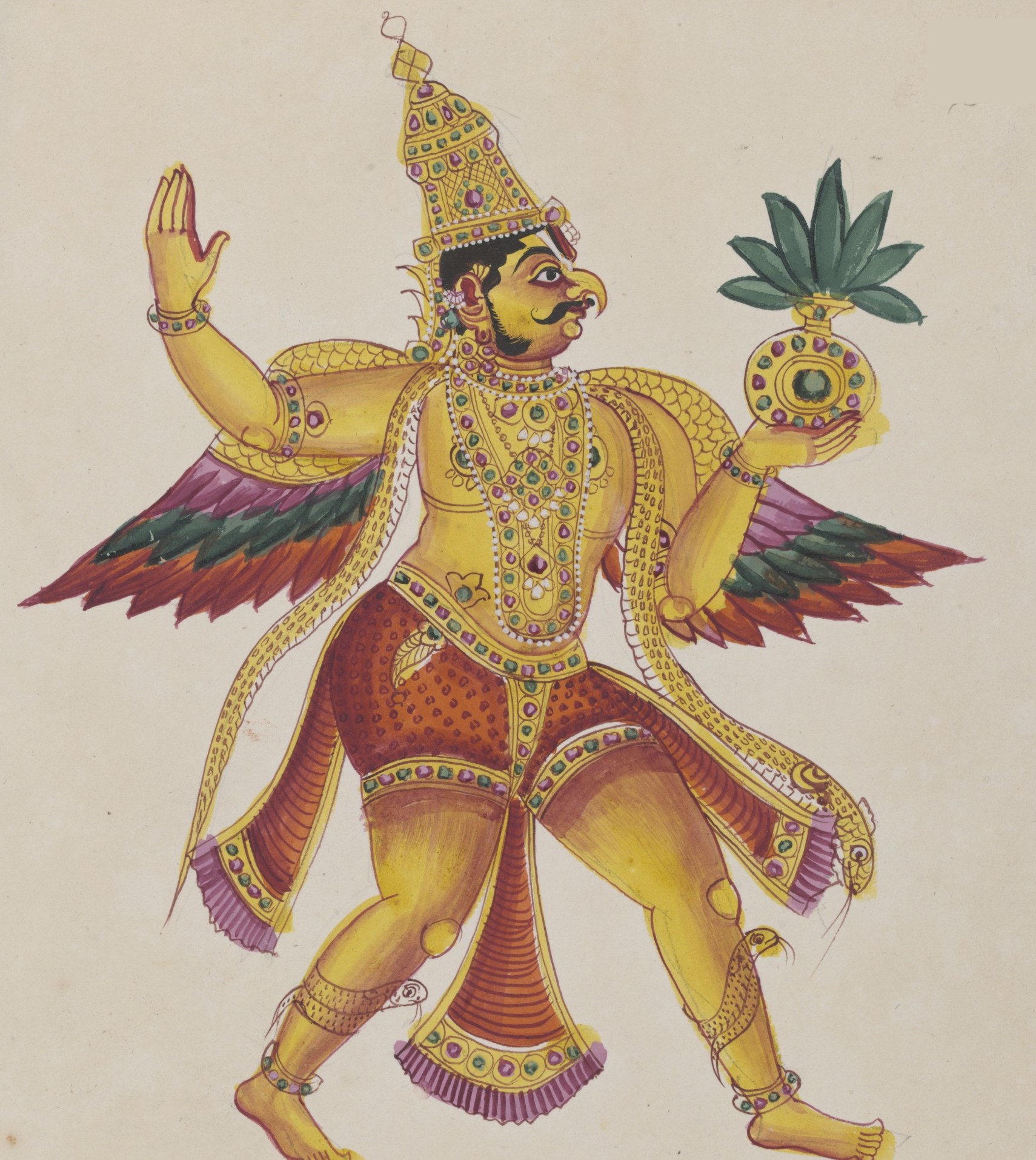
The gods looked up and thought the world was ending. Out of a broken egg had risen something so bright they mistook it for Agni, the fire itself, and begged the fire-god not to burn them where they stood. Agni corrected them. That is not me, he said. That is Garuda, equal to me in splendour, the destroyer of the NagasThe thousand serpent-sons of Kadru; in this myth the hereditary enemies of Garuda and, by his own bargain, his food., the serpents. The newborn blazed like the fire at the end of the world, his eyes bright as the lightning-flash. Before heaven had finished being afraid of him he had already left, hungry, in quest of food. He was born the enemy of serpents, and he was born starving, and those two facts drive everything that follows.
The whole of it is told at length in only one ancient place: the Astika Parva of the Mahabharata, the epic whose core was taking shape across the centuries on either side of the turn of the era. The two Puranas the tradition attaches to his name add almost no story. The Vishnu Purana, composed some centuries after the epic, gives a single genealogical sentence. The Garuda Purana, later still, never tells the amritaThe nectar of the deathless, whose theft frees Garuda's mother; guarded in heaven and, in the epic, never drunk by the bird who carries it off. theft at all; it is a manual for the dead in which Garuda merely asks the questions. If you want the eagle’s story you go to the epic, and nowhere else.
Two sisters and a broken egg
Garuda’s mother Vinata and her rival sister Kadru were both wives of the sage Kaśyapa, and each had asked him for children. Kadru wanted a thousand snakes; Vinata wanted two sons who would outshine all thousand. Kadru laid a thousand eggs and Vinata laid two, and they were set in warm vessels to wait. After five hundred years Kadru’s thousand burst open. Vinata’s did not, and she could not bear it.
She cracked one of her two eggs early and found inside a child grown above the waist and unformed below, and the half-made son cursed her before he flew off to become Aruna, the charioteer of the sun seen at every dawn. Because she had broken the shell too soon, he told her, she would live as a slave, freed only by the second son if she had the patience to let him ripen. At the end of the full five hundred years the second egg opened on its own, and out came Garuda.
The slavery came through a wager. The sisters had quarrelled over the colour of Uchchaiśravas, the white horse thrown up when the gods churned the ocean, and staked their freedom on its tail. Kadru, to win, ordered her serpent-sons to hang themselves in the horse’s tail as black hairs. It was a cheat, and Vinata lost, and she and her son passed into Kadru’s service.
The price the snakes set on her release was steep and specific: fetch the amrita, the nectar of the deathless, out of heaven. That errand is the spine of the figure. Garuda is remembered less for what he was than for what he did to free the mother who had bought her enslavement with her own impatience.
The bearer of a terrible weight
Still hungry, he went to his father for food strong enough to fuel the raid, and Kaśyapa sent him to a lake where a giant elephant and a giant tortoise, two brothers cursed into animal shape over a family quarrel, fought without end. Eat them both, the sage said. Garuda took the elephant in one claw and the tortoise in the other and settled on a vast bough to eat, and the branch cracked under him.
Hanging head-down from it were the Valakhilyas, thumb-sized ascetics who drink the rays of the sun, and rather than let the falling bough kill them he caught it in his beak and flew on, unable to set the thing down. Watching the bird carry that impossible load, the little sages gave him his name. Let him be called Garuda, they said, bearer of heavy weight. It is the epic’s own play on the syllables, not a linguist’s account of the word, but it is the meaning the text hands the reader, and it is earned in the carrying.
Past the wheel and the fire
Heaven had built the amrita a fortress. Around it spun a wheel of steel with edges sharp as razors, turning without pause to cut any thief to pieces. Garuda shrank his enormous body small and slipped between the spokes. Inside the wheel two serpents guarded the nectar, breathing fire, their tongues bright as lightning and their gaze enough to reduce an intruder to ash.
He raised a storm of dust with his wings, blinded them, struck them where they could not see him, and tore them apart. Then he took up the amrita, and here the whole story turns on a thing he did not do. He carried the nectar of immortality out of heaven without drinking a single drop of it.
That restraint is what makes him more than a magnificent thief. On the way home he met Vishnu, who was so pleased by the self-denial that he offered a boon, and Garuda asked for the one thing the nectar in his own claws could have given him and he had refused to take: I shall be immortal and free from disease without drinking the amrita. Vishnu granted it, and asked a boon in return, and so the arrangement that fixes Garuda’s place in the whole pantheon was struck almost in passing.
He became the vahanaThe animal a Hindu god rides or is borne by; Garuda is the vahana of Vishnu, set on the flagstaff of the god's chariot. of Vishnu, set on the flagstaff of the god’s chariot, riding above the deity he serves. Indra, meanwhile, flung his thunderbolt at the fleeing bird and could not so much as bruise him. Struck by your thunder, Garuda told him, I have not felt the slightest pain. Out of respect for the sage from whose bone the weapon was forged he shed a single feather, and the watching worlds renamed him again for its beauty: Suparna, the fair-feathered.
Why the snake’s tongue is split
He never meant to keep the amrita for the snakes. He and Indra made a pact: Indra could take the nectar back to heaven, and in exchange the serpents would become Garuda’s food forever. Then he brought the jar to Kadru’s sons, laid it on a bed of kuśa grass, and told them to bathe and perform their rites before they drank; that delivery discharged his mother’s ransom and set her free.
While the snakes were washing, Indra swept the nectar back up to heaven. The serpents came back to an empty patch of grass and, desperate for any trace of the deathless, licked the sharp blades where the jar had stood. The grass split their tongues down the middle, and that, the epic says, is why every serpent since has flickered a forked tongue, and why kuśa grass has been holy ever since it touched the nectar.
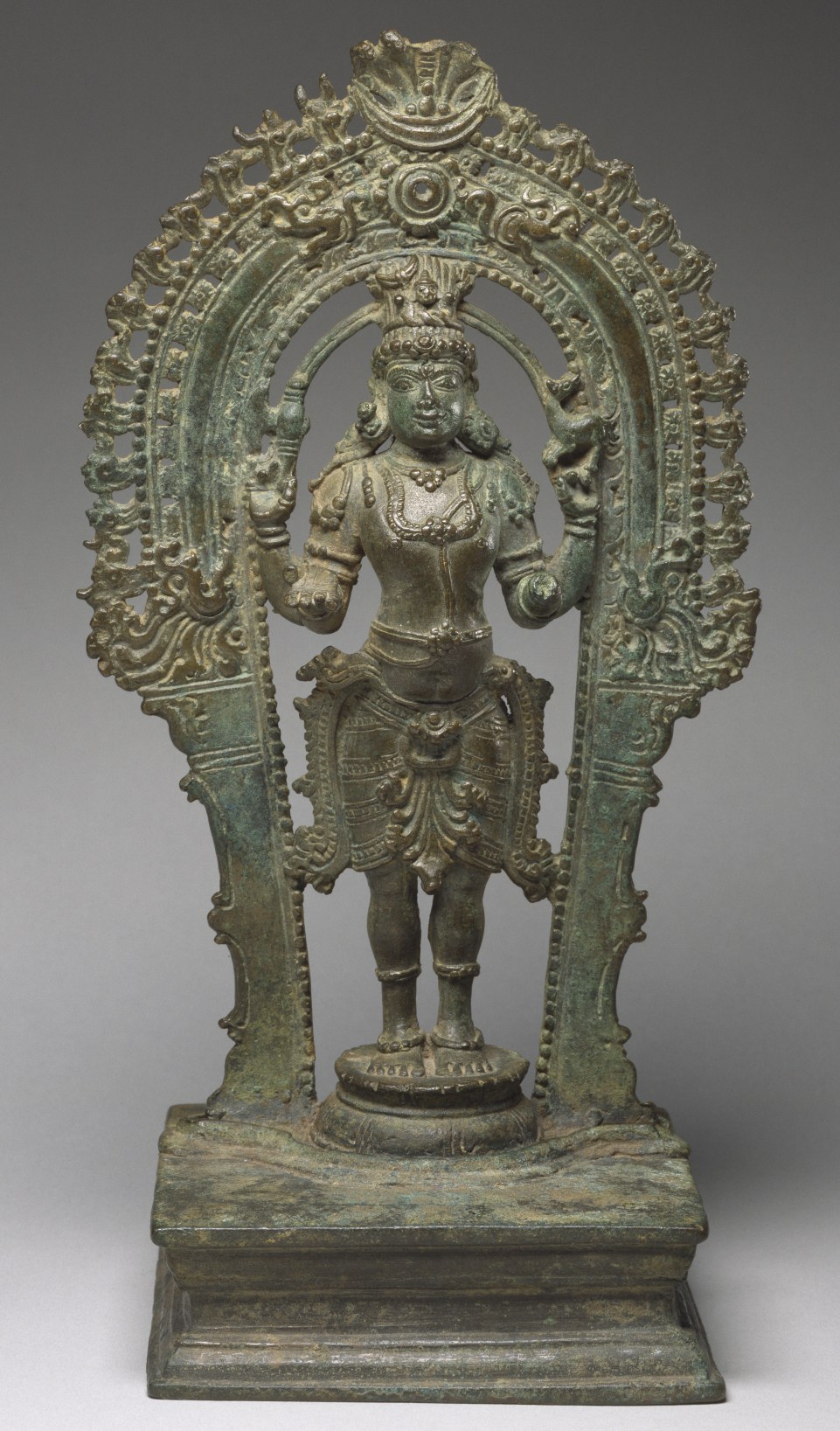
None of the temple images belong to this story. The Garuda a worshipper knows, eagle-winged and beak-faced with a man’s torso, bearing Vishnu aloft and trampling snakes, is the figure of later devotional and Puranic convention. The epic gives him only blazing light and terrible size and the one act of restraint that earned him everything. Behind even the epic stands something older still.
More than a thousand years before the Mahabharata reached its finished form, the Rigveda already sang of a śyena, an eagle that steals the soma from heaven, and scholars have long read that hymn as the seed of the whole idea. The Veda never names Garuda. But the shape was there at the beginning: a great bird, a stolen drink of the gods, and a raid on the sky.
This is Garuda, equal to me in splendour, the destroyer of the Nagas. (Mahabharata, Ādi Parva, Astīka Parva XXIII, tr. Ganguli)
- Mahābhārata, Ādi Parva, Astīka Parva, Sections XVI–XXXIV (tr. Kisari Mohan Ganguli, Pratap Chandra Roy edition, 1883–1896; text composed c. 400 BCE–400 CE)the connected birth-and-amrita narrative and the only ancient source that tells it whole. The mistaking of the newborn for Agni and Agni’s correction (§XXIII); the two sisters, the thousand eggs and the two, and Aruna’s premature birth and curse (§XVI); the horse-wager over Uchchaiśravas and Vinatā’s enslavement (§§XVII, XX, XXIII); the elephant-and-tortoise, the Valakhilya bough and the folk-etymology of the name (§§XXIX–XXX); the razor-wheel, the fire-breathing guardian serpents, and the theft
without drinking it himself
(§XXXIII); Vishnu’s boon of immortality-without-amrita and Garuda as his carrier, Indra’s failed Vajra, the shed feather and the name Suparṇa (§XXXIII); the pact with Indra, the kuśa-grass delivery, Vinatā’s freedom, and the split tongues of the snakes (§XXXIV). Read verbatim. - Viṣṇu Purāṇa, Book I, Chapter XXI (tr. H. H. Wilson, 1840; text c. 4th–5th c. CE)a single genealogical sentence naming Garuḍa and Aruṇa the sons of Kaśyapa and Vinatā, Garuḍa
also called Suparṇa
the king of the feathered tribes andthe remorseless enemy of the serpent race
. No narrative. Read verbatim. - Garuḍa Purāṇa, opening frame (wisdomlib, from the astrojyoti abridgement; extant form c. 8th–11th c. CE)Garuḍa asks Vishnu for a Purāṇa in his name and the privilege of being his mount, and is blessed. The body of the work is funerary and eschatological (the Preta Kāṇḍa), and does not narrate the amrita theft. Read verbatim.
- Ṛgveda (Vedic, c. 1500–1200 BCE)a śyena, an eagle that carries the soma off from heaven, widely treated as the mythic prototype of the nectar-stealing bird. The hymn does not name Garuḍa; cited here only as the scholarly-proposed antecedent, not read verbatim for this piece.