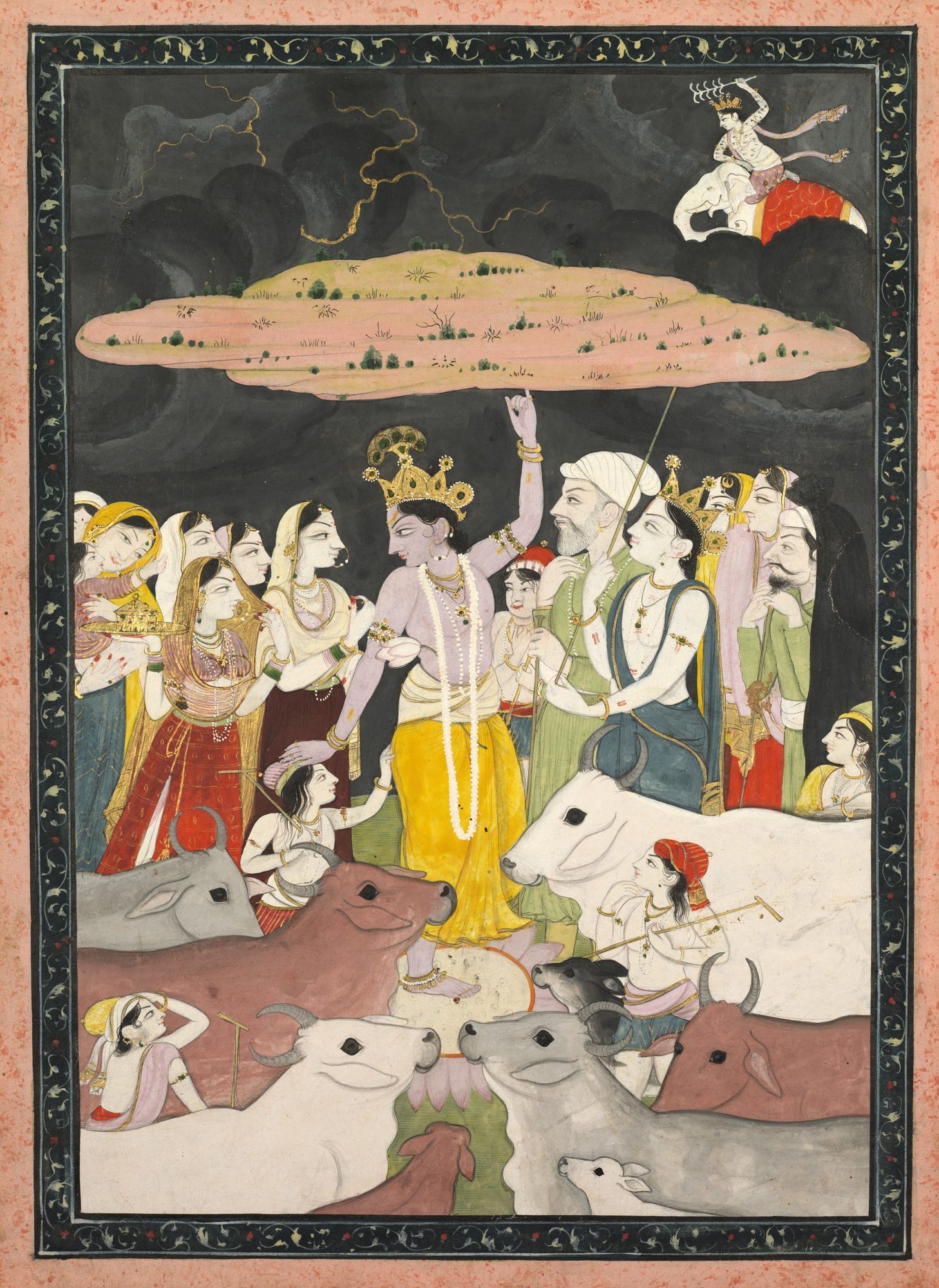
The infant was hungry, and the hungry infant saw the sun come up. He took it for a red and ripe fruit hung low in the morning, the way a child takes any bright round thing for something to eat, and he leapt. He bounded thousands of leagues straight up into the burning sky, gaining on the sun, closing his small fists to seize it. His father the wind ran ahead of him with a stream of cool breath so the fire would not scorch the child who was climbing to swallow it. And it happened that on that same morning the eclipse-demon Rāhu had come to take the sun for himself, and found a baby getting there first; Rāhu fled and complained to Indra, king of the gods, who rode out on his white elephant to see.
The child, still certain that everything within reach was fruit, lunged at the elephant too. So Indra threw the thunderbolt. It struck the baby full on the face and broke his jaw, and he dropped out of the sky onto a mountain, and the god who had crippled him gave him, by way of the wound, his name. In Sanskrit a jaw is a hanu. The broken-jawed one would be called Hanuman. The strength that had carried him to the sun would soon be sealed away, waiting for a voice to call it back.
A pile of gifts for the child
His father was not appeased by a name. Vāyu, the wind, gathered up his son and withdrew, and drew the breath out of every living thing in the three worlds along with himself, until gods and creatures alike began to strangle. The price of the wind’s return was a pile of gifts for the child. Indra granted him that no thunderbolt could ever harm him again. The sun-god gave him a hundredth part of his own blaze and, stranger for a monkey, mastery of eloquence and of the sacred texts.
Varuṇa’s waters and noose would never bind him; Yama’s rod would never kill him and no sickness would touch him; Kubera’s mace, Śiva’s shafts, the weapons of Brahmā and of the craftsman of the gods were all made harmless against his body. And Brahmā gave him the gifts that would matter most in the story to come: he could change his shape at will, go wherever he wished, and move faster than the mind can follow.
Made to forget he had it
Here the tale plays its cruelest and cleverest trick. This child, armoured against every weapon and quicker than thought, grew into an unruly boy who tormented the hermitages of the forest sages, and the sages of the old ascetic lines cursed him for it. They did not take his strength away. They made him forget he had it. He would not know his own power until, at the moment it was needed, someone else reminded him of it.
The mightiest being in three worlds would walk through the world unaware of what he carried, waiting all his life for a voice to say: you can do this; you always could. He grew up learned as well, following the sun across the sky to master grammar and prosody until, the text says, none equalled him in the sciences and he rivalled the teacher of the gods himself. The strongest of the monkeys was also the most exact scholar among them, and that is not incidental to who he is.
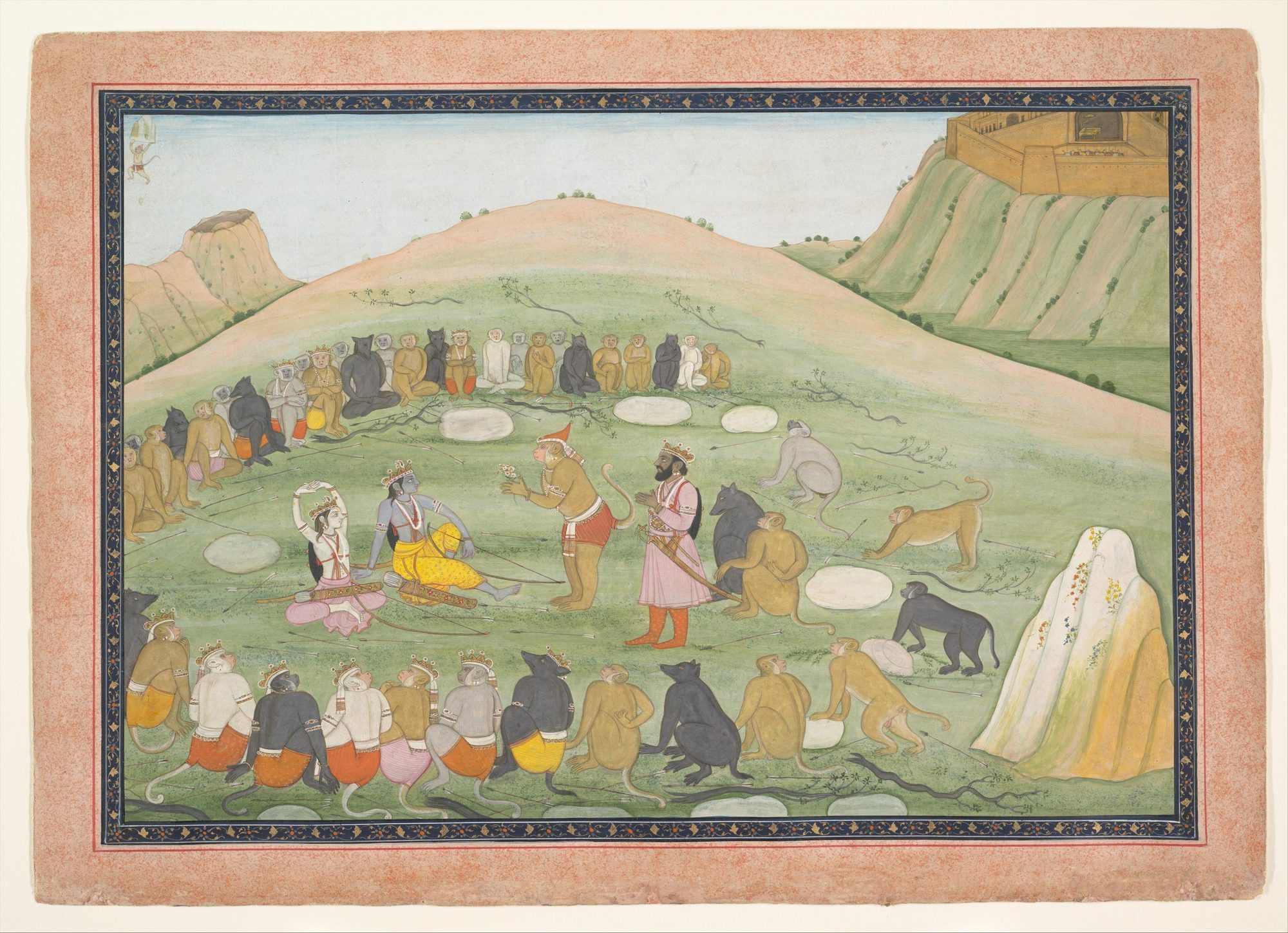
The voice, when it came, belonged to a prince. Hanuman was serving as minister to the exiled monkey king Sugrīva when Rāma, an exiled prince himself, came searching for his abducted wife. Sugrīva sent Hanuman down to take the measure of the strangers, and Hanuman went disguised as a wandering monk, and spoke.
What he said is lost to the point that Rāma’s answer makes: turning to his brother, Rāma said that only a man steeped in the Ṛg-Veda, conversant with the other Vedas, thorough in his grammar, could speak at such length and so entirely without a single error. The strongest creature Rāma would ever meet announced himself not by a feat of arms but by the flawlessness of his sentences, and Rāma loved him for it before he had seen him lift anything at all. Out of that meeting Hanuman brokered the alliance that would carry the whole war.
A shadow forty miles long
Then the ocean, and the leap that is his signature forever. Told that Sītā was held across a hundred yojanas of open sea, on the island of Laṅkā, Hanuman climbed Mount Mahendra and pressed it down under his swelling body until the mountain gushed gold and silver and red arsenic like ichor from a rutting elephant’s temples, and the uprooted flowering trees streamed up into the sky behind him like relatives seeing off a traveller. He vowed that he would fly to Laṅkā as an arrow loosed by Rāma flies, and either return having found her or tear the island up by its roots and carry it home with its king.
His shadow on the water ran forty miles long. Sea-serpents took him for the eagle of the gods. Midway, a golden mountain named Maināka rose out of the sea to offer him rest and fruit, a courtesy owed to Rāma’s house, and Hanuman touched it with his hand in thanks and pressed on, because he had vowed not to rest on the way. It is the smallest of his feats and the one that tells you most about him. Offered a kindness, he acknowledged it and refused it, because the errand of the one he served came first.
Two things to carry back
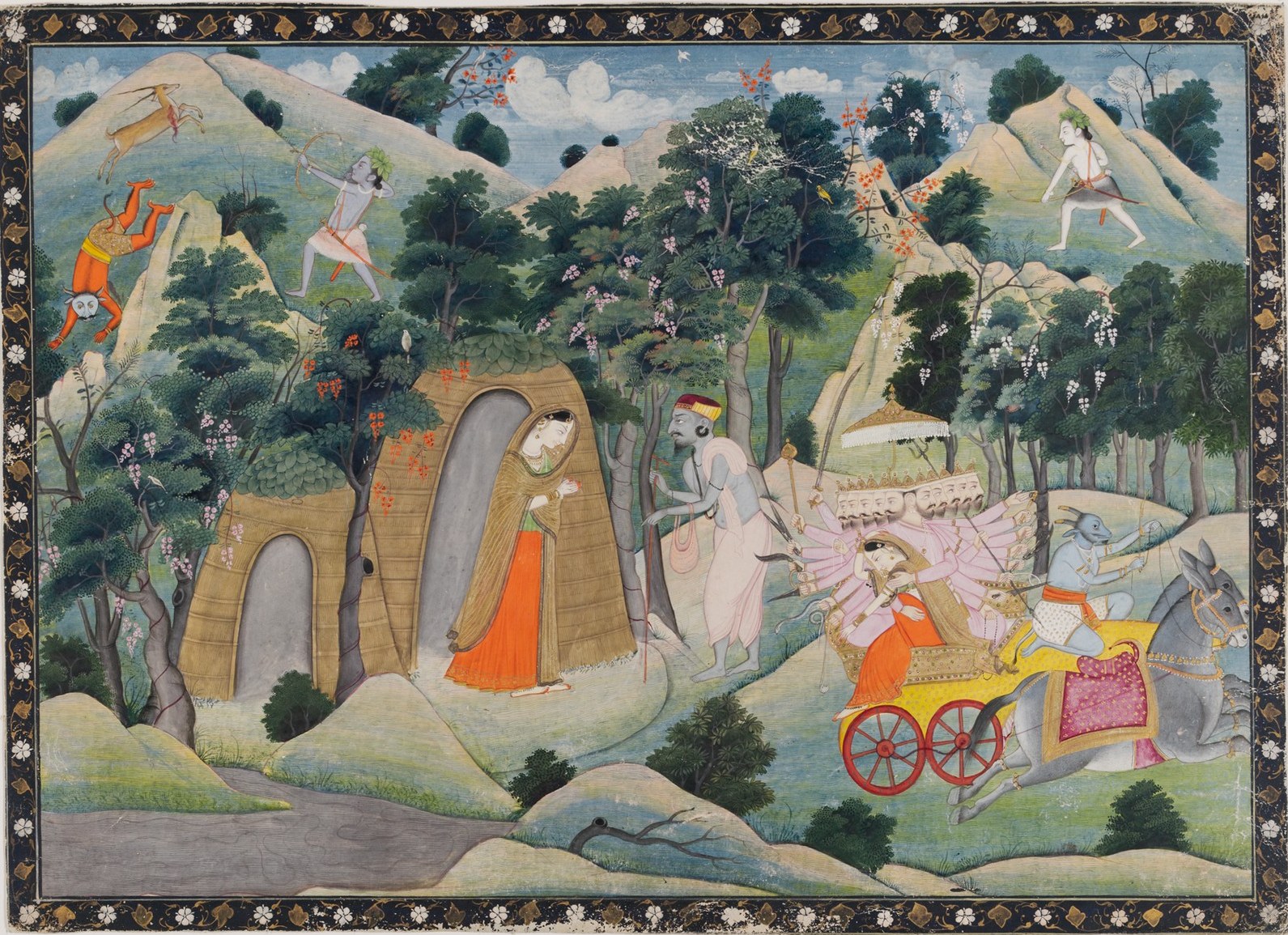
In Laṅkā he found her at last in a grove of aśoka trees, ringed by the demon king’s women, and when he made himself known and offered to carry her home on his back she would not go. She would not touch the body of any man but Rāma, and beyond that she would not steal the glory of her own rescue from her husband; it must be Rāma who came for her. Instead she gave him two things to carry back.
The first was a memory, the private story of a crow at Citrakūṭa that only she and Rāma shared, so that Rāma would know his envoy had truly stood before her. The second was the crest-jewel from her forehead, shining with a light that was not of this world, too small to fit on his arm so that he wore it on his finger. And she gave him a deadline that was not a threat but a countdown: she had one month to live, she told him, and after that month she would die.
Snow fallen on his tail
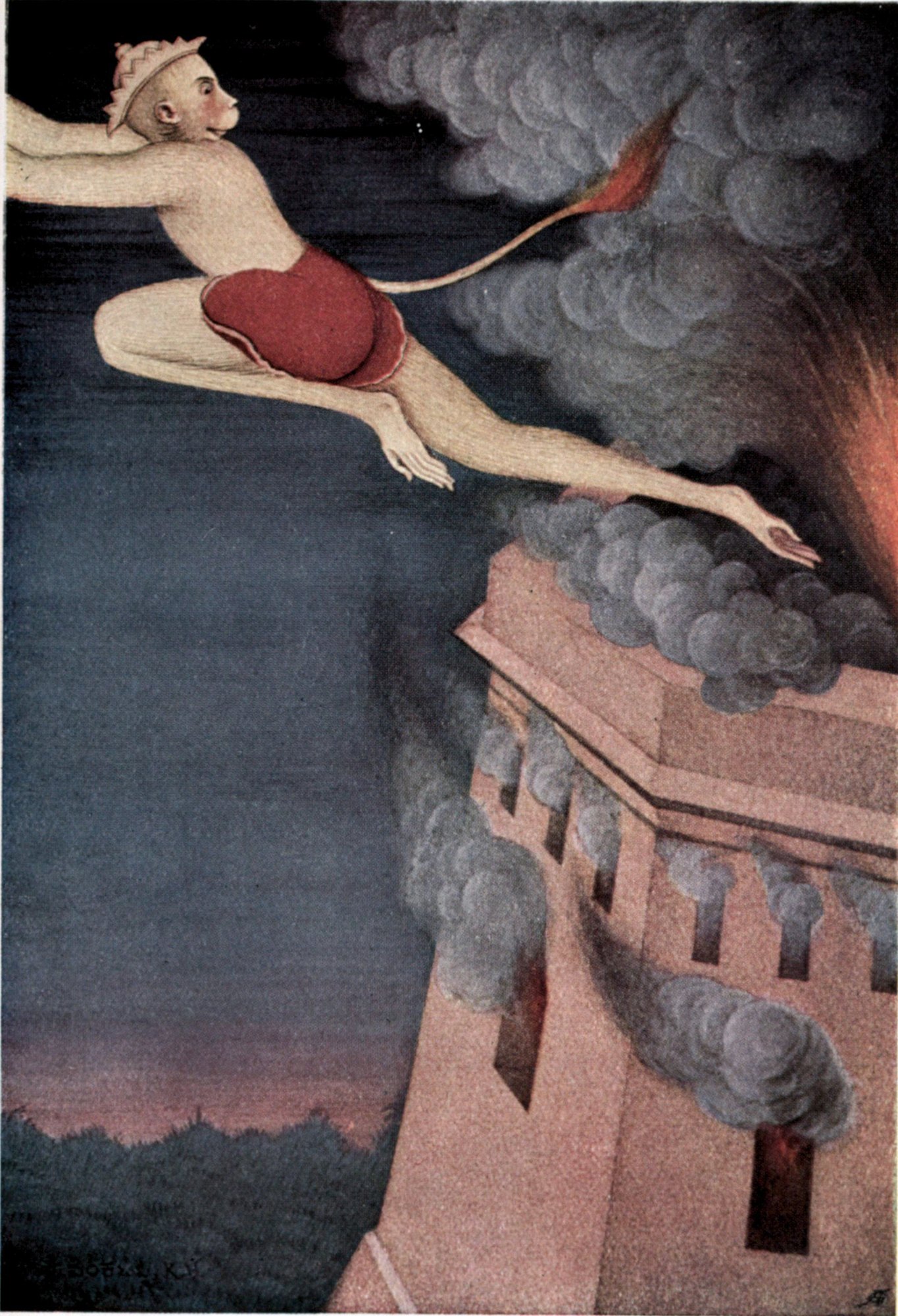
He did not leave quietly. Taken and dragged before the ten-headed Rāvaṇa, an envoy and so by law not to be killed, Hanuman had his tail wrapped in oil-soaked rags and set alight to be paraded through the streets in mockery. It did not burn him. Sītā prayed by the truth of her own chastity that the fire spare him; the fire-god turned the flame cool, and his father the wind blew ice-cold through it, so that Hanuman felt only what he described as snow fallen on his tail.
And then he made the mockery into a weapon. With his own burning tail for a torch he went leaping roof to roof through Laṅkā, setting the mansions of the warlords ablaze one after another until the whole city streamed molten gold and coral and pearl, and only then did he dip his tail in the sea to quench it and turn for home.
Tearing the luminous peak loose
The last of the great feats came in the war itself, and it turns on the old curse coming full circle. When Rāma and Lakṣmaṇa and the whole monkey army lay fallen under a demon’s celestial weapon, it was the ancient bear-king Jāmbavān who did what the sages’ curse required: he reminded Hanuman of what Hanuman was — Rāma had admired the scholar, Jāmbavān woke the strength — and sent him north to the mountain of healing herbs in the Himālaya. Four herbs were named there, the reviver of the dead, the drawer of darts, the restorer of the flesh, the knitter of wounds, glowing so bright they lit the ten directions.
But the herbs sensed him coming and hid themselves, and Hanuman, unable to tell one from another, did the only thing left to a being of his size: he tore the entire luminous peak out of the earth and flew it back through the air like the discus of Viṣṇu. The fallen breathed the herbs, and the dead rose as sleepers wake when the night is over, and Rāma and his brother and their whole slaughtered host stood up alive. Then he carried the mountain back and set it down where it had stood.
The popular imagination has since fixed on a leaner, more desperate version of that flight, in which Hanuman races to save only the dying Lakṣmaṇa before sunrise and, unable to identify the one right herb, snatches up a whole mountain called Droṇagiri. It is a magnificent scene and a later one, born in the great vernacular retellings and the folk theatre, not in the ancient Sanskrit where four herbs are named and both brothers and the whole army come back to life with no race against the dawn.
What the older text and the newer share is the shape of him. Faster than thought, immune to every weapon, learned enough to earn a prince’s admiration with a sentence, and unaware of all of it until someone he served needed him to remember. The god the subcontinent would come to love above almost any other, and later name immortal and worship in his own right, is at the root of the story a servant who is only ever fully himself when he is acting for someone else.
Only one versed in the Ṛg-Veda and conversant with the Yajur and the Sāma Vedas would speak thus. He has studied grammar thoroughly, and though he has spoken at length, it has been void of error. (Rāmāyaṇa, Kishkindhā-kāṇḍa 3, tr. Hari Prasad Shastri)
- Vālmīki, Rāmāyaṇa, Uttara-kāṇḍa (Book VII), sargas 35–36 (Hari Prasad Shastri trans., 1952; read verbatim at wisdomlib.org)the infant Hanuman mistaking the rising sun for a fruit and leaping thousands of leagues after it, Rāhu’s flight and Indra riding out on his elephant, Indra’s thunderbolt breaking the child’s jaw and Vāyu shielding him with cool breath (35); the naming
Hanuman
from the broken hanu (jaw), Vāyu’s wrath and the gods’ compensating boons (invulnerability to the thunderbolt, a share of the sun’s effulgence with mastery of eloquence and the śāstras, immunity to Varuṇa, Yama, Kubera, Śiva, Brahmā and the divine weapons, and Brahmā’s gift of shape-shifting, unlimited motion and speed), the ṛṣis’ curse that he forget his own strength until reminded, and his Vedic and grammatical scholarship (36). Both sargas belong to the Uttara-kāṇḍa, widely regarded by scholars as a later stratum than the core Sundara/Yuddha deeds. - Vālmīki, Rāmāyaṇa, Kishkindhā-kāṇḍa (Book IV), sarga 3 (Shastri; read verbatim)Hanuman, disguised as a wandering mendicant, first approaches Rāma and Lakṣmaṇa in flawless, courteous Sanskrit; Rāma’s astonishment that
only one versed in the Ṛg-Veda… would speak thus… void of error
; and Hanuman’s brokering of the Rāma–Sugrīva alliance. - Vālmīki, Rāmāyaṇa, Sundara-kāṇḍa (Book V), sarga 1 (Shastri; read verbatim)the leap across the ocean; Hanuman pressing down Mount Mahendra until it gushes gold, silver and red arsenic; his body swelling and his shadow
forty miles in extent
; the vow to course to Laṅkāas an arrow loosed by Rāghava
; and the golden mountain Maināka rising mid-sea to offer rest, touched in acknowledgement and declined withI have vowed not to rest on the way.
- Vālmīki, Rāmāyaṇa, Sundara-kāṇḍa 14–15 (Shastri)Hanuman finds Sītā captive in the Aśoka grove, guarded by the rākṣasī women. (The surrounding chapters were read; the precise sarga labels for the grove follow the wisdomlib chapter index, and no verbatim line is drawn from 14–15.)
- Vālmīki, Rāmāyaṇa, Sundara-kāṇḍa 37–38 (Shastri; read verbatim)Hanuman offers to carry Sītā to Rāma and she refuses, both because
I may not touch the body of any save Rāma
and because the glory of the rescue must be Rāma’s; the private crow (Kākāsura) episode at Citrakūṭa given as a secret proof-token; the crest-jewel (cūḍāmaṇi)of celestial radiance,
too small for his arm and so worn on his finger; and Sītā’sI have but one month to live.
- Vālmīki, Rāmāyaṇa, Sundara-kāṇḍa 53–54 (Shastri; read verbatim)Rāvaṇa, forbidden to kill an envoy, orders Hanuman’s tail wrapped in oil-soaked cotton rags and set alight; the flame turned cool through Sītā’s chastity, Agni’s grace and Vāyu’s ice-cold breath, so that it feels
as if the snow had fallen upon it
; Hanuman firing the mansions of Laṅkā’s warlords one after another with his own burning tail, and quenching it at last in the sea. - Vālmīki, Rāmāyaṇa, Yuddha-kāṇḍa (Book VI), sarga 74 (Shastri; read verbatim)after Indrajit’s celestial weapon fells Rāma, Lakṣmaṇa and the host, Jāmbavān reminds Hanuman of his powers and sends him to the mountain of medicinal herbs in the Himālaya; the four named herbs Mṛtasañjīvanī, Viśalyakaraṇī, Suvarṇakaraṇī and Sandhānī; the herbs making themselves invisible; Hanuman uprooting the whole luminous peak and bearing it
like the discus of Viṣṇu
; and the revival of both princes and the fallen army, who riselike sleepers waking when the night is over.
- Vālmīki, Rāmāyaṇa, Kishkindhā-kāṇḍa 66 (Shastri)the alternate birth account in which Vāyu grants the son to Añjanā manasā (non-physically), a more sublimated telling than the Uttara 35 begetting. Cited here as a corroborated variant; not read word-for-word this pass, so no line is quoted from it.
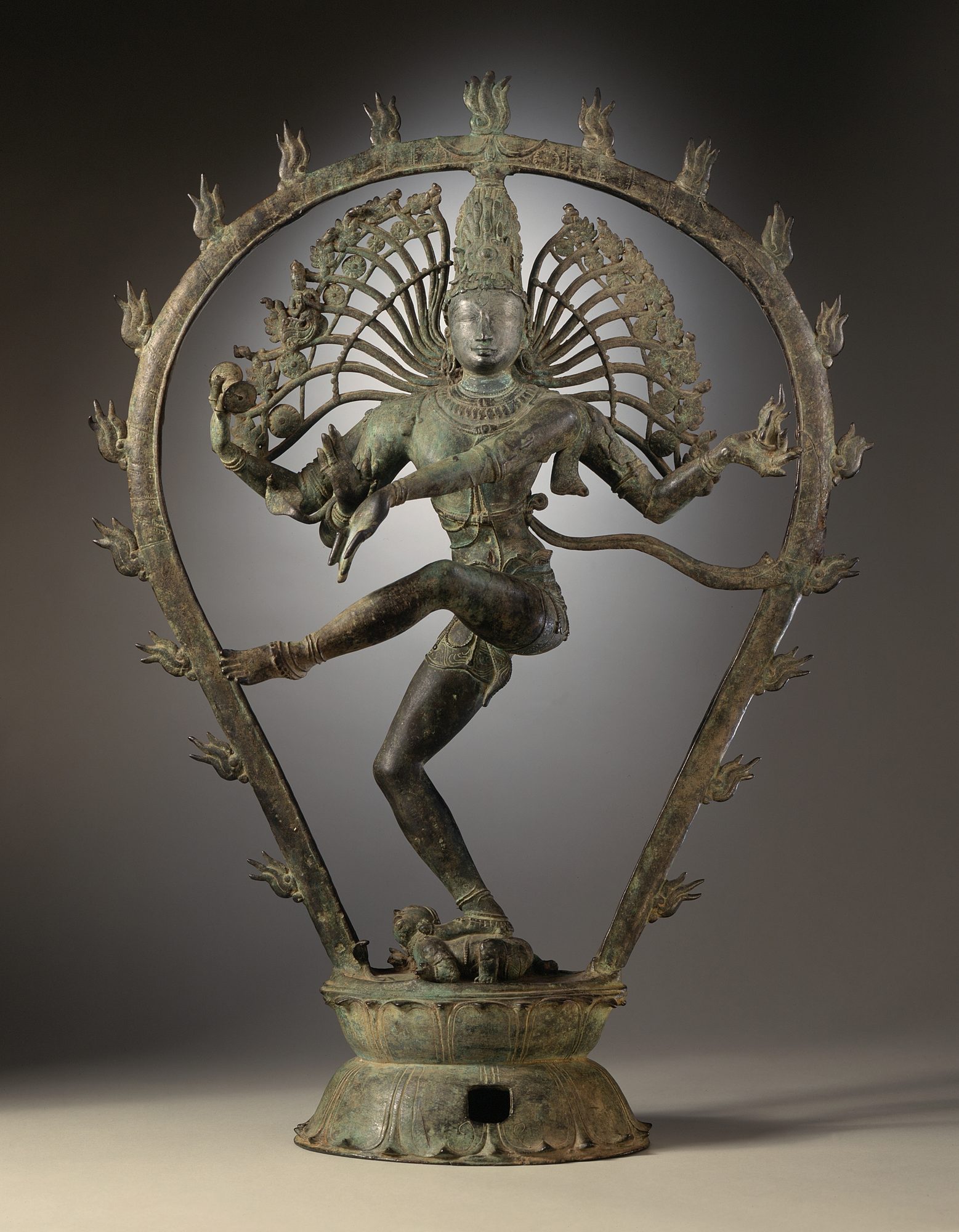
- Variant traditions. The wildly popular form of the healing-herb episode, in which Hanuman flies to revive only Lakṣmaṇa before dawn and, unable to identify the one herb, carries back the whole Droṇagiri mountain, is a later regional dramatization (widespread in Rāmcaritmānas retellings, folk theatre and calendar art), not the Yuddha-kāṇḍa 74 account read here, which names four herbs, has no race against sunrise, and revives both princes and the army. Hanuman as an avatāra of Śiva / an
eleventh Rudra,
his immortality as a cirajīvī, and his standalone temple cult are later Purāṇic and devotional theology, crystallized above all in Tulsīdās’s Rāmcaritmānas (~1575 CE) and the Hanumān Cālīsā, centuries after Vālmīki. The backstory that Añjanā was a cursed apsaras (Puñjikasthalā), and the devotional-era images of Hanuman tearing open his chest to show Rāma and Sītā within, or of his vermilion body, are likewise later accretions, absent from the Vālmīki passages here. The Bāla-kāṇḍa and Uttara-kāṇḍa (Books I and VII) are themselves broadly held by scholars to be later additions to the core epic (Books II–VI), so the birth-story, boons and curse belong to a later stratum than the Sundara and Yuddha deeds, though still classical and pre-Tulsīdās. (Translations throughout are Hari Prasad Shastri’s, 1952; the Princeton/Goldman Rāmāyaṇa of Vālmīki is the critical-edition scholarly benchmark, with closely mapping kāṇḍa/sarga numbering.)