In the first age there was nothing to buy and nothing to sell. A man who wanted a thing had only to think of it, and it came; there was no toil, no trade, no coin passing from hand to hand. Sickness did not touch the body and the senses did not dim with the years. There were no gods yet and no demons, no spirits of the woods or the waters, no serpent-people coiled beneath the earth.
There was one Veda, one sacred word, the single syllable Om, and men lived four hundred years apiece in a world where virtue stood whole and four-square and entire. This was the Kṛta age, the age of perfection, and the oldest strata of the Mahābhārata remember it with something close to homesickness. It was the golden dawn of the world. What the texts want you to understand, before anything else, is that it did not last, and that its passing was not an accident but the first turn of a wheel built to turn forever.
The Hindu imagination did not picture time as a line running from a beginning to an end. It pictured a cycle, vast and recurring, and within that cycle four ages in fixed and descending order: Kṛta, then Tretā, then Dvāpara, then Kali, each worse than the one before, and then, when the last and darkest is spent, Kṛta again. The Mahābhārata puts it flatly: after the Kali age is over, the Kṛta age comes again. The whole structure is a slow fall followed by a sudden renewal, over and over, without first or final term.
A beast standing on four feet
The measure of the fall is virtue itself. Manu gives the image that the tradition never let go of. Dharma, right order, is a beast that stands on four feet, and in the Kṛta age it stands foursquare and complete, and Truth stands with it. Then, age by age, Dharma loses a foot. Three-quarters of virtue abide in the Tretā, half in the Dvāpara, and in the Kali age a quarter only remains, the last leg of a crippled thing, while unrighteousness comes creeping in through theft and falsehood and fraud.
The gain of every age is loss. And the god who presides over the ages wears their decline on his own body. Nārāyaṇa changes colour as the cycle darkens: white in the golden Kṛta, red in the Tretā, yellow in the Dvāpara, and black at the dawn of the iron Kali, so that the very complexion of the divine keeps time with the world’s corruption.
Twelve thousand years of the gods
The numbers are where readers stumble, so it is worth walking through them carefully, because the confusion is always the same confusion. The ages are counted not in human years but in years of the gods. One year of ours is a single day and night to the celestials; three hundred and sixty of their days make one of their years. Reckoned in these divine years, the Kṛta age runs four thousand years, wrapped in a dawn and a dusk of four hundred each; the Tretā runs three thousand with twilights of three hundred; the Dvāpara two thousand with two hundred; the Kali one thousand with one hundred.
Set end to end, with all their twilights, the four ages come to twelve thousand years of the gods, and this span, the whole four-age turn, is what the tradition calls a mahāyuga, a great age. To render it in our own reckoning you simply multiply by that same three hundred and sixty: twelve thousand divine years become four million three hundred and twenty thousand human ones. The small figures and the vast ones are not rival traditions quarrelling over the length of the world. They are one measurement written in two units, the difference between a day of the gods and a year of a man.
Sporting with worlds like a child
And even this immensity is only a single tick. A thousand mahāyugas, four billion three hundred and twenty million of our years, make a single day of Brahmā, the creator, and his night is exactly as long. That day bears its own name, a Kalpa, and within it fourteen Manus preside in succession, each a progenitor of humankind, each ruling for a stretch of seventy-one great ages.
The present Manu is Vaivasvata, the son of the Sun, and more of his kind will follow before Brahmā’s single day is done. The scale defeats the mind on purpose. Manu says the creations and destructions of the world are numberless, and that Brahmā sets them turning again and again as though at play, sporting with worlds the way a child sports with sand.
Seven rays swelling into seven suns
Every day of Brahmā ends the same way, in a dissolution the tradition calls pralaya, and the Vishnu Purāṇa describes it with a terrible, concrete patience. First the drought. When a thousand great ages have worn the earth down, the rains fail and a dearth settles over the world for a hundred years, until every living thing that can perish has perished. Then Vishnu, taking the destroying form of Rudra, enters the seven rays of the sun and drinks up all the waters.
The rays swell and dilate until they are seven suns, and their light glows above and below and on every side and sets the three worlds and the underworld beneath them ablaze. The earth is scorched bare of every green thing, drained of moisture until it looks, the text says, like the back of a tortoise; the god becomes the scorching breath of the world-serpent Śeṣa and burns the underworld itself to ash, and the three spheres show like a heated frying-pan.
Saṃvartaka clouds, vast as elephants
Only then, over the cinders, comes the flood. Rudra breathes out enormous clouds, the Saṃvartaka clouds, vast as elephants and roaring and shot through with lightning, some black as the blue lotus, some pale as the water-lily, some the colour of smoke and ash and sapphire and conch. They open, and the rain drowns the burnt world, and for a whole night of Brahmā the waters cover everything. When the god wakes at dawn, creation begins again. This is the wheel’s smaller turn, one day and one night of the creator, and the Purāṇas count larger dissolutions still, reaching all the way to the end of Brahmā’s own immense life, when not merely the worlds but their very elements unravel.
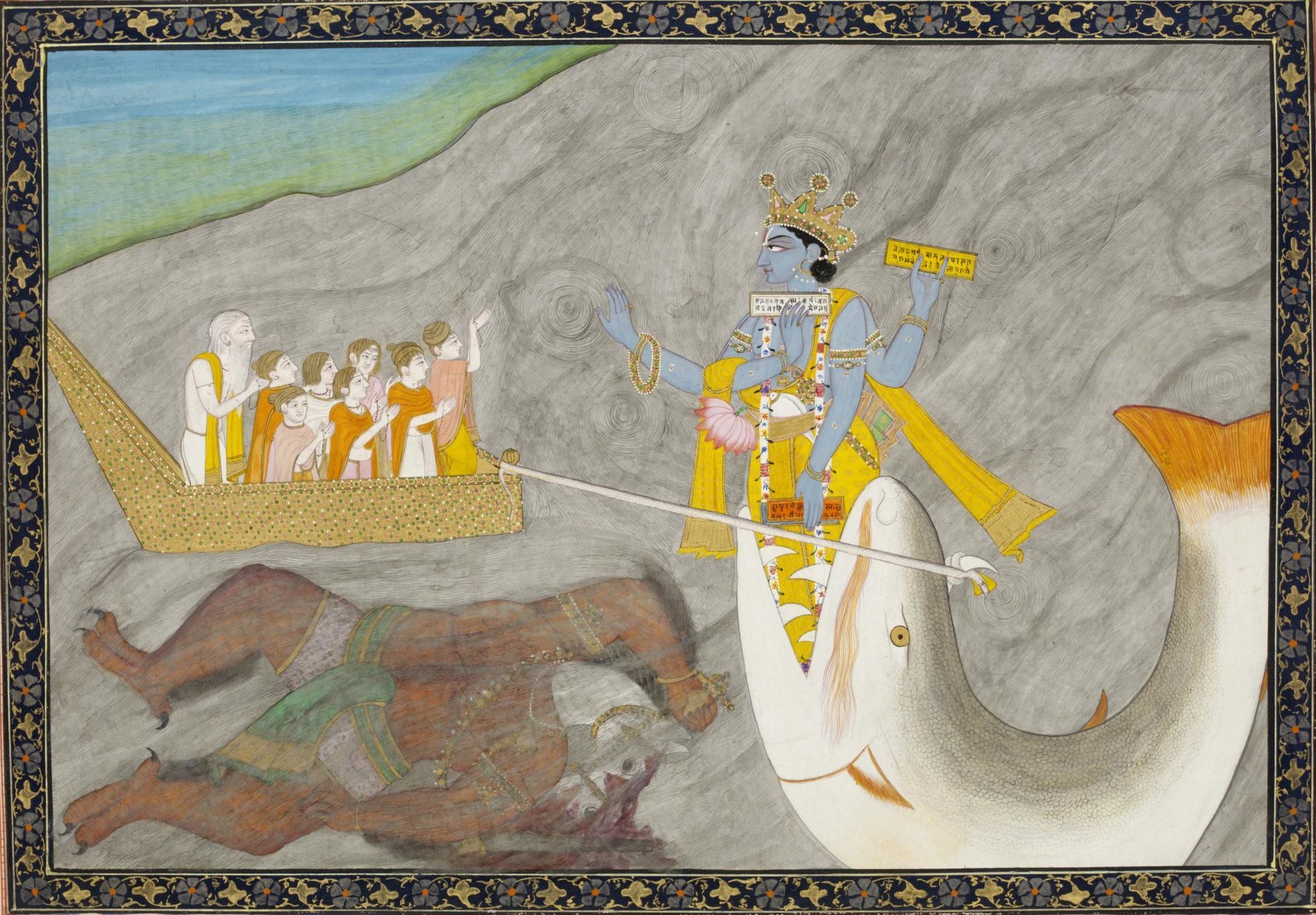
A rope tied to the fish’s horn
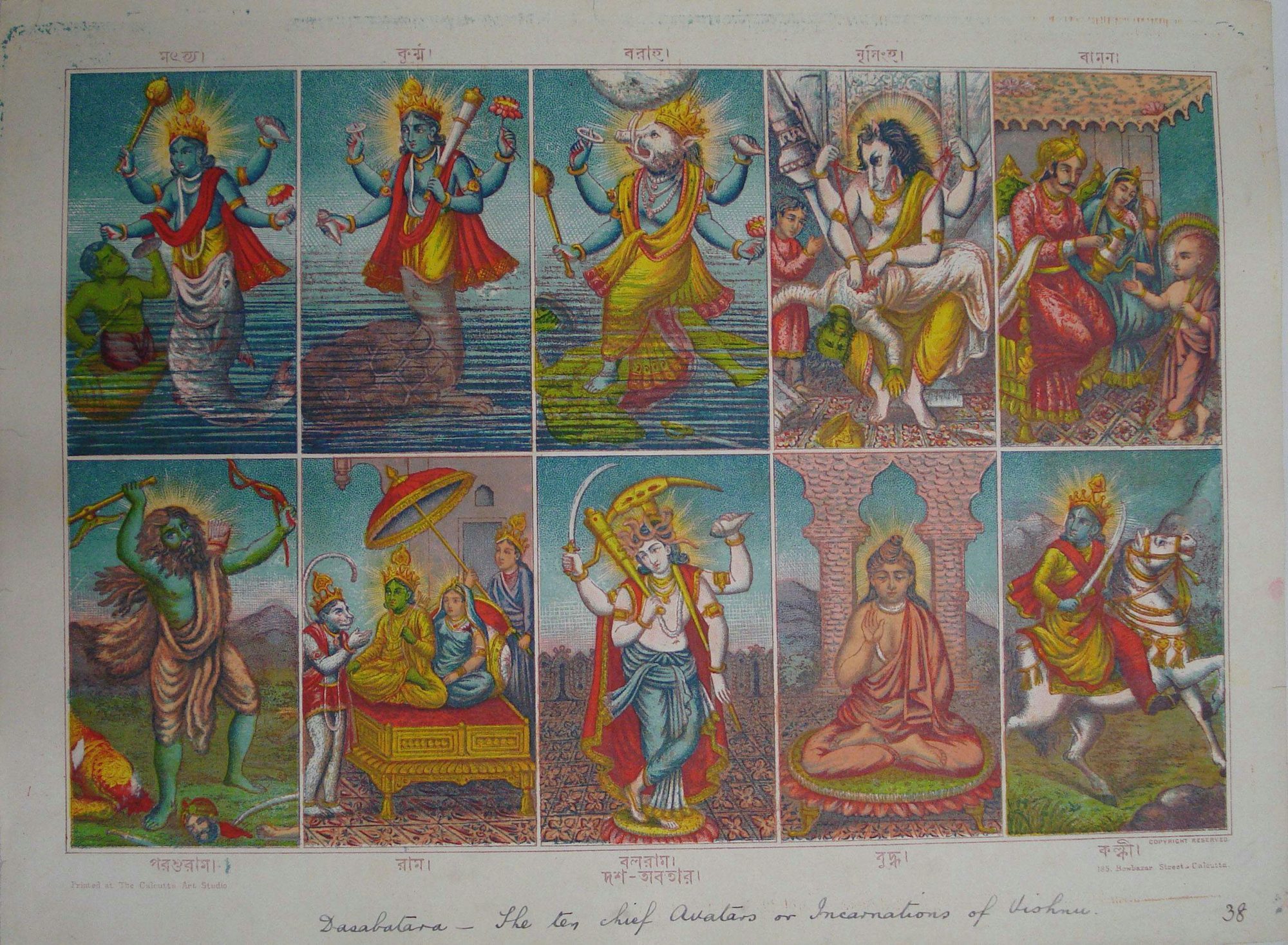
The tradition holds two renewals side by side without forcing them into one story, and it is honest to leave them as it found them. In the one, the reset is a matter of cosmic law: when the Kali age is nearly spent and the signs of the end multiply, a Brāhmaṇa named Kalki will be born in a town called Sambhala, sweep the false kings and the barbarians from the earth, perform the great Horse-sacrifice, and inaugurate a new Kṛta age. The very heavens mark the moment, for the fresh age begins when the Sun, the Moon and Jupiter stand together with the constellation Puṣya in a single sign of the sky.
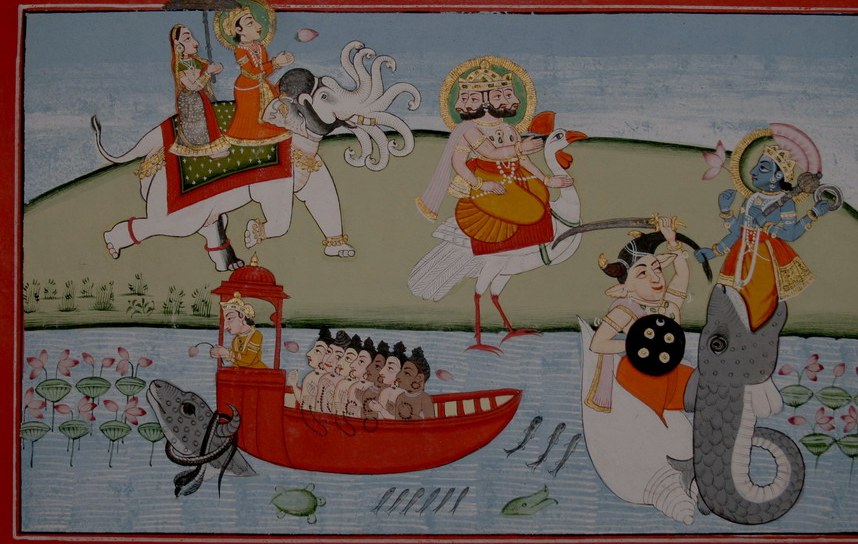
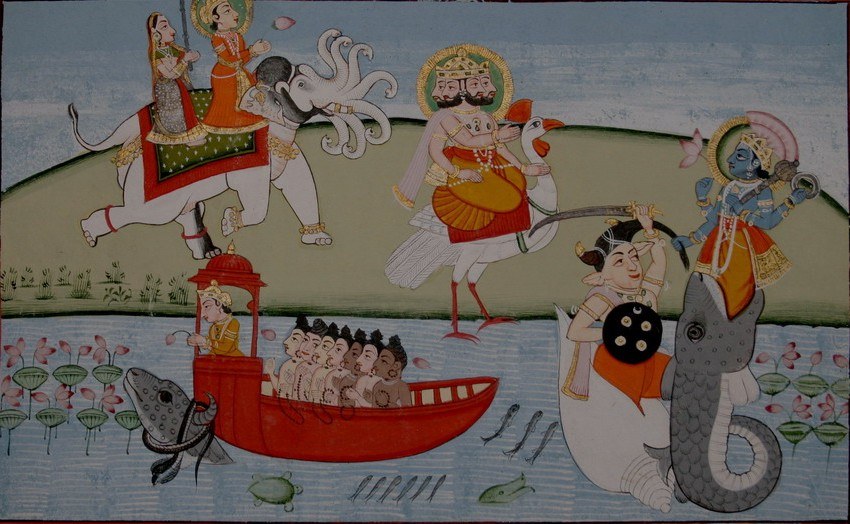
The signs of the end that Kalki answers are small and awful and strangely modern: the right hand will cheat the left, men will abandon their own countries to wander after new ones, the cattle will yield little milk and the trees few flowers and fruit, and human beings will grow short-lived and weak and small of body. In the other renewal, older and stranger, a fish warns Vaivasvata Manu of a coming flood and bids him build a strong and massive ark, furnished with a long rope, and go aboard with the seven Ṛṣis and the seeds of all living things. He ties the rope to the horn on the fish’s head, and the ark is dragged across a shoreless sea where nothing at all can be seen but Manu, the seven sages, and the fish, reeling on the endless water like a drunken harlot until the world is ready to bear life once more.
Both are true in the way that myths are true, and neither cancels the other. What they share is the shape underneath: the conviction that ruin is never final, that the wheel which grinds the golden age down to iron is the same wheel that lifts iron back to gold, and that a man who lives, as we are told we do, in the fourth and darkest quarter of a single fading age is standing on the crippled last leg of a very old and very patient god, waiting for the turn.
In the Krita age Dharma is four-footed and entire, and (so is) Truth… In the other (three ages)… Dharma is deprived successively of one foot, and unrighteousness increases through theft, falsehood, and fraud. (Manu Smṛti 1.81–82, Bühler trans., Sacred Books of the East vol. 25)
- Mahābhārata, Vana Parva (Book 3), Section CXLIX (Ganguli trans., P. C. Roy ed.; archive.org id
mahabharataofkri03roypuoft)Hanumān’s account to Bhīma of the four yugas — virtue whole in the Kṛta and lessened by a quarter each successive age (in the Kali Yuga a quarter only of virtue abideth
); the colours of Nārāyaṇa, white, red, yellow and black; and the Kṛta age withno buying and selling
andno manual labour,
its wantsobtained only by being thought of,
free of gods, demons and disease, with a single Veda and the single mantra Om. - Mahābhārata, Vana Parva, Section CLXXXVIIIthe exact yuga durations in divine years (Kṛta 4,000 + 400 + 400; Tretā 3,000 + 300 + 300; Dvāpara 2,000 + 200 + 200; Kali 1,000 + 100 + 100),
a cycle of the Yugas… comprised a period of twelve thousand years,
anda full thousand of such cycles would constitute a day of Brahma
; together with the concrete signs of the failing Kali age. - Mahābhārata, Vana Parva, Mārkaṇḍeya-Samāsyā, Sections CLXXXIX–CXCthe collapse of the Kali age and the Kalki prophecy —
a Brahmana of the name of Kalki
bornin a town of the name of Sambhala,
who exterminates the barbarians, performs the Horse-sacrifice, and inaugurates a new Kṛta age, which dawnswhen the Sun, the Moon, and Vrihaspati (Jupiter)… with the constellation Pushya, enter the same sign.
- Mahābhārata, Vana Parva, Section CLXXXVIIthe Matsya (fish) and Vaivasvata Manu — the fish’s warning, the
strong massive ark… furnished with a long rope,
the seven Ṛṣis andall the different seeds
aboard, the rope fastened to the fish’s horn, and the ark thatreeled about like a drunken harlot
on a sea wherenone but Manu, the seven Rishis and the fish could be seen.
- Manu Smṛti (Mānava-Dharmaśāstra) 1.67–86 (G. Bühler trans., Sacred Books of the East vol. 25; archive.org id
lawsofmanu00manuuoft)the divine-year reckoning (a year… is a day and a night
of the gods; 360 such days a divine year); the yuga durations 1.69–71;these twelve thousand (years)… are called one age of the gods
; that age multiplied by seventy-one asthe period of a Manu (Manvantara)
(1.79);the sum of one thousand ages of the gods (makes) one day of Brahman, and… his night has the same length
(1.72); four-footed Dharma losing a foot an age (1.81–82); and the lifespansfour hundred years in the Krita (age),
lessened a quarter each age thereafter (1.83). - Vishnu Purāṇa, Book VI, Chapter 3 (H. H. Wilson trans.; archive.org id
bub_gb_RO8oAAAAYAAJ)the day-of-Brahmā (Naimittika) and elemental (Prākṛtika/Mahā-pralaya) dissolutions, with Wilson’s note adding the further Ātyantika and Nitya kinds; the 360-day divine year and the twelve thousand divine years of a four-age cycle;a thousand periods of four ages complete a day of Brahma… termed a Kalpa,
during whichfourteen Manus preside
; the hundred-year drought; the seven solar rays dilating to seven suns; Rudra asthe scorching breath of the serpent Sesha
; the scorched earthresembling… the back of a tortoise
; and the Saṃvartaka cloudsresembling vast elephants in bulk
that flood the world for a night of Brahmā.