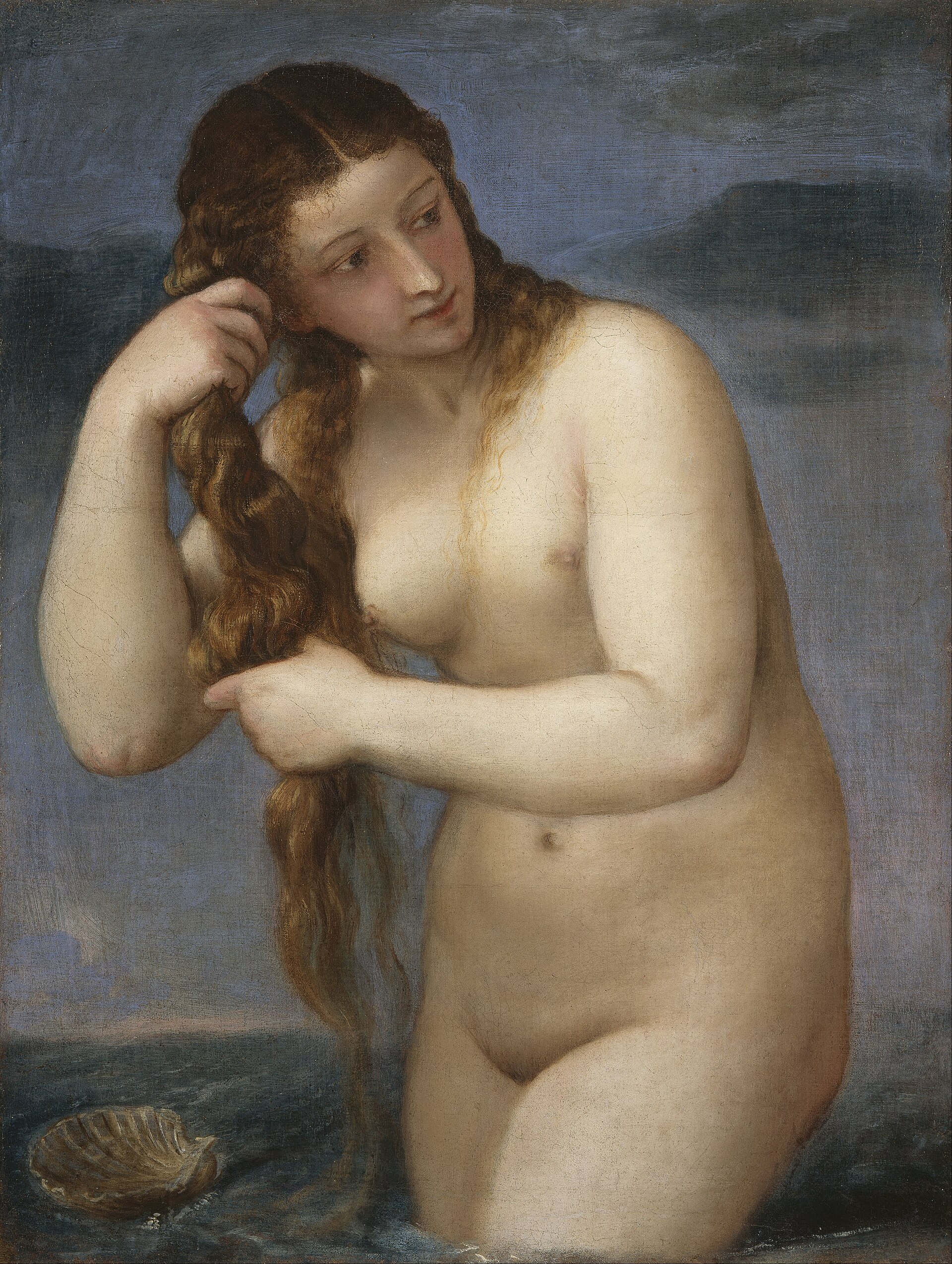
The old sky-god was bleeding into the sea, and out of the white foam a goddess was growing.
Hesiod tells it as the most violent birth in Greek myth. Kronos, hating his father Ouranos (Heaven), had lain in ambush with a jagged sickle of grey flint, and when Heaven came down over the Earth in the dark he struck, severing his father’s genitals and flinging them behind him into the surging waters. Where the immortal flesh drifted, a white foam spread around them,
and in that foam something took shape and grew.
It was a maiden. She rode the swell to holy Kythera first, then on to sea-girt Cyprus, and where she stepped ashore the grass sprang up beneath her feet. Hesiod names her from the foam that made her: aphros, foam, and so Aphrodite. (The gloss is his own folk-etymology, offered inside the poem; modern linguists suspect the name is older and non-Greek, and it is best kept as Hesiod’s explanation rather than settled fact.)
Not the shell of the painters
She did not arrive alone, and she did not arrive on a shell. That famous scallop belongs to painters, above all Botticelli, and to a much later iconographic type; the archaic poets know only the foam, the maiden growing in it, and the grass at the shore. What they do give her at once is company: Eros (Love) and Himeros (Desire) fell in beside her at her very birth and walked with her into the assembly of the gods. Her allotted portion among gods and men was fixed from the start, the whisperings of maidens and smiles and deceits with sweet delight and love and graciousness.
The other birth
That is one story of her origin, and it is not the only one. Homer knows a wholly different Aphrodite: not a primordial power older than the Olympians but an Olympian by ordinary birth, the daughter of Zeus and the goddess Dione, who flees weeping to her mother’s lap in the Iliad after Diomedes wounds her hand in battle. The two accounts cannot be reconciled. One goddess has no parents and predates the gods; the other is Zeus’s own child. Later thinkers such as Plato would tidy the split by proposing two Aphrodites, Ourania the Heavenly and Pandemos the Common, but that is philosophy imposed on the myth centuries afterward, not part of either original tale.
Whichever birth you follow, the reach of her power is the same, and the Homeric Hymn in her honour states it without hedging. She stirs up sweet passion in the gods and subdues the tribes of mortal men and birds that fly in air and all the many creatures that the dry land rears, and all the sea.
Almost nothing escapes her. The hymn allows exactly three exceptions, three goddesses her charms cannot touch or ensnare: Athena, Artemis, and Hestia. Everyone else is fair game, up to and including the king of heaven, for she beguiles even his wise heart whensoever she pleases,
and mates him with mortal women behind Hera’s back.
What Zeus did to humble her
It is that last liberty that undoes her. To humble the goddess who had made a fool of him so often, Zeus turned her own weapon against her, casting into Aphrodite a helpless desire for a mortal: Anchises, a Trojan herdsman tending his cattle on the slopes of Mount Ida. The hymn lingers on how she came to him. First her toilette at Paphos, where the Graces bathed her in fragrant, immortal oil such as blooms upon the bodies of the eternal gods,
dressed her in gold, fastened twisted brooches to her robe, set flower-shaped earrings in her ears and draped lovely necklaces around her neck, until her robe shimmered like the moon.
Then the crossing of Ida itself, where grey wolves and grim-eyed lions, bears and fleet leopards fawned at her passing while she filled them with longing so that they paired off two by two through the shadowy valleys. She reached Anchises disguised as a mortal girl, calling herself a daughter of Otreus who ruled all Phrygia, and he took her to a bed spread with the skins of bears and lions he had killed himself. Only afterwards did she stand and let her true nature blaze out, her head brushing the roof-beam, unearthly light streaming from her cheeks. She foretold the son she carried, Aeneas, drawing his name from the ainos, the awful grief, she felt at having lain with a man who must die.
The net over the bed
Her own bed held a scandal too. Though married in the Odyssey to Hephaestus the smith, she took Ares the war-god as her lover in secret, until Helios the all-seeing Sun caught them at it and told her husband. Hephaestus answered with craft rather than rage, forging bonds fine as spiders’ webs, so that no one even of the blessed gods could see them,
draping them over his own bed, then pretending to leave for Lemnos.
The lovers were snared in the act and the assembled gods summoned to laugh at them. Even here the sources decline to agree on the marriage itself: elsewhere Hesiod gives Hephaestus a different wife, Aglaia, youngest of the Graces, so Aphrodite’s union with the smith is one tradition among several rather than a fixed fact.
Older than the gods who rule
That, in the end, is the shape of her. Not a gentle patroness of romance but a force, older in one telling than the gods who fear her, able to bend Zeus himself, welcomed on land by grass and beasts and desire, and dangerous precisely because almost nothing alive can say no to her.
She “subdues the tribes of mortal men and birds that fly in air and all the many creatures that the dry land rears, and all the sea.” Only three goddesses stand outside her power. Everyone else, up to the king of heaven, is hers to move.
- Hesiod, Theogony 176–206the castration of Ouranos by Kronos with the flint sickle, the foam-birth of Aphrodite, her landfall at Kythera and Cyprus with grass springing beneath her feet, her attendants Eros and Himeros, the aphros etymology, and her allotted domain of love and beguilement. The oldest and fullest account of her origin. (H. G. Evelyn-White trans., Loeb 1914.)
- Homeric Hymn 5 (To Aphrodite) 1–199her universal power over desire and the three goddesses immune to it (Athena, Artemis, Hestia), her sway over Zeus, and Zeus turning that power back on her in the seduction of Anchises on Mount Ida, including her toilette at Paphos, the fawning beasts, her disguise, and the conception and naming of Aeneas. (H. G. Evelyn-White trans., Loeb 1914.)
- Homer, Odyssey VIII.266–366the Song of Demodocus, in which Aphrodite, wife of Hephaestus, is caught with her lover Ares by the invisible net the smith forges after Helios informs on them, and the trapped pair are exposed to the laughter of the gods. (A. T. Murray trans., Loeb 1919.)
- Homer, Iliad V.370–371the variant parentage, in which Aphrodite is the daughter of Zeus and Dione and flees to her mother after Diomedes wounds her. Cited for the divergence from the Hesiodic foam-birth. (Loeb.)