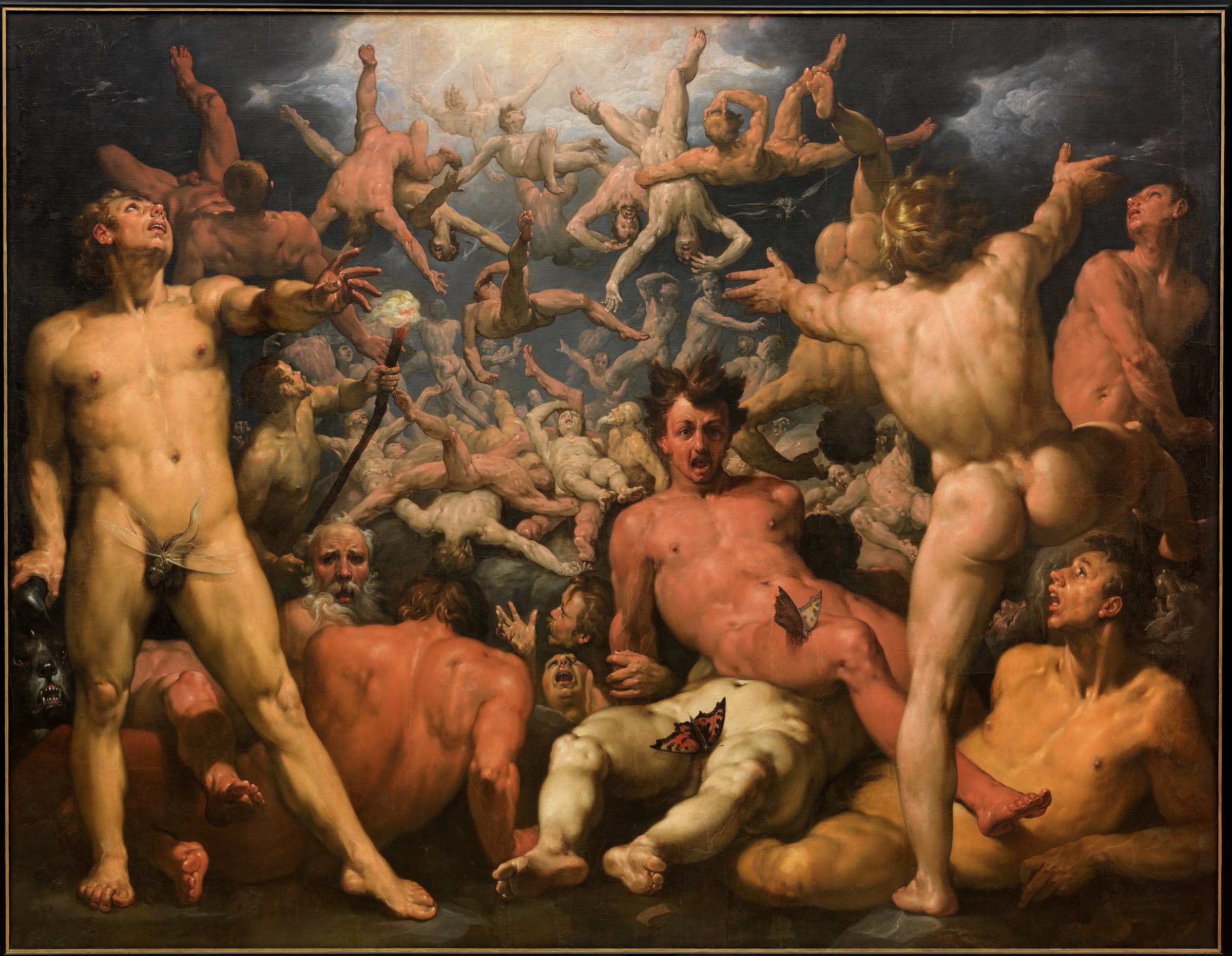
First of all there was the gap. Not a storm, not a soup of churning matter, not a dark ocean waiting to be parted: simply Chaos, a yawning chasm that opened where nothing had opened before. The Greek word means a gape, a cleft, the space that yawns between things, and Hesiod chooses his verb with care. Chaos came to be. Nobody made it. It had no parent and no maker, and it is the one thing in the whole account for which the poet offers no cause. From that first opening everything else would follow, being calling being into existence down the long generations, until the world had a shape and gods to rule it.
Not out of the gap, beside it
What came next did not come out of the gap. This is the hinge on which the whole cosmogony turns, and it is the point most often got wrong. After Chaos there arose wide-bosomed Gaia, the Earth, the ever-sure foundation of all the deathless ones who hold the peaks of snowy Olympus.
Then dim Tartarus, far down in the depths of the broad-pathed Earth. Then Eros, fairest among the deathless gods, who unnerves the limbs and overcomes the mind and wise counsels of all gods and all men.
But Gaia and Tartarus and Eros are not the children of Chaos. In Hesiod’s Greek they simply came to be alongside it, coeval powers welling up in the first moments, not offspring born from a parent. Only two beings are actually born from Chaos: Erebus, the darkness of the underworld, and black Nyx, the Night. Flatten that distinction and you turn a subtle account of coeval origins into a tidy family tree that the text never draws. Later writers did exactly that; Hesiod did not.
Consider the Eros who stands here at the beginning. He is not the winged boy with the bow and the honey-tipped arrows, not the mischievous son of Aphrodite who will not be born for several generations yet. This elder Eros is a cosmic force, the raw principle of attraction that makes generation possible at all, the pull that loosens limbs and overturns careful counsel so that beings seek one another and beget. Plato remembered him precisely this way, citing Hesiod in the Symposium to prove that Love is among the oldest of the gods. Without this Eros present from the first, nothing that follows could couple, and the cosmos would stall at its own threshold.
Night and her bright opposites
From Chaos, then, came Erebus and Night, and Night lay with Erebus and bore their bright opposites: Aether, the shining upper air, clean and untainted, and Hemera, the Day. Darkness begets light; this is the logic of the poem, opposites drawn out of one another. Meanwhile Gaia set about her own work, and she did it alone. Without any partner, without sweet union of love,
she brought forth first Ouranos, the starry Heaven, and made him equal to herself, to cover her on every side.
Picture that exactly: a dome of sky shaped to match the disk of earth, a lid fitted precisely to its vessel, a secure and everlasting seat for the gods to come. Then she bore the Ourea, the long Hills, haunts of the mountain Nymphs, and Pontus, the barren raging Sea, again with no father at all. The Earth generates the frame of the world out of herself before any consort touches her.
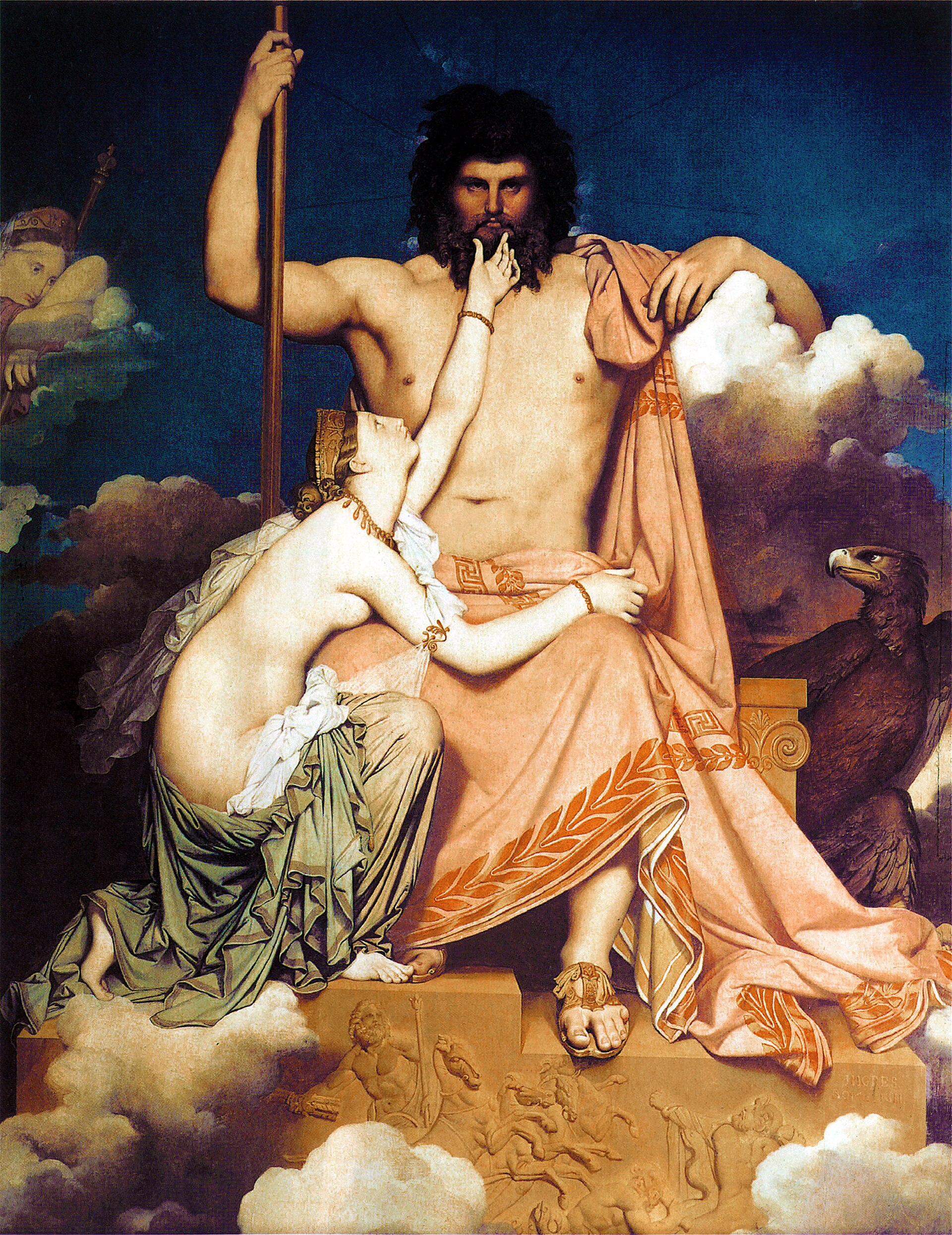
Only then does the pattern shift from solitary birth to union. Gaia lay with her own son Ouranos, and from that embrace came the great third generation: the twelve Titans, Oceanus and Coeus and Crius, Hyperion and Iapetus, Theia and Rhea, Themis, Mnemosyne, Phoebe and Tethys, and last of all Cronos the wily, youngest and most terrible of her children, who hated his lusty sire.
She bore, too, the three Cyclopes, Brontes and Steropes and Arges, whose names mean Thunderer and Lightner and Bright, and the three Hundred-Handers, Cottus and Briareos and Gyes. The world now teems. And it is precisely here, at the moment of greatest fertility, that the first great violence enters the story.
The sickle in the ambush
Ouranos hated his own children. As each was born he hid it away, pressing it back into the body of Gaia and refusing to let it into the light, so that the Earth groaned within, crammed full and stifled. So she made a plan. From grey flint she forged a great jagged sickle, and she called on her children to punish their father’s cruelty, and only Cronos, the youngest and most terrible, dared to answer. He took the sickle and lay in wait. When Ouranos came at nightfall, longing for love,
and spread himself full upon the Earth, Cronos reached out from ambush with his left hand, took the great sickle in his right, and cut.
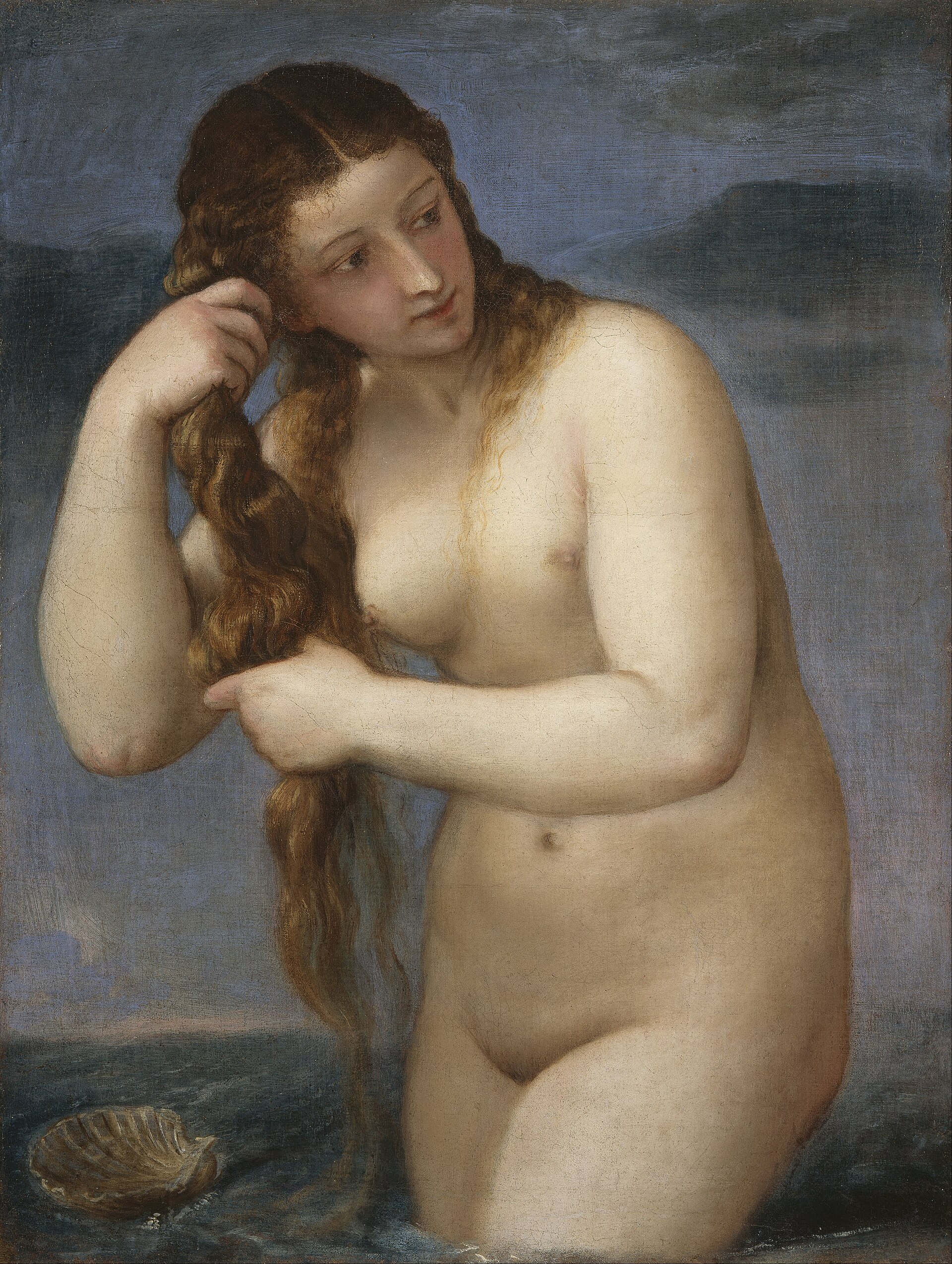
He flung the severed members away behind him, and they did not fall barren. From the blood-drops that spattered onto Gaia sprang the Erinyes, the avenging Furies, and the Giants, and the Meliae, the Nymphs of the ash trees. From the members themselves, cast into the sea, a white foam gathered and grew, and out of that foam rose Aphrodite. The first act of the ordered succession is a son maiming his father to free his siblings, and the goddess of desire is born from the wound. Beauty and violence share a single origin here, and the poem does not soften it.
First of all the Chasm came to be; but next wide-bosomed Earth, the ever-sure foundation of all.
Not born of the gap, but beside it, together, at the beginning of everything.
That is the Hesiodic account, the oldest and most complete Greek cosmogony we have, and it is worth being clear about how much of the received tradition it does not contain. If you turn to ApollodorusThe unidentified compiler of the Library, a systematic prose summary of the myths written too late to be the work of the Athenian scholar whose name it carries, and so commonly cited as Pseudo-Apollodorus., the great mythological handbook of the Roman era, expecting the birth of the cosmos, you will not find it. The Bibliotheca opens flatly: Sky was the first who ruled over the whole world,
and moves straight to his marriage with Earth and the birth of the Hundred-Handers, the Cyclopes and the Titans.
There is no Chaos in Apollodorus, no emergence of Gaia, no Tartarus welling up, no primordial Eros. He begins the story only once Ouranos is already king. Even in the detail he diverges: from the blood of the castrated Ouranos he names only the Furies, Alecto and Tisiphone and Megaera, and says nothing of the Giants, the Meliae, or the foam-born Aphrodite. Anyone reaching for Apollodorus 1.1
as a source for the origin of the world is reaching into a gap of a different kind.
The egg the Orphics told of
There were other beginnings, too. The Orphics, the mystery-poets who traced their teaching to the singer Orpheus, told the story differently and in several incompatible ways at once. Their common thread is a cosmic egg. In one strand, Water and Mud came first, and from them the Earth solidified; then Khronos, unaging Time in the form of a winged serpent with the extra heads of a bull and a lion, entwined with Ananke, Necessity, whose arms stretched across the whole universe. This Time fashioned a bright silver egg in the boundless Aether, and from the egg hatched Phanes, whom the Orphics call the first king of all: a golden-winged, two-sexed being with the heads of a bull and a lion growing from his flanks and a serpent upon his brow, presenting the appearance of all kinds of animal forms,
his very name meaning to bring to light, to make appear.
The two halves of his shattered eggshell became the sky above and the earth below. The Orphics equated this Phanes with Hesiod’s elder Eros, the same principle of first light and first desire wearing a stranger face. But there was no single Orphic poem. Different theogonies (the Derveni, the Rhapsodic, the Hieronyman) disagreed about what stood first, whether Water or Time or Night, and survive only as fragments quoted by much later writers. Present them as one system and you misrepresent them; the egg and its shining occupant are the shared image, not a fixed creed.
The comic poet Aristophanes knew this tradition well enough to parody it. In the Birds, his chorus sings a cosmogony of their own devising: at the beginning there was only Chaos and Night, dark Erebus and deep Tartarus, with no Earth or Air or Heaven anywhere. Then black-winged Night laid a wind-egg in the boundless bosom of Erebus, and from it, after the long revolving ages, hatched golden-winged Eros, swift as the whirlwinds of the tempest,
who went on to mate with Chaos and bring the race of birds into being. It is a joke, and it is also a faithful echo of the Orphic egg, proof that an Athenian audience in 414 BCE would catch the reference and laugh.
What chaos did not mean
One caution, finally, worth carrying out of all this. The modern sense of chaos
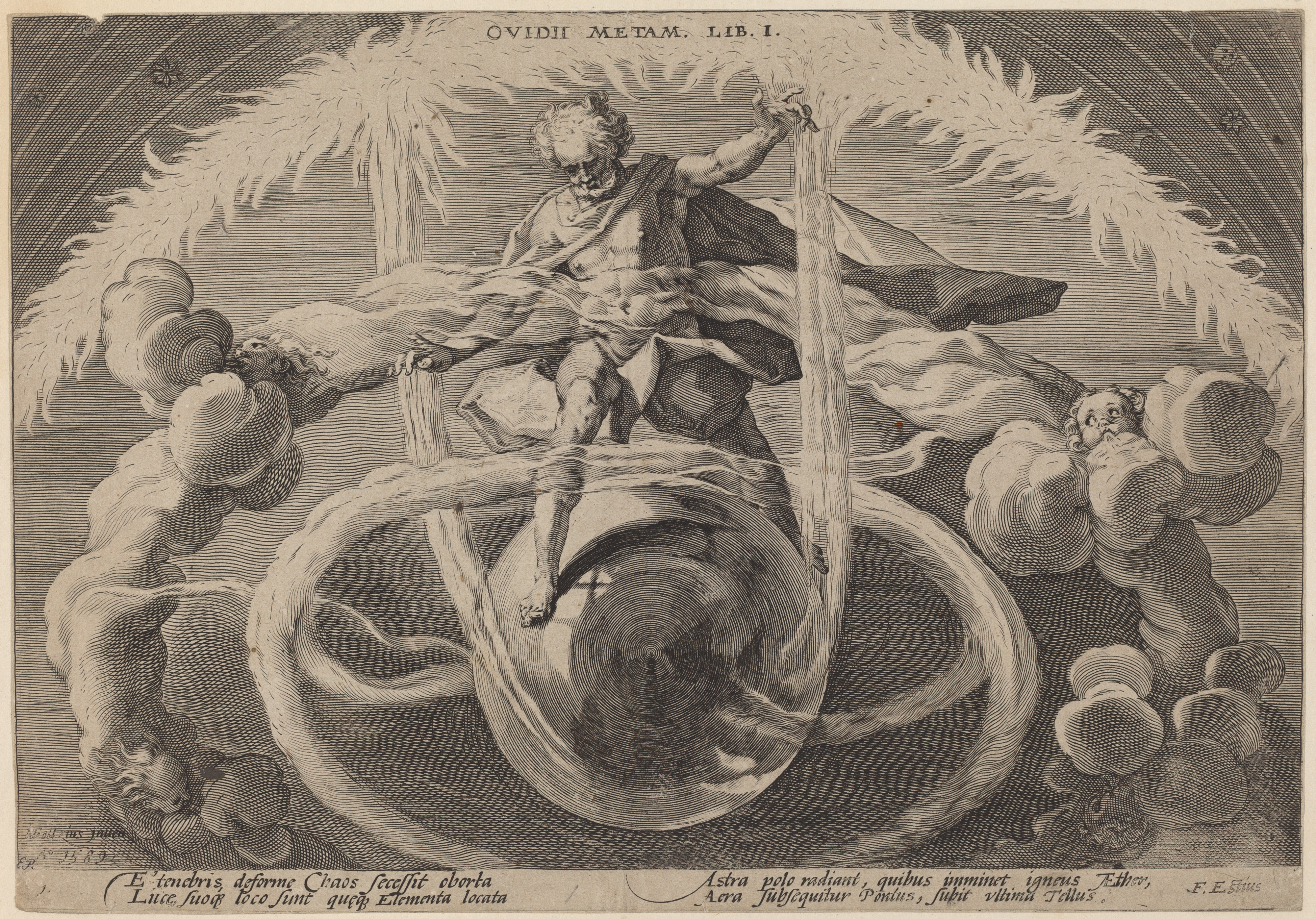
as churning disorder, a formless mass of warring elements, is not Hesiod’s and not archaic Greek at all. It comes from Rome. Ovid opens the Metamorphoses with Chaos as an undifferentiated, confused mass of clashing elements, until a god or kindlier nature
intervenes to sort it into a world. That is a philosopher’s cosmos dressed in poetry, and it is where our primordial chaos
imagery is truly born. Hesiod’s Chaos is quieter and stranger than that: not a churning soup but a gap, a dark cleft yawning open, the first empty space out of which, and beside which, everything came to be.
- Hesiod, Theogony 116–210the core text and the oldest complete Greek cosmogony, giving the whole succession. Chaos first, then Gaia, Tartarus and Eros arising beside it (not from it); Erebus and Nyx born from Chaos; Aether and Hemera from Nyx and Erebus; Gaia’s parthenogenic bearing of Ouranos, the Ourea and Pontus; then by Ouranos the twelve Titans, the three Cyclopes and the three Hundred-Handers; and the castration of Ouranos, from whose blood spring the Erinyes, Giants and Meliae, and from whose severed members Aphrodite is foam-born. (8th–7th c. BCE; trans. Evelyn-White, Loeb 1914.)
- Apollodorus (Pseudo-Apollodorus), Bibliotheca 1.1.1–1.2.1begins with Ouranos already ruling and omits the primordial phase entirely (no Chaos, Gaia-genesis, Tartarus or Eros); useful for the succession from Ouranos onward and for the divergent detail that only the Furies (Alecto, Tisiphone, Megaera) spring from Ouranos’s blood, with no Giants, Meliae or foam-born Aphrodite named. (~1st–2nd c. CE; trans. Frazer, Loeb 1921.)
- Orphic Fragments (Kern) 54, 57, 66, 101–102, 167the reconstructed cosmic-egg cosmogonies, surviving only as quotations in much later authors (Damascius, Athenagoras, Proclus) and the Derveni Papyrus. Frag. 54 and 57: Water and Mud, the serpent Khronos and Ananke, the bright egg, and Phanes as first king; the eggshell halves becoming Ouranos and Gaia. Frag. 101–102: the succession Phanes to Nyx to Ouranos. Multiple, non-reconcilable Orphic theogonies are collated under these modern editorial numbers; the egg-and-Phanes motif is their common thread, not a single ancient poem.
- Aristophanes, Birds 693–702the comic-Orphic cosmogony, with Chaos, Night, Erebus and Tartarus first, Night’s wind-egg laid in Erebus, and golden-winged Eros hatching from it to father the birds. Comic parody, but a faithful witness to the Orphic egg tradition. (414 BCE; trans. O’Neill.)
- Plato, Symposium 178bcites Hesiod’s primal Eros as among the oldest of the gods, an external attestation of the cosmogonic-Eros tradition and distinct from the later son of Aphrodite. (4th c. BCE.)
- Aristotle, Metaphysics 984b; 1071bphilosophical discussion treating Hesiod’s Chaos and Eros as first principles, a later interpretation of the archaic text rather than an independent narrative.
- Hyginus, Fabulae Prefacea Latinised, divergent genealogy (Mist to Chaos to Nox, Dies, Erebus and Aether), noted here as a later variant that also flattens Gaia and the rest into offspring of Chaos. (Roman, 2nd c. CE; trans. Grant.)
- Ovid, Metamorphoses I.5–20Chaos as an undifferentiated, confused mass of warring elements separated by
a god or kindlier nature,
a philosophically driven Roman reworking rather than the archaic Greek scheme, and the true source of the modernchaos as disorder
sense. (1st c. BCE–1st c. CE.)