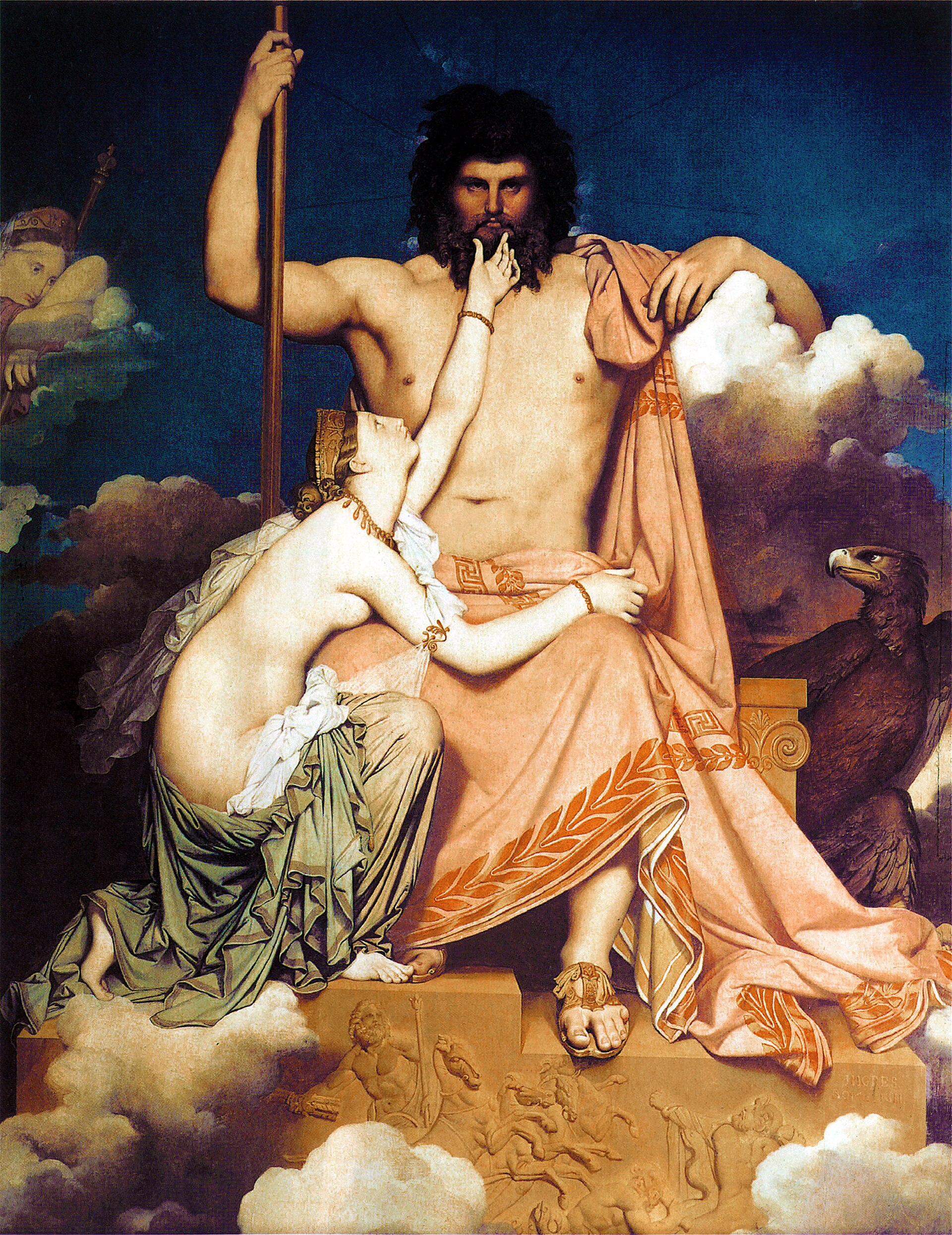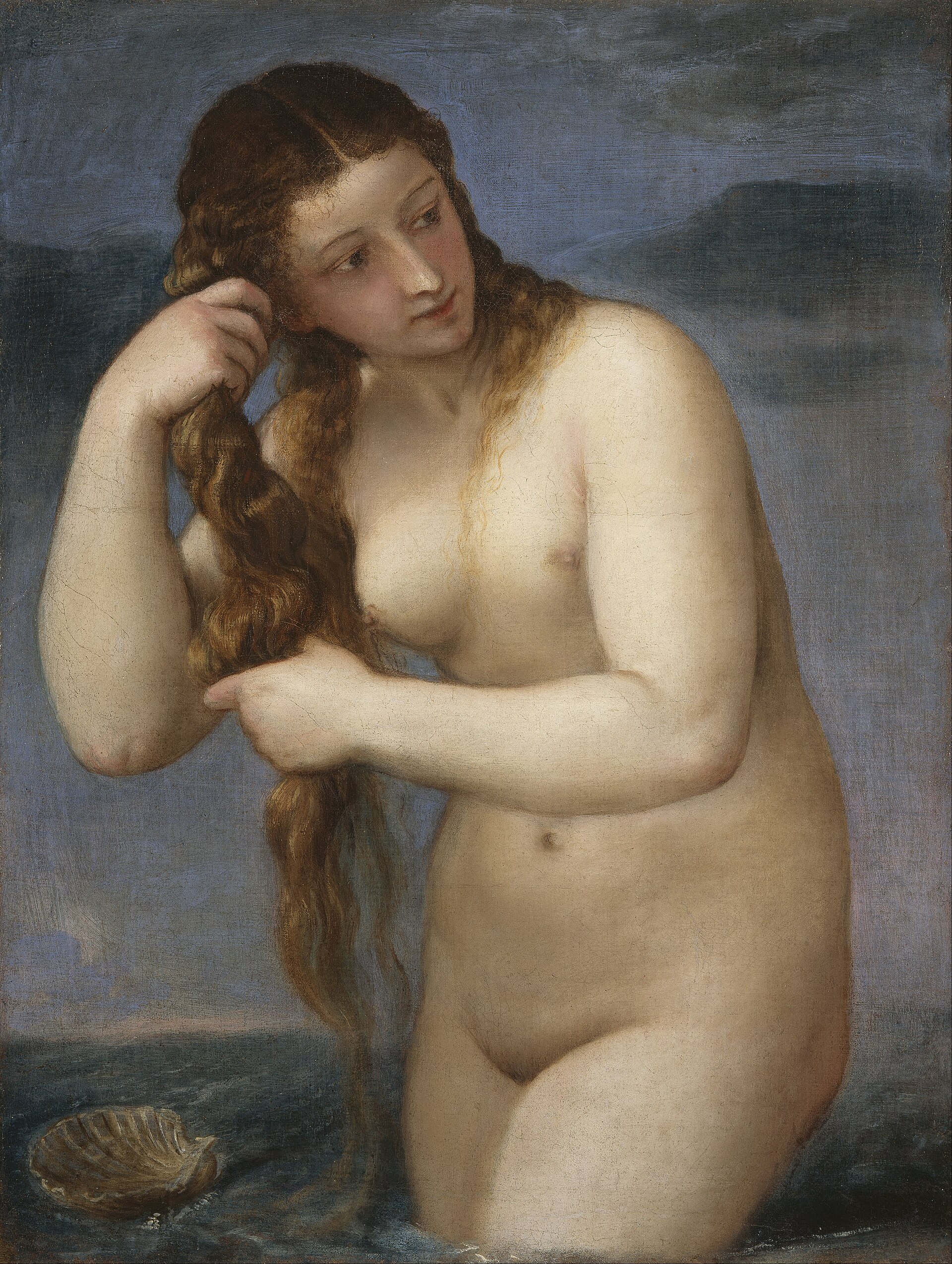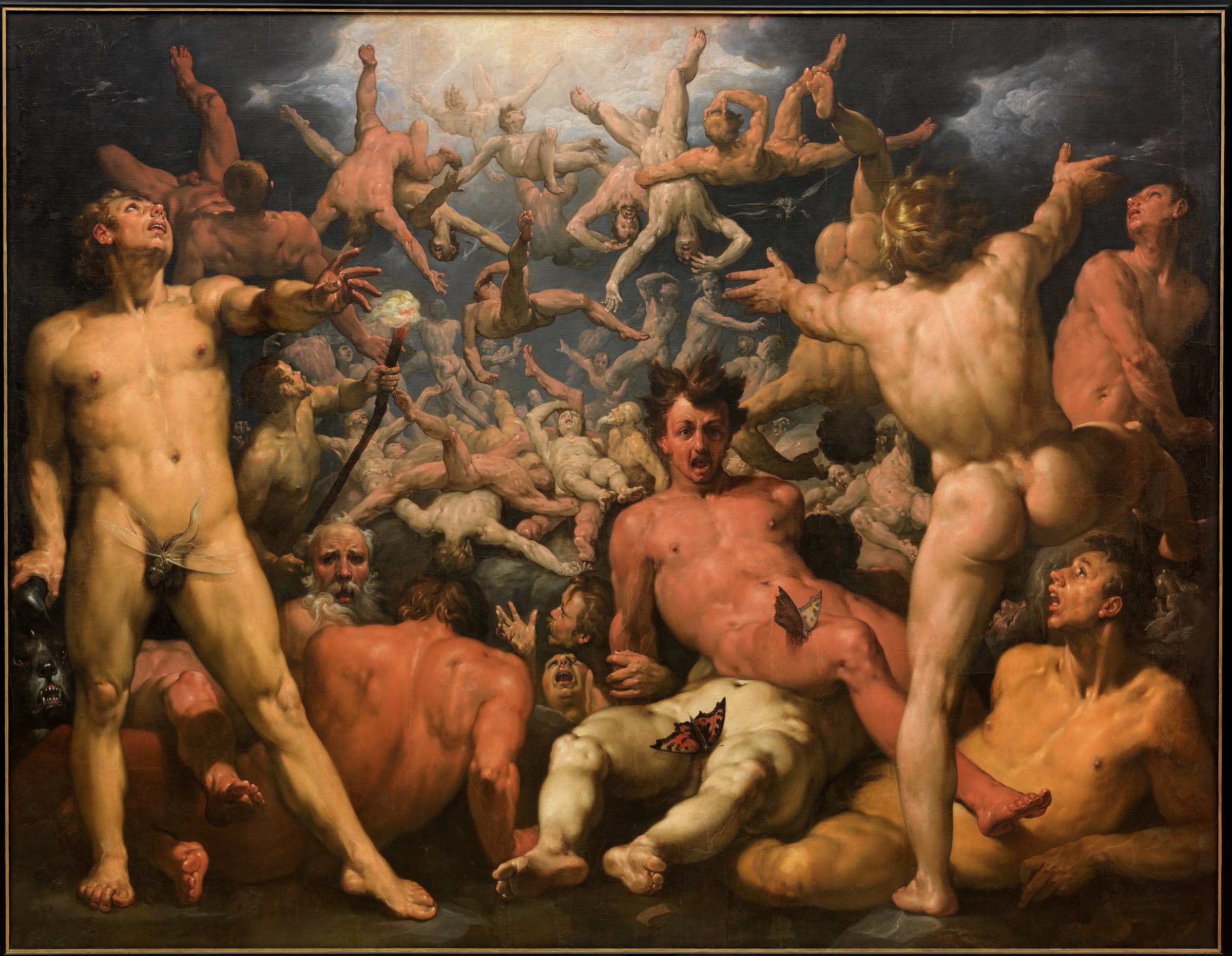
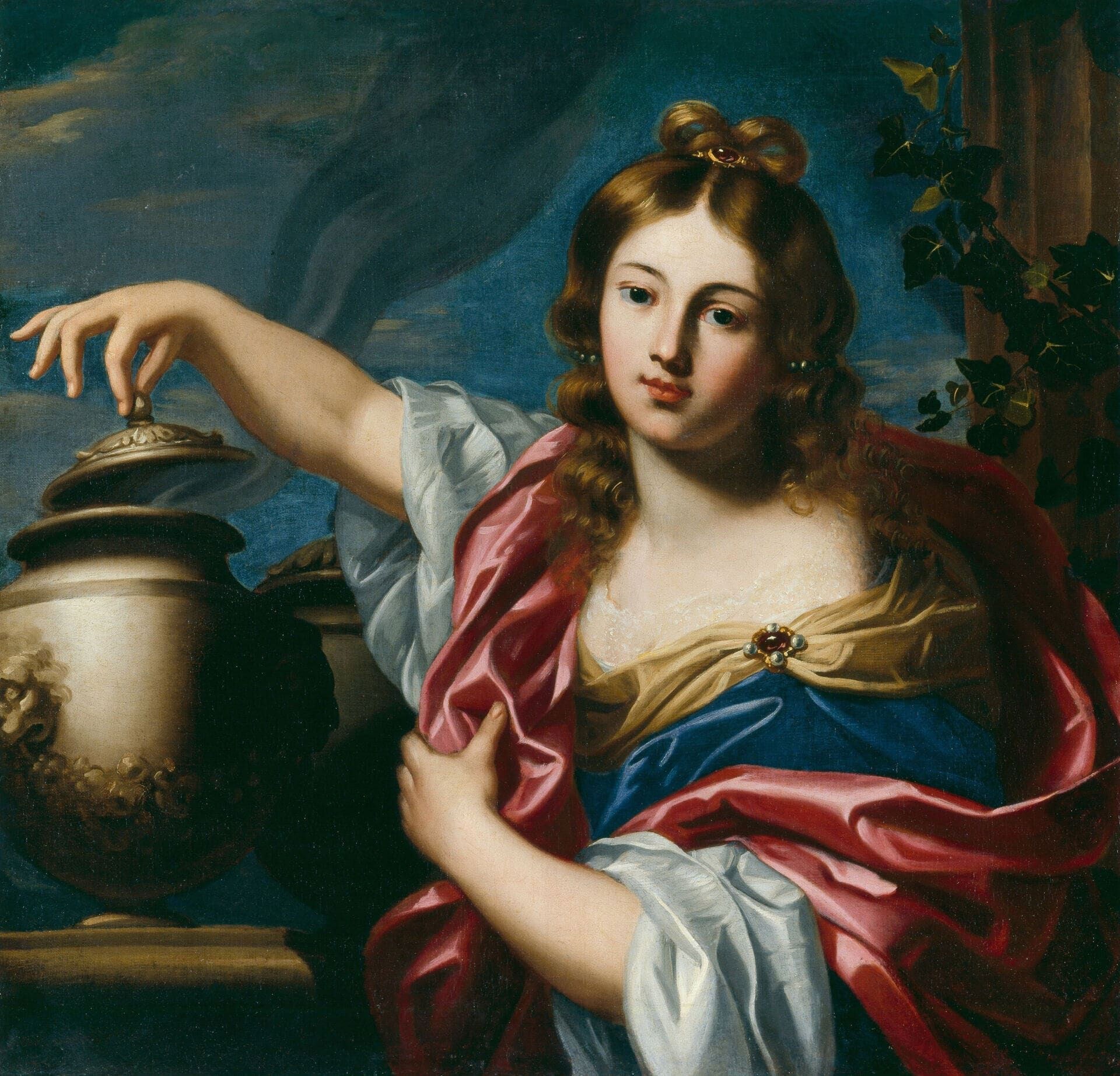
Zeus laughed aloud when the idea came to him. Prometheus had just cheated him of fire, smuggling the flame down to mankind in a hollow fennel-stalk, and the father of gods and men answered not with a thunderbolt but with a gift. He would make men something lovely to hold, and hide the ruin inside it. So said the father of men and gods,
Hesiod tells us, and laughed aloud.
The first woman was conceived as a joke at humanity’s expense, and the god who devised her thought it was funny.
Every hand on Olympus
The making of her is the strangest workshop scene in Greek myth, because every hand on Olympus takes a turn. Zeus orders Hephaestus to mix earth with water and mould a sweet, lovely maiden-shape, like to the immortal goddesses in face.
From clay, then, the same stuff a potter works. Athene girds and clothes her and teaches her the loom. Golden Aphrodite sheds grace upon her head, and with it cruel longing and cares that weary the limbs.
The Graces and Persuasion hang golden necklaces at her throat; the Hours crown her with the flowers of spring. Then Hermes, last of all, puts into her a shameless mind and a deceitful nature,
fills her with lies and crafty words,
and gives her a voice to carry them. She is beautiful in every visible particular and hollow with deceit at the centre, and both qualities are deliberate. She is a made thing, assembled to a specification.
Her name is the seal on the design. Hesiod glosses it inside the poem: he called this woman Pandora, because all they who dwelt on Olympus gave each a gift, a plague to men who eat bread.
All-Endowed, All-Gift. The gods have each dropped something into her the way you might load a snare, and the word for the finished trap is a girl’s name.
The brother who thought afterwards
Hermes leads her down to Epimetheus, whose name means afterthought, and the naming there is no accident either. His brother Prometheus, the one who thinks ahead, had warned him plainly: never accept a gift from Zeus, send it straight back. Epimetheus forgot the warning, took the beautiful stranger into his house, and afterwards, when the evil thing was already his, he understood.
That single beat of dawning horror is one of the truest things in the story. He does not understand as it happens. He understands once it is too late to give her back.
A jar, not a box
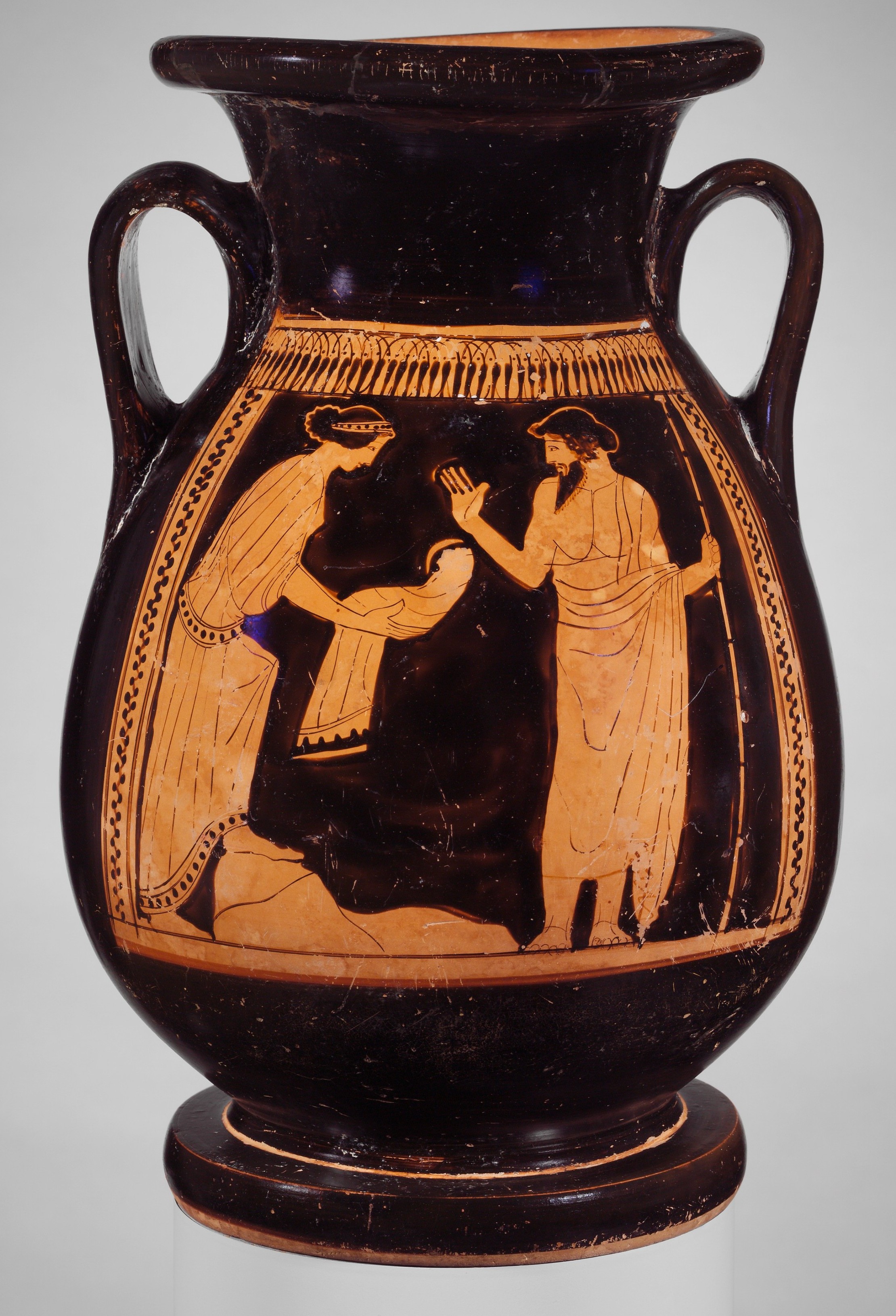
Then there is the jar. Note the word, because almost everyone gets it wrong: Hesiod’s Pandora opens a jar, a pithos, a great ceramic storage vessel of the kind that held a household’s grain or wine, tall enough to bury a body in. There is no box. The famous Pandora’s box
is a mistranslation that entered the tradition more than two thousand years after Hesiod, when the humanist Erasmus rendered pithos into Latin as pyxis, a small box, and the slip stuck fast to the English imagination.
Strip it away and the image sharpens. This is a big lidded pot, and inside it are all the miseries that had until then been kept away from men. Before the lid came off, Hesiod says, the tribes of men lived on earth remote and free from ills and hard toil and heavy sickness.
She takes off the great lid with her hands and scatters them. Sorrows, diseases, ten thousand plagues go wandering out over the earth, and misery makes men grow old before their time. What Hesiod does not give her is a motive. He never says she was curious, never says she could not help herself, never says a woman’s weakness undid the world. The curious girl who couldn’t resist
is a later, softer story painted over the original. In the earliest text she simply lifts the lid, and the evils escape, and that is that.
The one thing left inside
One thing stays inside. Hope, Elpis, remained there in an unbreakable home within under the rim of the great jar, and did not fly out at the door; for ere that, the lid of the jar stopped her, by the will of aegis-holding Zeus.
And here Hesiod hands us a riddle he never solves. If the jar was full of evils, why is Hope among them, and why does it comfort us that Hope alone did not get loose? Some read it as a blessing kept safe for mankind against the day it is needed.
Some read it as a cruelty, the one thing we might have used to bear the rest, sealed away by Zeus’s will where we cannot reach it. Some read Hope itself as the subtlest evil of all, a flattering delusion that keeps men enduring what they ought to flee. The lines will support any of the three, and Hesiod chose not to choose. Whatever else Pandora loosed, she left the argument about Hope behind for us, and it is not settled yet.
The nameless second telling
There is a second Pandora, and she is nameless. In the Theogony Hesiod tells the making again: Hephaestus shapes the likeness of a shy maiden,
Athene clothes her in silver and a broidered veil, and the smith crowns her with a gold diadem engraved with the creatures of land and sea, wrought so fine they seem like living beings with voices.
Zeus leads her out before gods and men as kalon kakon, the beautiful evil, sheer guile, not to be withstood.
But this account has no jar, and it never speaks her name. From her, it says, springs the deadly race and tribe of women who live amongst mortal men to their great trouble.
That is the colder purpose behind the whole invention, stated without apology: the first woman is a punishment, and womankind is the punishment continuing. The misogyny is not a modern reading forced onto Hesiod. It is his own point, worth naming as his rather than pretending the story means something gentler than it does.
The later handbooks let her cool into genealogy. ApollodorusThe unidentified compiler of the Library, a systematic prose summary of the myths written too late to be the work of the Athenian scholar whose name it carries, and so commonly cited as Pseudo-Apollodorus., writing perhaps eight centuries after Hesiod, records only that Pandora was the first woman fashioned by the gods,
that she married Epimetheus, and that she bore a daughter, Pyrrha, who would survive the great flood beside her husband Deucalion and help repeople the drowned world. No jar, no gods crowding a workbench, no laughter of Zeus. Just a name at the head of a family line, the manufactured curse quietly become a grandmother of the human race.
The gods gave her everything, which is what her name means, and every gift was a wound. Hesiod’s Pandora is not a woman who ruined the world by accident. She is the world’s ruin, built to look like a bride.
- Hesiod, Works and Days 42–105the fullest ancient narrative and the only source for the jar. It gives the fire-theft context and Zeus’s laughter (42–59), the collaborative fashioning of Pandora by Hephaestus, Athene, Aphrodite, Hermes, the Graces and the Hours (60–82), her naming as
All-Endowed
(80–82), her delivery to Epimetheus against Prometheus’s warning (83–89), the opening of the jar and the escape of the evils (90–100), and Hope left alone under the rim (96–99). (H. G. Evelyn-White trans., Loeb 57, 1914.) - Hesiod, Theogony 570–593the parallel creation account. The same fashioning and adornment, the engraved gold crown of living-seeming creatures (578–584), and the presentation of the
beautiful evil
(kalon kakon) before gods and men (585–589), closing with the aetiology ofthe race of women
(590–593). This version never names her and contains no jar. (H. G. Evelyn-White trans., Loeb 57, 1914.) - Apollodorus, Bibliotheca 1.7.2the late mythographic note. Pandora is
the first woman fashioned by the gods,
wife of Epimetheus and mother of Pyrrha, who with Deucalion survives the flood. No jar narrative; a genealogical role the Hesiodic poems do not develop. (J. G. Frazer trans., Loeb 121, 1921.)