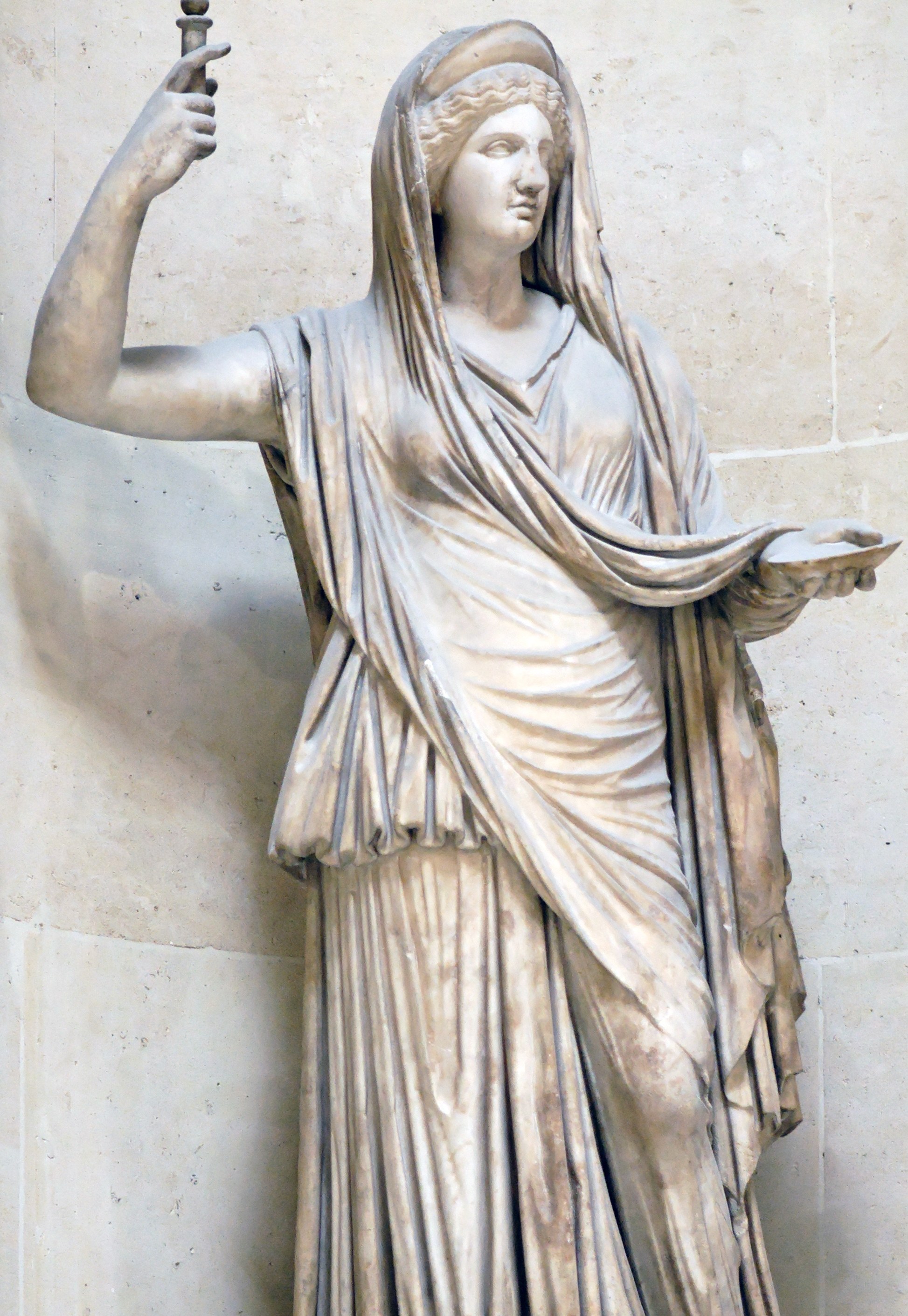
High on a peak of Olympus, a queen was watching her husband and deciding to deceive him.
Below and away on Mount Ida sat Zeus, favouring the Trojans, and Hera hated it. So in the fourteenth book of the Iliad she resolves, in Homer’s phrase, to beguile his mind: to make herself so desirable that the king of the gods forgets the war entirely, and then, with sleep poured over him, to leave the field to the gods who back the Greeks. It is the longest sustained portrait we have of Hera acting as sovereign in her own right, and it is worth noticing what her weapon is. Not the thunderbolt. The bedroom.
The sealed chamber
She goes to the private chamber Hephaistos built for her, a room sealed with a secret bolt no other god can open, and there she arms herself. She cleanses her body with ambrosia and anoints it with a fragrant ambrosial oil so potent that, stirred in the halls of Zeus, its scent would reach to earth and heaven.
She plaits her hair into bright immortal tresses, puts on a robe Athena wrought and embroidered for her, pins it at the breast with golden brooches, and girds herself with a belt set with a hundred tassels. In her pierced ears she hangs earrings of three clustered drops, and over it all she draws a veil white as the sun. Only then, shod in shining sandals, does she go to war.
The borrowed girdle
There is one weapon she does not own, and she has to borrow it. She goes to Aphrodite and, on the false pretext that she means to reconcile the long-estranged Oceanus and Tethys, asks for the goddess’s embroidered breast-band, the kestos himas, in which are fashioned love and desire and sweet dalliance, the beguilement that steals the wits even of the wise.
(The girdle is Aphrodite’s, and Hera returns it after; the popular image of a magic belt that simply belongs to Hera is a later slip.) Then she flies. She darts down from Olympus, crosses Pieria and Emathia and the snowy peaks of Thrace, skims Mount Athos without once grazing the ground with her feet, and comes to Lemnos, where she strikes her bargain with Sleep, the brother of Death, promising him a golden throne forged by Hephaistos if he will lull Zeus once the god has been overcome.
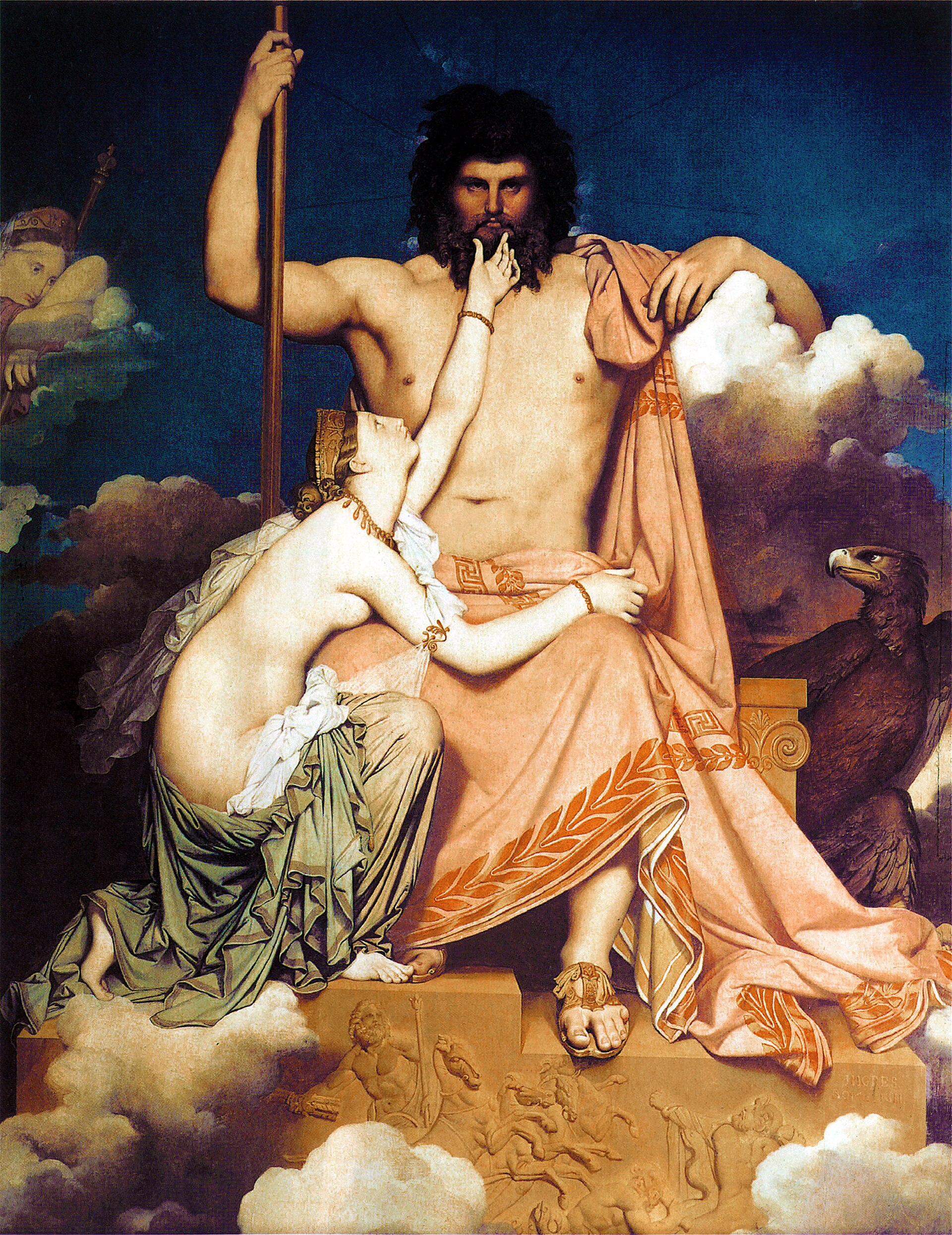
It works completely. Zeus sees her and desire folds over his reason; he reels off the roll of women who never moved him as she does now, Danaë and Europa and Semele, Alkmene, Demeter, Leto, the catalogue of his own infidelities recited, absurdly, as a compliment to his wife. They lie together on the height of Ida wrapped in a golden cloud, and beneath them the earth sends up fresh grass, dewy lotus, crocus and hyacinth, thick and soft, while glistening dew falls from the cloud that hides them even from the all-seeing Sun. Hera has turned the very instrument of her humiliation, Zeus’s endless appetite, into a lever of policy.
Golden-throned, whom Rhea bore
That doubleness is the whole of her. She is, in Hesiod’s Theogony, a daughter of the Titans Kronos and Rhea, swallowed at birth by her father along with her siblings and later disgorged when Zeus forced the old Titan to bring them up again. She becomes Zeus’s sister and wife, and the Iliad says the gods honour her with the same reverence they give her husband; he takes her counsel and confides in her above all the others.
As his only fully wedded consort she is the goddess of marriage and of childbirth, and the Eileithyiai who preside over labour are called her daughters. The little Homeric Hymn to her fixes the image in a line: golden-throned Hera, whom Rhea bore, queen of the immortals, surpassing all in beauty, the sister and wife of loud-thundering Zeus.
A crown heavier in the retellings
Yet in that same Homeric world she is emphatically not a co-ruler. She must obey Zeus; when she crosses him he threatens her and, in one grim passage, reminds her how he once hung her from the sky with anvils tied to her feet. The full conception of Hera as a regal queen of heaven with power to match her husband’s is largely a later growth, elaborated by Roman-era poets such as Ovid, who write her as Juno. In Homer she is the honoured wife of the king, formidable and never safe, but under him. The queen of the title is real, but her crown is heavier in the retellings than in the oldest songs.
The shadow the marriage casts
And she is dangerous, chiefly to the women and children of Zeus’s affairs. She hounds Leto through her pregnancy with Apollo and Artemis; she engineers the death of Semele, mother of Dionysos; she delays the birth of Heracles to cheat him of a kingdom, sends serpents to his cradle, and later drives the grown hero mad.
When Zeus takes the mortal Io, Hera has her transformed into a heifer and sets the hundred-eyed giant Argos Panoptes to guard her, sleepless. This is the Hera the ancients called jealous and quarrelsome, and it is not a petty footnote to her marriage. It is the shadow the marriage casts. The goddess who blesses the wedded bond is also the one who punishes, without mercy, every violation of her own.
Her wrath even shapes a war. When Paris judged Aphrodite fairer than Hera and Athena, Hera became the settled enemy of Troy and threw her weight behind the Greeks; the seduction on Ida is one move in that longer campaign. Her sacred places kept the older, stranger imagery: at the great Argive Heraion, Polykleitos’ colossal gold-and-ivory Hera sat crowned with the Graces and the Seasons, a pomegranate in one hand and, in the other, a sceptre topped by a cuckoo, the bird in whose guise Zeus was said to have first seduced her. Argos itself was called simply the house of Hera.
She is the queen who schemes, dresses, bargains, and endures, in a marriage that is also a rivalry, to a king she can move but never rule.
Her weapon is not the thunderbolt. It is the sealed chamber, the borrowed girdle, the veil white as the sun: seduction turned into strategy against the one god she cannot command.
- Homer, Iliadthe Deception of Zeus (14.153–353), the fullest portrait of Hera as sovereign schemer, covering her plan to beguile Zeus, her toilette in the chamber Hephaistos built, the borrowed kestos himas of Aphrodite, the bargain with Sleep, and the union on Ida beneath the golden cloud; and, for the marital-power dynamic, her quarrels with Zeus and his threats and punishments of her (1.536–567; 8.407–484; 15.14–19) and her hatred of Troy (4.51–67). (A. T. Murray trans., Loeb 1924.)
- Hesiod, TheogonyHera among the children of Kronos and Rhea, swallowed by her father and later disgorged (453–500); and her marriage to Zeus and her children Hebe, Ares and Eileithyia, with Hephaistos born of her alone (921–929). (c. 700 BCE.)
- Homeric Hymn 12 (To Hera)the short hymn naming her golden-throned, born of Rhea, queen of the immortals, sister and wife of Zeus. Homeric Hymn 3 (To Apollo) 305–355: Hera’s angry solo birth of a monstrous son in resentment of Zeus’s own solo birth of Athena. (H. G. Evelyn-White trans., Loeb 1914.)
- Apollodorus (Pseudo-Apollodorus), Bibliothecaher parentage and disgorging (1.1.5; 1.2.1), the parthenogenetic birth of Hephaistos (1.3.5), and her persecutions of Io (2.1.3) and of Heracles, whom she attacks in the cradle and later maddens (2.4.8). A later mythographic handbook. (~1st–2nd c. CE.)
- Ovid, MetamorphosesRoman-era narrative expansions of Hera’s jealous wrath as Juno, in the transformation of Io into a heifer under the guard of Argos (1.588–723), the death of Semele (3.256–315), and the delaying of Heracles’ birth (9.280–323). A later source. (c. 8 CE.)
- Pausanias, Description of Greece 2.17the Argive Heraion and Polykleitos’ chryselephantine seated Hera, crowned with the Graces and Seasons, holding a pomegranate and a cuckoo-topped sceptre; Argos as
the house of Hera.
A later source, used for cult and iconography. (2nd c. CE.)