She was a small child sitting on her father’s knee when she made her demands. Callimachus stages the scene like a fond domestic anecdote that happens to concern the fate of the wilderness: the child Artemis, small enough to be carried, reaches up to Zeus and asks him to grant her, first of all, her maidenhood forever. Then the rest of the list. A bow and arrows. A tunic cut short at the knee so she can run down beasts.
Sixty young daughters of Ocean for her choir and twenty river-nymphs to mind her hunting boots and her hounds. All the mountains for her own, and just one city, since she means to live in the hills and come down among people only rarely. Zeus laughs, nods his head, and gives her more than she asked: not one city but thrice ten that will worship her alone. It is a portrait of a goddess who knows exactly what she wants before she is old enough to be talked out of it.
The bargain on her father’s knee
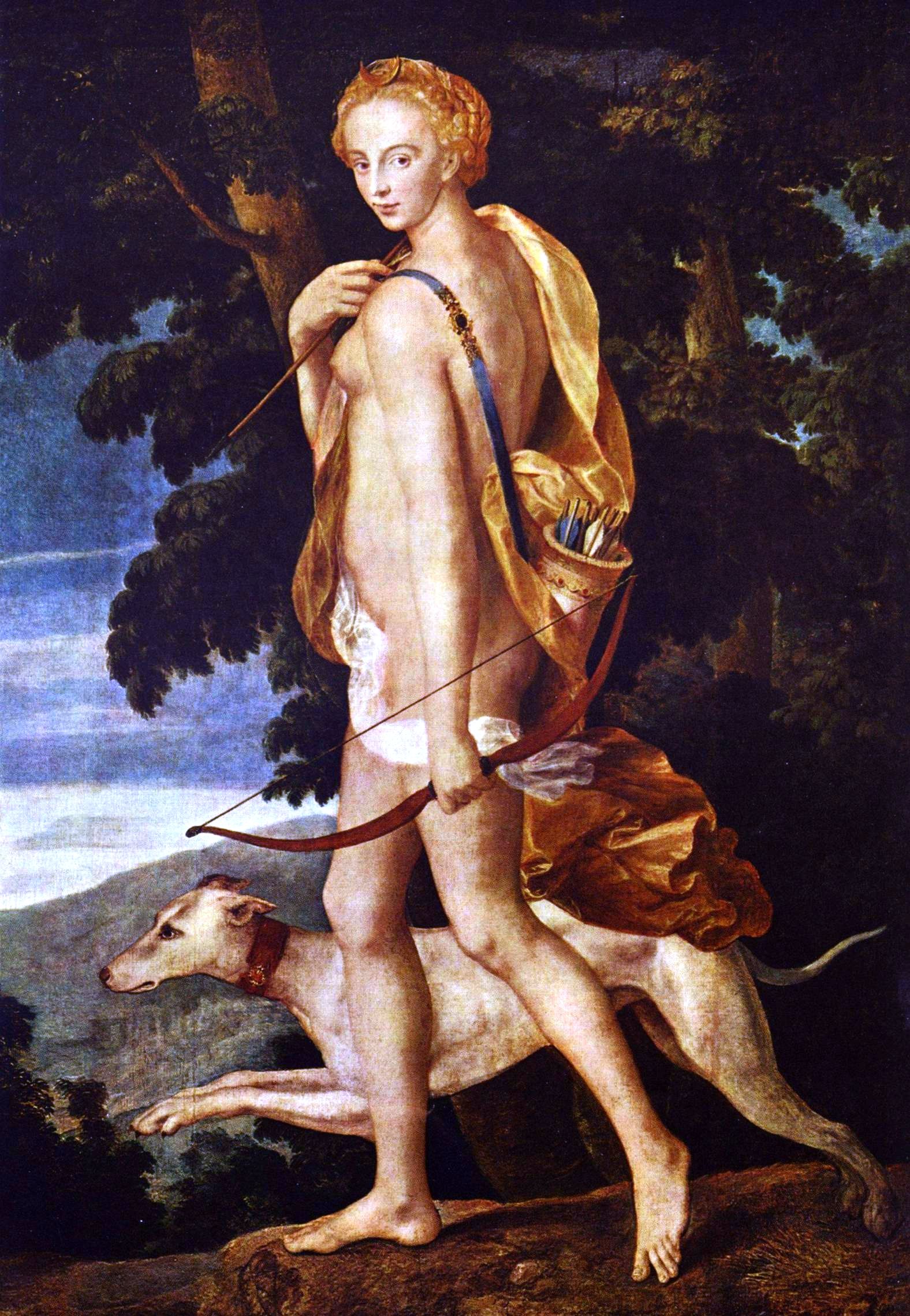
What she wanted was the frontier, and the freedom to rule it unmarried. Everything the archaic sources say about Artemis radiates from that childhood bargain. The Homeric Hymn to her shows the result full-grown: the golden-shafted huntress ranges the shadowy hills and the windy peaks, drawing her golden bow in delight, and as she looses her arrows the crests of the high mountains tremble and the deep woods ring with the death-cries of beasts.
The earth shakes and the sea shudders. She is potnia theron, mistress of the wild animals, and her passage through her own country reads less like a hunt than a scouring, the whole animal race put to the sword by a single archer for the pleasure of it.
Then, the same hymn insists, she stops. When she has taken her fill of the chase she unstrings the curved bow, hangs the arrows up at the house of her brother Apollo at Delphi, and leads the dance of the Muses and Graces. The huntress who makes the woods echo with slaughter is also the one who orders the choir. Both halves are original to her; neither is a softening of the other.
Into the smithy of the Cyclopes
To arm her, the poem sends the child down into fire. Leto carries the three-year-old into the smithy of the Cyclopes on their volcanic island, where the one-eyed giants, tall as the crags of Ossa, are hammering out a watering-trough for Poseidon’s horses. The din is monstrous: the anvils shriek, the islands and the mainland cry out, and the nymphs of the sea cover their faces.
Human mothers, Callimachus adds with a straight face, still frighten disobedient children by threatening to fetch Arges or Steropes from the forge. The infant goddess is unimpressed. She marches up to Brontes, seats herself on his knee, and tears a fistful of hair out of his chest, so that to this day, the poet says, the giant carries a bald patch there. She will have her Cydonian bow, and she is not afraid of the men making it.
The rest of her kit follows in the same key of concrete detail. From Pan at his Arcadian fold she takes her pack of hounds: two black-and-white, three the colour of rust, one dappled dog strong enough to drag living lions home by the throat, and seven swift bitches from Cynosura.
For her chariot she runs down, on foot and without dogs, four of five enormous golden-horned deer that graze the Parrhasian hill, deer larger than bulls; the fifth escapes by Hera’s design, to wait in the future as a labour for Heracles. Her nymphs rub the deer down, feed them clover from Hera’s own meadow and fill golden troughs for them to drink from. Every object in her train is specified, and most of it is gold.
The goddess at the birth bed
There is a second office folded into the first, and it is not the one you would predict of a killer of beasts. Artemis is a goddess of childbirth. In the boon-scene she tells Zeus she will visit the towns of mortals only when women, worn down by the sharp pangs of labour, cry out to her for help, a duty the Fates laid on her at the very moment of her own birth, because Leto bore her without pain.
She earned the role at once. ApollodorusThe unidentified compiler of the Library, a systematic prose summary of the myths written too late to be the work of the Athenian scholar whose name it carries, and so commonly cited as Pseudo-Apollodorus. records that Leto delivered Artemis first and then, with the newborn daughter serving as midwife, gave birth to Apollo. The goddess who ranges the deadly wild is also the hand that eases mortals into the world, and the Greeks felt no strain in holding the two together: the mistress of the threshold between wild and tame keeps the threshold of birth as well.
What trespass costs
That threshold is dangerous to cross without leave. The pop-culture Artemis who simply hates men and kills anyone who glimpses her is not in these sources; what is there is a goddess who answers specific offences with exact severity. The hunter Actaeon saw her bathing and she turned him into a stag, whereupon his own hounds ran him down and tore him apart, unable to know their master under the antlers. When Niobe boasted that her many children made her more blessed than Leto with her mere two, Artemis and Apollo answered together, she shooting down the daughters and he the sons. Insult the goddess, or her mother, and the golden bow that empties the forests will find you too.
The sources do not always agree on the details, and the disagreements are worth keeping rather than smoothing. Apollodorus counts Niobe’s slain children as seven and seven, but records in the same breath that Hesiod made them ten and ten, Herodorus two and three, and Homer six and six. Actaeon’s crime is usually that he saw the goddess bathing, though Apollodorus notes that Acusilaus blamed his wooing of Semele instead.
Orion the giant hunter dies at her hands in several incompatible ways: slain on Delos, killed for challenging her to a throwing-match, shot for laying hands on the Hyperborean maiden Opis. Even her birthplace is unsettled, Ortygia in one hymn, Delos in Apollodorus. The lush, familiar versions of the bathing pool and the weeping stone Niobe come mostly from the Roman poet Ovid, centuries later, and the equation of Artemis with the moon is later still; in Homer and Hesiod she is not the moon at all, only the huntress with shafts of gold.
Everything sharpened to one edge
Hold the pieces together and she coheres around a single edge. Maidenhood, the hunt, the mountains and the pangs of birth are all versions of the same thing: the wild boundary where the tame world stops, and the goddess who patrols it. She grants safe passage across it, into life or out of it, to those who ask properly. To those who trespass, the bow.
She asked for the bow and the mountains before she was old enough to walk far into them, and her father, laughing, gave her more than she named. Everything the huntress becomes is the keeping of a child’s word.
- Homeric Hymn 27 (to Artemis) 1–20the archaic portrait. The golden-shafted huntress ranging the shadowy hills and windy peaks, the trembling mountains and echoing woods as she slays the beasts (1–10), then the laying-up of the bow at Apollo’s house and the dance of the Muses and Graces (11–20). (H. G. Evelyn-White trans., Loeb 57, 1914.)
- Callimachus, Hymn 3 (to Artemis) 1–268the richest single source. The childhood boon-scene on Zeus’s knee, maidenhood, bow, short tunic, the sixty Oceanid and twenty Amnisian nymphs, the mountains and the grant of thrice-ten cities (6–39); the childbirth duty ordained by the Fates (20–25); the Cyclopes’ forge and the hair torn from Brontes (46–86); Pan’s gift of the hounds (87–97); the golden-horned deer of the Parrhasian hill (98–109); and the nymphs tending the deer (162–169). (A. W. Mair trans., Loeb 129, 1921.)
- Hesiod, Theogony 918–920 (with 404–406 for Leto’s parentage)the genealogy. Leto, daughter of Coeus and Phoebe, bore Apollo and Artemis,
who delights in arrows,
to Zeus. (Evelyn-White trans., Loeb 57.) - Homer, Iliad 21.468–496Artemis named
queen of the wild beasts
in the battle of the gods, taunting Apollo and then rebuked and physically humiliated by Hera, who snatches the bow from her shoulders and boxes her ears with it as the goddess flees weeping. (A. T. Murray trans., Loeb 1924.) - Apollodorus, Library 1.4.1; 1.4.3–5; 3.4.4; 3.5.6the mythographer’s variants. Artemis born first on Delos and midwife to Apollo’s birth, and the shooting of Tityos (1.4.1); the several deaths of Orion (1.4.3–5); Actaeon transformed and devoured, with two variant offences (3.4.4); and Niobe’s slaughtered children, with four different tallies attributed to Hesiod, Herodorus, Homer and Apollodorus himself (3.5.6). (J. G. Frazer trans., Loeb 121, 1921.)