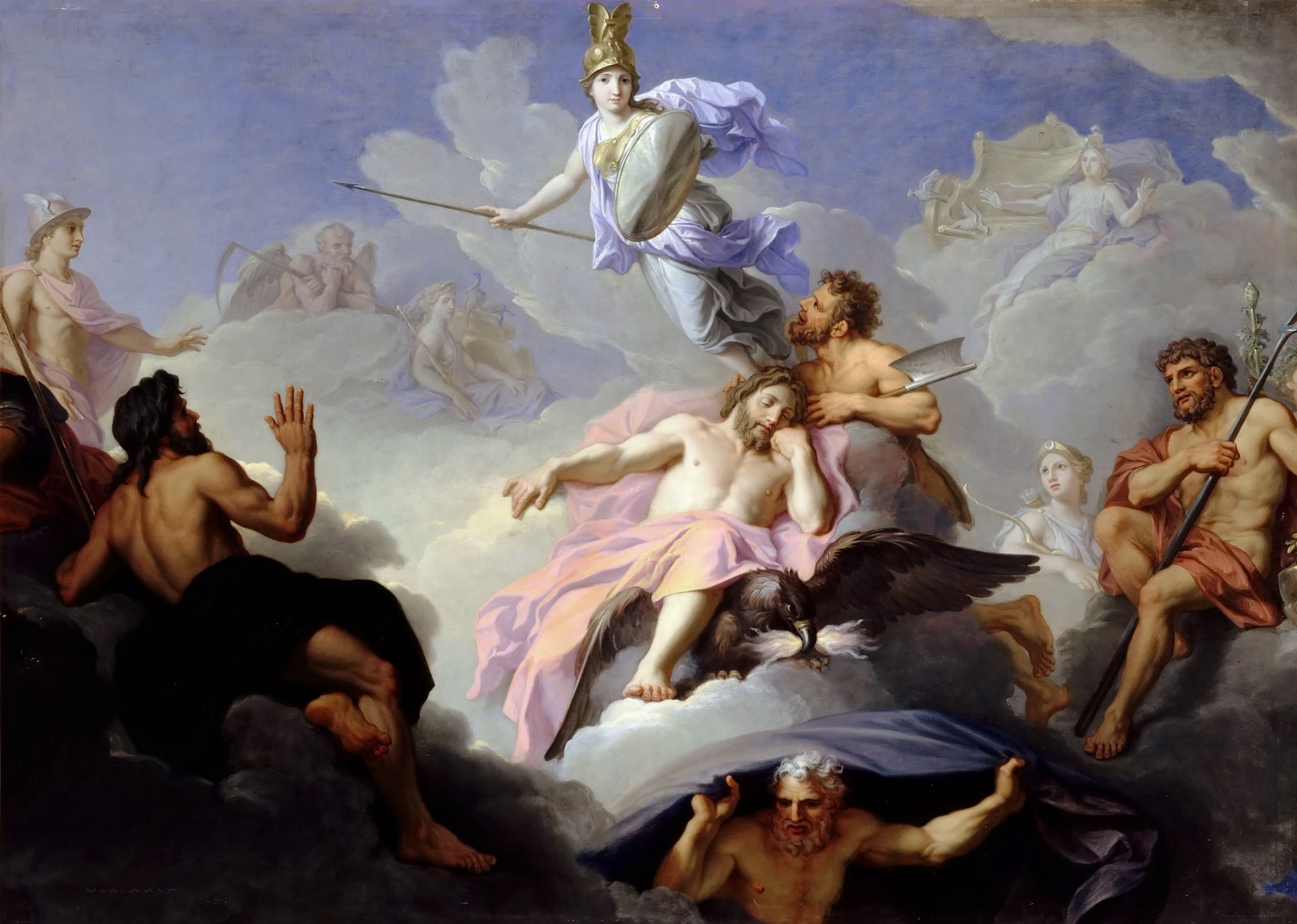
Great Olympus reeled. The earth cried out, the sea heaved with dark waves, foam bursting from it, and Helios halted his horses and held them in the sky. All of this because a full-grown goddess had just stepped out of a god’s head. She came in gleaming armour, brandishing a sharp spear, and the deathless gods were seized with awe until she lifted the arms from her shoulders and set them down. Only then did the sun move on. This is how the Homeric Hymn to Athena stages her birth: not a swaddled infant but an armed woman arriving mid-stride, and a cosmos that flinches at her.
The wife he swallowed
To understand why Zeus carried a daughter in his skull, go back a generation. His first wife was Metis, an Oceanid whose name means Cunning, the wisest among gods and mortal men. She was pregnant when Gaia and Ouranos, Earth and Heaven, warned Zeus that Metis was fated to bear first a daughter equal to her father in strength and wisdom, then a son who would overthrow him and rule the gods in his place.
Zeus knew how that story ended, having taken his own throne by toppling his father. So he broke the prophecy the way his line always did, only more cleverly: he coaxed Metis with soft words and swallowed her whole, wisdom and unborn child and all, so that no son of hers would ever be born.
The daughter came anyway. In Hesiod she is simply born from Zeus’s own head, the awful, the strife-stirring, the host-leader… who delights in tumults and wars and battles.
Note the precision: Hesiod says she sprang from his head but never says anyone split it. The iconic axe belongs to later tellings, Pindar and then ApollodorusThe unidentified compiler of the Library, a systematic prose summary of the myths written too late to be the work of the Athenian scholar whose name it carries, and so commonly cited as Pseudo-Apollodorus., in whom Prometheus or Hephaestus strikes the skull open at the river Triton and Athena leaps out already armed and shouting her war cry. The Archaic poets give us the miracle; the later handbooks give us the mechanics.
The mother nobody agrees on
Her parentage is the single most contested thing about her, and the honest answer is that the Greeks never fully agreed. Homer never names her mother at all: she is only ever daughter of Zeus,
the one who bears the aegis. Hesiod supplies Metis. Local cults told other stories, that she was daughter of the winged giant Pallas, whom she killed and flayed for assaulting her so that his skin became her aegis; or, in a Libyan tradition Herodotus reports, daughter of Poseidon and the nymph Tritonis, only later adopted by Zeus.
The head-birth from Zeus is the account that won; the rest are regional and etiological. Even her oldest title, Tritogeneia, defeated the ancients, who derived it variously from a river called Triton, a dialect word for head,
or a birth on the month’s third day. It is a genuine mystery, better left as one.
The loom and the spear
What she does with a body, once she has one, defines her twice over. The Iliad catches her arming on the floor of her father’s house. She lets fall the soft embroidered robe she wove with her own hands and puts on the tunic of Zeus: the weaver-goddess sets down her weaving to take up war.
Over it she flings the tasselled aegis, that terror-fraught goatskin crowned with Rout and ringed with Strife, Valour and Onset, the severed Gorgon’s head at its centre; on her head a golden helmet fitted with the men-at-arms of a hundred cities
; in her grip the heavy spear. Craft and battle are not two sides of Athena but one gesture, the same hands that thread a loom closing on a shaft.
Both halves have a darker edge. On the craft side stands Arachne, though the story survives chiefly through the Roman poet Ovid and reads as later literary elaboration, not archaic Greek myth. Arachne was a Lydian weaver so gifted she boasted she surpassed the goddess and dared her to a contest. Enraged, Athena tore the mortal’s work and struck her; Arachne hanged herself in shame, and the goddess loosed her from the noose into a new shape. Her fingers drew in to her sides as long thin legs, her body shrank into her belly, and from it she spun a fine thread. She weaves still, the first spider, punished for a pride that reached past its station.
The tree she planted on the rock
On the civic side stands her contest with Poseidon for the land of Attica. He struck the Acropolis rock with his trident and brought forth a salt sea, though other tellings make his gift a horse or a saltwater well; Apollodorus flags the disagreement himself.
Athena, with Cecrops as her witness, planted the first olive tree in the Pandroseion, and because Cecrops testified she had planted it first, the twelve gods sitting as arbiters awarded her the land. Apollodorus notes that the tree is still shown
on the Acropolis in his own day. The goddess of strategy won her city not by drowning it but by giving it something that could be pressed for oil and light and food: the useful victory.
She is also, throughout, parthenos, the pure virgin, and the strangest story attached to her tests exactly that. She went to Hephaestus for arms, and the smith-god, freshly spurned by Aphrodite, tried to force himself on her. She fought him off, and his seed fell upon her leg. She wiped it away with a tuft of wool, erion, and cast it to the ground, and from the earth a child was born: Erichthonius, whose name the Greeks heard as an echo of that wool and soil.
Athena reared him in secret, sealing him in a chest with a guardian serpent and giving it to Cecrops’s daughter Pandrosus, forbidding her to look inside. The other sisters could not resist. They opened the lid, saw the snake coiled about the child, and were either killed by it or driven mad and flung themselves from the Acropolis. The virgin goddess still becomes, obliquely, foster-mother to Athens’s first king, born of the very ground she would rule.
Kept close and made indispensable
Hold the pieces together and a single figure emerges from the reeling of Olympus. Athena is the wisdom Zeus swallowed made visible, the daughter the prophecy promised would equal him and who stands at his side because he took her mother’s mind into his own. She is the loom and the spear, the olive and the aegis, the craft that builds a city and the strategy that keeps it: thought that has learned to fight, and fighting that has learned to think.
She let fall the soft embroidered robe she had woven with her own hands, and flung the tasselled aegis about her shoulders. The weaver-goddess set down her weaving only to take up war, and in Athena the two were never truly different.
- Hesiod, Theogony 886–900Zeus takes Metis, wisest of gods and mortals, as his first wife; warned by Gaia and Ouranos that she would bear a daughter equal to him and then a son to overthrow him, he swallows her while she is pregnant. The prophecy that motivates the whole birth. (Evelyn-White trans., Loeb 57, 1914.)
- Hesiod, Theogony 924–926Zeus gives birth from his own head to Tritogeneia,
the awful, the strife-stirring, the host-leader… who delights in tumults and wars and battles.
The oldest statement of the head-birth itself, and note that it names no axe and describes no armour in the line. (Evelyn-White trans., Loeb 57.) - Homeric Hymn 28 (to Athena) 1–18the emergence in full armour with levelled spear; the cosmic disturbance as Olympus reels, earth cries out, the sea heaves and Helios halts; her stripping off the arms; her titles
pure virgin, saviour of cities
and Tritogeneia. The dramatic set-piece of the birth. (Evelyn-White trans., Loeb 57, 1914.) - Homer, Iliad V.733–747Athena’s arming on the floor of Zeus’s house. The self-woven robe laid aside, the tunic of Zeus, the tasselled aegis ringed with Rout, Strife, Valour and Onset and bearing the Gorgon’s head, the golden two-horned four-bossed helmet
of a hundred cities,
and the great spear. The definitive portrait of the war-goddess as weaver-turned-warrior. (A. T. Murray trans., Loeb 1924.) - Apollodorus, Library 1.3.6; 3.14.1; 3.14.6the systematising handbook. 1.3.6, the swallowing of Metis and the splitting of Zeus’s head by Prometheus or Hephaestus at the river Triton, Athena springing out fully armed. 3.14.1, the contest with Poseidon for Attica, sea against olive, the twelve gods as arbiters (Apollodorus explicitly correcting the rival
Cecrops and Cranaus
version), and the olivestill shown
in the Pandroseion. 3.14.6, the Hephaestus assault, the wool, the earthborn Erichthonius, the chest, the serpent and the fate of Cecrops’s daughters. A late compilation (1st–2nd c. CE), authoritative for the shape of the myths. (J. G. Frazer trans., Loeb 121, 1921.) - Ovid, Metamorphoses 6.1–145the weaving contest with Arachne and her transformation into a spider, her fingers drawn to her sides as thin legs, her body absorbed into the abdomen, the fine thread spun out. Augustan Roman poetry, and the source for the Arachne tale in its familiar form; read as later literary elaboration, not archaic Greek myth. (F. J. Miller trans., Loeb 42, 1916.)