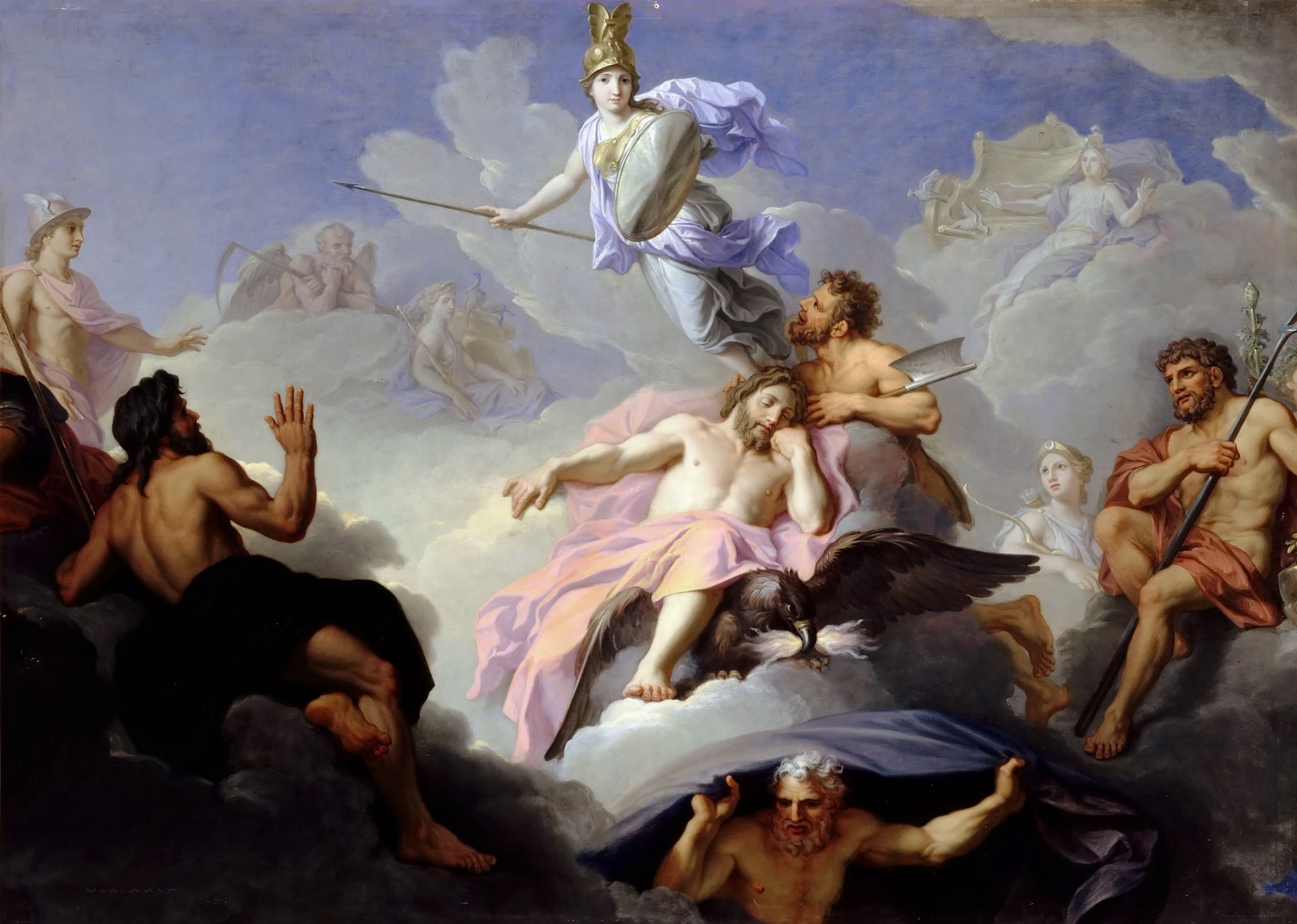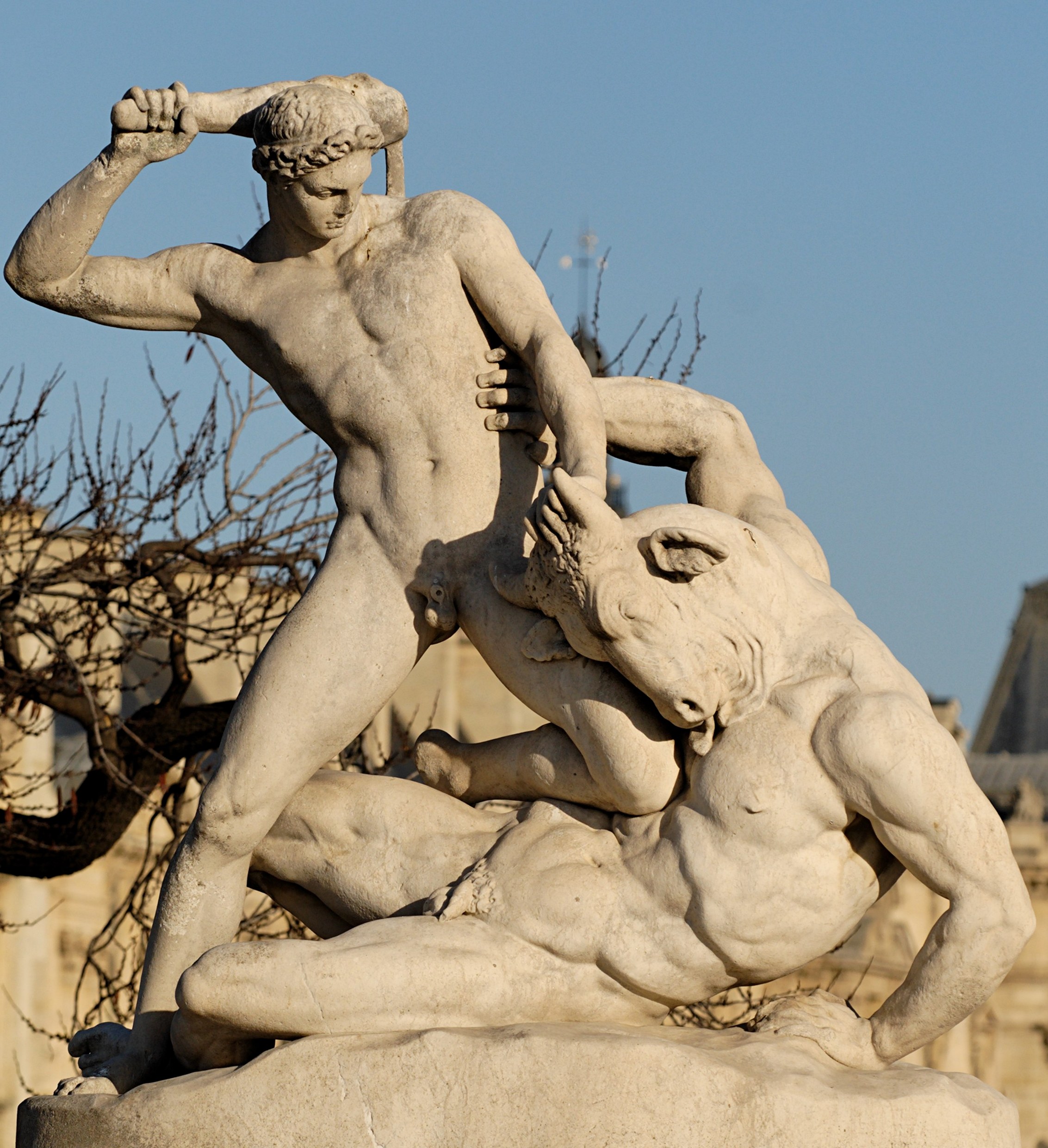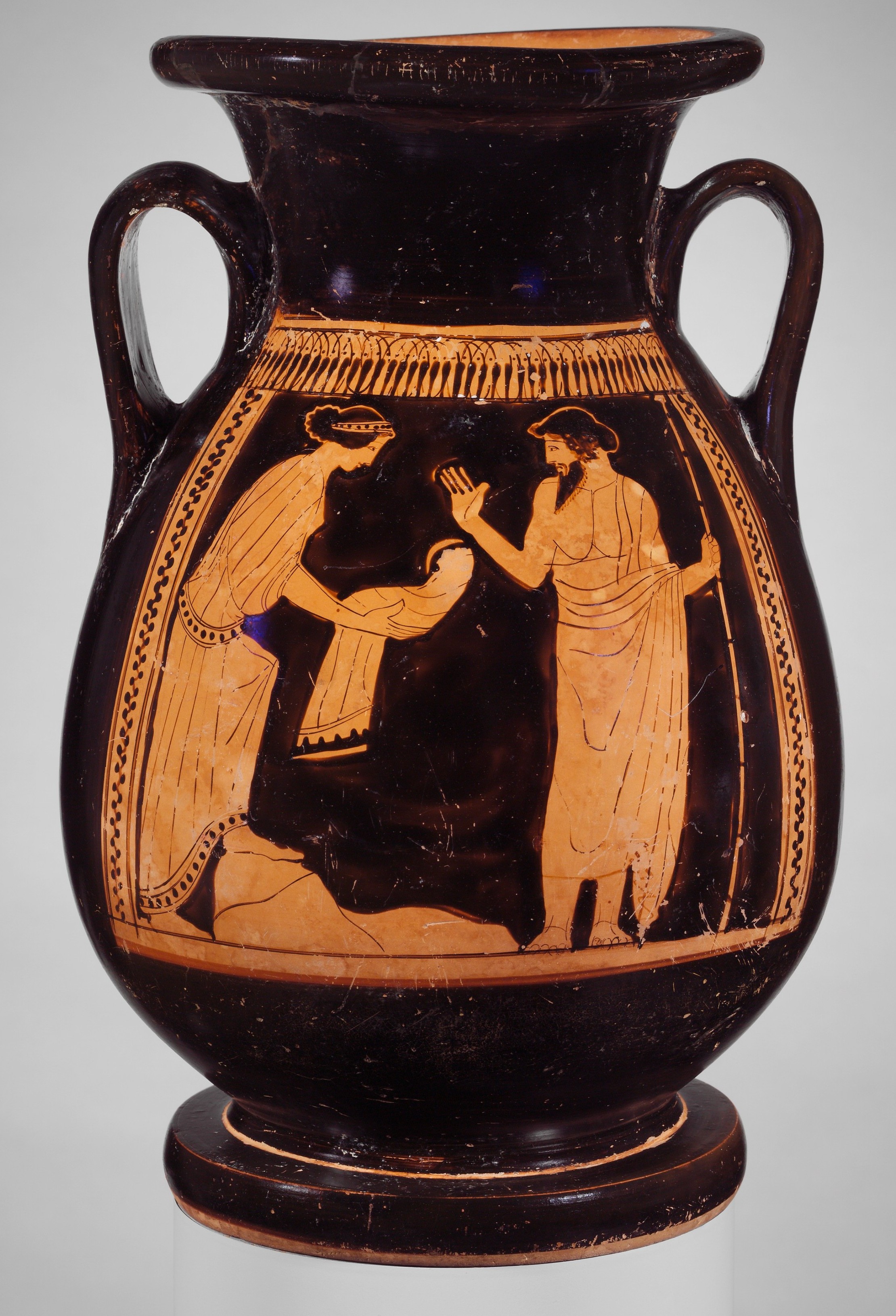
The gold came through the roof. Acrisius, king of Argos, had shut his daughter Danae in a chamber of bronze sunk under the ground, walled away from every man alive, because an oracle had told him plainly that Danae’s son would one day kill him. Bronze keeps out men. It did not keep out Zeus, who poured himself into the cell as a stream of gold falling through the ceiling into her lap, and from that shining rain she conceived.
Acrisius refused to believe the god’s part in it (some said the true father was his own twin Proetus, though the golden shower is the version the tradition kept), and rather than kill mother and child outright he sealed them in a wooden chest and pushed it out to sea. The chest did not sink. It grounded on Seriphus, where a fisherman named Dictys drew it up in his net and took the castaways in, so the boy the prophecy doomed was raised by a poor man while the grandfather who had cast him off believed the danger drowned.
A king who wanted his mother
The trouble that made a hero of him was, at bottom, a squalid one. Dictys had a brother, Polydectes, king of Seriphus, who wanted Danae and found the grown Perseus in his way. So Polydectes staged a fiction: collecting contributions towards a bride-gift, ostensibly for Hippodamia, he manoeuvred Perseus into a rash promise to fetch anything at all, even the Gorgon’s head, then held him to it at once. Bring me Medusa’s head, he said, knowing it for an errand no one returns from. It was a way to be rid of the young man without spilling blood in his own hall.
The grey sisters and one eye
Perseus did not go unaided. Hermes and Athena took his side, and the road to the Gorgon ran first through the Graeae, the grey sisters born old, who shared a single eye and a single tooth and passed them hand to hand. Perseus snatched the eye and the tooth as they crossed and would not return them until they told him the way to the nymphs. From those nymphs came the tools the task demanded, each one named: the winged sandals for flight, the kibisis to carry the head, and the cap of Hades that hid its wearer; from Hermes, an adamantine sickle, the harpe.
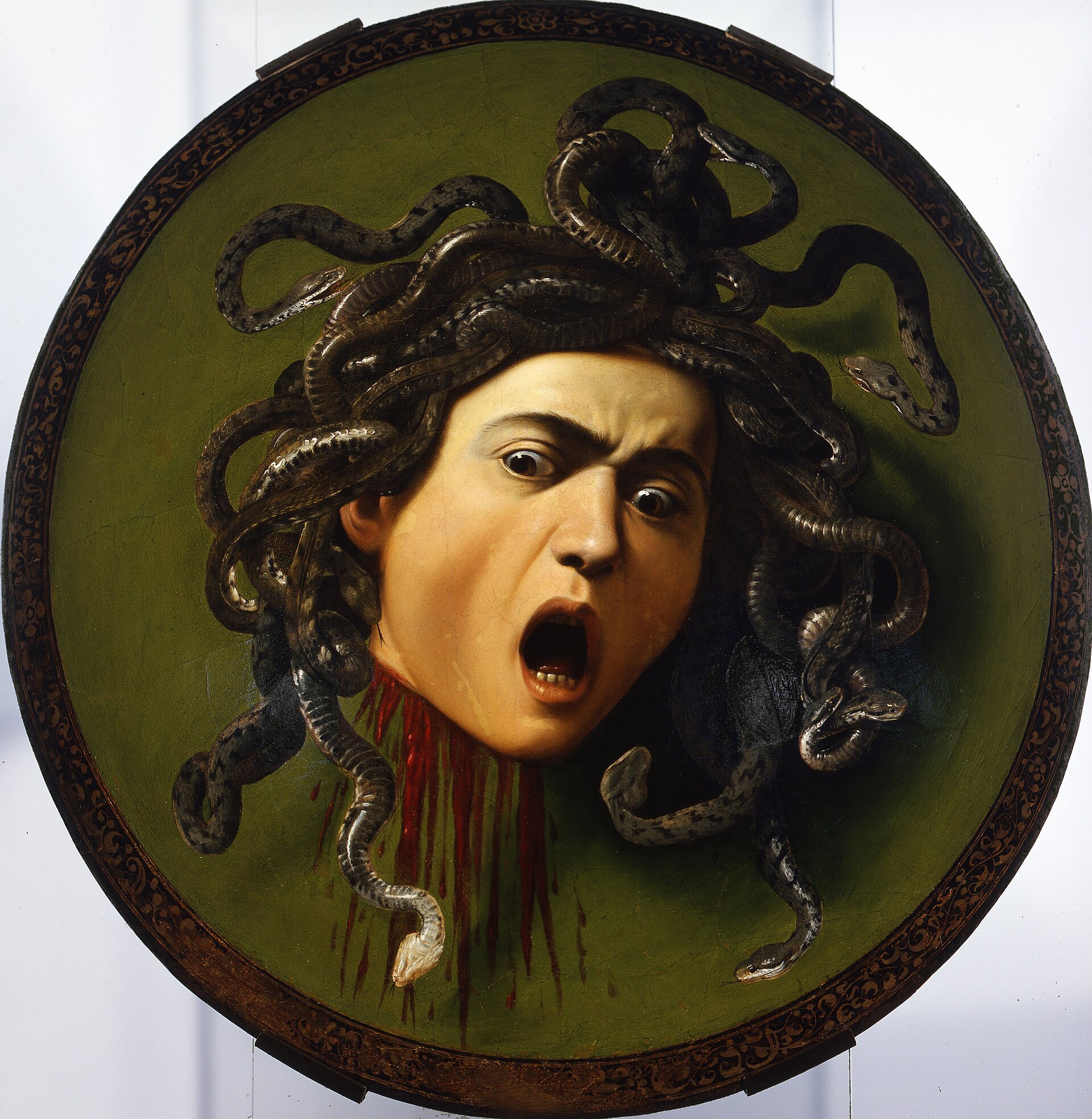
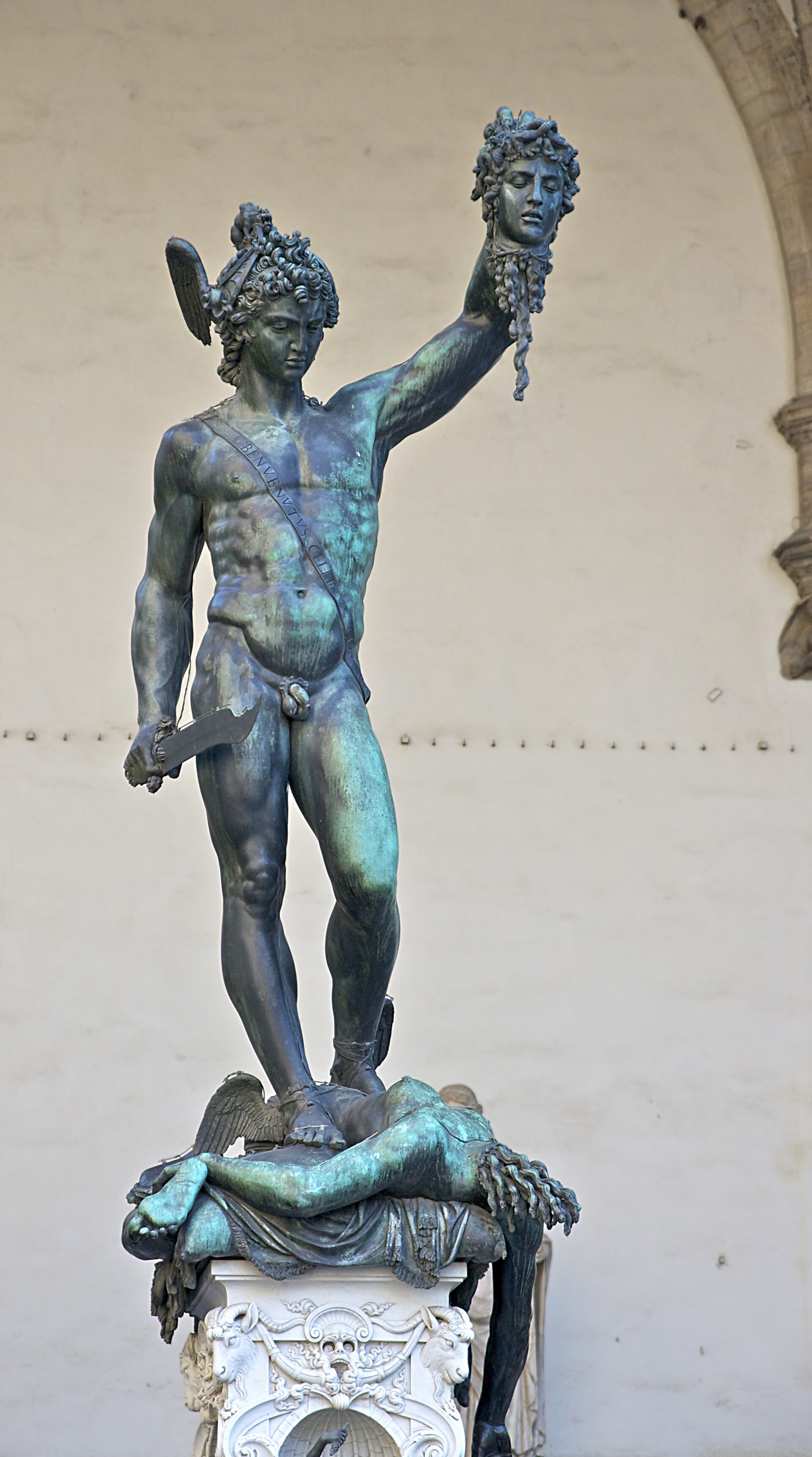
He found the three Gorgons asleep, Stheno, Euryale, and Medusa, and of the three only Medusa could die, so it was the mortal one the errand was really about. He did not look at her. Watching her reflection in the polished bronze of his shield so her gaze could never catch him, with Athena guiding his hand, he struck the head from the sleeping neck. Out of the wound sprang her unborn children by Poseidon, the winged horse Pegasus and the giant Chrysaor, born in the instant of her death.
Why the killing at all, and why this monster, the sources answer more than one way. ApollodorusThe unidentified compiler of the Library, a systematic prose summary of the myths written too late to be the work of the Athenian scholar whose name it carries, and so commonly cited as Pseudo-Apollodorus. gives the plain reason: Medusa alone was mortal, and Polydectes had demanded the head. But he also records a colder, older motive as a variant, that some say she was beheaded for Athena’s sake, having presumed to rival the goddess in beauty.
The sympathetic Medusa of modern retellings, the lovely maiden violated in Athena’s temple and punished with serpents for a crime done to her, comes from one poem only, Ovid’s, written seven centuries after the earliest tellings. In Hesiod and Apollodorus there is no transformation and no wronged innocent: the Gorgons are monstrous from birth, scaled and tusked and bronze-handed, needing no backstory.
The princess on the rock
The flight home carried him to Ethiopia, and to the second monster of his life. A princess stood chained to a rock by the sea, so still that Perseus took her at first for marble, until the breeze stirred her hair and he saw the tears on her face. This was Andromeda. Her mother, Cassiepea, had boasted that her beauty outshone the Nereids, and Poseidon answered the insult with a flood and a sea-monster; the oracle of Ammon demanded the girl be exposed to it.
Perseus struck his bargain in the moment, her hand for her life, and turned on the creature as it came breasting the swell like a great ship. He stooped upon it as an eagle drops on a basking snake and drove his blade in to the hilt, its blood spouting until his wings were soaked and he had to rest on a rock. Freeing her did not end the danger: Phineus, her uncle and her first betrothed, came against Perseus with a mob, and Perseus, turning his own face away, lifted the Gorgon’s head and left them frozen in the poses they had struck.
Back to Seriphus with the head
The head kept its power for as long as he needed it, and that is the grim engine of his story: the weapon outlives the enemy. Back on Seriphus he found Danae and Dictys crouched at the altars, sheltering from Polydectes’ violence. Perseus walked in, averted his eyes, and showed the king and his court the face of Medusa; the whole company stiffened into stone where they sat. He made Dictys king in his brother’s place, returned the sandals, cap, and kibisis to Hermes for the nymphs, and handed the head to Athena, who set it in the centre of her aegis. The face that killed became the face on the goddess’s shield, worn to terrify.
The discus and the prophecy
The oracle was still waiting, and it kept its appointment the way prophecies in these stories always do, by the very swerve meant to avoid it. Acrisius had fled to keep clear of the grandson he had condemned. At funeral games in Larissa, Perseus threw the discus in the pentathlon; the throw went wide, struck an old spectator on the foot, and killed him. It was Acrisius, dead exactly as foretold, by the hand he had tried to drown.
Ashamed to inherit Argos from a man he had killed, Perseus traded kingdoms with Megapenthes and took Tiryns instead, fortifying Midea and Mycenae and founding the line that would one day produce Heracles. In one tradition recorded by Apollodorus he even gave his name, through his son Perses, to the Persians: a Greek myth-etymology, not history, but told in earnest.
One clarification the sources demand, since later retellings blur it. Perseus flew on the winged sandals, not on Pegasus; the horse sprang from Medusa’s neck and went its own way, and the image of him riding it to Andromeda is a much later conflation with Bellerophon. The petrifaction of Atlas is Ovid’s alone, and the Ethiopian sea-monster has no name here: it is simply the ketos, the beast from the deep, not the Norse-named Kraken
of the modern screen.
Condemned by a prophecy before he could speak, thrown to the sea as an infant, sent as a young man to fetch a head that killed at a glance. He beat the unkillable face by refusing to meet it, and killed the grandfather who feared him with a throw he never aimed. The oracle was right about him from the start. It was only wrong about who was steering.
- Pseudo-Apollodorus, Bibliotheca 2.4.1–2.4.5 (1st–2nd c. CE)the fullest continuous prose narrative and the spine of this retelling. The oracle to Acrisius and Danae’s imprisonment in the bronze chamber, Zeus as the shower of gold, the chest cast to sea and the rescue on Seriphus by Dictys, the trap set by Polydectes, the Graeae and the stolen eye, the nymphs’ gifts and Hermes’ sickle, the mirror-shield beheading with Athena guiding the hand, the birth of Pegasus and Chrysaor, the rescue of Andromeda, the petrifaction of Phineus and of Polydectes, the head given to Athena’s aegis, the accidental killing of Acrisius at Larissa, the exchange of kingdoms, and the descendants. Also records the variants: paternity
as some say, by Proetus,
and the beheadingfor Athena’s sake.
- Ovid, Metamorphoses IV.610–803 (continuing into Book V for the Phineus battle) (c. 8 CE)the poetic elaboration and the source of the vivid detail. The petrifaction of Atlas (IV.627–662, peculiar to Ovid), the Andromeda rescue with Andromeda first mistaken for marble and the extended aerial fight with the sea-monster (IV.663–739), the aetiology of coral (IV.740–752), the three turf altars to Mercury, Minerva, and Jove (IV.753–760), Perseus’ own first-person account of the Graeae and the mirror-shield (IV.772–786), and the specifically Ovidian story of Medusa’s former beauty and Minerva’s punishment (IV.794–803). English line numbering may not align with the Latin; cited by episode where it matters.
- Pindar, Pythian 10.31–48 (498 BCE)the earliest of the three sources here. Perseus,
son of Danae,
led by Athena to the feast of the blessed Hyperboreans beyond the North Wind, a people free of sickness and old age; the killing of the Gorgon; and the bringing ofstony death to the islanders
of Seriphus. - Hesiod, Theogony 270–283 (c. 700 BCE)the genealogy and the early variant tradition. The Graiai (Pemphredo and Enyo) and the three Gorgons (Stheno, Euryale, Medusa) as children of Phorcys and Ceto; Medusa alone mortal; Poseidon lying with her
in a soft meadow among spring flowers
; and Chrysaor and Pegasus born when the head was cut away. No transformation and no violated maiden: the Gorgon is monstrous from birth.