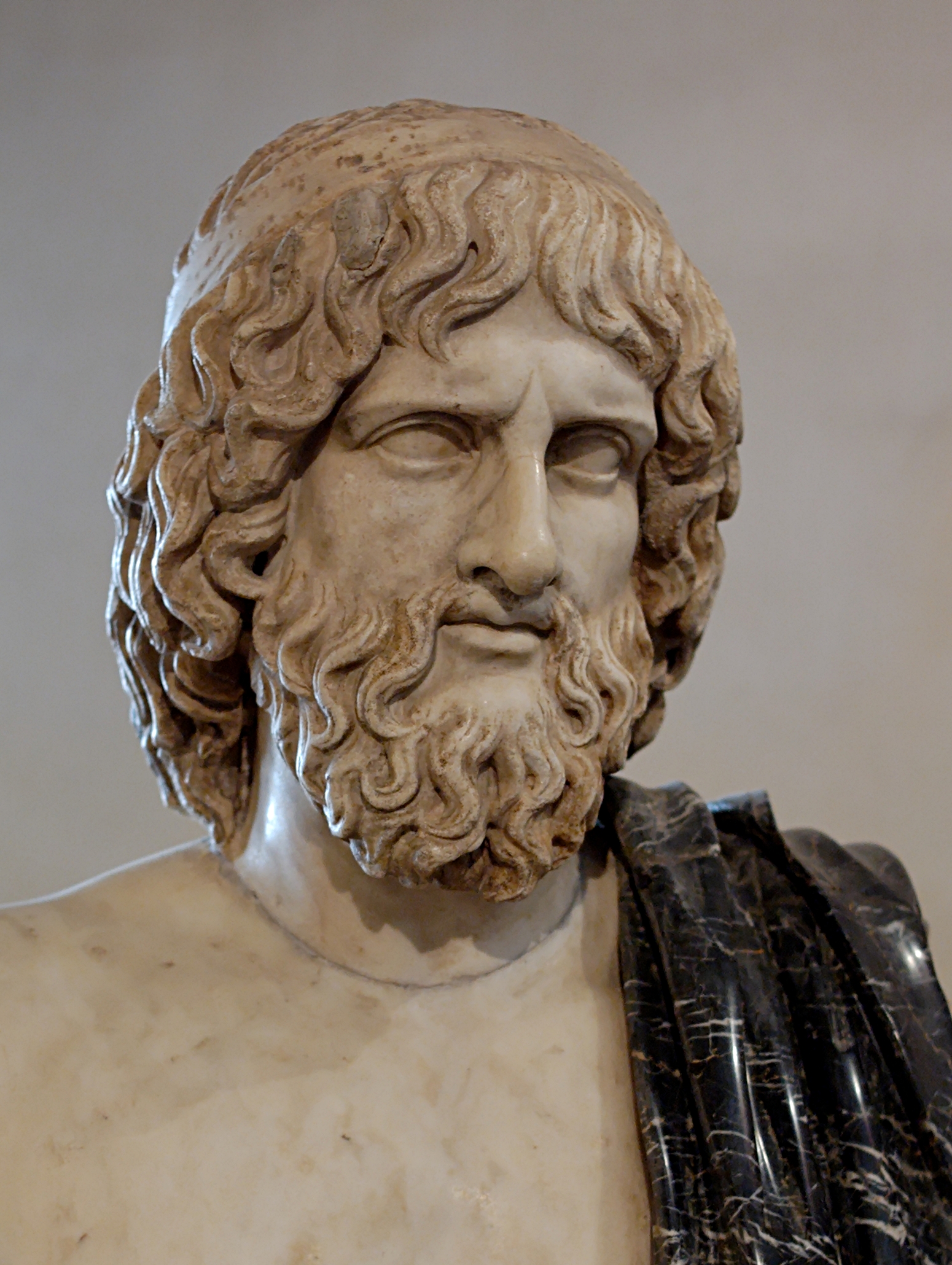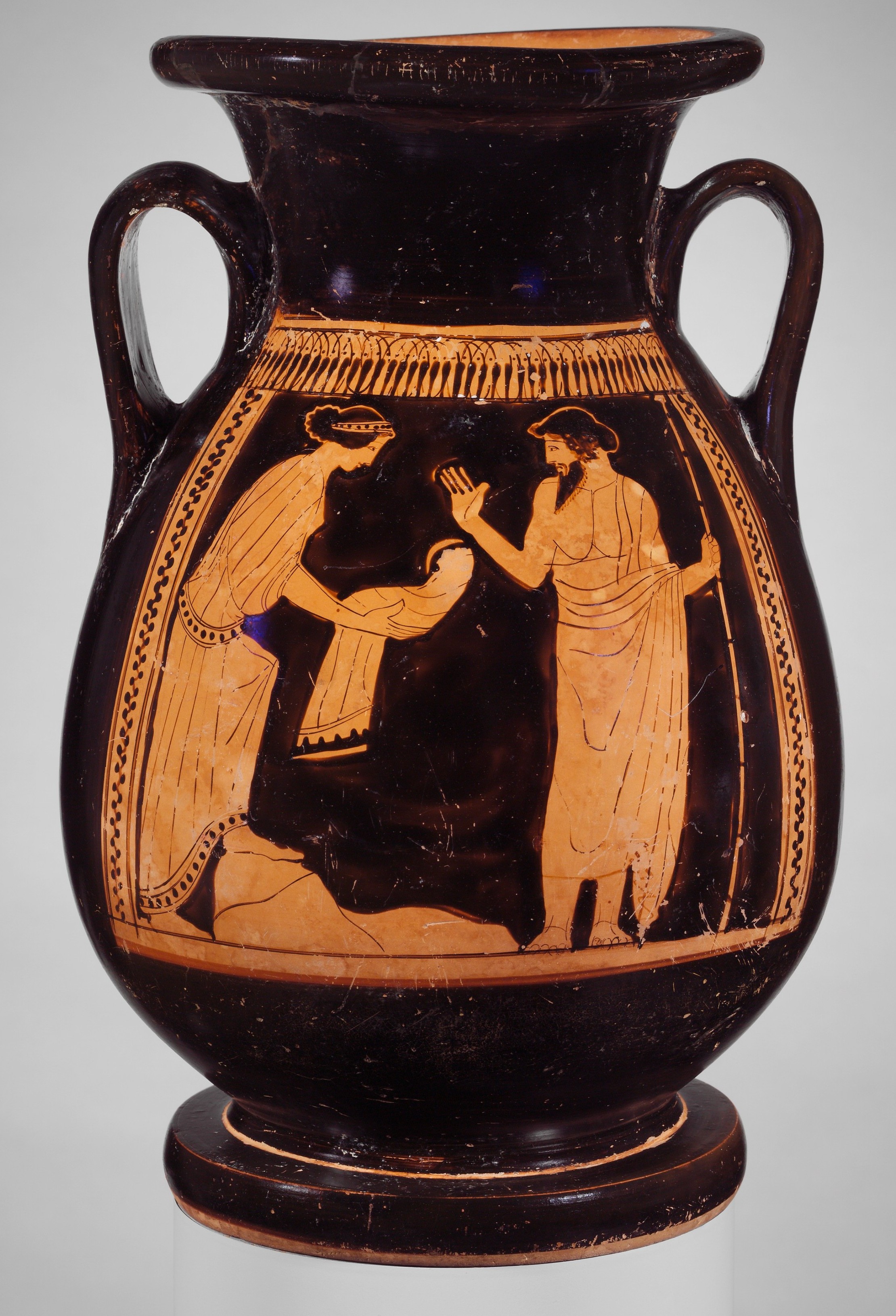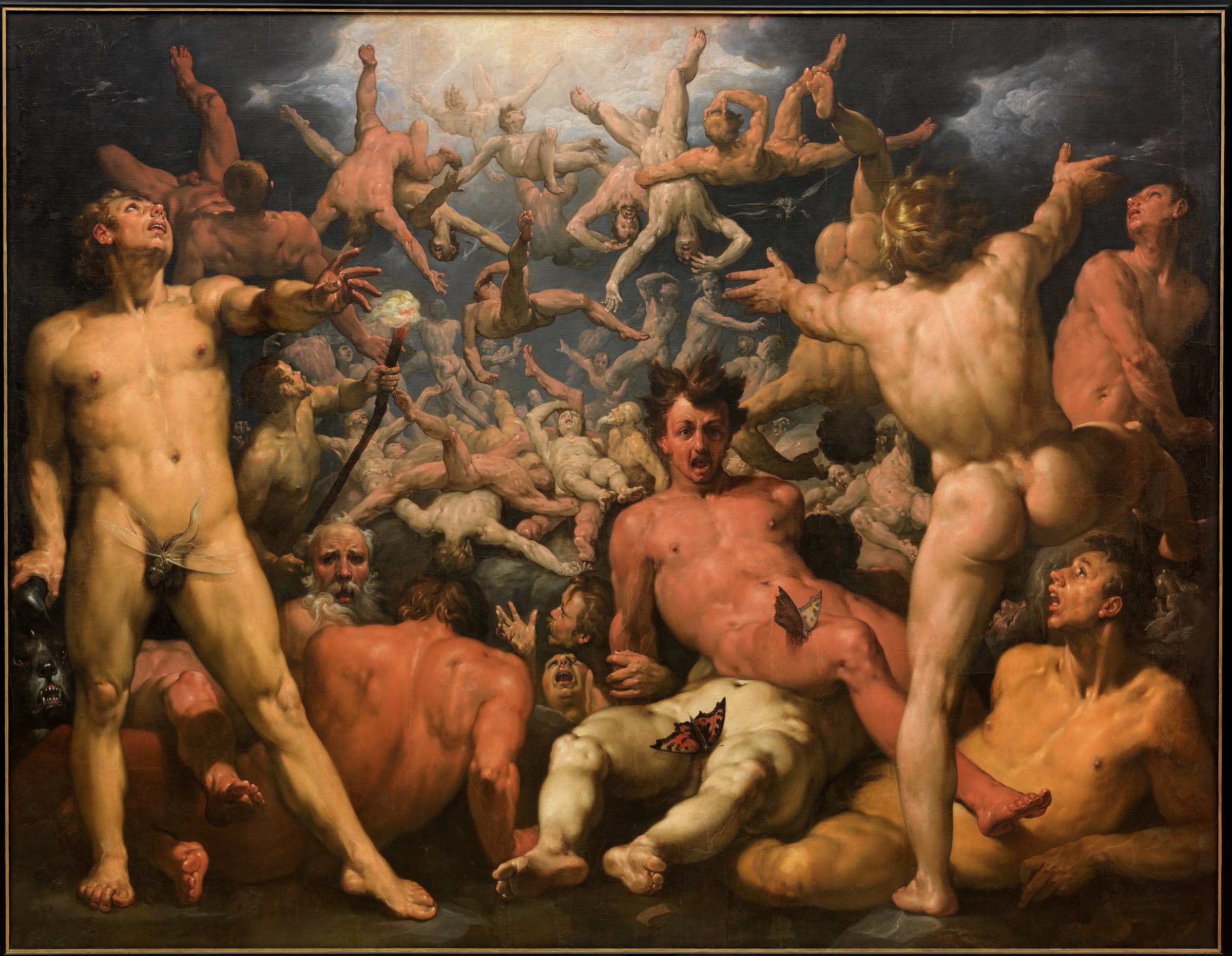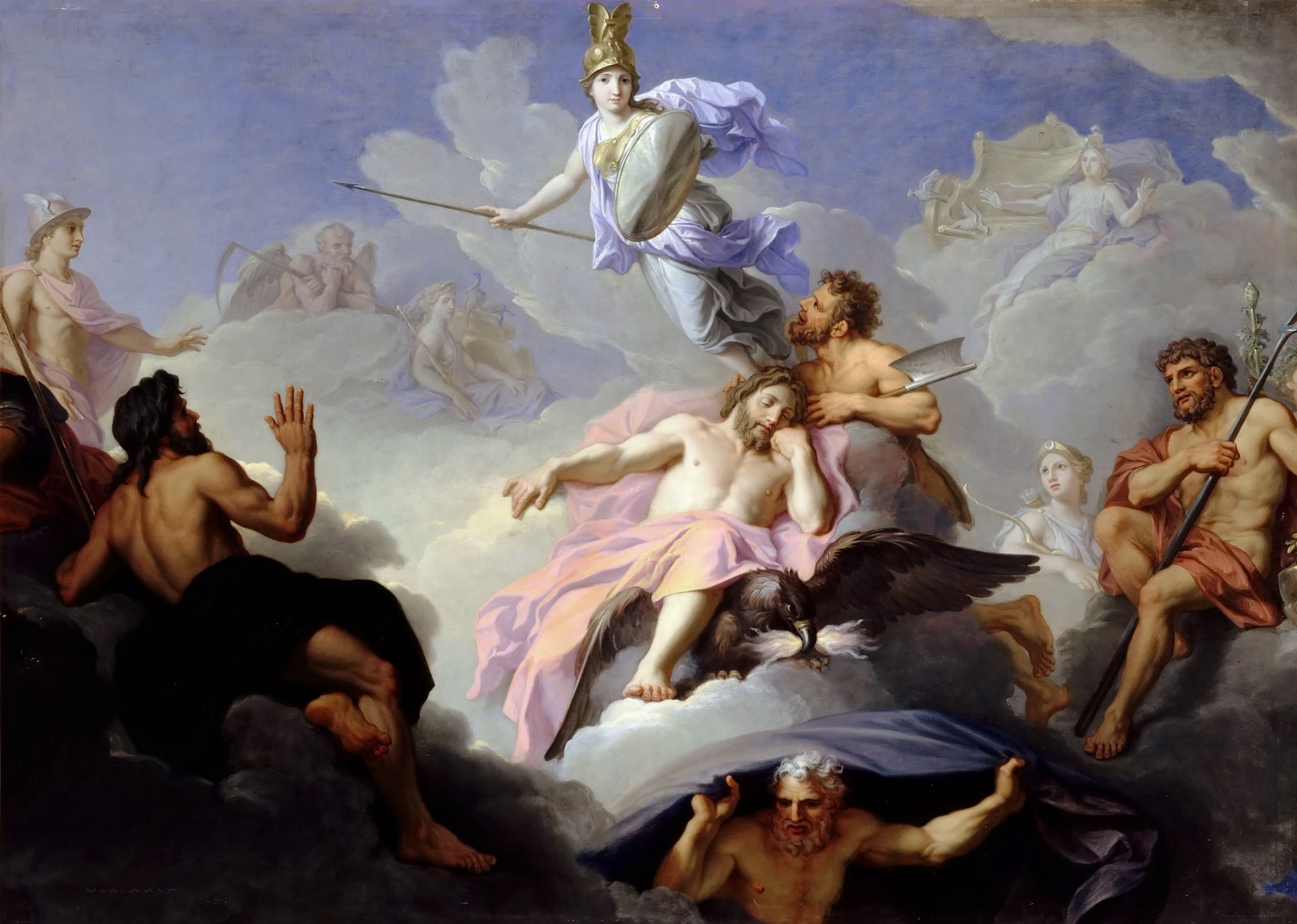
A father was eating his children, and one of them was going to end him for it. This is the Greek succession myth of Zeus’s rise from hidden infant to ruler of Olympus, told across Hesiod, Homer and later traditions that do not always agree.
Kronos had been warned, by Gaia the Earth and by starry Ouranos, his own parents, that a son of his was fated to overthrow him, exactly as he had overthrown his own father before. So he took precautions of a monstrous kind. As each child came from Rhea’s womb he swallowed it whole: Hestia first, then Demeter and Hera, then strong Hades, then Poseidon the earth-shaker. Five deathless gods went down alive into their father’s belly, and Kronos kept his watch, and thought himself safe.
But Rhea, pregnant with her sixth and carrying a grief no mother should bear, went to Gaia and Ouranos and begged them for a plan. They hid her away to the rich land of Crete, and there, in the dead of night, she bore Zeus. Then she wrapped a great stone in swaddling-clothes and put that into the hands of the king of the gods. He swallowed it, suspecting nothing. He had eaten a rock and called it his son.
A swap and a lie
This is where Hesiod’s Theogony, our oldest and fullest account of it, begins the making of Zeus: not with thunder, but with a swap and a lie, a deception that keeps the future king alive. It is worth marking at the outset, because the god who emerges from this story is a walking contradiction, and the contradiction is not a modern invention. The Greeks knew exactly what they had built.
Crete, or Arcadia
Where the infant was reared is the first place the sources part ways. Hesiod points to Crete, near Lyktos, and says only that Gaia received the child and hid him. Later tradition fills the cave with company (the goat Amaltheia who suckled him, the armed Kouretes who clashed their weapons to drown out his crying, even the bees), but those are accretions, attested in the mythographer ApollodorusThe unidentified compiler of the Library, a systematic prose summary of the myths written too late to be the work of the Athenian scholar whose name it carries, and so commonly cited as Pseudo-Apollodorus. and in Callimachus, not in Hesiod. Callimachus goes further and disputes the Cretan claim altogether, arguing for Arcadia and quoting the old slander that Cretans are always liars.
Record it as a genuine split, Crete for Hesiod and Arcadia for the Hellenistic poet, and resist the tidy composite modern retellings assemble.
Ten years on Othrys
Grown, Zeus came back for his siblings. He forced Kronos to disgorge them, and the stone came up too, which Zeus set at Pytho, in the glens of Parnassos, a sign thereafter and a wonder to mortal men.
The omphalos at Delphi was that stone: the swallowed lie, stood upright as a monument. Then came the war. For ten years the Olympians on Olympos fought the Titans on Othrys, and neither side could break the other. On Gaia’s advice Zeus freed the Hundred-Handers (Kottos, Briareos, and Gyes, each with fifty heads and a hundred arms), and it was they who turned it, hurling three hundred rocks at once until the Titans lay buried under the volley.
The sea boiled and the sky groaned and the earth scorched; in Hesiod the war reads as the near-unmaking of the world. And the thunderbolts were themselves a gift: Zeus had also freed the Kyklopes (Brontes, Steropes, and Arges, the thunder-smiths, not to be confused with the one-eyed cannibal of the Odyssey), and in gratitude they forged for him the thunder, the lightning, and the keraunos, the bolt. The Titans went down to Tartaros, chained, with the Hundred-Handers set to guard them.
He blasted the hundred-headed monster with the bolt, and the earth and the sky and the sea and even Hades trembled.
One challenger remained. Typhoeus, last son of Gaia and Tartaros, rose against him: a hundred snake-heads flickering dark tongues, eyes flashing fire, a throat that spoke in the voices of bulls and lions and hounds. In Hesiod the fight is a clean rout, Zeus scorching the monster’s heads with a rain of bolts and flinging the smoking hulk into Tartaros. (Apollodorus, centuries later, dramatises it: Typhon severs Zeus’s sinews and hides them, and Hermes has to steal them back before the king can rise and finish the fight. A good story, but a post-Hesiodic one.)
The lottery Hesiod never mentions
Then Zeus was king, and here, too, the sources disagree on the mechanism of his rule, in a way modern versions quietly merge. Homer’s Iliad gives the famous three-way lot: the brothers drew, and Zeus took the broad sky, Poseidon the grey sea, Hades the misty dark, while earth and Olympos stayed common to all. But Hesiod narrates no lottery at all; there the gods simply urge Zeus to reign and he apportions their honours by his own authority. Sovereignty by lot, or sovereignty by acclamation: the two are not the same, and both are ancient.
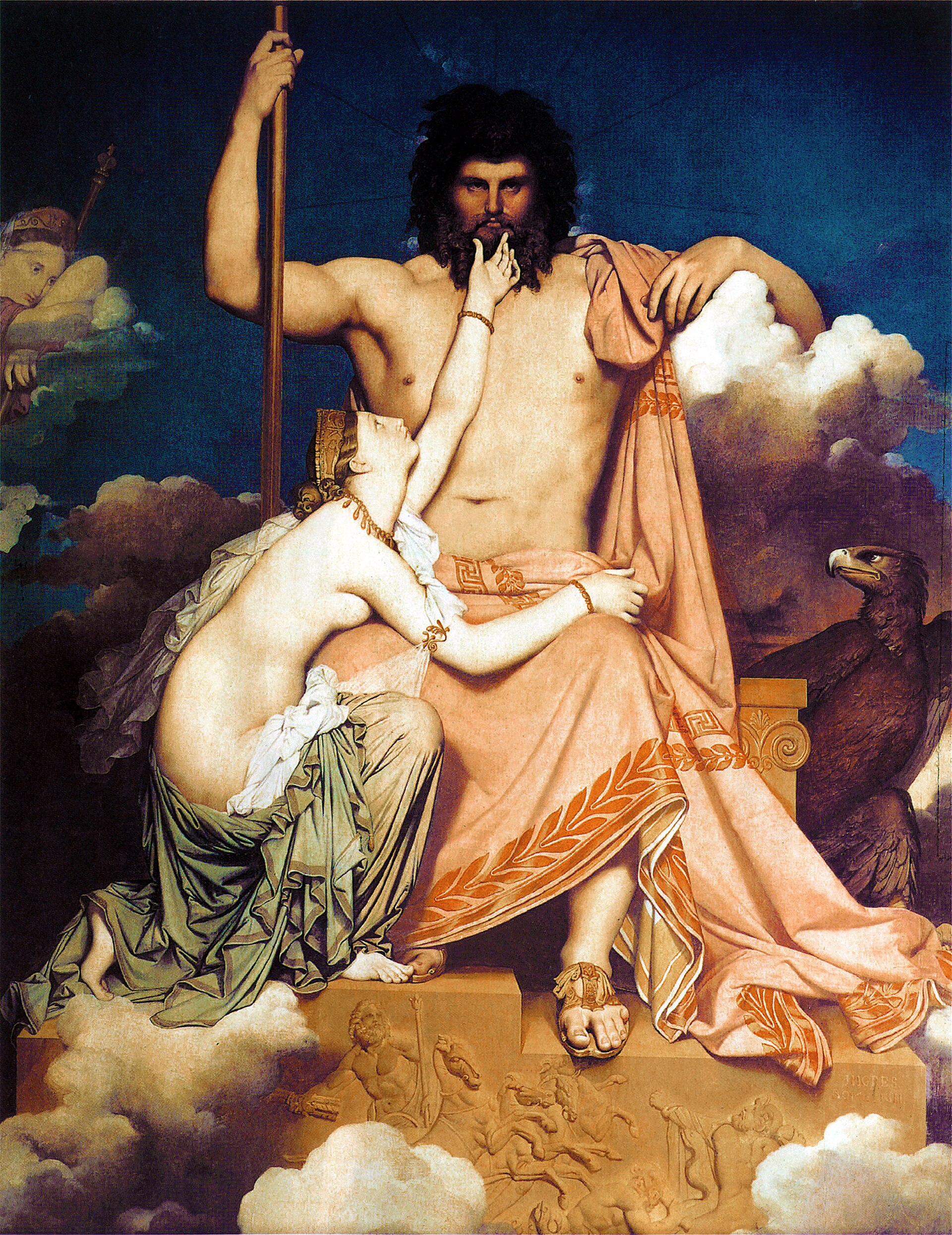
What that sovereignty looked like, Homer draws in gestures. The nod of his head that shakes great Olympos and makes a promise no god can undo. The golden scales in which he weighs the death-fates of men before a battle, letting the beam decide who falls. The aegis he shakes to rout whole armies, for he is aigiochos, the aegis-bearer. He gathers clouds (nephelēgereta), delights in thunder (terpikeraunos); he is the counsellor, mētieta, and above all father of gods and men.
His bird is the eagle, his tree the oak; at Dodona his oracle spoke through a sacred oak tended by priests called the Selloi.
Eating the future
And yet. This same weigher of just fates, this guarantor of oaths (Horkios) and protector of the guest and the stranger (Xenios), came to his throne by swallowing a rock, freeing monsters, and burying his own kin under three hundred boulders. Nor did the cunning stop once he was crowned.
Warned in his turn that his first consort, Metis (Cunning herself), would bear a child mightier than its father, Zeus did to her exactly what Kronos had done to his children: he swallowed her whole while she was pregnant. But where Kronos’s swallowing doomed him, Zeus’s secured him. He absorbed her wisdom into himself, and in time Athena was born fully armed from his own head. The succession that toppled two kings before him stopped at Zeus, because Zeus had learned to eat the future rather than fear it.
That is the contradiction the Greeks handed down without embarrassment: the sky-father who upholds justice, oaths, and the sacred bond of host and guest is also the arch-deceiver who rules by force and cunning, who tricks his rivals and overthrew his father to take the throne. The just king and the usurper are one god. It is not a flaw in the myth. It is the myth: a portrait of power as the Greeks understood it, holding the crown by being cleverer and more violent than everything before it, then declaring itself guardian of the very order it seized.
- Hesiod, Theogonythe foundational succession myth, covering Zeus’s birth and the swallowed stone (453–491), the disgorging of the children and the setting-up of the stone at Delphi (492–500), the Kyklopes’ gift of the thunderbolt (501–506), the Titanomachy and the decisive Hundred-Handers (617–735), the defeat of Typhoeus (820–868), and Zeus’s kingship, the swallowing of Metis, and the birth of Athena (881–929). The core Greek theogonic source. (c. 700 BCE.)
- Homer, IliadZeus reigning as
father of gods and men
; the three-way division of the cosmos by lot (15.187–193); the nod that seals fate (1.524–530); the golden scales weighing men’s deaths (8.69–74; 22.209–213); the aegis (17.593–596); the Deception of Zeus (Book 14); Dodona and the Selloi (16.233–235). - Homer, Odysseythe oak-oracle of Dodona (14.327–328; 19.296–297); and, for contrast only, the distinct one-eyed Kyklopes tradition (Book 9), not to be conflated with Hesiod’s thunder-smith Kyklopes.
- Homeric Hymnsesp. Hymn 28 (to Athena) for the birth from Zeus’s head, and Hymn 23 (to Zeus), which hymns him as counsellor and lord who takes counsel with Themis; Zeus presides throughout the longer hymns as the ruling authority.
- Apollodorus (Pseudo-Apollodorus), Bibliotheca 1.1–1.6a later mythographic handbook systematising the myth, giving the rearing of Zeus by nymphs, Amaltheia, and the Kouretes (1.1.6–7), the Titanomachy, and the expanded Typhon episode with the theft of Zeus’s sinews (1.6.3). A later source; used here only for post-Hesiodic variants. (~1st–2nd c. CE.)
- Callimachus, Hymn 1 (to Zeus)the Hellenistic hymn arguing for the Arcadian rather than Cretan birthplace and preserving rearing details. A later source. (3rd c. BCE.)