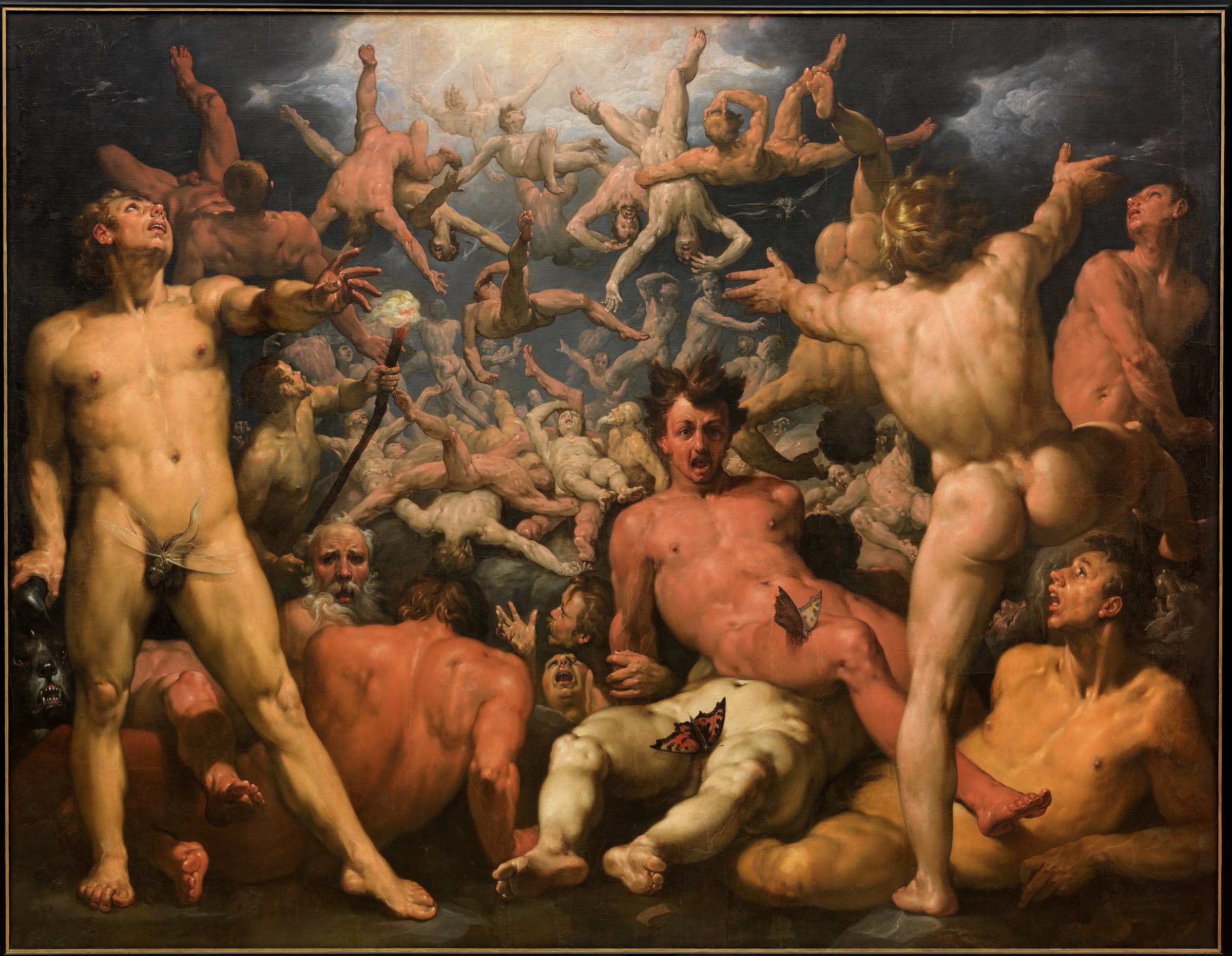
Ten years, and neither side could win. On one crag stood the Titans, dug in on Mount Othrys; on the facing height the younger gods, the children of Cronos, held Olympus. Between the two mountains the war for the mastery of the cosmos ground on without an inch of advantage to either army, the outcome, in Hesiod’s phrase, hung evenly balanced. Thunder answered thunder across the gulf and nothing moved. A stalemate among the deathless is a terrible thing, because the deathless do not tire and do not die, and a battle they cannot win is a battle that need never end.
The counsel from the Earth
What broke it was not a weapon but a piece of counsel. Gaia, the Earth herself, mother of the Titans and grandmother of the gods who now fought them, gave Zeus a prophecy: victory would be his if the Olympians freed and allied with the powers imprisoned beneath the ground. Down in the dark, bound and forgotten, lay three monstrous brothers, the Hundred-Handers, Cottus and Briareus and Gyes, each with a hundred arms springing from his shoulders and fifty heads set on his stout limbs. Their own father had chained them there in an earlier age, hidden away like a shameful thought. Zeus went down, struck off their bonds, and brought them back into the light.
Nectar for the hundred-handed
He did more than free them. He fed them nectar and ambrosia, the food of the gods, until the proud spirit revived in each of them after the long ache of their captivity, and then he stood before them and spoke. He reminded them plainly of what he had done: he had brought them back from under the misty gloom, up from their pitiless bondage, into the light. Now he asked them to stand with him.
Cottus answered for all three. What Zeus had grasped, he said, they too understood; the god’s wisdom and his counsel were surpassing, and he had rescued them from a cruel doom. With minds set fast they would fight the Titans in the hard press of battle. The bargain was struck not by threat but by gratitude, one of the few moments in the whole succession where power is repaid with loyalty rather than fear.
Then the balance tipped, and the poem tips with it into something closer to apocalypse than to battle. The Hundred-Handers took up crags from their hands and hurled them at the Titans, and the sheer number of arms turned a volley into a storm.
The boundless sea rang terribly and the earth crashed aloud; wide Heaven groaned and was shaken, and high Olympus reeled on its foundations at the onset of the immortals, and the heavy quaking of their feet reached down as far as dim Tartarus. This is Hesiod straining the vocabulary of catastrophe past its limits, because the thing being described is not a clash of two forces within the world. It is the world itself convulsing while its rulers are decided.
The whole of the thunder
Into that shaking Zeus at last unleashed the whole of his power, and held nothing back. From Olympus and the open sky he came flashing, hurling his bolts thick and fast, the thunder and the lightning and the lurid thunderbolt flying together from his massive hand, whirling an awesome flame as they went. The life-giving earth crashed as it burned; the vast forests crackled and caught; the whole land seethed, and Ocean’s streams and the barren sea. Hot vapour lapped round the earthborn Titans, and the endless glare of the thunderstone and the lightning reached their eyes and blinded them, mighty as they were.
An astounding heat took hold of Chaos itself, the primordial gap at the root of things. To watch and to hear it, Hesiod says, was as if broad Heaven were falling upon Earth, so vast the crash would be if the sky came down and the earth rose up to meet it. The winds brought rumbling earthquake and dust-storm, thunder and lightning, and drove the din on. It reads less like a description of a war than of a universe coming apart at the seams and being welded shut again in the same instant.
Three hundred rocks at once
The Hundred-Handers finished it. Cottus, Briareus and Gyes loosed three hundred rocks in a single overshadowing volley, one crag upon another, and buried the Titans’ fury under sheer stone. They took them, overpowered them for all their courage, and bound them in bitter chains as far beneath the earth as heaven is high above it. Hesiod cannot leave that distance as a figure of speech; he reaches for a measure.
A bronze anvil falling from heaven would fall nine nights and days and reach the earth on the tenth, and again a bronze anvil falling from earth would fall nine nights and days and reach Tartarus on the tenth. That is the depth to which the beaten Titans went down. Around their prison runs a fence of bronze, and Night is poured about its throat in a triple line, with the roots of earth and sea rising above. And the same three brothers who won the war were set at the gates as its keepers, jailers now where they had once been prisoners, the last and neatest justice of the whole account.
That is Hesiod’s war, the earliest and fullest we have, written around 700 BCE, and it is worth being clear about where the familiar picture comes from something later. The compact prose handbook of ApollodorusThe unidentified compiler of the Library, a systematic prose summary of the myths written too late to be the work of the Athenian scholar whose name it carries, and so commonly cited as Pseudo-Apollodorus., composed the better part of a thousand years afterwards, tells the same ten-year war and the same imprisonment, but it adds furniture Hesiod never built. In Apollodorus it is Metis who supplies the drug that forces Cronos to disgorge the children he had swallowed, the precondition of the war; Hesiod credits that stratagem to Gaia instead and says nothing of Metis.
Apollodorus has Zeus slay a she-monster, Campe, the jailer of the deep, to spring the prisoners; Campe appears nowhere in Hesiod. And it is Apollodorus who stages the Cyclopes forging Zeus’s thunderbolt as part of the war effort, along with a helmet for Pluto and a trident for Poseidon, where Hesiod had already armed Zeus with thunder and lightning generations earlier in the poem. Both are genuinely ancient; they simply are not the same account, and the later hand fills in what the older one left bare.
The lots came later
One motif that popular retellings almost always graft onto the war does not belong to it at all. The famous drawing of lots, in which the three brothers divide the sky, the sea and the underworld between them, is not in Hesiod’s war passage. It comes from Homer, spoken by an angry Poseidon in the Iliad, and from Apollodorus, who places it after the fighting is done. In Hesiod the victorious Zeus does not gamble for his portion. The division of the realms is its own story, and it happens once this one is over.
They bound them in bitter chains, as far beneath the earth as heaven is above it.
That is where the Titans went, and there they remain, walled in bronze at the bottom of the world, watched by the hundred-armed brothers Zeus set free. The war that could not be won was won in the end by the powers the old order had thrown away.
- Hesiod, Theogony 617–728the fullest and earliest surviving account of the war, and the spine of this retelling. It gives the freeing and reviving of the Hundred-Handers with nectar and ambrosia (617–626, 639–643), Gaia’s advising (626–628), the ten-year stalemate with the issue hanging evenly balanced (630–638), Zeus’s rallying speech and Cottus’s reply (644–663), the Hundred-Handers’ rock-storm and the convulsing of sea, earth, Olympus and Tartarus (664–686), Zeus’s thunderbolt assault and the heat seizing Chaos (687–712), the three-hundred-rock volley and the binding of the Titans (713–720), and the measure of Tartarus by the falling bronze anvil, its bronze fence and the Hundred-Handers set as guards (720–735). (8th–7th c. BCE; trans. Evelyn-White, Loeb 1914.)
- Apollodorus (Pseudo-Apollodorus), Bibliotheca 1.2.1the later mythographic summary, drawn on here for the contrasts it introduces rather than as a Hesiodic source. Metis’s drug forcing Cronos to disgorge the swallowed children; the ten-year war; Gaia’s prophecy of victory through the freed prisoners; the slaying of the jailer Campe; the Cyclopes forging the thunderbolt for Zeus, a helmet for Pluto and a trident for Poseidon as war-gear; the confinement of the Titans in Tartarus with the Hundred-Handers as their guards. These details (Campe, Metis, the explicit weapon-handout) are absent from Hesiod and belong to the later tradition. (~1st–2nd c. CE; trans. Frazer, Loeb 1921.)
- Homer, Iliad I.403–404; XV.187–193cited for two points kept out of the war narrative proper. At XV.187–193 Poseidon recounts the three brothers’ lot-division of sky, sea and underworld, the motif popular retellings wrongly fold into the Titanomachy; it is post-war and Homeric, not Hesiodic. At I.403–404 the second Hundred-Hander is named, Briareus among the gods but Aegaeon among men, matching the Obriareus/Briareus/Aegaeon variation in the sources. (Trans. A. T. Murray, Loeb 1924.)
- Plato, Gorgias 523acited by Frazer as a parallel for the tripartite division of the cosmos among the sons of Cronos, reinforcing that the lot-motif circulated independently of Hesiod’s war passage. (4th c. BCE.)