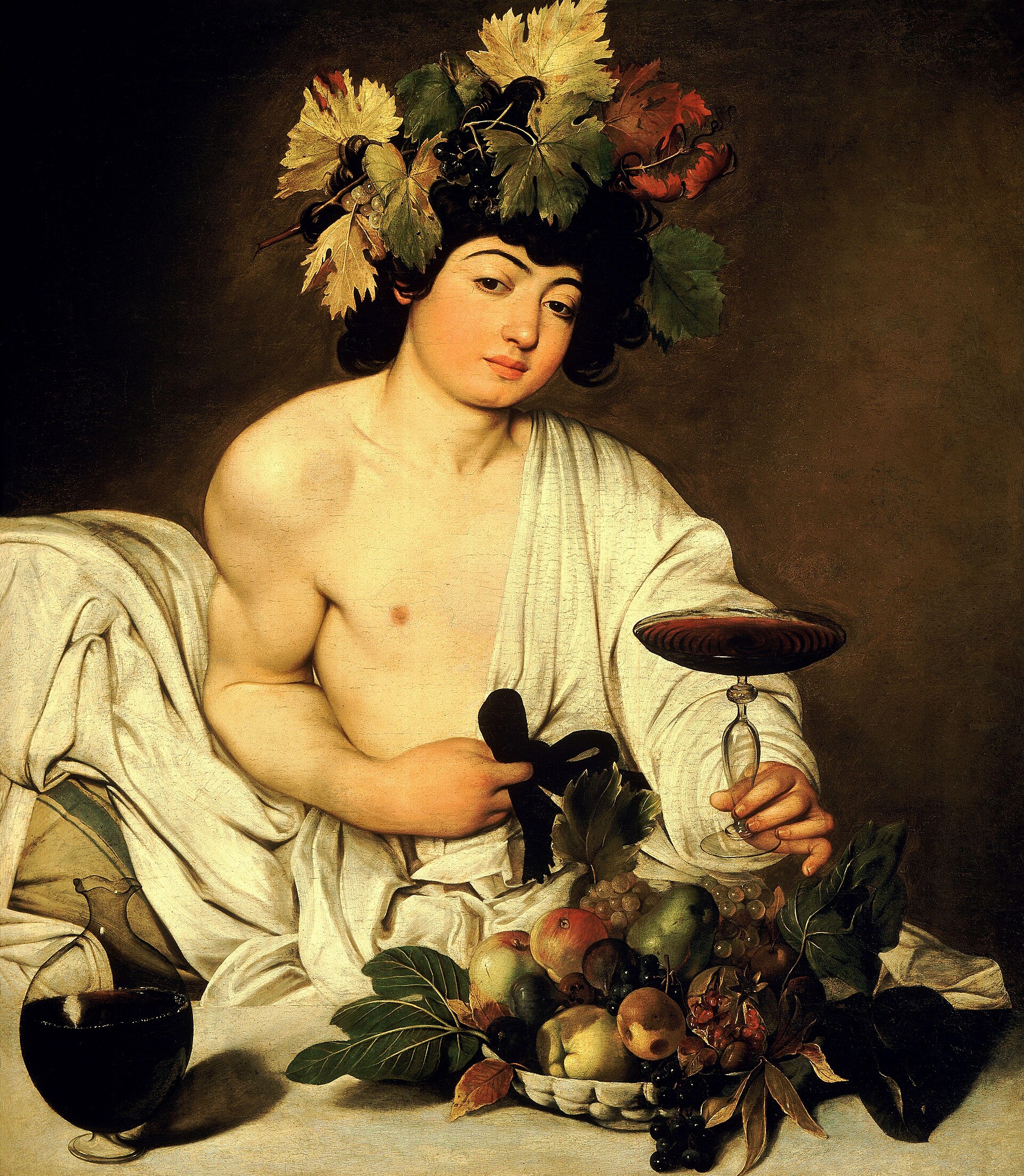
The pirates thought they had caught a prince. A beautiful youth stood on the headland by the wine-dark sea, dark hair about his shoulders, a purple cloak across his strong back, and the Tyrrhenian sailors seized him and hauled him aboard, certain he was some king’s son and would fetch a fat ransom. They tried to bind him. The ropes would not hold; they fell from his hands and feet and left him sitting there, smiling. The helmsman understood, and begged the crew to let the stranger go, for this was surely a god.
They laughed at him and sailed on. Then the miracle came in earnest. Wine ran streaming and fragrant across the deck, a vine spread over the sail heavy with clusters of grapes, and dark ivy wound up the mast and broke into berry and flower. The god became a roaring lion and conjured a shaggy bear beside it, and the terrified sailors leapt overboard and turned, as they fell, into dolphins. Only the helmsman, who had known, was spared.
That is the seventh Homeric Hymn, and it is the whole of Dionysus in miniature: a god who arrives disguised, is refused, and answers refusal with wonders that shade without warning into terror. He is the loosener of cares, and the last god in Greece anyone should insult.
The mother struck by lightning
He was born, the mainstream tradition holds, of Zeus and a mortal woman, the Theban princess Semele, daughter of Cadmus. Hesiod records it plainly in the Theogony: Semele, daughter of Cadmus, bore him a splendid son, joyous Dionysus, a mortal woman an immortal son.
Her death is the strangest overture in Olympian myth.
While Semele carried the child, a jealous Hera came to her in disguise and worked on her pride until she extracted from Zeus a reckless oath to grant her anything, then asked to see her divine lover in his full glory. Bound by his word, Zeus came to her as the lightning, and the fire of his own epiphany consumed her. (ApollodorusThe unidentified compiler of the Library, a systematic prose summary of the myths written too late to be the work of the Athenian scholar whose name it carries, and so commonly cited as Pseudo-Apollodorus. and Ovid name the disguise and the trick; Euripides, in the Bacchae, gives the lightning-death but leaves the deception in shadow.)
Sewn into his father’s thigh
The child did not die with her. Zeus snatched the premature infant from Semele’s burning body and sewed him into his own thigh, carrying him there until he came to term, and from the thigh Dionysus was born a second time. This is what twice-born
means in the Olympian telling: born once too soon from a mortal womb, born again from the body of a god.
The cult kept the memory in his epithets, pyrigenēs, fire-born,
and mērotraphēs, thigh-nursed.
Hidden from Hera’s still-burning jealousy, the infant was passed to the nymphs of Mount Nysa and to old Silenus, and for a time disguised as a girl in the house of Semele’s sister Ino, until Hera found the household and drove Ino and her husband Athamas mad. Wherever this god goes, someone is punished for standing in his way.
What Thebes paid for refusing him
The pattern reaches its most harrowing form at Thebes, in the play Euripides wrote at the end of his life. Dionysus returns to his mother’s city as a soft-faced foreign stranger, and his own cousin Pentheus, the young king, refuses to honour him and moves to stamp out the new rites. What the god does to him is the darkest thing in Greek tragedy. He fills the women of Thebes with divine madness and sends them to the slopes of Cithaeron, where a messenger watches them work impossibilities: one strikes the rock with her fennel wand and a stream of water leaps out; another’s thyrsus brings up wine; the earth runs with milk and honey; they suckle wolf-cubs and gazelles at the breast and wear living snakes that lick their cheeks.
Then the same hands tear a herd of cattle apart barehanded. When Pentheus, dressed by the god himself as a woman to spy on the rites, is discovered in his fir tree, the maenads uproot it and fall on him. His own mother Agave, deep in the frenzy, takes his head for a mountain lion’s and carries it home fixed on her wand, proud of the hunt, and only slowly comes back to herself to see what she holds. This is the god the Greeks called Lyaeus, the loosener who frees us from care. The wine that frees is the same wine that unmakes, and the ecstasy he offers becomes lethal madness in anyone who denies that he is a god.
More than one Dionysus
Even his parentage refuses to settle. The Semele line is dominant, but the ancients themselves counted several Dionysi and did not agree on his mother. The Orphic tradition makes him the son of Zeus and Persephone, a first-born Dionysus called Zagreus, distinct from the Semele child; Diodorus reports mothers as various as Demeter and Dione; Cicero, drily cataloguing, counts five separate Dionysi conflated under one name. The Orphic strand carries its own dark birth-story, in which the Titans lure the infant Zagreus, tear him apart, and devour him, his heart alone saved so that he can be reborn.
A word of caution belongs here: the tidy single narrative of dismemberment, rebirth, and a Titanic original sin
in human nature is largely a modern scholarly reconstruction, stitched from scattered fragments and hostile later testimony. The individual motifs are genuinely ancient; the seamless myth is a reassembly. (And the Zagreus who stars in a modern videogame as a son of Hades is a recent invention; in the old material he is a form of Dionysus, son of Zeus.)
His patronage of the theatre belongs to a different order of truth. That Athenian drama grew up in his worship at the great City DionysiaThe main Athenian spring festival of Dionysus, at which the tragedies and comedies were staged as part of his worship., and that Aristotle traced tragedy itself back to the dithyramb, the choral hymn to Dionysus, are not myths but facts of history and cult. The god of the vine is also, in the plainest documentary sense, the god in whose honour tragedy and comedy were first performed.
Down to the house of Hades
He does not only deal death. Dionysus went down into the house of Hades to retrieve the mother he had never known, brought Semele up from among the dead, and set her on Olympus as the goddess Thyone. On Naxos he found Ariadne, the Cretan princess abandoned there by Theseus, and made her his bride; Hesiod says Zeus granted her deathlessness for his sake, and Ovid set her wedding crown among the stars. The god of blurred boundaries, male and female, human and animal, Greek and foreign, sane and mad, is fittingly the god who crosses the last boundary and brings someone back.
Bind him, and the ropes fall away; refuse him, and the vine still climbs your mast. Dionysus is the wine that loosens every knot, and the same loosening, in a mind that will not bend to him, becomes the madness that tears a son apart.
- Euripides, Bacchae (405 BCE)the central dramatic source. The prologue on Semele’s lightning-death and the thigh-birth (1–63, 88–100, 286–297); the arrival of the disguised god at Thebes and the resistance of Pentheus; the messenger’s account of the maenads’ miracles on Cithaeron, the streams of water, wine, milk and honey, and the sparagmos of the cattle (677–774); and the death of Pentheus and Agave with his head (1043–1152).
- Homeric Hymn 7 (to Dionysus) (c. 7th–6th c. BCE)the Tyrrhenian pirates, the ropes that will not hold, the vine and ivy over the ship, the god as lion and bear, and the sailors turned to dolphins.
- Homeric Hymn 26 (to Dionysus)the nurture of the infant god by the nymphs of Nysa.
- Hesiod, Theogony 940–942, 947–949, 975–978 (c. 700 BCE)the birth from Semele; the deification of Ariadne, made deathless and unaging for Dionysus; and Semele numbered among the mortal-born who became gods.
- Homer, Iliad 6.130–140Lycurgus of Thrace who drove the nurses of Dionysus down the sacred mountain, the earliest literary reference to resistance against the god (a separate episode from Pentheus, not a version of it).
- Apollodorus, Bibliotheca 3.4.3 and 3.5.1–3; Epitome 1.9 (~1st–2nd c. CE)the birth and thigh-rebirth, the Hera-in-disguise trick, the fostering with Ino and Athamas, the spreading of the cult, the recovery of Semele from Hades; and Ariadne on Naxos.
- Ovid, Metamorphoses 3.253–315 (Semele’s death and the thigh-birth), 3.511–733 (Pentheus and the pirates), 8.176–182 (Ariadne’s crown set among the stars) (c. 8 CE).
- Diodorus Siculus, Bibliotheca Historica 3.62–74 and 4.2–5, 4.25the multiple Dionysi and their several reported mothers, the Orphic/Persephone line, and the descent to fetch Semele. A later compiler, used for the variant traditions.
- Nonnus, Dionysiaca 5–6 (Zagreus and the dismemberment by the Titans) and 8–9 (Semele and the second birth)the fullest late-antique treatment, highly elaborated. A 5th-century-CE source, used with caution.
- Cicero, De Natura Deorum 3.21–23the
five Dionysi,
evidence that the ancients themselves recognised several conflated deities under one name.