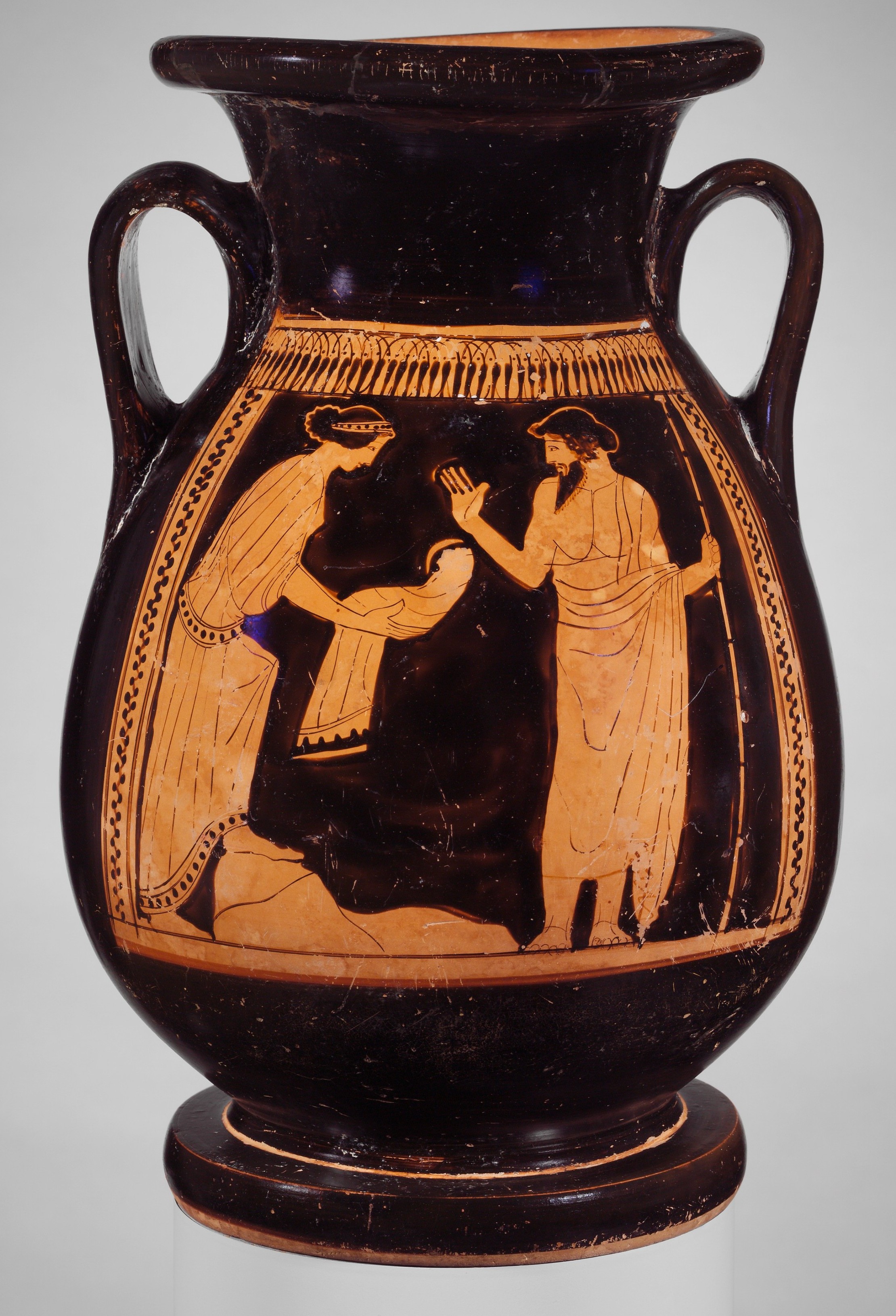
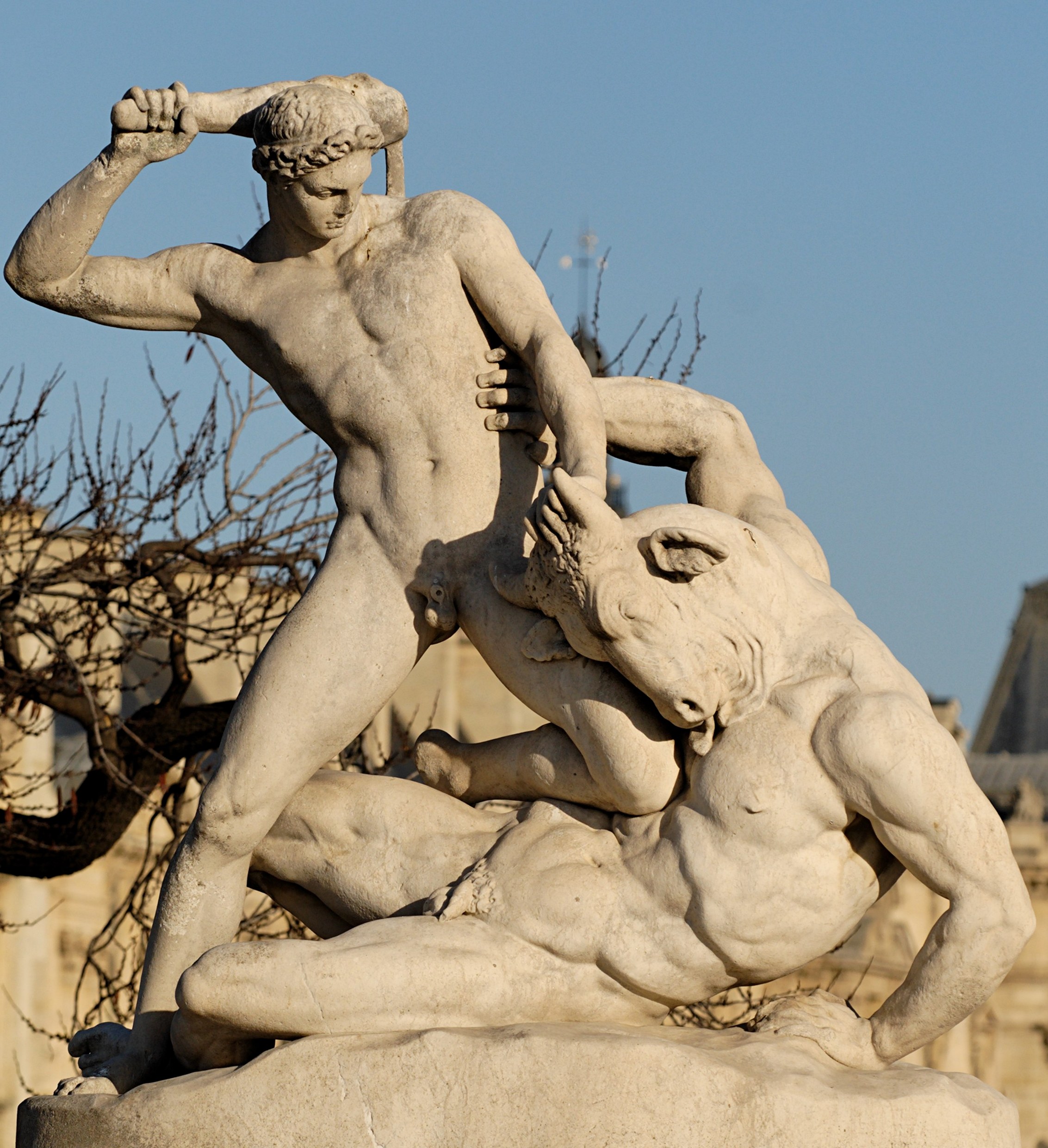
The boy went to the rock alone. His father had buried the proof of who he was beneath it, and his mother Aethra had waited years in Troezen to tell him where. Aegeus, king of Athens, had lodged there once and lain with her, then hidden a sword and a pair of sandals under a great stone: send the child to me, but only when he is strong enough to lift this. Theseus set his shoulders to the rock, rolled it aside, and took up the tokens that named him a king’s son. There was a second father too. The same night Aegeus lay with Aethra, so the story ran, Poseidon lay with her as well, so that the sea-god’s blood ran in the boy alongside the Athenian king’s.
The long road with the bandits
He could have sailed to Athens. The sea route was short and safe; the land route ran through country thick with murderers, and he chose the land. Plutarch catches the pattern that governs what follows: Theseus killed each brigand in the very manner the man had used on travellers, giving back exactly what had been dealt out. Sinis, who bent pine trees to tear travellers apart between them, was torn the same way.
Sciron, who made men wash his feet on the Megarian cliffs before kicking them into the sea to a waiting turtle, went over the edge himself. Cercyon the wrestler was wrestled down at Eleusis. And Procrustes, who kept two beds and fitted his guests to them by stretching the short and lopping the tall, was measured against his own iron frame. By the time Theseus reached Athens he was already a name, and already a problem for those waiting there.
Poison at his father’s table
The first danger in the city was quieter than any bandit. Medea, the sorceress, was Aegeus’s wife, and she knew the stranger for who he was before the old king did. A grown son meant a rival, so she moved to have him killed: first by sending him against the wild bull of Marathon, and when he mastered it and sacrificed it to Apollo, by poison at a feast.
The cup was in Theseus’s hand when Aegeus saw the sword at his side, the token from under the rock, and knew his own blade and his own son in the same instant. He dashed the cup away. Medea was driven out, and the boy from Troezen had a father and a city.
The tribute of fourteen
Then Crete came for its due. Years before, Minos’s son Androgeus had died on Athenian soil, and the price Minos exacted was a tribute of the living: seven youths and seven maidens, sent every ninth year to be shut in the Labyrinth with the thing that waited inside it. The Minotaur was Minos’s shame, the bull-headed child of his wife Pasiphae, a creature Euripides called a mingled form and hybrid birth, man and bull joined in one body. Theseus went among the tribute, whether chosen by lot or by his own offer the sources disagree, and Aegeus made him swear a signal: the ship sailed under black, but if the boy came home alive it would return under white.
A thread out of the dark
On Crete, Ariadne saw him and could not help herself. Minos’s daughter fell in love with the doomed Athenian, and on the advice of Daedalus, who had built the maze, she gave Theseus the one thing that could undo it: a ball of thread. Ovid likens the Labyrinth to the river Maeander of Phrygia, which doubles back and meets itself, so intricate its own builder could scarcely retrace his steps. Against that, a thread.
Theseus tied it at the door and let it out behind him, so the way back was always in his hand. He killed the Minotaur at the heart of the maze, and here the ancient sources are plainer than the pictures painted since: ApollodorusThe unidentified compiler of the Library, a systematic prose summary of the myths written too late to be the work of the Athenian scholar whose name it carries, and so commonly cited as Pseudo-Apollodorus. says he did it with his fists, and Ovid names no weapon at all. The clean sword-thrust of later art is an embellishment, not the old account. Then he followed the thread out of the dark and took the freed youths and Ariadne down to the ship.
She did not reach Athens with him. On Naxos the story loses her: in one telling Theseus abandons her sleeping on the shore and Dionysus finds her and weds her, setting the crown he gives her among the stars as the Corona Borealis; in another the god takes her from Theseus outright. What every strand keeps is the leaving. The girl who handed him the thread out of the dark does not come home.
And then the sail. Grieving, or simply forgetting, Theseus never changed the black canvas for white. Aegeus was watching from the height, and when the black sail came over the horizon he read it as the death of his son and threw himself down to his own. The boy came home to a dead father and a throne, and the tradition would later give the sea the old king’s name, the Aegean.
Fifty sons of Pallas
What Theseus did with the throne is why Athens kept him. He killed the fifty sons of Pallas who contested his rule, then did the founder’s work the city credited him with forever: he gathered the scattered townships of Attica into one, the synoikismos. He abolished the separate council-halls of the little communities, built one common chamber, gave the united thing a single name, Athens, and established the festivals that bound it, the Panathenaea and the Metoikia. Whether any single king ever did such a thing is a historian’s question, and the answer is almost certainly no; but Athens told it as though he had, because the city wanted a founder who looked like its own idea of itself.
He does not stay heroic. The same sources that make him a founder make him an abductor: with his friend Pirithous he seized the young Helen before she was of age, and the two went down living into Hades to carry off Persephone herself, an escapade that left Theseus trapped below until Heracles hauled him out. Driven from Athens at last with Menestheus in his place, he withdrew to Skyros, and King Lycomedes led him up to the heights and threw him from the cliffs, the same death he had once dealt Sciron.
And they kept his ship. The thirty-oared galley that carried him to Crete was preserved for generations, its rotten timbers pulled out and new ones fitted in, until the philosophers took it up as a puzzle. A thing every plank of which has been replaced, is it still the same thing? It is a fitting question to leave beside him. Theseus was always the hero a city rebuilt in its own image, plank by plank, until the man underneath was harder to find than the founder on top.
He beat the maze with a thread and the monster with his hands, then forgot the one sail that would have kept his father alive. Athens made him its founder and its mirror, yet the sources keep the abductor and the abandoner in the same frame. A hero, they insist, is everything the road did to him, and everything he did on it.
- Plutarch, Life of Theseus (Perrin trans.; c. 1st–2nd c. CE)the fullest biographical treatment and the backbone of this retelling. The birth-tokens and the rolling of the rock (3–6), the road-brigands each punished in kind (8–11), the Marathonian Bull and the recognition by the sword (12, 14), the tribute of seven youths and seven maidens every ninth year and the Minotaur (15–17), the death of Aegeus (22), the Ship of Theseus preserved down to Demetrius of Phalerum (23), the synoikism of Attica and the founding of the Panathenaea and Metoikia (24–25), the crane dance on Delos (21), the death on Skyros (35), and Cimon’s recovery of the bones (36). Records competing versions throughout, including the many local traditions for Ariadne’s fate (20).
- Apollodorus, Bibliotheca Epitome 1.1–1.24 (Frazer trans.; 1st–2nd c. CE)the compact narrative spine and the source for the road-brigands (1.1–1.4), the Medea plot and the poisoned cup (1.5–1.6), the tribute and the black-and-white sail (1.7), Ariadne and the thread and the Minotaur killed with the fists (1.8–1.9), the death of Aegeus (1.10), the Pallantides (1.11), the Amazons and the uncertainty over which one (1.16), Phaedra and Hippolytus (1.16–1.19), and the abduction of Helen and the descent to Hades with Pirithous (1.21–1.24). Also gives the variant in which Theseus offers himself for the tribute rather than being chosen, and in which Dionysus carries Ariadne off from Naxos.
- Apollodorus, Bibliotheca 3.15.6–3.15.7the birth. The riddling oracle to childless Aegeus (
loose not the bulging mouth of the wineskin until thou hast reached the height of Athens
), Pittheus making him drunk at Troezen and uniting him with Aethra, the dual paternity of Aegeus and Poseidon, the sword and sandals hidden under the rock, and the death of Androgeus that set the tribute in motion. - Bacchylides, Ode 17 (
Youths, or Theseus
; 5th c. BCE)the sea-dive on the voyage to Crete, and the corrective to the popular telling. Minos challenges Theseus’s descent from Poseidon and throws a gold ornament into the sea; Zeus answers with a lightning-sign; Theseus leaps from the deck, dolphins carry him to Poseidon’s hall, the Nereids dance with their limbs shining like fire, and Amphitrite throws a purple cloak around him and sets a wreath dark with roses on his hair. He surfaces beside the ship unwetted, a marvel to all. Note that the ode’s climax is Amphitrite’s gifts and the miraculous return, not the retrieval of the ring the modern version supplies. - Ovid, Metamorphoses 8.152–182 (c. 8 CE)the Cretan sequence and the source of the vivid detail. The Labyrinth built by Daedalus and likened to the doubling river Maeander so intricate its own maker could hardly retrace his steps (8.159–168), the victims sent for three seasons of nine years each (8.170–171), Ariadne’s thread, the slaying of the Minotaur with no weapon named, the abandonment at Naxos, and Bacchus setting Ariadne’s crown among the stars as a constellation (8.176–182).