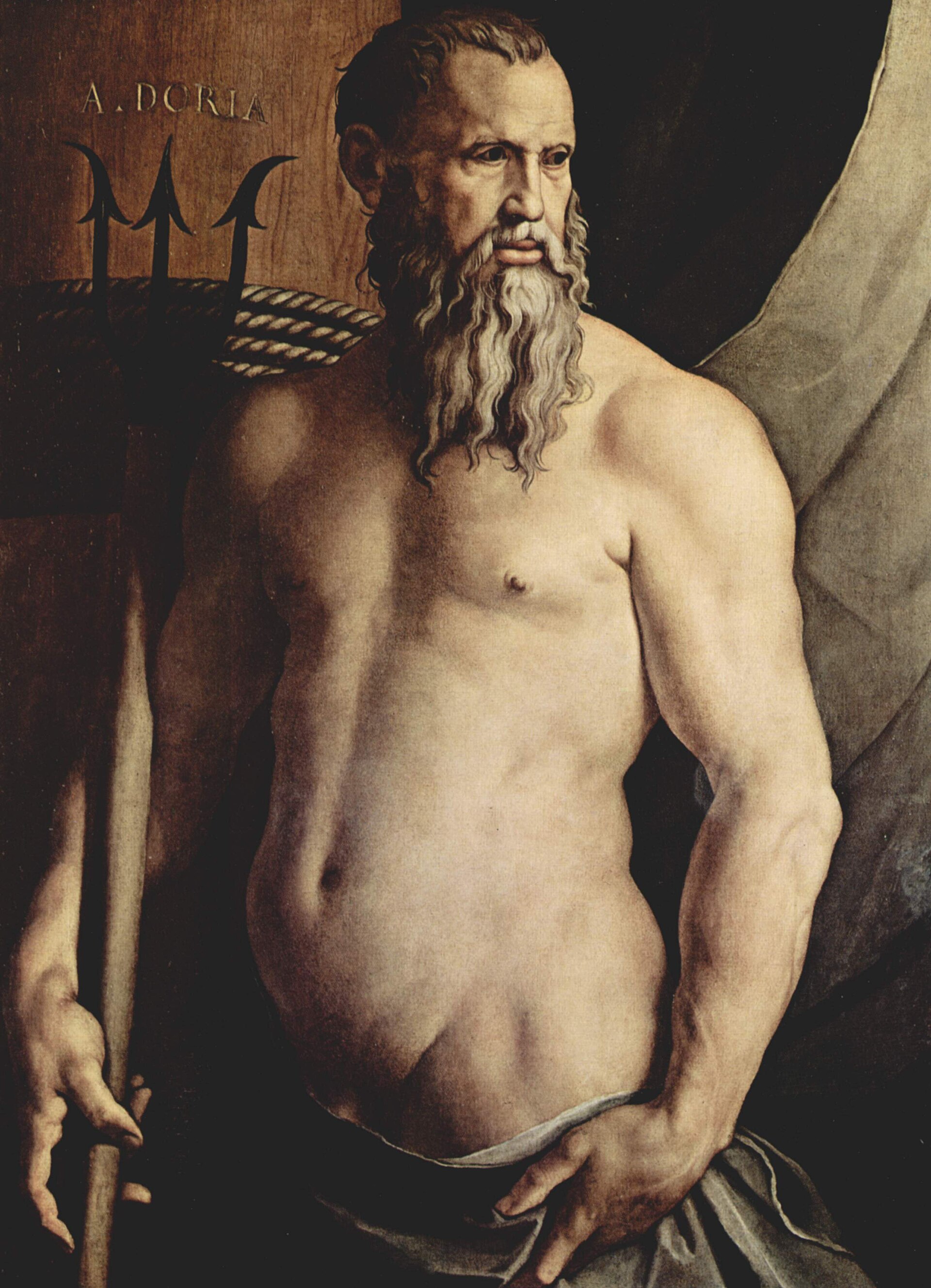
Far out beyond Phaeacia, coming home across the water from the Ethiopians, the Earth-Shaker looked up from the mountains of the Solymi and saw a raft. On it sat the one mortal he had sworn to break. The gods had waited for his back to turn, and now Odysseus was almost free. Poseidon knew the man could not be killed outright, fate would not allow it, so he settled for ruin: he gathered the clouds in his fists, seized his trident, troubled the sea and roused all four winds at once. East and South and West and North dashed together, a mighty wave reared up, and night rushed down out of heaven upon land and sea alike. This is the god the Odyssey gives us, not a distant lord of storms but a personal enemy, patient and pitiless, drowning a man for blinding his son.
The sea came to him by lot
He came to the sea by lot, not by longing. When the Titans fell and the three brothers of the new order divided the cosmos between them, they shook the lots, and, as Poseidon himself recounts in the Iliad, I won for my portion the grey sea to be my habitation for ever.
Hades drew the murky darkness below, Zeus the broad sky above; earth and Olympus were left common to all three. It is a telling detail that the sea was not chosen but dealt. Poseidon rules a domain he was assigned, and something of that resentment, the younger brother handed the restless element while Zeus took the throne of heaven, runs beneath every storm he raises.
Go back further and the resentment has deeper roots. He was a son of the Titans Cronus and Rhea, one of six, and at birth his own father swallowed him whole. Cronus had heard he would be overthrown by a son and meant to forestall it by devouring each child as it came, until the youngest, Zeus, was hidden away and grew to force the others back up into the light.
Local traditions soften the horror in their own directions: the Arcadians said Rhea hid the infant Poseidon among a flock of lambs and gave Cronus a foal to swallow in his place, while at Rhodes he was reared by the Telchines at his mother’s request. The mainstream Greek account keeps him inside his father’s belly with the rest, disgorged only when Zeus prevailed.
The three-pronged spear
What the Cyclopes gave him in that war became his signature. They forged the trident, a three-pronged fisherman’s spear, and it is never merely ornamental in his hands. He cleaves the crag of Gyrae to drown Ajax with it; he strikes the sea to raise the tempest against Odysseus; and, in the founding quarrel of Athens, he drives it into the rock of the Acropolis.
The Homeric Hymn names his two-fold office
precisely, tamer of horses and saviour of ships, and calls him the mover of the earth and the fruitless sea, the dark-haired lord of the deep. His palace lies in the depths near Aegae, where he keeps horses with brazen hooves and golden manes; when he yokes them and rides out, the sea grows smooth before him and the monsters of the deep frolic around their king.
He struck first, and salt came up
The contest for Athens is the story that defines his ambition and his temper together, and it is worth telling in the version the earliest Greek sources actually give. The gods resolved that each would seize a city for their own worship, and Poseidon came first to Attica. He struck the middle of the Acropolis with his trident and brought forth a salt sea, afterwards called the Erechtheis.
Then Athena came, called King Cecrops to witness, and planted an olive tree. When the two strove for the land, Zeus set the twelve gods as arbiters, and they awarded Attica to Athena, because Cecrops testified that she had planted the olive first. She named the city for herself. Poseidon, in his anger, flooded the Thriasian plain and laid Attica under the sea.
Later tradition remembers his gift differently, and the difference matters. The version in which Poseidon’s offering was the first horse rather than a salt spring is a Roman-era systematisation, rooted in Virgil’s line that the earth, struck by Neptune’s great trident, first poured forth the neighing horse, and grafted onto the Athens contest only by late commentators.
The earliest Greek sources give the salt sea, and Pausanias reports that the brackish sea
was still shown inside the Erechtheion in his own day, a well that roared like waves when the south wind blew, the trident-marks scored in the rock beside Athena’s sacred olive. As for how the vote fell, a much later Latin tradition preserved by Augustine from Varro tells it as a citizens’ ballot, men for Neptune and women for Minerva, decided by a single woman’s vote; but that is a Christian author transmitting a Roman antiquarian, not a Greek witness, and it carries its own moralising freight.
The stallion at Thelpusa
His horse-nature is not only civic. At Thelpusa in Arcadia they told a darker tale: Demeter, wandering in search of her lost daughter and fleeing Poseidon’s pursuit, turned herself into a mare to escape him. He became a stallion and took her by force. From that violence she bore the divine horse Arion and a daughter whose name the initiates guarded and Pausanias would not write down, calling her only Despoine, the Mistress.
The Arcadians, Pausanias adds, were the first to worship him as Poseidon Hippios, Poseidon of Horses. Set beside the dignified Olympian of Homer, it is a jarring picture, and the Greeks did not pretend otherwise; the god of the smooth-riding chariot is also the god who runs down a fellow deity in the shape of a beast.
He builds and he drowns
Hold the pieces together and the pattern is consistent. Poseidon builds and Poseidon drowns, and the hinge between the two is always a debt or a slight. He raises the walls of Troy for Laomedon and, cheated of his wage, sends a sea-monster against the coast. He offers Athens a sea and, refused, buries the plain beneath one.
He is cheated of the sky by a lottery and spends the Odyssey making one man pay. This is a god of enormous generative power, the horse and the spring and the safe voyage, lashed to a temper that never forgets. The grey sea he was dealt suits him exactly: calm one hour, and the next, without warning, all four winds at once.
He gathered the clouds together and, grasping his trident in his hands, roused all the winds and covered land and sea alike with cloud; and down rushed the night from heaven. This is Poseidon undisguised: a wronged god settling a private score with the weather of the world.
- Hesiod, Theogony 453–467; 278–286; 930–933Poseidon’s parentage as a son of Cronus and Rhea and his swallowing at birth (453–467); his union with Medusa
in a soft meadow amid spring flowers
and the birth of Chrysaor and Pegasus (278–286); his marriage to the Nereid Amphitrite and their son Triton (930–933). The earliest Greek frame for his origins and family. (Evelyn-White trans., Loeb 57, 1914.) - Homer, Iliad 15.187–193; 7.452–453; 21.441–457the division of the cosmos by lot, Poseidon speaking,
I won for my portion the grey sea,
with Hades drawing the darkness and Zeus the sky (15.187–193); and the building of Troy’s walls with Apollo for Laomedon (7.452–453; 21.441–457). (A. T. Murray trans., Loeb 1924.) - Homer, Odyssey 5.282–296; 1.68–75; 4.499–511the storm against Odysseus, the gathering of clouds and the rousing of all four winds (5.282–296); the grudge itself, that Odysseus blinded the Cyclops Polyphemus, Poseidon’s son by the nymph Thoosa (1.68–75); and the trident splitting the rock of Gyrae to drown Ajax (4.499–511). (A. T. Murray trans., Loeb 1919.)
- Homeric Hymn 22 (to Poseidon) 1–7his titles and his
two-fold office,
tamer of horses and saviour of ships, mover of the earth and the fruitless sea, the dark-haired lord. The compact hymnic portrait. (Evelyn-White trans., Loeb 57, 1914.) - Apollodorus, Library 3.14.1; 1.1.5–1.2.1; 2.5.9the contest for Attica, the trident-struck salt sea against Athena’s olive, judged by the twelve gods on Cecrops’s testimony, and Poseidon’s flooding of the Thriasian plain in anger (3.14.1); the birth and disgorging of the children of Cronus and the trident forged by the Cyclopes (1.1.5–1.2.1); the Troy sea-monster sent against Laomedon (2.5.9). A late systematising compilation (1st–2nd c. CE), authoritative for the shape of the myths. (J. G. Frazer trans., Loeb 121, 1921.)
- Pausanias, Description of Greece 8.25.4–8; 1.24.5; 1.26.5; 8.8.2the Thelpusan tale of Demeter as a mare and Poseidon as a stallion, the birth of Arion and of Despoine
the Mistress,
and the Arcadians as the first to worship Poseidon Hippios (8.25.4–8); the saltsea
and trident-marks shown in the Erechtheion beside Athena’s olive (1.24.5; 1.26.5); and the Arcadian lamb-and-foal variant of his birth (8.8.2). (W. H. S. Jones trans., Loeb 1918–1935.) - Virgil, Georgics 1.12–13Neptune’s trident-strike drawing the first neighing horse from the earth, the root of the later
horse gift
tradition. Augustan Roman poetry, and the source of a variant grafted onto the Athens contest only by late commentators, not present in Apollodorus or the earliest Greek sources. (H. R. Fairclough trans., Loeb 63, 1916.) - Augustine, City of God 18.9 (citing Varro)the
citizens’ vote
version of the Athens contest, men for Neptune and women for Minerva, decided by one vote, with Neptune flooding the land in reprisal. A Latin Christian author transmitting a Roman antiquarian, useful for the vote-variant but not a Greek primary witness. (c. 426 CE.)