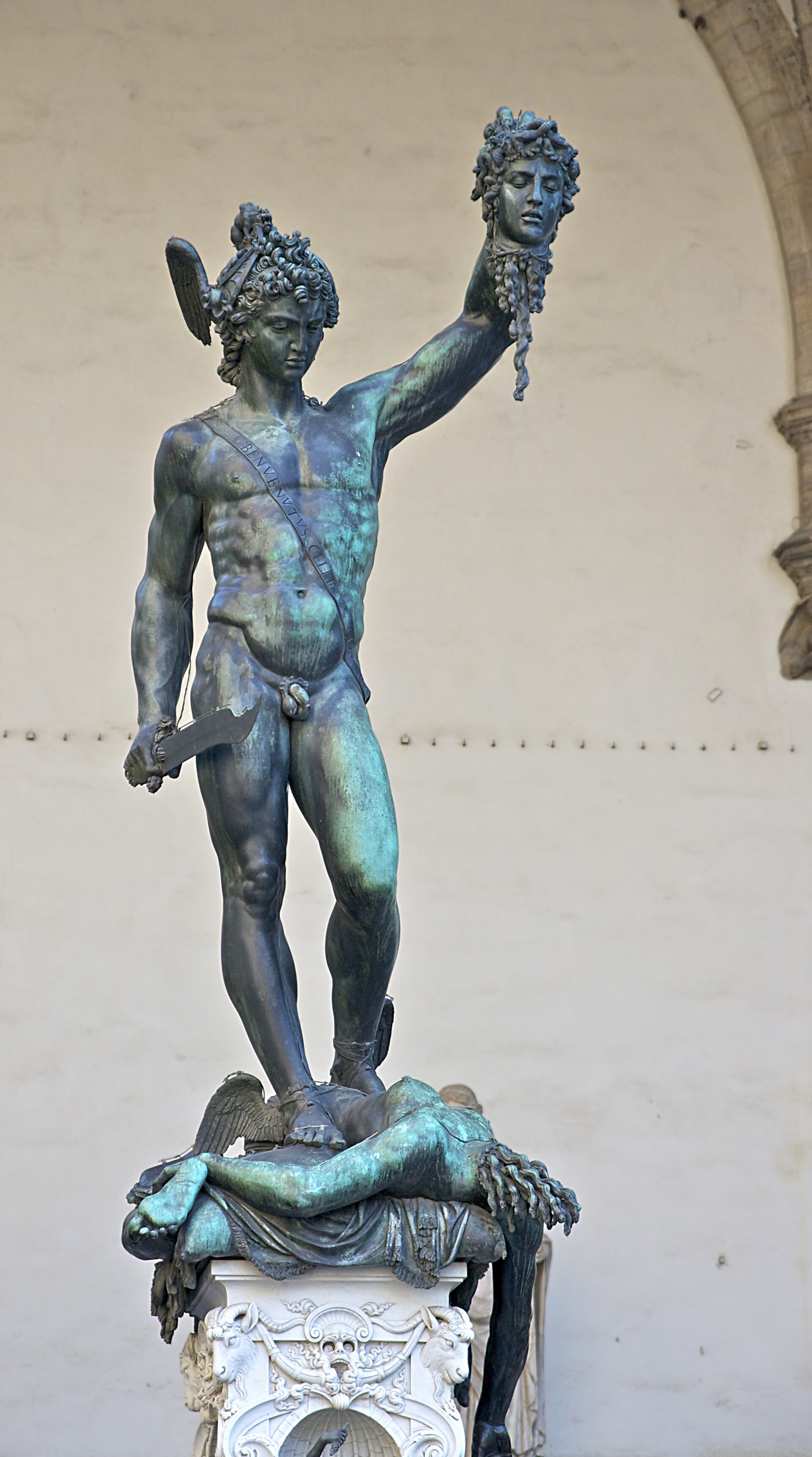
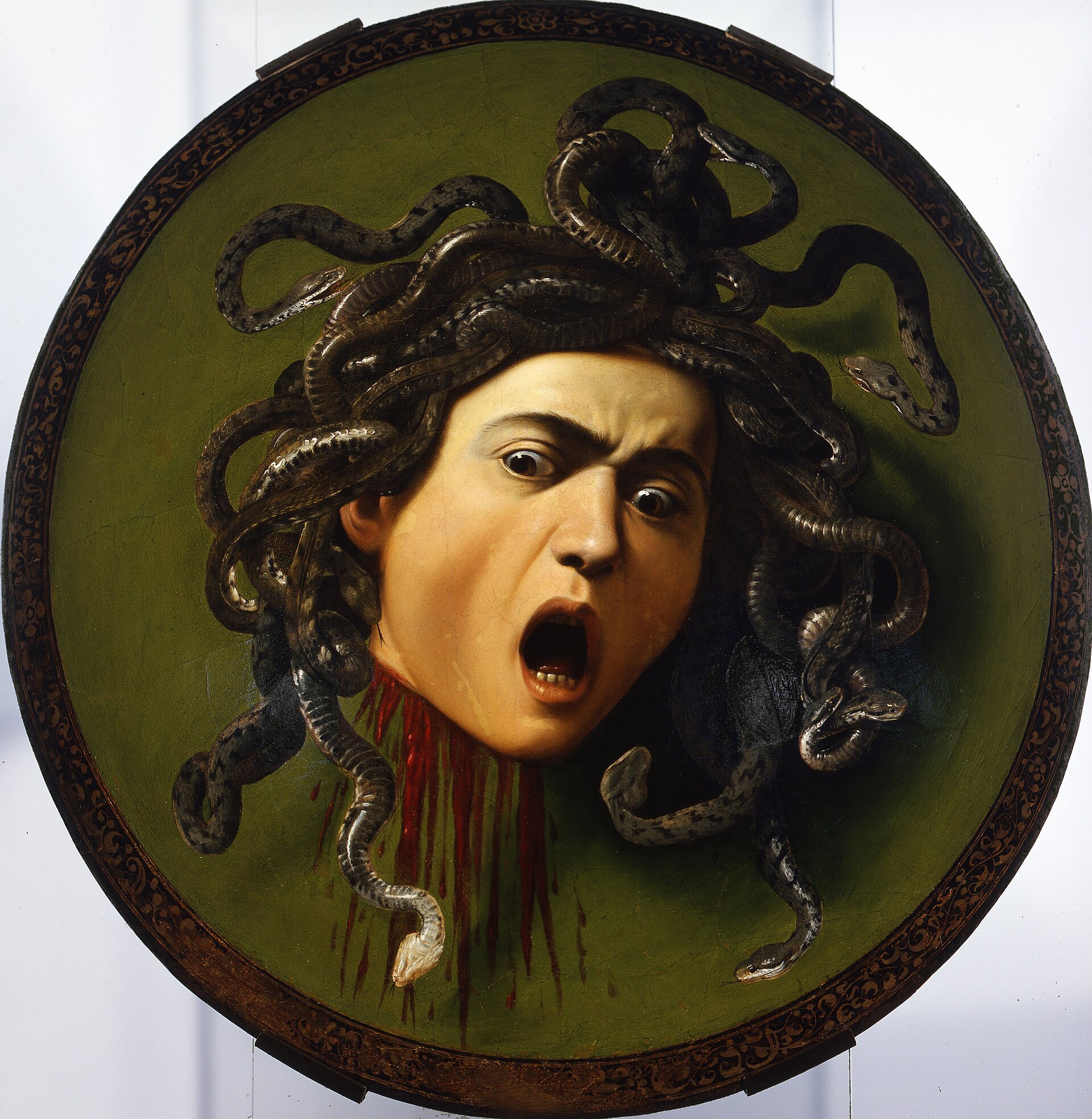
She never sees him coming, because he never looks at her. That is the whole trick of it. Perseus stands over the sleeping Gorgon with the curved sickle raised, his eyes fixed not on her but on the bright bronze of the shield in his left hand, reading her by reflection, and while (as Ovid tells it) deep sleep held fast Medusa and her snakes,
he brings the blade down. The one power that made her unkillable was her face, and he has beaten it by the simple expedient of refusing to meet it. The most feared monster in Greek myth dies without ever getting to use the thing that made her feared.
Three sisters at the world’s edge
The Gorgons were three sisters, and Hesiod, the oldest source we have, sets them at the edge of the world: Sthenno, Euryale, and Medusa, living beyond glorious Ocean in the frontier land towards Night, where are the clear-voiced HesperidesNymphs of the far west who guarded a garden of golden apples, used by Hesiod to place the Gorgons at the edge of the world..
Two of the three were immortal and ageless. Only Medusa could die, and it is the mortal one the story is about. Even in the earliest telling there is a note of something wrong in the family: Poseidon, he of the dark hair,
had lain with her in a soft meadow among spring flowers,
an incongruously gentle image for a creature that turns onlookers to stone.
What did they look like? ApollodorusThe unidentified compiler of the Library, a systematic prose summary of the myths written too late to be the work of the Athenian scholar whose name it carries, and so commonly cited as Pseudo-Apollodorus. gives the fullest inventory, and it is nobody’s idea of a beautiful woman with unfortunate hair. The Gorgons had heads twined about with the scales of dragons, and great tusks like swine’s, and brazen hands, and golden wings, by which they flew.
Wide mouths, lolling tongues, the tusks of a boar: the archaic Gorgon is a mask of pure fright, and the earliest vase-painters drew her exactly so. This matters, because the Medusa most people carry in their heads is a much later invention.
The beauty story came late
The wronged-beauty story everyone knows comes from a single poem. In Ovid’s Metamorphoses, written in Rome seven centuries after Hesiod, Medusa was once most beautiful, and the jealous hope of many suitors,
famous above all for her glorious hair. Poseidon violated her in the temple of Athena, and the goddess, unwilling to let the outrage go unpunished, changed the Gorgon’s hair to hideous snakes.
That is effectively the only ancient source for the sympathetic Medusa of modern retellings, the victim punished for her own assault. It is a powerful story. It is also late, Roman, and singular. Hesiod knows nothing of it, Homer knows nothing of it, and the archaic artists who drew her tusks and beard knew nothing of it. She was, in the mainstream of the tradition, simply born a monster into a family of monsters, and no transformation was ever needed to explain her.
Even the reason for her death shifts between tellers. Apollodorus records a colder motive with no assault in it at all: some say Medusa was beheaded for Athena’s sake; and they say that the Gorgon was fain to be compared with Athena even in beauty.
Not a violated innocent but a proud rival, killed for the hubris of measuring herself against a goddess. Two ancient explanations, and they do not agree; the retelling that flattens them into one certain backstory is choosing a version and hiding the choice.
Cap, sandals, and a bright shield
Perseus was equipped for the impossible. Sent by Polydektes, king of Seriphos, to fetch the head as a way of ridding himself of an inconvenient young man, he first cornered the Graiai, the grey sisters who shared a single eye and a single tooth between them, and snatched the eye as it passed from hand to hand, ransoming it for the way to the nymphs.
From them he took the tools the job required, each named precisely: the winged sandals, the kibisis (a pouch to hold the head), and the cap of Hades that made its wearer invisible. Hermes gave him an adamantine sickle, the harpe; a polished bronze shield served as his mirror. He found the three asleep, and, watching Medusa only in the reflection so her gaze could not catch him, struck.
What sprang from the neck
Her death was violently fertile. From the severed neck sprang the winged horse Pegasos and the golden-sworded giant Khrysaor, the children she had carried by Poseidon, born in the instant of her killing. Hesiod, Apollodorus and Ovid all agree on this, the one detail the whole tradition holds in common. The two immortal sisters woke and gave chase, but the cap of Hades hid Perseus, and he escaped carrying the still-lethal head.
Blood dripped from it as he flew over Libya, and where the drops fell they bred serpents, and so that land still swarms with deadly snakes to this day,
an old story reaching out to explain a real and dangerous desert. Ovid adds that fresh seaweed the head touched hardened into coral: soft underwater, stone in the air, because the Gorgon’s power passed into it.
Frozen in the poses they held
The head kept killing after she was dead, which is the grim genius of the myth: the weapon outlives the enemy. Perseus used it as an instrument. He froze the rival Phineus and his men to stone at a wedding feast, and finally carried it home to Seriphos and petrified Polydektes and his whole court in the poses they happened to be holding, each one turned to stone in the attitude he chanced to have.
Ovid alone adds the Titan Atlas, turned into the mountain that bears the sky. Then Perseus gave the head to Athena, who fixed it at the centre of her aegis. The Gorgoneion, the face that kills, became the face on the goddess’s shield, a thing worn precisely to frighten. Even in death her one gift was still being put to work.
She is the only mortal in a house of deathless monsters, killed asleep by a man who would not look at her. And her face outlasts her: prised off, kept, and mounted on a goddess’s shield to do to others exactly what it did to her.
Not everyone let her stay a monster. PausaniasA second-century AD travel writer whose guide to Greece records local traditions, often in a sceptical, explaining-away register. passed on a flatly rationalising account: Medusa was a Libyan queen who ruled the people around Lake Tritonis, made war on Perseus, and was assassinated by him in the night, her head cut off to show the Greeks its marvellous beauty. Diodorus went further and made the Gorgons an entire warlike tribe of Libyan women. These are not older or truer versions but later attempts to explain the myth away, to find a plain history under the horror. The tradition that mattered kept the monster monstrous: a face at the end of the world that no one could look at and live, undone by a hero who won by looking away.
- Hesiod, Theogony 270–283 (c. 700 BCE)the earliest full account. The three Gorgons beyond Ocean by the Hesperides, only Medusa mortal, Poseidon in the spring meadow, and Pegasos and Khrysaor sprung from her neck at the beheading. No beautification and no transformation: she is monstrous from birth. (Evelyn-White trans., Theoi.com.)
- Homer, Iliad 5.741 (also 8.349, 11.36) and Odyssey 11.634 (c. 750 BCE)a single Gorgo, not three; the Gorgon-head already fixed on Athena’s aegis, and the Gorgon as a dreaded phantom in the house of Hades.
- Pindar, Pythian 12.6–23 and Pythian 10.44–48 (5th c. BCE)the sisters’ death-shriek, which Athena imitated in inventing the flute; the petrifying power of the gaze; Seriphos turned to stone.
- Aeschylus, Prometheus Bound 793–800 (5th c. BCE)the Graiai (Phorkides) with their one shared eye and tooth, the winged snake-haired Gorgons whom no mortal can look on, and the location at the
Gorgonean plains of Kisthene.
- Ovid, Metamorphoses 4.617–803 and 5.177ff (c. 8 CE)the sole ancient source for the beautiful maiden violated in Athena’s temple and punished with serpent hair; also the mirror-shield beheading, the Libyan serpents, the aetiology of coral, the petrifaction of Atlas and of Phineus. (Melville trans., Theoi.com.)
- Pseudo-Apollodorus, Bibliotheca 2.4.2–3 (parentage at 1.2.6) (1st–2nd c. CE)the fullest prose narrative. The Graiai’s stolen eye, the nymphs’ gifts, the sickle from Hermes, the mirror-shield kill, the sisters’ pursuit, the petrifaction of Phineus and Polydektes, the head given to Athena; and the rival
willing to be compared with Athena in beauty
variant. (Aldrich trans., Theoi.com.) - Apollonius Rhodius, Argonautica 4.1513–1517 (3rd c. BCE)the venomous serpents of Libya bred from the blood dripping off the severed head as Perseus flew over.
- Hyginus, Fabulae 151 & Preface; Astronomica 2.12 (1st–2nd c. CE)variant parentage (Gorgon and Ceto; Typhon and Echidna) and the harpe supplied by Vulcan rather than Hermes. (Grant trans., Theoi.com.)
- Pausanias, Description of Greece 2.21.5–6 (2nd c. CE)the rationalising tradition that Medusa was a Libyan warrior-queen assassinated in her sleep, and the report that her head was buried under a mound in the Argos agora. A later interpretation, not a mythic variant. (Jones trans., Theoi.com.)
- Diodorus Siculus, Library of History 3.52–55 (1st c. BCE)the euhemerist account making the Gorgons a warlike tribe of Libyan women. Rationalisation, not myth. (Oldfather trans., Theoi.com.)