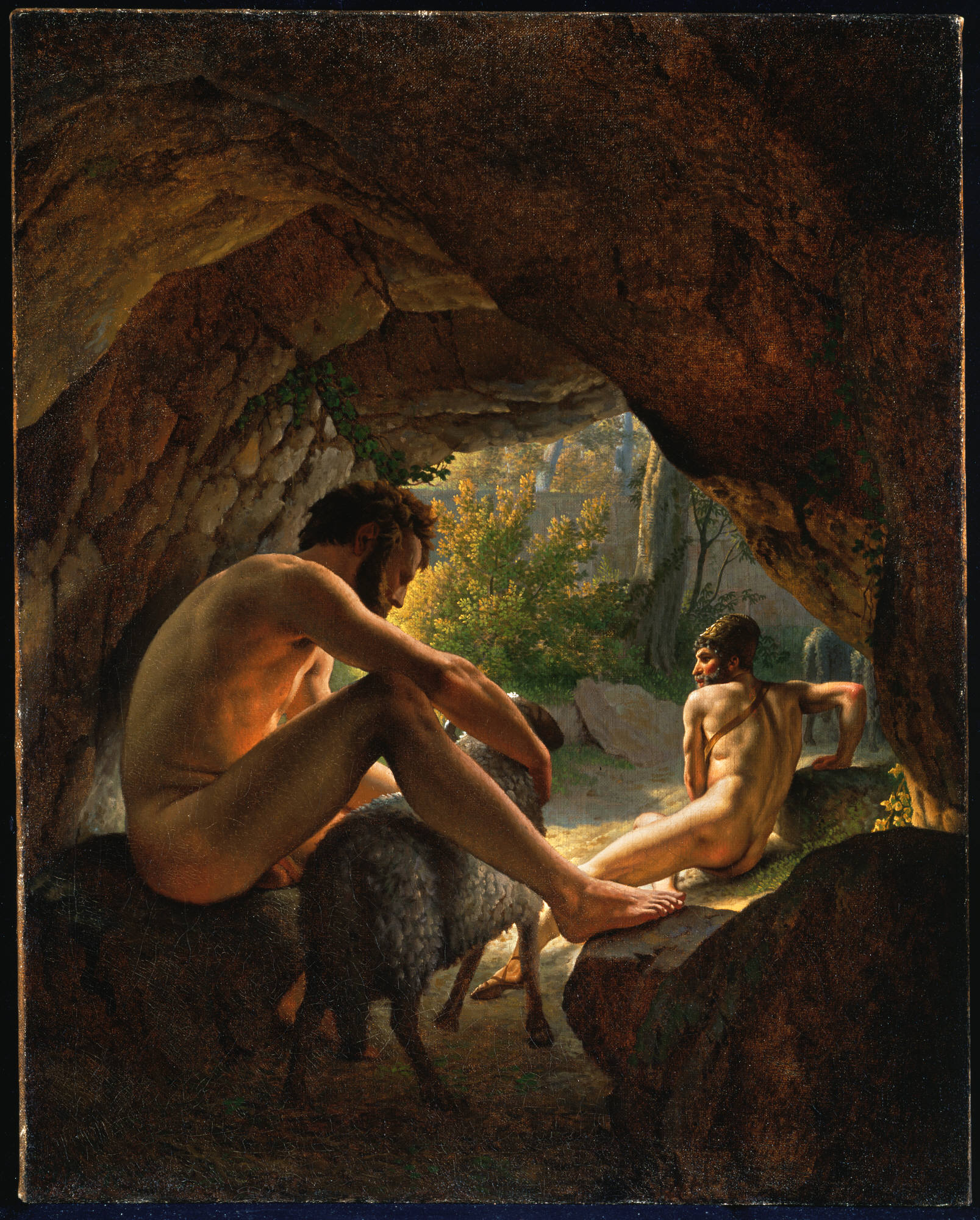
The wine went down dark and honey-sweet, and the giant asked for a third bowl. Out on his mountain the Cyclops drank only the milk of his own ewes, and this red stuff burned pleasantly and loosened his tongue, so that he grew almost friendly with the ringleader who kept refilling his cup. Tell me your name, stranger, he said, and I will give you a guest-gift. He did not know he was talking to Odysseus. He did not know the wine was so strong it wanted twenty measures of water to one of it, or that the man pouring it had already decided how the night would end.
Why they went into the cave
They had come to be trapped in that cave through a curiosity that was really pride. Odysseus and his fleet had put in at the land of the Cyclopes, a folk Homer paints as the opposite of everything a Greek city stood for: an overweening and lawless
people who neither plough nor plant, hold no assemblies and keep no laws, but live scattered in mountain caves, each ruling his own and caring nothing for his neighbours.
It is a place with no host-guest custom, no xenia, and that absence is the engine of what follows. Odysseus took twelve of his best men and a goatskin of Maron’s potent unmixed wine and went to see what lived there. His crew wanted to grab some cheeses and run; he wanted to meet the owner and claim the gift a host owes a stranger, the more dangerous choice, made out of sheer appetite for the encounter.
The cave was stocked like a well-run dairy: racks sagging with cheeses, pens of lambs and kids sorted by age, pails swimming with whey. Then the owner came home. Polyphemus drove his flocks in and set a door-stone across the mouth so vast that twenty-two four-wheeled wagons could not have shifted it. There is a strange domestic tenderness in what he does next, milking his ewes and goats each in turn and setting each mother’s young beneath her. This is the same hand that moments later snatches up two of Odysseus’s men, dashes them against the floor like puppies until their brains wet the ground, and eats them raw, washing the meal down with milk.
Odysseus had appealed to him as a suppliant, invoking Zeus Xenios, protector of guests. The Cyclops laughed: the Cyclopes reck nothing of Zeus or the blessed gods, being mightier than they. Here was a being outside the whole moral order the plea assumed. So cunning had to do what piety could not.
Why the sword stayed sheathed
The obvious move was to kill the giant in his sleep, and Odysseus rejected it at once for a coldly practical reason: only Polyphemus could roll back that door-stone, so a dead Cyclops meant a sealed tomb. So he waited, and the dead kept mounting. At dawn the Cyclops seized two more men for his breakfast, then drove his flocks to the mountain and rolled the stone back across the mouth, gone for the day.
At evening he returned, penned and milked his beasts in the same unhurried routine, and snatched up a third pair for his supper: six men now, two that first evening, two at dawn, two on this second. Only then, the fresh horror still on the giant’s hands, did Odysseus step forward with the wine. Three bowls in, pleased and heavy, the giant asked his name. Odysseus told him it was Outis, Nobody,
and the Cyclops promised that Nobody would be eaten last of all. Then he toppled into a drunken sleep, vomiting wine and gobbets of human flesh.
The weapon was ready: a stake of green olive-wood, big as the mast of a black ship, sharpened and hardened in the embers until it glowed though still green. Odysseus and four men drove the burning point into the giant’s single eye and leaned on it, spinning it the way a shipwright spins a drill with a leather thong. Homer reaches for the workshop twice: the stake turns in the socket like a drill boring a ship’s timber, and the scalded eyeball hisses round the point as a smith’s axe-head hisses when it is plunged into cold water to temper it. The blood boiled, the lids and brows singed, the very roots of the eye crackled in the fire.
The name that was nobody
Then came the pun that works only because the giant had swallowed the bait himself. Polyphemus wrenched out the bloody stake and bellowed, and the neighbouring Cyclopes gathered outside in the dark to ask what was wrong. Who is killing you, they called, by guile or by force? He gave the only answer he had: Noman is slaying me by guile and not by force.
So they concluded that if no one was hurting him the trouble must be sickness sent by Zeus, told him to pray to his father Poseidon, and went home. The trap is built from a single word. The Greek ou tis, not anyone,
is what the neighbours hear, and there is a second joke the translation cannot carry, a play of mē tis against mētis, the very word for the cunning that is Odysseus’s whole nature. The man who has made himself no one is at that instant most completely himself.
Under the bellies of the rams
Escape meant getting past both the door-stone and the hands of a giant who could still feel. At dawn Polyphemus rolled the stone aside and sat in the gap, arms spread to catch any man slipping out with the flocks. Odysseus lashed the rams together in threes and slung a man beneath the belly of each middle ram, then gripped the wool under the belly of the single greatest ram and hung there face-up.
The giant ran his hands along each animal’s back as it passed and felt nothing, because the men rode underneath. The cruellest beat is the last one out: Polyphemus stops his favourite ram and speaks to it with real grief, wondering why the beast that always leads is going last today, put out, he guesses, by a worthless Noman. His enemy hangs an inch beneath his fingers, and he suspects nothing.
The taunt across the water
They reached the ships, and here Odysseus undoes everything the cleverness had won. Safely offshore, he could not resist a taunt, and the enraged giant tore a peak off the mountain and hurled it, raising a wave that drove the ship back to shore. His crew begged him to stop. He would not.
He shouted across the water and gave the giant the one thing a curse needs to find its target, his true name: say that Odysseus, sacker of cities, son of Laertes, whose home is in Ithaca, put out your eye. This is the hinge the retellings so often flatten. The blinding did not doom the voyage. The boast did. A cursed man has to be named to be cursed, and Odysseus, out of pride, handed the monster his name like a gift.
Polyphemus took it. He remembered now an old prophecy: the seer Telemus, son of Eurymus, had foretold he would lose his eye to Odysseus, though he had watched for a tall, mighty hero and not this puny weakling
who beat him with a cup of wine. Then he lifted his hands to his father and prayed. Let Odysseus never reach home; or if he is fated to, let him come late and broken, in a stranger’s ship, having lost every companion, to find nothing but trouble in his house.
Poseidon the Earth-shaker was his father by the sea-nymph Thoosa, daughter of Phorcys, and he heard. That prayer is the seed of the rest of the Odyssey: the lost years, the drowned crews, the god who will not let the sea lie still. A second, larger rock landed just astern and drove the ship on towards the island where the rest of the fleet waited.
To vanish, he became Nobody, and no curse can fasten to a man without a name. To be remembered, he gave his own name back. The same tongue that saved the crew delivered them all to the sea.
The figure at the centre of this has never sat still in the tradition. Homer’s Polyphemus is one lawless man-eater among many scattered Cyclopes; Homer never names his brothers or fixes his island, and only later writers pin the Cyclops-land to Sicily and the slopes of Etna. Guard, too, against fusing three figures who share a name and an eye: this cave-dwelling cannibal; the lovesick fool of Theocritus and Ovid, mooning over the sea-nymph Galatea; and the older Cyclopes of Hesiod, the three divine smiths who forge Zeus’s thunderbolt. Three strands, one name; this retelling keeps to the first.
- Homer, Odyssey 9.105–566the foundational and fullest account, and the source of nearly everything above — the arrival at the lawless Cyclopes’ land, the stocked cave, Maron’s potent wine, the eating of six men, the
Noman/Outis
trick and its sustained pun, the fire-hardened olive stake and the two workshop similes for the blinding, the escape lashed beneath the rams, the fatal boast, Telemus’s remembered prophecy, and Polyphemus’s curse to Poseidon. (Trans. A.T. Murray, Loeb 1919, via Perseus.) - Homer, Odyssey 1.68–75Polyphemus’s parentage as the son of Poseidon and the sea-nymph Thoosa, daughter of Phorcys, and the framing of Poseidon’s grudge that drives the poem.
- Hesiod, Theogony 139–146, 501–506the other Cyclopes — Brontes, Steropes and Arges, the divine smiths who forge Zeus’s thunderbolt. Cited here only to distinguish this early tradition from Homer’s man-eating herdsman.
- Euripides, Cyclopsthe sole surviving complete Greek satyr play, which reworks the blinding as Sicilian comedy with Silenus, a chorus of satyrs enslaved to Polyphemus, and Dionysus thematically at the centre. A dramatic reworking, not an independent early source.
- Theocritus, Idylls 6 and 11Hellenistic pastoral in which Polyphemus is the lovesick suitor of Galatea — a separate tradition unconnected to the blinding.
- Ovid, Metamorphoses 13.750–897the Acis and Galatea story, Polyphemus as the jealous lover who crushes his rival with a rock.
- Ovid, Metamorphoses 14.154–222Achaemenides’ first-person account of the horror in the cave and of being abandoned there, later rescued by Aeneas — the Roman bridge between the epic cycles.
- Virgil, Aeneid 3.588–691Aeneas’s crew encounter the stranded Achaemenides and glimpse the blinded Polyphemus on the Sicilian shore; the model Ovid reworks.