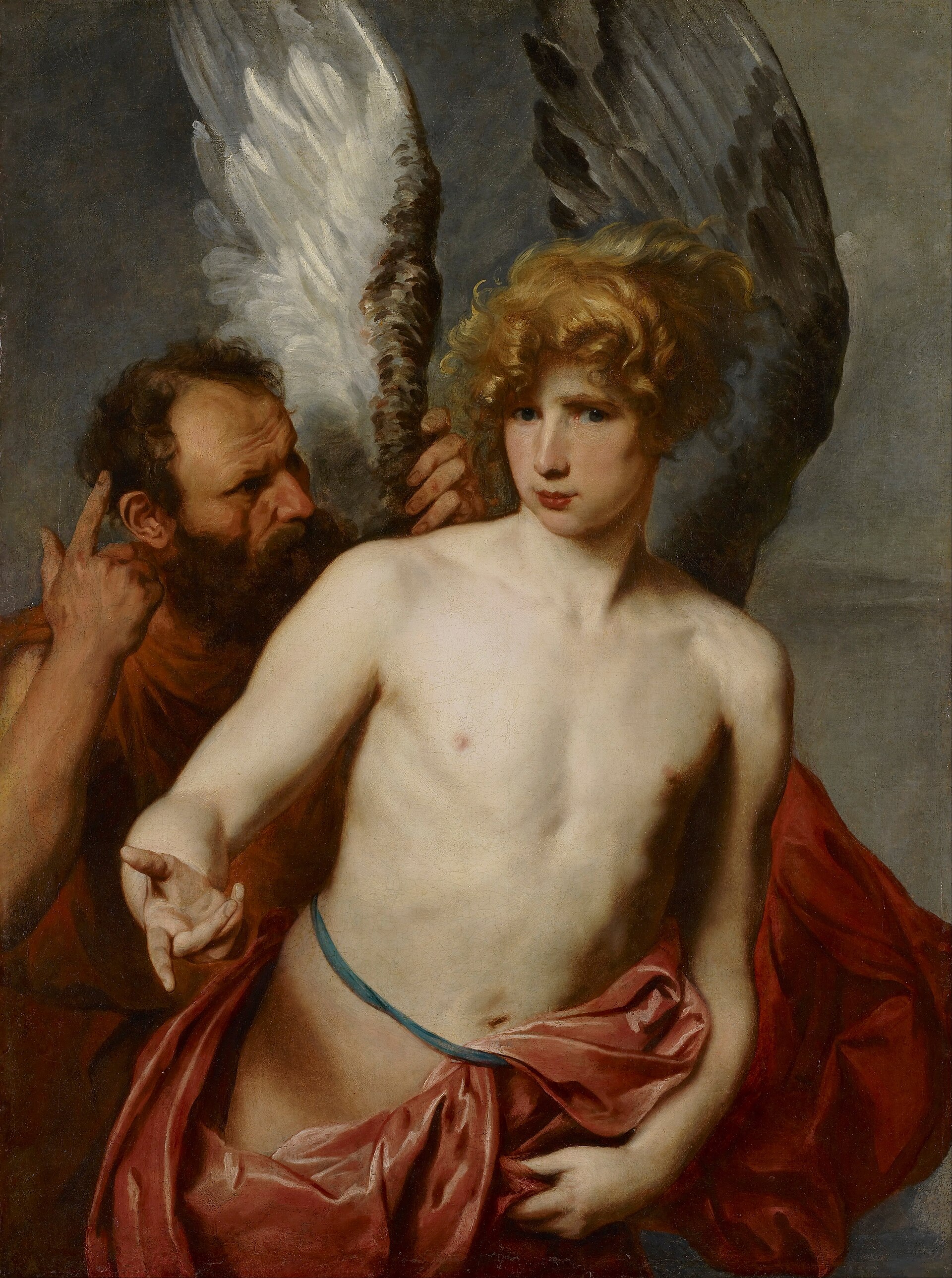
The man had built a maze so cunning that its own maker could barely find the way out, and now he was trapped on the island that housed it. Daedalus was the finest craftsman of the age, an Athenian of the old Erechthid line, and King Minos of Crete had no intention of letting such a mind sail home. The sea was watched. The harbours were watched. Every ship that left Crete left with the king’s knowledge. Daedalus turned the problem over the way he turned over everything, looking for the seam in it, and found the one road Minos had not thought to close. Ovid gives him the line that holds the whole story: though Minos may block escape by sea and land, the sky at least lies open.
Feathers laid in a graded rank
So he set his mind to work on the air. He laid out feathers in a graded rank, smallest to largest, the way the reeds of a rustic pan-pipe rise unequally from short to long. The middle of each row he bound with linen thread; the base he fastened with wax, then curved the whole into the gentle camber of a real bird’s wing.
This is Ovid’s picture, and the detail is his: the concise mythographers keep only the wax and say nothing of the feather-craft. Beside him his son got in the way, as small boys do. Icarus snatched at the feathers when the breeze stirred them, worked the yellow wax soft under his thumb, and played through the very danger his father was building, slowing the anxious work with his hands.
When the wings were done Daedalus fitted them to the boy himself, and here the master of every material met the one thing he could not engineer. His hands shook. There were tears on his aged cheeks, and he kissed his son, not knowing it was the last time. Then he gave Icarus the only instruction that mattered, and repeated it. Hold the middle course.
Fly too low and the sea-spray will soak the feathers and drag you down; fly too high and the sun’s heat will scorch the wax and loosen them. Keep between the water and the fire. ApollodorusThe unidentified compiler of the Library, a systematic prose summary of the myths written too late to be the work of the Athenian scholar whose name it carries, and so commonly cited as Pseudo-Apollodorus., telling the same story in a few dry sentences, gives the identical twofold warning: the glue melts if you climb too near the sun, the pinions come apart if you dip too near the sea.
Teaching the air as they went
They rose. Ovid likens the father to a bird coaxing a fledgling from a high nest, hovering close, glancing back, teaching the air as they went. And people saw them. A fisherman bent over his rod, a shepherd leaning on his crook, a ploughman at the handle of his plough all looked up and took the two figures overhead for gods, because what else crosses the sky under its own power? They left islands behind them in a named order that reads like a sailor’s chart of the Aegean: Samos sacred to Juno, then Delos and Paros dropping away on the left, Lebinthos and honey-rich Calymne rising on the right.
The rule the boy forgot
Somewhere over that bright water the boy forgot the rule. There was nothing malicious in it and nothing proud; the ancient texts are careful about this. Icarus was thrilled, and being young he wanted more of the thing that thrilled him, so he left his guide and climbed, drawn upward toward the open sky. The nearer sun softened the fragrant wax.
The feathers worked loose one by one. He beat bare arms that had no purchase on the air and dropped, calling his father’s name until the blue sea closed over the sound of it. That sea has carried his name ever since. The Icarian Sea, and the island where the body washed ashore, Icaria, are both named for the boy who fell into them.
Daedalus, flying on, did not know yet. He called back the way he had the whole flight: Icarus, where are you? In what quarter of the sky am I to look for you? Then he saw the feathers on the waves. He gathered up the small body, buried it on the island that would keep the name, and cursed the craft that was the best thing about him. The inventor who had beaten the sea and the land and the sky had been beaten by the one law he could not redesign, that wax melts, and by a boy who loved flying too much to come down.
Not a punishment for pride
It is worth being exact about what the fall was and was not. The lesson later ages hung on it, that Icarus was punished for overreaching, for hubris, for daring too much, is a reading laid on the story afterwards, not something the old sources say. No god strikes Icarus down. Ovid calls him simply the bold boy; Apollodorus and Diodorus put it down to youthful folly and recklessness. The wax melts because he flew too high, and he flew too high because he was young and delighted, not because heaven meant to make an example of him. The moral about ambition is reception. The text is a warning about physics and a father’s grief.
The ancients themselves were not even unanimous that there were wings. Diodorus preserves a de-mythologised version alongside the famous one: in it Minos’s own wife Pasiphae secretly gives Daedalus a ship, father and son sail off in the ordinary way, and Icarus drowns not from any melted wax but because he disembarks carelessly and falls into the sea.
In the same breath Diodorus reports the wax-wings tale told by certain writers of myths,
and is candid that it belongs to the register of marvel. He even adds a rationalist’s flourish the poets leave out: that Daedalus survived by skimming low and repeatedly wetting the wings to keep them cool, while the boy died flying too far aloft. Two traditions, running side by side in antiquity, one wondrous and one tidied up. The wings are the version the world remembered, and they earned it.
The wings he hung up
Daedalus reached safety in the end. The sources send him west to Sicily, to Camicus and the court of King Cocalus, where Minos would eventually track him down and meet a bad end of his own. But the craftsman arrives there already broken, carrying the thing he could not build a way around. He had made wings that worked. That was never the tragedy. The tragedy was that they worked well enough to be misused, and that the only person who did misuse them was the one he had made them for.
Daedalus could out-think a labyrinth, a king, and the sea itself, and he still could not engineer a boy’s restraint. He gave Icarus wings and one rule, and kept neither son nor rule. The ancients did not call it pride. They called it a father’s craft turned against him, and left the moralising to us.
- Ovid, Metamorphoses VIII.183–235 (Brookes More trans.; c. 8 CE)the fullest and most famous narrative and the backbone of this retelling. The reasoning that the sky lies open (185–187), the wings built from graded feathers bound with thread and fastened with wax and curved to a bird’s shape (189–200), the boy playing at the wax and feathers while his father works (195–200), the
middle course
warning against sea-damp and sun (203–206), the trembling hands, the tears, and the last kiss (211–216), the mother-bird simile and the flight past Samos, Delos, Paros, Lebinthos and Calymne (213–223), the fisherman, shepherd and ploughman who take the fliers for gods (217–220), Icarus’s climb and fall (223–230), the father’s cry and the recovery and burial of the body, and the naming of the Icarian Sea (231–235). The elaborate feather-craft is specifically Ovid’s; the other sources keep only the wax. - Apollodorus, Epitome 1.12–13 (Frazer trans.; 1st–2nd c. CE)the concise mythographic spine. Names Icarus’s mother as Naucrate, a slave of Minos (1.12); gives the same twofold warning that heat melts the glue and damp loosens the pinions (1.12); has Icarus drown after soaring too high (1.13); and brings Daedalus safely to Camicus in Sicily (1.13). Frazer’s note here is what catalogues the wider tradition, including the reports that in Pausanias father and son escape by newly invented sails and that in Virgil Daedalus lands at Cumae and dedicates his wings to Apollo.
- Diodorus Siculus, Library of History 4.76–77 (Oldfather trans.; 1st c. BCE)the source that preserves two escape traditions at once and the note of ancient scepticism. Gives Daedalus’s Athenian origin and Erechthid descent (4.76.1) and the killing of his nephew (4.76.4–7); tells the rationalised version in which Pasiphae secretly supplies a ship and Icarus drowns by disembarking carelessly (4.77.5–6); reports the wax-wings version told by
certain writers of myths
and openly frames it as a tale of marvel (4.77.7–9), adding that Daedalus survived by flying low and wetting the wings while Icarus perished flying too high (4.77.9); and names both the Icarian Sea and the island Icaria after the boy (4.77.6).