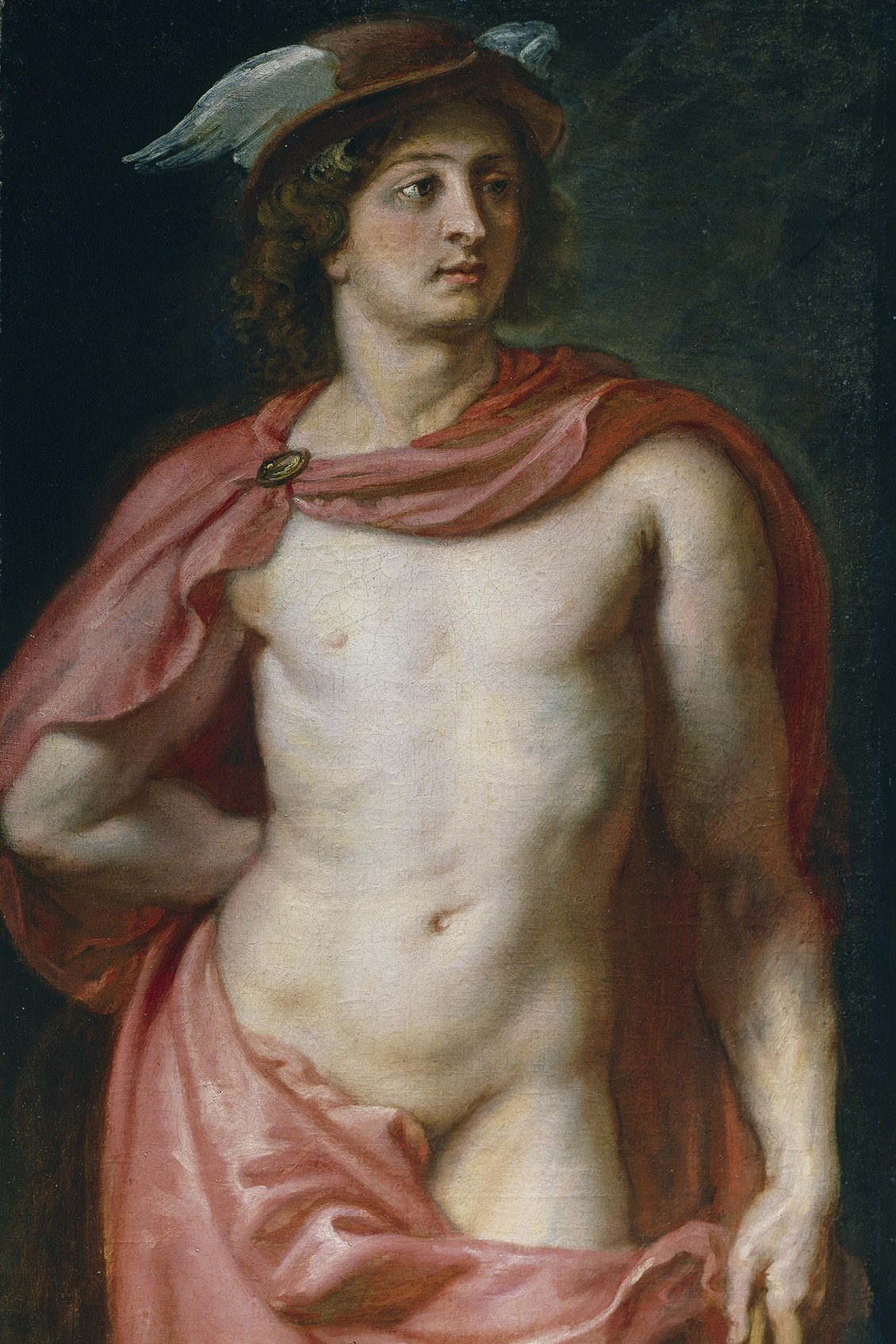
He was not a day old and he had already killed something. The newborn climbed out of the winnowing-basket that served as his cradle, slipped past his sleeping mother into the grey light at the mouth of the cave, and there, grazing on the rich grass by the doors, found a tortoise. He greeted it almost tenderly, the way you might greet a piece of luck. Then he scooped it clean of its living flesh, stretched cut reeds through the hollow shell, fixed oxhide and strings of gut across the frame, and by the time he was finished he had made a thing that had never existed before. He struck it, and it sang. This is the first act of the god the Greeks called Hermes: on Mount Cyllene in Arcadia, born at dawn to Zeus and the shy nymph Maia, he invented the lyre before he had learned to walk.
The Homeric Hymn to Hermes, the single richest source for his character, treats that morning as a portrait in miniature. Everything he will be is already present in the infant: the inventor who makes an instrument out of a dead animal, the musician, and, before the sun has fully risen, the thief. For no sooner had he set the lyre aside than he was seized by a craving for meat, and he knew exactly whose meat he wanted.
Fifty cows in the dark
By nightfall he had stolen the cattle of Apollo. He cut fifty loud-lowing cows from the immortal herds and drove them off in the dark, and here the trickster shows his hand for the first time. He drove them backwards, so their hoofprints pointed the wrong way, and he wove himself a pair of sandals out of tamarisk and myrtle twigs to blur his own tracks into nonsense.
Then, by the river Alpheus, he kindled a roaring fire and did something stranger than the theft: he divided a portion of the meat into twelve equal parts, one for each of the twelve gods, an offering laid out in the dark by a child who was himself now angling to be counted among them. And then he went home, squeezed back through the keyhole like mist on an autumn breeze,
wrapped himself in his swaddling clothes, and lay in the cradle clutching his lyre under one arm, the picture of a harmless sleeping baby.
The baby who denied everything
Apollo was not fooled for long. He tracked the thief to the Cyllene cave and found the culprit feigning sleep, and the scene that follows is one of the funniest in archaic Greek poetry: the towering god of prophecy accusing an infant of grand larceny, and the infant lying with brazen, wide-eyed innocence. How could I have done it? I was born yesterday. My feet are soft and the ground is hard. I don’t even know what cattle are. Apollo, unamused, hauled him up to Olympus to be judged before their father. Zeus heard the charge, looked at the newborn cattle-rustler, and laughed. He ordered the two of them to make peace.
The reconciliation is where the whole day pays off. To settle the quarrel, Hermes drew out the lyre and played, and the sound undid Apollo completely: the god of music had never heard anything like it, and a helpless longing seized him. So they struck the founding bargain of Hermes’ career.
He gave Apollo the lyre and kept the cattle, and the elder god, delighted, gave him in return a shining staff and the honours that came with it. The trickster had turned a theft into a treaty. He had, in a single day, stolen from a god, been caught, been tried, and walked away richer and now belonging, an Olympian by the strength of his own cunning rather than by right of seniority.
The herald and his wand
That staff becomes his signature. When we next meet him in Homer he is grown and fully in his office, the herald and messenger of the gods, of Zeus above all. In the fifth book of the Odyssey, Zeus wants Calypso to release Odysseus from her island, and it is Hermes he sends to carry the order. He binds beneath his feet the golden sandals, immortal and winged, that bear him over sea and over the boundless earth alike, swift as a breath of wind, and he takes up the wand with which, the poet says, he lulls the eyes of men to sleep or wakes the sleeping as he pleases.
Down he swoops to the island, delivers the will of Zeus, and the captivity ends. He is the god who crosses: between Olympus and earth, between one will and another, between waking and sleep. The wand that opens and closes a mortal’s eyes is the perfect tool for a god whose whole nature is the crossing of a threshold.
The guide of souls
He crosses the last threshold too. Hermes is the psychopompos, the guide of souls, the one who walks the dead down into the dark. At the opening of the twenty-fourth book of the Odyssey he takes up that same wand and summons the ghosts of the murdered suitors, and they follow him gibbering like bats in a cave, down the dank ways past the streams of Ocean to the meadow of asphodel where the dead have their home.
(It is worth knowing that this passage, the so-called Second Nekyia, was doubted by some ancient critics and is still argued over by scholars as a possibly late addition; but Hermes’ role as escort of the dead is old and secure in cult well beyond this single scene.) The same god who guides the traveller on the road guides the soul on the last road of all.
And this is the thread that ties the trickster to the herald to the soul-guide, which can otherwise look like a jumble of unrelated jobs. Hermes is the god of the in-between. Boundaries, roads, doorways, the space between one place and the next: these are his ground.
The traveller crosses distances, the herald crosses the gap between speakers, the thief crosses the line of ownership, the guide of the dead crosses the final border out of life. Even his cattle-raid is a crossing, of the line between mine and yours. He is not the god of any one country so much as the god of all the edges between them, which is why the Greeks set his stone markers at crossroads and property lines and city gates.
The epithet that misleads
A note on what he is not, at least not here. His most famous epithet, Argeïphontes, is usually translated slayer of Argus,
and Argus is the hundred-eyed giant set by Hera to watch over the girl Io. But that killing is told in full only by much later writers, ApollodorusThe unidentified compiler of the Library, a systematic prose summary of the myths written too late to be the work of the Athenian scholar whose name it carries, and so commonly cited as Pseudo-Apollodorus. and Ovid, not in the Homeric material that gives us the rest of this god; even the slayer of Argus
reading of the epithet is disputed by philologists, so it is best treated as a traditional gloss rather than a fact of the archaic Hermes.
The shepherd’s panpipe often handed to him belongs more properly to Pan in most traditions. And the winged staff twined with two snakes that you see today on ambulances and pharmacies is a modern muddle: that is the herald’s kērykeion confused with the quite separate rod of the healer Asclepius, an association the ancient Greeks would not have recognised. The real Hermes needs none of it. A tortoise, a stolen herd and a golden wand were enough.
He was born at dawn, invented the lyre by midday, stole a god’s cattle by dusk and talked his way out of it by nightfall. Every road the Greeks walked, and the last road they feared, was watched over by the child who did all that before he could stand.
- Homeric Hymn 4 (to Hermes) 1–580the birth-day narrative and the single richest source for the god’s character. Birth on Mount Cyllene to Zeus and Maia (1–9); the tortoise and the invention of the lyre (24–54); the theft of Apollo’s cattle, the reversed tracks and the wicker sandals (68–86, 210–211); the twelve portions of meat by the Alpheus (115–137); the return to the cradle and the feigned innocence (235–259); the trial before a laughing Zeus (254–408); and the reconciliation, the exchange of the lyre for the cattle and the honours (463–566). (H. G. Evelyn-White trans., Loeb 57, 1914.)
- Hesiod, Theogony 938–939the parentage. Maia, daughter of Atlas, bore Hermes to Zeus,
herald of the immortals.
(Evelyn-White trans., Loeb 57.) - Homer, Odyssey V.28–148Zeus dispatches Hermes to Calypso to free Odysseus; the winged golden sandals that carry him over sea and land (V.43–46) and the wand that lulls men to sleep or wakes them (V.47–48). The messenger and helper god in his office. (A. T. Murray trans., Loeb 1919.)
- Homer, Odyssey X.274–306Hermes meets Odysseus
like a young man with the first down on his lip
and draws the black-rooted, white-flowered herb moly from the ground as protection against Circe. (Murray trans., Loeb 1919.) - Homer, Odyssey 24.1–14Hermes as psychopompos, summoning the souls of the slain suitors with his wand and leading them down to the asphodel meadow. Textually the
Second Nekyia,
a passage whose authenticity was disputed by some ancient and modern critics; the soul-guide role itself is archaic and independently attested. (Murray trans., Loeb 1919.) - Homer, Iliad 24.333–469Zeus sends Hermes to conduct old Priam safely through the Greek camp to Achilles; the wand and the winged sandals described again (24.340–345). (A. T. Murray trans., Loeb 1925.)
- Apollodorus, Bibliotheca 2.1.3, and Ovid, Metamorphoses 1.668–721the slaying of hundred-eyed Argus, background to the epithet Argeïphontes. Later mythography, cited here only to mark that the Argus-slaying story is post-Homeric and not part of the archaic core above.